Competitive Enablement: How to Win Competitive Deals in B2B Sales
A practical perspective for connecting this idea to your revenue team’s next move.
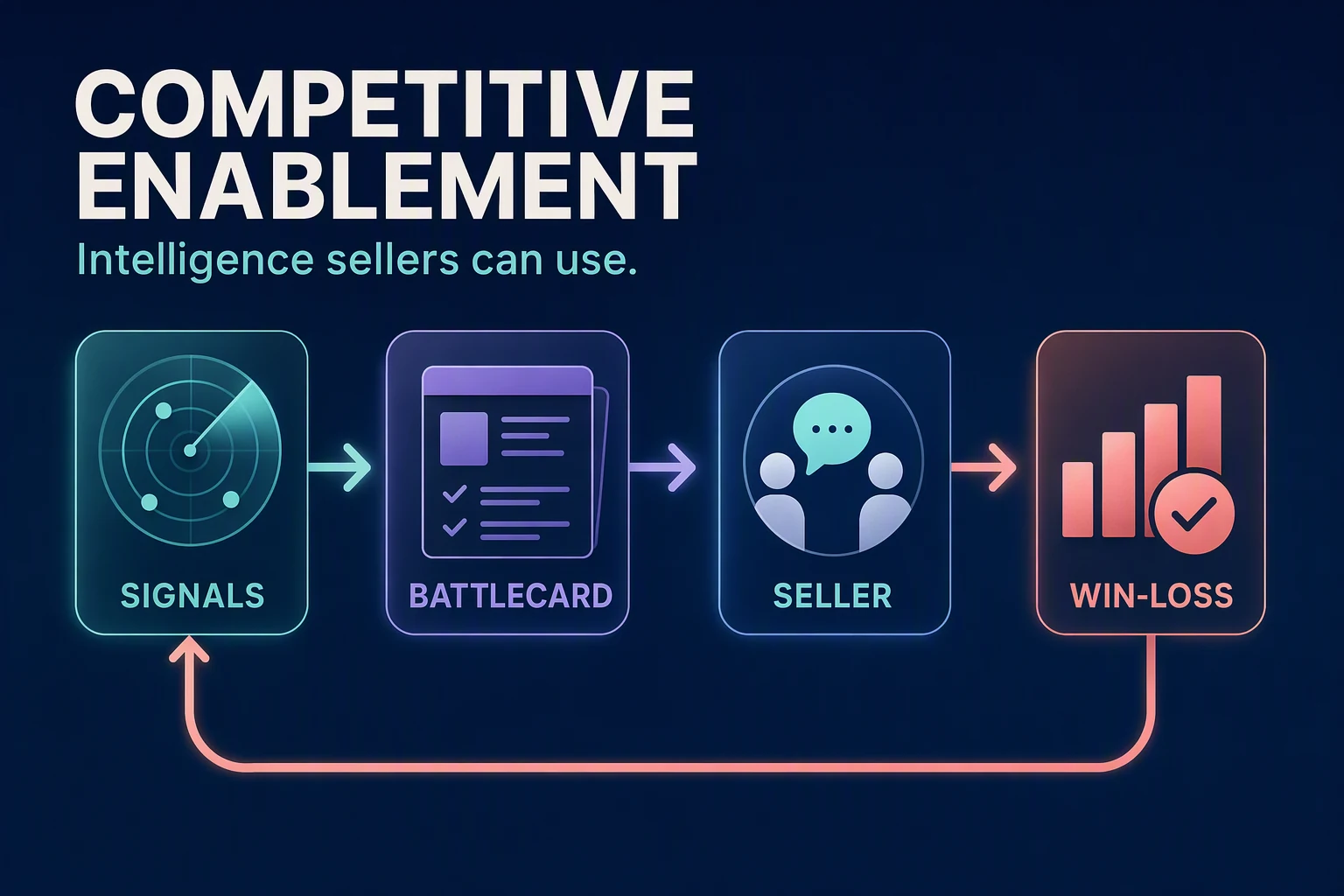
Competitive enablement gives sellers what they need to win deals where a named competitor or the status quo is in play: current battlecards, tested talk tracks, practice and deal support. To win competitive deals, shape the evaluation criteria early, prove differentiators with evidence, take risk off the table for the buyer, and update everything from win-loss data.
This guide covers how to build and maintain battlecards, talk tracks for cheaper, bigger and incumbent competitors, how to feed win-loss findings back into cards and training, how to measure competitive win rate, and who should own the program.
Last updated: 16 October 2026
What is competitive enablement?
Competitive enablement turns what you know about competitors into seller behaviour that wins deals. It covers the battlecards and talk tracks, the training and certification on them, the practice before calls, the support on live competitive deals, and the feedback loop that keeps all of it current.
Competitive enablement vs competitive intelligence
Competitive intelligence is the research: what competitors sell, how they price, how they position and where they win. Competitive enablement is the delivery: getting that research to sellers in a form they use in a live conversation, then checking it changed outcomes. Intelligence without enablement produces reports nobody opens; enablement without intelligence produces confident talk tracks that are wrong.
Competitive intelligence
Competitive enablement
Main question
What is true about this competitor?
What should our seller say and do about it?
Typical owner
Product marketing or a CI analyst
Sales enablement, with product marketing
Outputs
Competitor profiles, pricing research, market updates
Battlecards, talk tracks, certifications, role-plays, deal reviews
Success measure
Accuracy and timeliness of insight
Competitive win rate and seller readiness
Why competitive deals need a system
Most deals are contested, and most teams know they are not good at it. Crayon’s 2025 State of Competitive Intelligence report (based on “hundreds” of product marketers, CI professionals and enablement leaders; no exact sample published) says sellers face a competitor head to head in 68% of deals, and that the average team rates its competitive selling at 3.8 out of 10.
Timing matters too. A Gong Labs analysis of sales calls by Chris Orlob (published 15 December 2016, updated 4 March 2026; sample size not stated) found that deals where the buyer mentioned competitors early were 49% more likely to close, while mentions in mid-to-late stages slightly lowered the odds. That is a correlation, not proof of cause (Gong itself suggests early mentioners are often more serious buyers), but it supports surfacing the competition in discovery, not at pricing.
Knowing the message is not the same as delivering it. In Highspot’s 2026 Go-to-Market Performance Gap Report (450 GTM leaders, page modified 19 August 2026), 36% said sellers struggle to apply messaging in live conversations. That is why practice belongs in competitive enablement.
How to win competitive deals: six moves for any competitor
- Ask about alternatives in discovery. “Who else are you looking at, and what do you like about them so far?” An early answer lets you shape the evaluation.
- Shape the decision criteria. Agree in writing what the buyer needs to be true in year one. Your differentiators should map to criteria the buyer has already accepted.
- Prove, don’t claim. Every differentiator needs a proof asset: a reference customer in the same segment, a demo of the specific workflow, a security document, a pilot result.
- Acknowledge their strengths. Buyers know them already. Saying them first builds credibility and lets you reframe: “They are strong at X. If X is your main need, they may be the better fit. If Y matters more, here is how we compare.”
- Take risk off the table. Buyers worry about blame for a bad choice. References, phased rollouts, clear success criteria and exit terms reduce that fear more than another feature slide does.
- Multithread. If the competitor has a champion in finance and yours sits only in sales, you are likely to lose. Map the buying committee and each person’s view of each option.
Should you badmouth competitors in sales?
No. Beyond the risk of saying something inaccurate, there is evidence it rebounds on you. Skowronski, Carlston, Mae and Crawford described “spontaneous trait transference” in the Journal of Personality and Social Psychology (April 1998): listeners tend to attach the traits a speaker describes in others to the speaker. ScienceDaily’s report of the APA release (19 March 1998) gives the example of a politician who calls an opponent corrupt and may then be seen as dishonest. Compare on facts the buyer can check, and let the buyer draw the conclusion.
How to build and maintain battlecards
A battlecard is a short, scannable reference that shows a seller how to position against one competitor: why we win, where they are strong, landmine questions, objection responses and proof. Our free sales battlecard template has the full field list and an example. The program around the cards matters as much as the cards.
1. Tier your competitors
- Tier 1: competitors that appear in a meaningful share of your deals or cause your largest losses. Full card, tested talk tracks, certification and quarterly review.
- Tier 2: competitors you meet in some segments. Short card with positioning, top objections and proof.
- Tier 3: occasional names. A one-paragraph summary and who to ask for help.
Base the tiers on validated deal data, not only the CRM competitor field. Win-loss vendor Clozd compared CRM data with buyer interviews for 1,000 closed-lost deals and found the CRM competitor was wrong in nearly 7 of 10 (Clozd, Nate Bagley, undated, accessed 16 October 2026).
2. Collect evidence before you write
Good sources: win-loss interviews, recorded calls where the competitor came up, the competitor’s own website and pricing page, analyst reports, review sites, partners, and customers who switched in either direction. Record the source and date for every claim, because sellers will repeat it to buyers.
3. Write for the moment of use
Sellers open a card minutes before a call or during one. Lead with three reasons you win, each with a proof asset and one line to say. Put landmine questions and objection responses next, and pricing guidance last. If it does not fit on a screen without scrolling far, it is an analysis, not a card.
4. Set an owner, a review date and update triggers
Every card needs a named owner and a next-review date on its face. Review Tier 1 cards at least quarterly, and immediately when a competitor changes pricing or packaging, launches a major product, or appears in several losses in a row. Keep a short change log so sellers can see what changed and why.
5. Publish where sellers work, and retire what is stale
Surface the card on the CRM opportunity when the competitor is recorded, in the tools sellers use to prepare for calls, and in the deal channel. Remove expired cards from every location; an outdated pricing comparison does more harm than none. Crayon’s 2025 data supports regular delivery: per Crayon’s 5 August 2025 summary of the report, teams sharing intelligence daily or weekly were 75% more likely to report revenue impact from their compete program.
Buyer-facing competitive content
Buyers read comparison pages before they speak to you. Know what yours say and what competitors publish about you, and keep both consistent with your battlecards. Revspire’s own sales enablement alternatives hub, for example, compares it with 15 tools in four categories. Have legal or a senior reviewer approve any comparative claim that will appear in buyer-facing material.
Competitive talk tracks for cheaper, bigger and incumbent competitors
The situation changes the buyer’s real question more than the competitor’s name does. Build one talk track per situation, then tailor it per competitor on the card.
Situation
What the buyer is really weighing
Lead with
Proof to bring
Avoid
Cheaper competitor
Is the extra cost worth it, and can I defend it internally?
Agreed year-one requirements, then total cost against them
Business case, implementation plan, simple pricing
Discounting at the first mention of price
Bigger competitor
Is the smaller vendor a safe choice?
Focus on the use case you win; access and attention
Same-segment references, pilot criteria, security documents, exit terms
Competing on breadth you do not have
Incumbent
Is switching worth the disruption and the blame if it fails?
What has changed since they chose the incumbent
Migration plan, parallel run, mutual action plan
Criticising the original decision
Status quo (no decision)
Is it safer to wait?
A clear recommendation and a smaller first step
Risk reducers: phased scope, success criteria
Piling on more options or more information
How to win against a cheaper competitor
Price is often not the real reason deals are lost. Klue Labs analysed more than 3,400 buyer win-loss interviews and found price ranked third among loss reasons, behind product and seller experience. Within price-related losses, confusing pricing structure and model issues contributed to over 40%, value and ROI concerns to 22%, and budget limits to under 10% (Klue, Adam McQueen, 10 October 2024, page modified 4 September 2025). So isolate the objection, rebuild the business case and make your pricing easy to follow.
Example talk track: “You’re right that their list price is lower. Before we compare numbers, can we agree on what you need in the first year? Then let’s price both options against that list, including setup, admin time and any add-ons. If they still come out ahead, that’s a fair result. If not, we’ll both know where the difference comes from.”
Offer a smaller scope or a phased start before you offer a discount, and track discount depth in competitive wins so you can see whether price pressure is growing.
How to win against a bigger competitor
Buyers lean towards familiar names when budgets are tight. In 6sense’s B2B Buyer Experience Report for 2025 (nearly 4,000 buyers), close to 70% said economic concerns affected their vendor choice and pushed them towards conservative picks such as known vendors and incumbents, and 85% had prior experience with the vendor they chose. The same report found buyers bought from their day-one shortlist 95% of the time, so smaller vendors need to be known before the buyer starts evaluating.
Example talk track: “They’re a strong company, and if you need the full suite across every region on day one, they may be the better fit. Where teams like yours pick us is [use case], because [proof]. Which matters more for this decision: breadth across the suite, or [outcome] in the next two quarters?”
Then reduce perceived risk: a same-size reference, a scoped pilot with written success criteria, a named executive sponsor, and clear data-export and exit terms.
How to displace an incumbent vendor
Someone at the buyer chose the incumbent, and may still be in the room. Find the trigger that reopened the decision (a renewal date, a new leader, a failed rollout, a new requirement), and size the cost of staying put in the buyer’s own numbers. Then make switching feel safe: a migration plan with milestones, a parallel-run period, and a mutual action plan with owners on both sides.
Example talk track: “Most teams chose [incumbent] for good reasons at the time. What has changed since then? If we can show a migration plan that keeps your team running, with a clear point to stop if it isn’t working, would a scoped pilot be worth discussing?”
How to sell against the status quo
The most common competitor is no decision. Research led by Matt Dixon and Ted McKenna, covering 2.5 million recorded sales conversations, found that 40% to 60% of lost deals ended in no decision, and that fear of making the wrong choice drove indecision more than fear of missing out (Challenger, 22 February 2024). Their JOLT approach is to judge the level of indecision, offer a recommendation, limit the exploration and take risk off the table. In practice: recommend one option, narrow the choices, and propose a smaller first step with clear success criteria.
How to train sales reps on competitors
- Certify on Tier 1 competitors. Each seller records the three reasons you win and the answers to the top two objections, and a manager scores them against the card.
- Practise before the call, not after the loss. Run role-plays where the buyer raises the competitor at different stages: discovery, demo, pricing. AI role-play makes this repeatable; Revspire’s AI Sales Training & Coaching, for example, includes deal-specific objection practice with battle cards.
- Coach from real calls. Pull recorded moments where a competitor came up and review them in team meetings: what was said, what worked, what the card should change.
- Re-certify when the card changes materially. A pricing change or a new competitor product should trigger a short refresher and a new practice scenario.
How to use win-loss analysis to update battlecards and training
Win-loss analysis is the evidence base for competitive enablement, but CRM fields alone are a weak base. In Clozd’s comparison of 1,000 closed-lost deals with buyer interviews, CRM loss reasons matched what buyers said only 15% of the time, and 44% of CRM loss reasons described an outcome (“lost to competitor”) rather than a cause (Clozd, undated). For more benchmarks and their caveats, see our win-loss statistics page.
No systematic tracking of competitive win-loss? How to fix it
- Fix the data at the source. Make “primary competitor in final evaluation” a required picklist field at a set stage, plus a required loss-reason field with causes, not outcomes.
- Interview a sample every month. Speak to buyers from both wins and losses, ideally with someone other than the seller asking the questions.
- Code reasons into themes. Use the same themes each month (product gap, pricing clarity, seller experience, risk, timing) so trends are visible.
- Hold a monthly compete review. Product marketing, enablement, a sales leader and RevOps agree what changes: card edits, new talk tracks, product feedback.
- Close the loop into training. Every material card change produces a practice scenario and, for Tier 1 competitors, a re-certification.
- Measure the effect. Track the competitive metrics below for the quarters after each change.
How to measure competitive win rate and competitive enablement
Metric
How to calculate it
Why it matters
Head-to-head win rate vs a competitor
Deals won where the competitor was in the final evaluation ÷ (those wins + deals lost to that competitor)
The core measure of competitive performance
Competitive win rate, all outcomes
Deals won ÷ all closed deals where the competitor was in the final evaluation, including no-decision and losses to others
Stops a rise in stalled deals hiding behind fewer direct losses
Competitive presence rate
Closed deals with a recorded competitor ÷ all closed deals
Sizes the problem and sets competitor tiers
Displacement win rate
Deals won that replaced an incumbent ÷ closed deals with an incumbent
Shows whether incumbent plays work
Discount depth in competitive wins
Average discount in wins against a competitor vs non-competitive wins
Tracks cheaper-competitor pressure
Competitor field accuracy
Interviewed deals where the CRM competitor matches the buyer’s account ÷ interviewed deals
Tells you how far to trust the other metrics
Card freshness
Tier 1 cards reviewed within their cadence ÷ all Tier 1 cards
Leading indicator of content quality
Competitive readiness
Sellers certified on the Tier 1 competitors they face ÷ those sellers
Leading indicator of seller behaviour
Illustrative example (not real data): 40 deals closed last quarter with Competitor A in the final evaluation. You won 14, lost 18 to A, lost 3 to another vendor, and 5 ended in no decision. Head-to-head win rate against A is 14 ÷ (14 + 18), about 44%. The all-outcomes rate is 14 ÷ 40, or 35%. Report both, plus the no-decision count, and use rolling two-quarter windows when deal counts are small.
Card views and practice scores are useful leading indicators, but more card views in won deals is an association, not proof. Where you can, compare cohorts before and after a change.
Who owns competitive enablement?
Ownership is usually split, and the split is where programs fail. Crayon’s 2025 report found that 52% of compete programs had no sales executive sponsor, even though 85% of those programs said enabling sales was their responsibility, and fewer than a third engaged with sales daily or weekly (Crayon, 2025). Name one accountable owner per activity and a sales executive sponsor for the program as a whole.
Activity
Product marketing / CI
Sales enablement
Sales leadership
RevOps
Legal
Competitor research and battlecard content
A/R
C
C
I
C
Talk tracks, certification and practice
C
A/R
C
I
I
Competitor and loss-reason fields, reporting
C
I
I
A/R
I
Win-loss interviews and themes
A/R
C
C
C
I
Competitive deal reviews
C
C
A/R
I
I
Comparative claims in buyer-facing material
R
I
I
I
A
R = responsible, A = accountable, C = consulted, I = informed.
A governance cadence that works
- Weekly: a short competitive update to sellers (what changed, which card, what to say).
- Monthly: a compete review of win-loss themes and card changes.
- Quarterly: Tier 1 card reviews, re-tiering from deal data, and a report to the CRO on the metrics above.
- Per deal: a competitive deal review for large or strategic opportunities: who is competing, which criteria the buyer has accepted, where each committee member stands, the risk to remove next and the proof still needed.
Where a platform helps
Spreadsheets and shared drives can run a small program. As the number of competitors, sellers and regions grows, look for approval workflows, version control and delivery inside the CRM. Revspire’s AI Playbook Engine drafts battlecards and competitive plays from approved knowledge, routes them for human approval, analyses deals and calls for win-loss patterns, and publishes plays to the seller workspace, the CRM opportunity and digital sales rooms.
Frequently asked questions
How do you win against a cheaper competitor?
Isolate the price objection, agree the buyer’s year-one requirements, and compare total cost against them, including implementation and add-ons. Klue’s analysis of 3,400+ win-loss interviews found confusing pricing structure and model issues behind over 40% of price-related losses, so make your pricing simple to follow. Offer a smaller scope before a discount.
How do you win against a bigger competitor?
Narrow the decision to the use case where you are strongest, acknowledge the competitor’s breadth, and remove the risk of choosing a smaller vendor with same-segment references, a scoped pilot and clear exit terms. Get on the buyer’s shortlist early: 6sense found buyers bought from their day-one shortlist 95% of the time in 2025.
How often should battlecards be updated?
Review Tier 1 battlecards at least quarterly, and update them immediately when a competitor changes pricing or packaging, launches a major product, or appears in several losses in a row. Every card should show its owner and next review date.
How do you build a closed-loop process from win-loss insight to sales training?
Interview a sample of won and lost buyers every month, code the reasons into stable themes, and review them in a monthly compete meeting that decides card and talk-track changes. Each material change then becomes a practice scenario and, for top competitors, a re-certification. Track competitive win rate in the following quarters to see whether the change worked.
Who owns competitive enablement?
Product marketing or a CI analyst usually owns the research and battlecards, sales enablement owns talk tracks, training and certification, RevOps owns the data, and sales leadership owns competitive deal reviews. The program also needs a sales executive sponsor; Crayon’s 2025 report found 52% of compete programs had none.
Start with your top competitor: download the free sales battlecard template and fill in the header, the three reasons you win and the landmine questions first.
Sources
All pages were accessed on 16 October 2026.
- The 2025 State of Competitive Intelligence, Crayon (2025; exact sample not published). Accessed 16 October 2026.
- 5 tips to better enable your sales team, backed by new 2025 data, Sheila Lahar, Crayon (5 August 2025). Accessed 16 October 2026.
- How competitor mentions influence B2B sales, Chris Orlob, Gong Labs (15 December 2016, updated 4 March 2026). Accessed 16 October 2026.
- 2026 Go-to-Market Performance Gap Report, Highspot (page modified 19 August 2026). Accessed 16 October 2026.
- Spontaneous trait transference: report of the APA release on Skowronski et al., Journal of Personality and Social Psychology 74(4), ScienceDaily (19 March 1998). Accessed 16 October 2026.
- 5 lies your CRM is telling you about your buyers, Nate Bagley, Clozd (undated). Accessed 16 October 2026.
- The real deal breakers: competitive pricing strategy, Adam McQueen, Klue (10 October 2024, page modified 4 September 2025). Accessed 16 October 2026.
- The B2B Buyer Experience Report for 2025, 6sense (2025). Accessed 16 October 2026.
- Losing to customer indecision, Challenger (22 February 2024). Accessed 16 October 2026.