How to Build a B2B Sales Messaging Framework (With Template)
A practical perspective for connecting this idea to your revenue team’s next move.
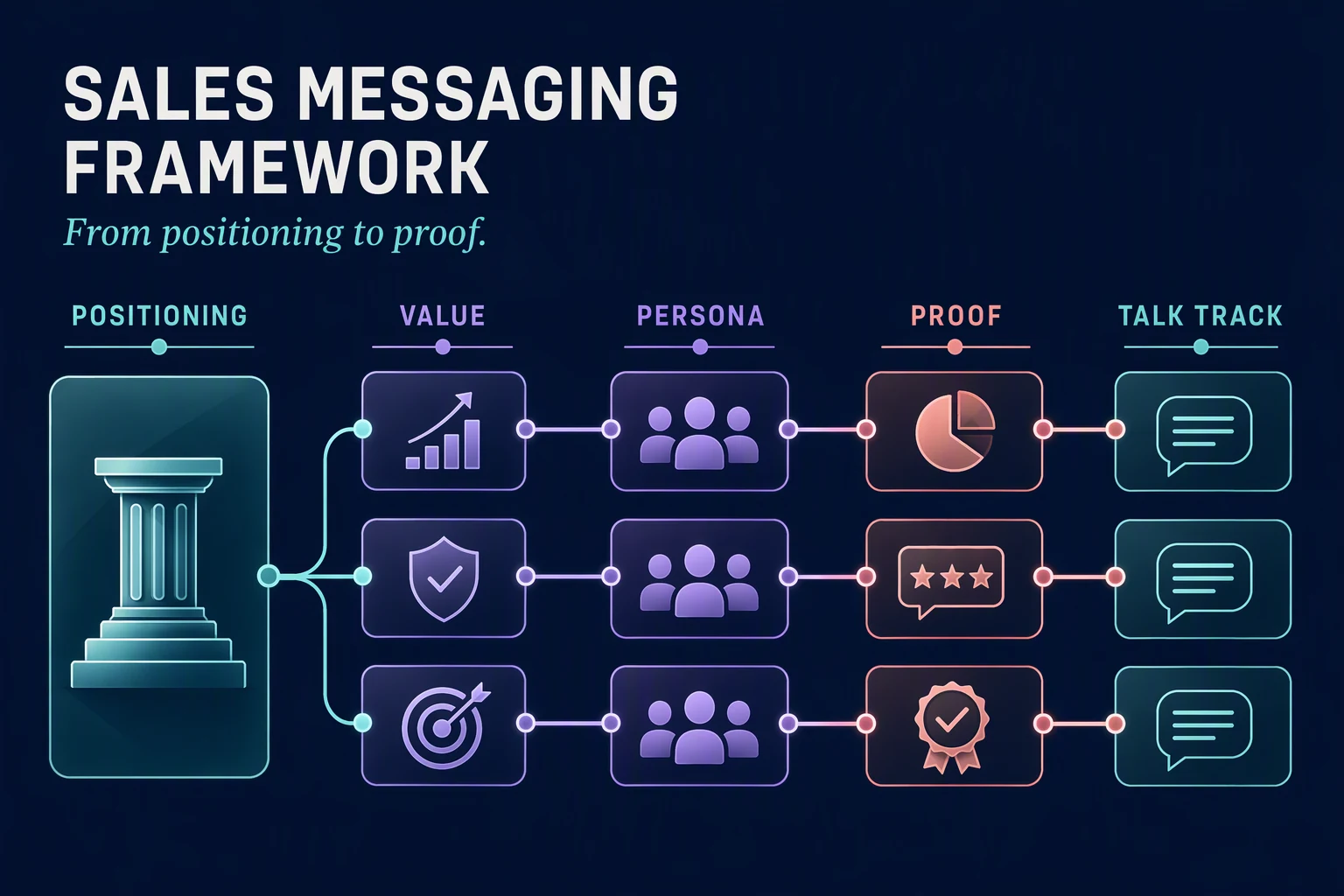
A sales messaging framework is one approved document that turns your positioning into what sellers actually say: a positioning statement, three or four value pillars backed by sourced proof points, and a tailored message for each role on the buying committee. It keeps every call, email and deck telling the same true story, adapted to the listener.
This guide builds one step by step with a worked example, then gives you a fill-in template.
Last updated: 16 October 2026
What is a messaging framework?
A messaging framework is the source document for everything a company says about a product. Marketing uses it to write campaigns; sales uses it to run discovery, pitch and handle objections. A B2B sales messaging framework usually has these parts:
- Positioning statement: an internal summary of who the product is for, what it replaces and why it is different.
- Core message: one sentence a buyer could repeat to a colleague.
- Value pillars: three or four themes that support the core message.
- Proof points: sourced evidence for each pillar.
- Role messages: how each pillar is framed for each member of the buying committee.
- Talk tracks and objection responses: the spoken versions sellers use.
- Language rules: words to use and words to avoid.
- Governance fields: owner, approvers, version and next review date.
Messaging framework, messaging house, message map and messaging hierarchy
These terms overlap. The table shows how teams usually use them.
Term
What it is
Typical use
Positioning
The strategic choice of target customer, competitive alternative, differentiation and market category
Leadership and product marketing decisions
Positioning statement
A short internal paragraph that records the positioning; not customer-facing copy
Alignment across product, marketing and sales
Messaging framework
The full set of approved messages, proof and role variants derived from positioning
Source for sales content, campaigns and talk tracks
Messaging house
A visual version: core message as the roof, value pillars as columns, proof as the foundation
Workshops and quick reference
Message map
A one-page grid of core message, supporting points and proof for one audience or launch
Launches, spokespeople, single personas
Messaging hierarchy
The order of importance: core message, then pillars, then supporting points, then proof
Deciding what goes first on a page, slide or call
Talk track
The spoken version of a message for one selling moment
Discovery, demos, objection handling
Messaging terms compared.
What is the difference between positioning and messaging?
Positioning is the decision; messaging is the expression. Positioning decides who the product is for, what buyers would use instead, what you do that the alternative cannot, and which market category frames that value. Messaging turns those decisions into words for a given audience and channel.
Positioning should change rarely, for example after a new product line or a shift in target segment. Messaging changes more often: when a competitor launches, a proof point expires or a new role joins the buying committee. If your messaging keeps changing because nobody agrees who the product is for, the problem is positioning. The description of April Dunford’s book Obviously Awesome on her books page puts it bluntly: connecting a product with consumers “isn’t a matter of filling in the blanks on an old-school positioning statement”. Decide the positioning first; the statement only records it.
What is a positioning statement?
A positioning statement is a short internal paragraph naming the target customer, their need, the product’s market category, its key benefit and how it differs from the main alternative. It guides everyone who writes or says anything about the product. It is not a tagline and rarely appears word for word in customer-facing copy.
The classic fill-in template was popularised by Geoffrey A. Moore in his 1991 book Crossing the Chasm , according to Umbrex’s framework guide (modified 1 October 2026). The book was revised in 1999 and again in 2014 (Wikipedia). A Shortform article on positioning statements (29 October 2021) summarises the elements Moore asks teams to state in two or three sentences: the product’s name, the target customers, their compelling reason to buy, the market alternative being displaced, the product alternative, and why the company is credible. A widely used version reads:
For [target customer] who [need, or dissatisfaction with the current alternative], [product name] is a [market category] that [key benefit or compelling reason to buy]. Unlike [primary competitive alternative], [product name] [primary differentiation].
Wording varies between sources. Some versions add a final line of “reasons to believe”, which is where proof points start.
How to write a positioning statement
- Name the competitive alternative. What would the buyer do if you did not exist: an incumbent vendor, an ERP add-on, spreadsheets, an internal build or nothing?
- List what you do that the alternative cannot. Be specific and verifiable. “Easy to use” is not a differentiator; “approval rules configured without code” can be demonstrated.
- Translate each difference into value. What does the buyer gain: time, risk reduction, revenue, control?
- Define the target customer as the segment that cares most about that value, including the trigger that makes them look (a failed audit, a new CFO, an acquisition).
- Choose the market category that makes your value obvious to that customer.
- Write the statement, then cut every phrase a competitor could also say truthfully.
Worked example (fictional company)
Ledgerline is an invented accounts-payable automation vendor used throughout this guide.
For finance teams at mid-market manufacturers who still approve supplier invoices by email and spreadsheet, Ledgerline is an accounts-payable automation platform that routes each invoice to the right approver and matches it to its purchase order before payment. Unlike ERP add-on workflows, Ledgerline handles multi-entity approval rules without custom code.
Every phrase has to be provable. “Without custom code” needs a demo and documentation behind it before any seller says it.
What are messaging pillars?
Messaging pillars are the three or four themes that support your core message. Each pillar is a buyer outcome, not a feature, and each needs its own claim, capabilities and proof. Fewer than three usually leaves a major buyer concern unaddressed; more than four and sellers stop remembering them.
Pillar
Claim
Capabilities behind it
Proof required before use
Control
Every invoice is approved by the right person before it is paid
Approval rules by entity, amount and cost centre; audit log
Live demo of the rules; sample audit log; an approved customer story
Faster close
Month-end close stops waiting on invoice approvals
Email and mobile approvals; reminders; automatic PO matching
A dated, consented customer case study with its measurement method, or no number at all
Fit
Works with the ERP you already run
Native connectors; field mapping
Integration list from current product documentation
Example value pillars for the fictional Ledgerline.
To choose pillars, start from the reasons you win and lose in win/loss analysis, check each against what buyers say in discovery calls, and drop any pillar your main competitor could claim just as convincingly.
How to write persona-based messaging for a buying committee
Complex B2B purchases involve several people with different jobs, so the same pillars need different emphasis for each member of the buying committee. Keep the claims identical and change the lead pillar, the language and the proof.
Role
Measured on
Their first question
Example message (fictional)
Proof they trust
CFO
Cost, risk, close speed, forecast accuracy
What does this cost, what do we get back, and when?
Close the books without chasing approvals, with every payment traceable to an approver.
A business case with stated assumptions; references from peer finance leaders
Controller or AP manager (business owner)
Close timeline, exceptions, team workload
Will this remove the bottleneck my team lives with?
Invoices reach the right approver automatically and are matched to the PO before they reach you.
A demo on their own approval flow; a peer customer story
CIO or IT
Architecture fit, admin effort, integration risk
What will my team have to build and maintain?
Connects to your ERP through standard connectors; approval rules are configured, not coded.
Integration documentation, architecture diagram, admin guide
CISO or security and compliance
Data protection, access control, audit
Where does our data go, and who can see it?
Role-based access and a complete audit trail for every approval.
Security documentation; current certifications with the certified entity and scope; data processing agreement
Procurement
Terms, vendor risk, comparability
Can we compare this fairly with alternatives?
Standard terms and a pricing structure that maps to your number of entities.
Standard order form and terms; completed vendor-risk questionnaire
Approvers (end users)
Time per task
Is this easier than what I do now?
Approve an invoice from email or your phone in one step.
A short product video or a trial
Persona and role messaging matrix, using the fictional Ledgerline example.
How to tailor messaging to the CFO
- Lead with money and risk: cash, cost, close speed, audit exposure.
- Show the assumptions behind any business case, so the CFO can change them.
- Skip the feature tour; offer one proof the CFO’s peers would accept.
How to tailor messaging to IT and security buyers
- Lead with architecture, integration effort and controls, not business benefits.
- Offer documentation before it is requested.
- State certifications precisely: which entity holds them, and what scope they cover. A hosting provider’s certification is not yours.
Proof points: why every claim needs a source
A proof point is evidence a buyer could check. If you cannot show the source, the statement is an assertion: remove it, or rephrase it as a capability you can demonstrate. The US Federal Trade Commission’s advertising guide for business (first issued April 2001, edited January 2025) says advertisers need a “reasonable basis”, meaning objective evidence, for their claims before the ad runs. The guide is framed around advertising to consumers, but it is a sound standard for B2B sales claims, which also end up in proposals and contracts.
Proof type
Example
What makes it usable
When to re-check
Customer outcome
“[Customer] shortened its close”
Customer consent, date, how it was measured, approved wording
Yearly, or when the relationship changes
Third-party research
An analyst or survey statistic
Link to the original, sample size, date and sponsor
When a newer edition appears
Product fact
“Supports multi-entity approval rules”
Current product documentation or release note
Every release
Security or compliance
“ISO 27001 certified”
Current certificate, the certified entity and its scope
Before the certificate expires
Comparative claim
“Unlike [competitor], we…”
Dated evidence from the competitor’s current materials; legal review
Each competitor release
Demonstration
A live or recorded demo
A demo environment that matches the current release
Every release
Proof point types and the source each one needs.
Keep a proof register next to the framework with, for each claim: the exact approved wording, the source link, its date, the owner, where it may be used (external or internal only) and an expiry date. When a source expires, every asset that uses the claim goes back to review.
How to turn positioning into sales talk tracks
A talk track is the spoken version of a pillar for one selling moment. Build each one as a chain: a question that surfaces the problem, the claim, the proof and a next step. Write them with your best sellers and keep their phrasing; three or four sentences is enough.
Example: CFO, discovery call (fictional).
- Question: “How many days of your close are spent waiting on invoice approvals?”
- Claim: “Teams in your position use Ledgerline so approvals stop holding up the close.”
- Proof: “I can show you the approval rules on your own entity structure, and share a story from a manufacturer that made the same change.”
- Next step: “Would a short session with your controller to map the approval flow be useful?”
Do the same for the 30-second answer to “what do you do?” and for the three objections sellers hear most. Each objection response should end in proof, not in a louder version of the claim.
How to test sales messaging
Test before launch and again in the field. Decide what success looks like before you start, and compare the new messaging with the current version rather than with nothing.
Method
What it tells you
Watch out for
Seller playback
Whether reps can explain the positioning and pillars in their own words
Measures understanding, not buyer reaction
Buyer message testing
How target buyers rate the copy; Wynter, a B2B message-testing service, assesses clarity, relevance, value and differentiation
Panel respondents read copy out of a real buying context
Call review
Whether pillar language is used on calls and how buyers respond
Sample calls deliberately across segments and reps
Outbound email tests
Which claims and subject lines earn replies
Change one variable at a time; results are noisy at low volume
Win/loss interviews
Whether the messaging influenced the decision
Slow; interview buyers from losses as well as wins
Ways to test B2B sales messaging.
How to keep sales messaging consistent and current
Message consistency means every rep, asset and channel makes the same claims in the same terms, adapted by role but never contradictory. It is hard to hold. In Allego’s 2021 survey of 330 B2B sales and marketing leaders (Lucid panel, published 26 October 2021), nearly 70% of companies said their reps frequently stray off message. More recently, Highspot’s 2026 Go-to-Market Performance Gap Report (page modified 19 August 2026), based on a survey of 450 go-to-market leaders, lists “sellers struggle to apply messaging live” at 36%. Highspot is now part of Seismic, following a merger announced on 18 August 2026.
Why sales reps go off message
- The framework lives in a slide deck nobody opens during a deal.
- Several versions circulate, and nobody knows which is current.
- It was written for web pages, not conversations, so reps improvise.
- Claims lack proof sellers trust, so they substitute their own.
- Reps never practised it out loud.
- It was not updated after a launch, a price change or a competitor move.
Who owns sales messaging?
Product marketing owns the framework and the proof register. Sales leadership co-owns the talk tracks, because they have to work in real calls. Enablement owns rollout, practice and certification. Legal approves comparative and regulated claims, and the deal desk owns anything that touches price. Write these owners into the framework’s governance fields.
How to roll out new messaging to sales
- Brief sales leaders first, so managers reinforce rather than question it.
- Publish one page per role, not the full framework.
- Update decks, email templates, battlecards and deal room templates on the same day, and retire the old versions.
- Practise the three most common selling moments as role-plays.
- Ask each rep for a short recorded playback of the core message.
- Review a sample of calls after the first few weeks and fix what is not landing.
How to update messaging after a competitor launch
- Confirm what changed from the competitor’s own, dated materials, not from rumour.
- Decide whether your positioning changes or only the comparison does.
- Update the battlecard and any pillar or proof point the launch affects.
- Tell sellers what changed, what to say and what not to say.
- Set a review date to check how buyers react.
Keep messaging current inside sales content
Messaging drifts when it is copied into dozens of decks and emails by hand. Treat it as governed content, with sales content governance rules for versions, owners and retirement, and make the framework the source for your sales playbook rather than a separate document. In the Revspire AI Playbook Engine, for example, role-specific messaging is written and approved once and then published across seller workflows.
Sales messaging framework template
Copy these tables into a shared document, fill in the middle column, and assign one owner. The right-hand column shows the fictional Ledgerline example.
Part 1: Positioning and core message
Field
What to write
Example (fictional)
Target customer
[Segment, size and the trigger that makes them look]
Finance teams at mid-market manufacturers whose invoice approvals run on email
Need
[The problem in the buyer’s words]
Invoices wait for approval and delay the close
Market category
[The category that makes your value obvious]
Accounts-payable automation
Key benefit
[The outcome, not the feature]
Every invoice approved by the right person and matched to its PO before payment
Primary alternative
[What buyers would use instead]
ERP add-on workflows and spreadsheets
Differentiator
[What only you can prove]
Multi-entity approval rules without custom code
Core message
[One sentence a buyer could repeat]
Close the books without chasing invoice approvals.
30-second answer
[Who it is for, the problem, the outcome, one proof]
[Write with your top sellers]
Part 2: Value pillars (repeat for three or four pillars)
Field
What to write
Pillar name
[A buyer outcome in two or three words]
Claim
[One sentence]
Buyer problem
[What hurts without it]
Capabilities
[The features that deliver it]
Proof
[Source link, date, owner, external or internal use]
Talk-track line
[How a seller says it out loud]
Part 3: Role messages (one row per buying-committee role)
Role
Measured on
Lead pillar
Message
Proof they trust
Words to avoid
[CFO]
[ ]
[ ]
[ ]
[ ]
[ ]
[IT / security]
[ ]
[ ]
[ ]
[ ]
[ ]
[Business owner]
[ ]
[ ]
[ ]
[ ]
[ ]
[Procurement]
[ ]
[ ]
[ ]
[ ]
[ ]
Part 4: Objections and governance
Field
What to write
Top three objections
[Objection, approved response, proof, owner]
Owner
[Usually product marketing]
Approvers
[Sales leader; legal for comparative claims; deal desk for price]
Version and last reviewed
[Version number and date]
Next review date and triggers
[Date; launches, competitor moves, expired proof]
Where it is published
[Playbook, decks, email templates, battlecards, deal rooms]
Frequently asked questions
What is a message map?
A message map is a one-page grid with a core message at the top, three or so supporting points beneath it, and proof under each point. Teams use it for a single launch, audience or spokesperson. A messaging framework is broader: it holds the positioning, all pillars, role variants and governance.
How do you build a messaging house?
Put the core message in the roof, one value pillar in each column and the proof points in the foundation. Build it from the positioning statement, test each pillar against win/loss reasons, and only add a proof point you can source. The house is a visual summary; the framework document holds the detail.
How do you write a value proposition for B2B SaaS?
Write one sentence that names the buyer, the outcome and how it differs from the alternative, for example: “[Product] helps [buyer] achieve [outcome] without [main cost of the current alternative].” Base the outcome on what customers measure, and keep every word provable.
How do you get sales to use product marketing messaging?
Write it with sellers, not for them: use their language from recorded calls, give them proof they trust and turn it into short talk tracks. Put the messaging inside the assets and tools they already use, have managers reinforce it in deal reviews, and practise it in role-plays before launch.
What is a messaging hierarchy?
A messaging hierarchy ranks your messages by importance: the core message first, then the value pillars, then supporting points, then proof. It tells writers and sellers what to say first when time is short, whether on a slide, a web page or the first minute of a call.
Next step: turn your comparative claims and proof points into a seller-ready one-pager with our sales battlecard template.
Sources
All pages were accessed on 16 October 2026. Publication or modification dates are shown where the page gives one.
- Positioning Statement Framework, Umbrex, modified 1 October 2026
- Crossing the Chasm, Wikipedia
- How to Create a Product Positioning Statement, Shortform, 29 October 2021
- Books, April Dunford, undated
- Advertising FAQ’s: A Guide for Small Business, US Federal Trade Commission, April 2001, edited January 2025
- Wynter homepage, Wynter, undated
- Allego data shows sales reps lack answers to nearly half of product questions asked by customers, Allego, 26 October 2021
- 2026 Go-to-Market Performance Gap Report, Highspot, modified 19 August 2026
- Seismic and Highspot merger, Highspot, announced 18 August 2026, modified 9 October 2026
- AI Playbook Engine, Revspire