Intent Data for B2B Sales: Types, Providers and How to Use It
A practical perspective for connecting this idea to your revenue team’s next move.
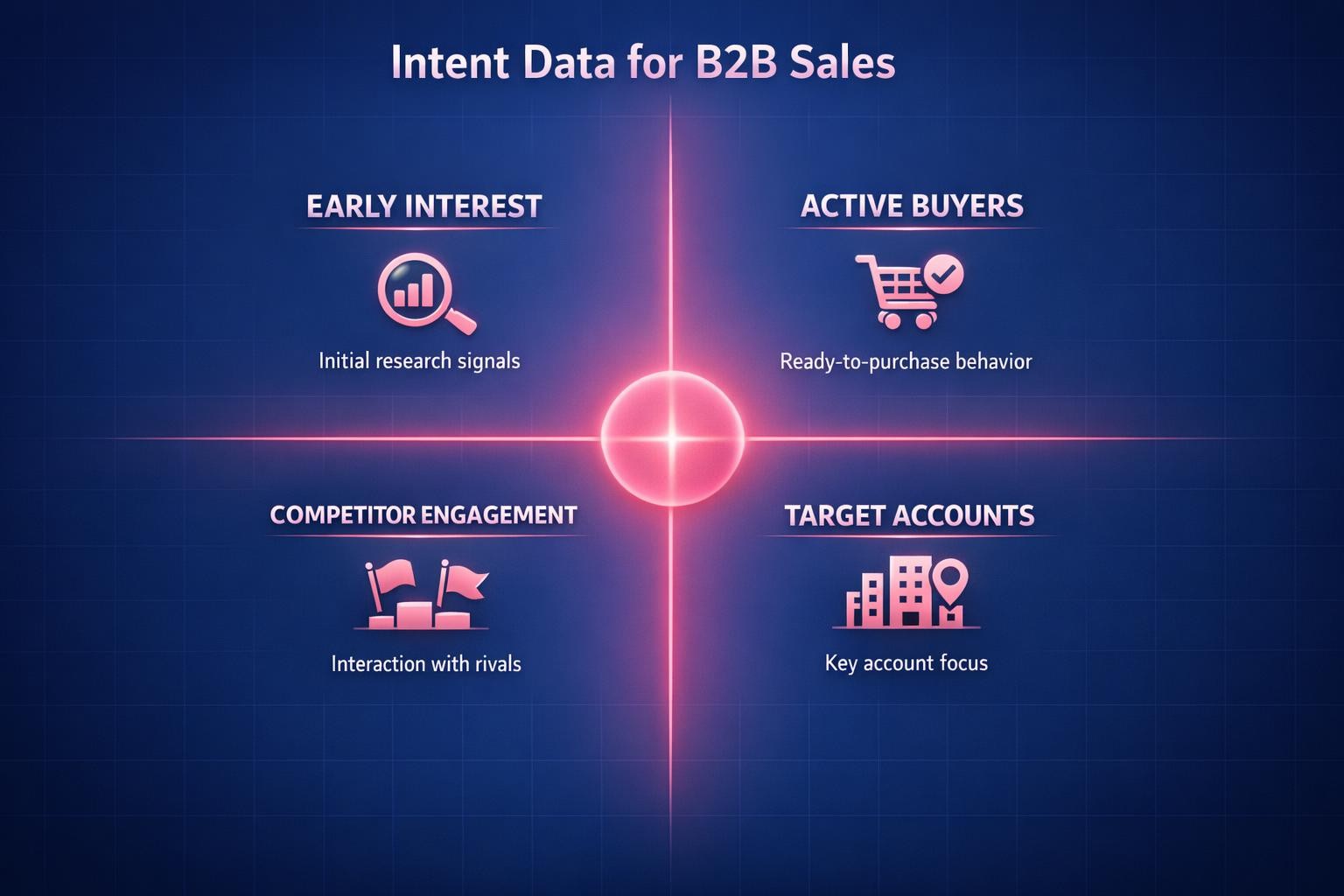
Intent data for B2B sales is evidence that a company is researching a problem or product you sell: visits to your pricing page, a spike in category reading across publisher sites, a review-site comparison, or a new stakeholder opening your proposal. Sales teams use it to decide which accounts to work now, who to contact and what to say.
It is a probability signal, not a hand-raise: most third-party intent is reported per account, and it shows a topic is being researched, not that a project is funded. This guide covers the three types, how eight providers collect it, how to act on it, how to measure its return and the mistakes that waste it. It reflects provider documentation and research available in October 2026.
Last updated: 16 October 2026
What is intent data?
Intent data is a record of research behaviour, matched to the company (and sometimes the person) doing it, and compared with that company’s normal level of activity. A single page view means little. A sustained rise in reading on one topic, across several people at the same account, is what providers call a surge or a trend.
Each provider defines that rise in its own way, which is why their scores cannot be compared directly:
- Bombora says it measures how many people at an organisation research a topic, how often and how deeply, compared with their normal activity, across a co-op of more than 5,000 B2B sites (Bombora, data page, accessed 16 October 2026).
- Demandbase flags “trending” intent when signals rise by two standard deviations over the last 7 days compared with the previous 8 weeks, and aggregates activity weekly (Demandbase Help Center, updated 2 June 2026).
- HubSpot compares a company’s research activity over the past 30 days with the previous 30 days and labels it High when the increase is greater than 160% (HubSpot Knowledge Base, updated 13 April 2026).
Intent data works alongside two other inputs. Fit data (industry, size, region, technology) says whether an account could buy, and engagement data says how known contacts respond to outreach. Intent says whether the account is researching now. Intent on an account outside your ideal customer profile is noise, however strong the surge.
Why does intent data matter in B2B sales?
Because most of the buying journey happens before a seller is invited in. In 6sense’s 2025 B2B Buyer Experience Report (nearly 4,000 buyers in North America, EMEA and APAC), buyers first contacted sellers 61% of the way through their journey, earlier than the 69% of prior years. Buyers initiated 79% of engagements, 94% of buyers said they had ranked their shortlist before engaging sellers, and they evaluated an average of 5.1 vendors. The vendor leading during the selection phase went on to win 77% of the time.
Read those figures with the source in mind: 6sense sells intent data, and the report is a buyer survey, not observed behaviour. The practical point still holds: by the time a buyer fills in a demo form, the shortlist is largely set. Intent data is one of the few ways to see an evaluation forming early enough to influence it.
First-party vs second-party vs third-party intent data
The three types differ in who collected the signal. That decides how specific, how early and how trustworthy each one is.
Type
Where it comes from
Examples
What it sees
Main weakness
First-party
Your own website, product, emails, webinars, proposals and deal rooms
Repeat pricing-page visits, demo-page views, proposal opens, new viewers in a deal room
Accounts and people already aware of you, in exact detail
Blind to research that happens before an account finds you
Second-party
Another company’s first-party data, shared with you
G2 Buyer Intent, TechTarget Priority Engine, LinkedIn Sales Navigator Buyer Intent
Research on that platform: your profile, your category, comparisons with competitors
Limited to that platform’s audience
Third-party
Aggregated from many publishers, networks or ad exchanges
Bombora Company Surge, Demandbase Intent, HubSpot research intent, 6sense and ZoomInfo intent
Topic or keyword research across the web, before an account contacts you
Usually account-level, inferred from IP and cookie matching, and noisier
How the three types of B2B intent data compare. Providers named are examples; see the provider table below for sources.
The labels are not used consistently: 6sense, for example, counts review sites among third-party sources (6sense, “6 Quick Wins Using Intent Data”, 13 January 2026). What matters is the question each answers. First-party: who is engaging with you. Second-party: who is evaluating your category on one platform. Third-party: who is researching a topic anywhere.
Keep the types separate before you blend them
Many teams merge every signal into one account score on day one, then cannot tell which source produced pipeline. Store each type in its own field and, for the first two quarters, compare four groups of in-profile accounts: first-party signals only, third-party only, both, and neither. Track the same outcomes for each group: meetings booked, opportunities created, win rate and cycle length. If accounts with both kinds of signal convert better than either alone, a blended score is justified. If third-party-only accounts perform like the “neither” group, you have learned something worth knowing before the renewal.
Intent data providers compared
Disclosure: Revspire publishes this guide. Revspire does not sell intent data and does not appear in this table; its deal rooms produce first-party engagement data, covered later in this guide. Providers are listed alphabetically, and each row is based on the provider’s own documentation, checked on 16 October 2026.
Provider
Type
Where the signal comes from
Level
One limitation
Third-party
Keyword research; accounts are placed in Awareness, Consideration, Decision or Purchase stages
Account
Keyword intent is reported per account: segments are lists of accounts, not people
Third-party
A co-op of 5,000+ B2B sites, organised into a taxonomy of 21,600+ B2B topics
Account
Bombora said in October 2021 that remote work made identity resolution harder, while reporting little impact on the product
Third-party, plus your website
Bidstream access through its B2B DSP (1 million+ publishers), its own network and open-web crawling; a vocabulary of 650,000+ keywords
Account
Intent views are aggregated weekly
Second-party
Nine signal types, including views of your profile, pricing, compare, alternatives and competitor pages
Account (visitor region and country only)
Sees only research on G2; its data reference does not explain how buying stages are assigned
First-party (visitor intent) and third-party (research intent)
Your site via the HubSpot tracking code; research intent across a 200,000+ website ecosystem, matched by reverse IP
Account
Research views show up to 1,000 companies at a time, and contacts only for companies already in your CRM
LinkedIn Sales Navigator Buyer Intent
Second-party
Buyer activity on LinkedIn; website visits and new connections to colleagues were added in 2023
Account, with individuals surfaced
Launched for Advanced and Advanced Plus licences; the current plans page lists it without saying which plans include it
TechTarget Priority Engine (now Informa TechTarget)
Second-party
Content consumption across 150+ technology-specific websites (2022 figure)
Account and prospect
Coverage follows TechTarget’s own technology-focused network
Third-party
Custom and “Streaming” intent topics, plus buyer intent signals in its Copilot plans
Account
No public prices; the number of intent topics depends on the package
Intent data providers, listed alphabetically. Each provider’s name links to the documentation used; all pages checked 16 October 2026. Publication dates are in Sources.
How to choose an intent data provider
- Start with what you already pay for. HubSpot includes buyer intent on the Starter, Professional and Enterprise editions of its hubs, and tracking a company costs 10 credits, charged monthly while tracking continues (HubSpot Knowledge Base, updated 1 September 2026). ZoomInfo lists buyer intent signals in its Copilot Advanced and Enterprise plans and sells topic allowances by package: 25 intent topics on Marketing Demand, 100 on ABM Lite and unlimited on ABM Enterprise (ZoomInfo pricing page, checked 16 October 2026). Test bundled intent before you buy another feed.
- Buy second-party data where your buyers evaluate. If your category is busy on G2, its compare and alternatives signals sit closest to a decision; if you sell to IT buyers, TechTarget’s network is built for that audience.
- Buy broad third-party data to see research before buyers know you. Ask Bombora, Demandbase, 6sense or ZoomInfo for the accounts that surged on your topics over the last two quarters, and compare that list with your own closed-won and closed-lost deals.
- Ask every provider five questions: how a signal is matched to a company; how the baseline and threshold work; how often data refreshes; whether people or only accounts are identified; and how consent was collected.
How to use intent data in B2B sales
- Filter by fit first. Apply intent only to accounts in your ideal customer profile and territory plan. Fit decides whether to work an account; intent decides when.
- Pick a short list of topics. Choose topics tied to problems you solve, your category name and your main competitors’ names. A short list of precise topics beats a long list of broad ones: a topic as broad as “cloud computing” tends to flag far more accounts than any team can work.
- Tier accounts by fit and intent. Use the matrix below so every rep reads a signal the same way.
- Route with an owner and a deadline. Send Tier 1 accounts to a named owner with an agreed response window, and expire signals nobody acts on. Intent decays: Demandbase and HubSpot both measure change over days and weeks, not quarters.
- Contact the buying group, not one person. Third-party intent rarely says who is researching. Reach three to five roles likely to own the problem (the business leader, the economic buyer, IT or security), which is the core of multithreading.
- Lead with the problem, not the signal. Never open with “I saw you were researching”. Open with the problem the topic implies and something useful, such as a benchmark or checklist. Using the signal as the opening line reads as surveillance.
- Log what happened. Record the signal, the action and the result on the account in the CRM, so you can measure the programme.
Fit
Intent
Tier
What to do
Strong ICP fit
Surging topic, or a first-party hand-raise
Tier 1
Named owner researches the account and contacts three to five roles within the agreed window; marketing runs matching ads
Strong ICP fit
No current intent
Tier 2
Keep in account-based nurture; recheck weekly
Weak fit
Surging topic
Tier 3
Marketing nurture only; no SDR time unless a person raises a hand
Weak fit
No intent
None
Exclude from active lists
A simple fit-by-intent tiering matrix. A direct request for a demo or quote always goes to sales, whatever the tier.
Signal-to-action playbook
Intent that is only reported changes nothing. Agree in advance what each signal triggers:
Signal
What it probably means
What to do next
Third-party surge on a category topic, no visits to your site
Early research; you are probably not on the list yet
Problem-led outreach to three to five roles with a useful asset; add the account to ad audiences
G2 compare or alternatives views involving a named competitor
Shortlisting is under way
Run the competitive play (see the section on competitive intent below)
Repeat visits to your pricing page
Budget or business-case work has started
Offer a business-case conversation that includes the economic buyer
Security, integration or API documentation viewed
Technical evaluation
Bring in a solutions engineer; send the security pack before it is requested
A new stakeholder opens the proposal or deal room
The champion is selling internally
Add the person to the stakeholder map; send a summary written for their role
No buyer activity in the deal room for 20 days
The deal is at risk
Re-engage the champion with something new, such as a revised business case or rollout plan, not a “just checking in” email
Common buyer intent signals and the action each should trigger.
Buyer intent signals inside open deals
Most writing on intent data stops at prospecting. Once a deal is open, the most reliable intent data is your own: who reads the proposal, who forwards it, which sections they return to and who has gone quiet. This is buyer engagement analytics, and it is first-party, person-level data about material buyers chose to open.
Look at it per stakeholder, not per deal. A score averaged across the buying group hides the most common failure: an enthusiastic champion plus a finance, IT or legal reviewer who has never opened anything. A finance leader who suddenly reads the ROI model is a cue to bring the economic-buyer conversation forward.
Revspire’s digital sales room benchmark (about 40 B2B companies, October 2025 to September 2026) shows how closely these signals track outcomes. Closed deals with an active deal room, meaning at least one buyer view before close, were won 35% of the time, against 28% for deals without one. Rooms reached 15 unique buyer stakeholders, against 1 to 5 on deals without a room, and 80% of rooms gained a new viewer after the first share. In the last two weeks before a won deal closed, 80% of buyer views went to the proposal and the implementation plan. After 20 days with no buyer view, the win rate fell below half the overall win rate. These are observed associations in Revspire customer data, not proof that a room caused a win: teams that use rooms may also qualify deals more carefully.
Revspire Digital Sales Rooms capture this layer: a branded room per deal with real-time buyer engagement analytics, buying-committee stakeholder mapping and mutual action plans. Third-party intent tells you an account is researching. Deal-room engagement tells you whether the people who must approve the purchase are reading what you sent.
Competitive intent data: spotting rivals in the evaluation
Competitive intent is research that names a competitor: an account comparing you with a rival on a review site, surging on a competitor’s brand keyword, or reading your comparison pages. It matters because competition is the normal case. In Revspire’s B2B SaaS win rate and sales cycle benchmark (about 40 B2B companies, October 2025 to September 2026), nine in ten closed deals had a named competitor recorded in the CRM, and those deals were won 30% of the time, against 35% for deals with no competitor recorded.
Competitive intent comes from three places:
- Review sites. G2 Buyer Intent reports compare and alternatives page views, plus a “competitive” signal when a buyer views a competing product’s pricing, profile or compare page in a shared category (G2 Documentation, updated 2 September 2026).
- Keyword intent. If your provider tracks keywords rather than fixed topics, add competitors’ brand and product names to the list you monitor.
- Your own site. Visits to your comparison and alternatives pages are first-party competitive intent.
Comparison activity tends to sit late in the journey. Dreamdata, an attribution vendor, analysed anonymised data from customers who connect G2 Buyer Intent to its platform. It found that 12% of closed-won deals had a G2 signal before close, and that comparison signals had the shortest path to a closed deal, an average of 63 days, against 147 days for product-profile signals and 174 days for category signals (Dreamdata Benchmarks, 28 October; the page does not show the year). The sample is limited to Dreamdata customers using G2, and the analysis is correlational, so treat it as a direction rather than a forecast.
Three mistakes recur with competitive intent:
- Writing the account off. An account comparing you with its incumbent is where a competitive play matters most: send proof that answers that comparison and a reference in the same segment.
- Attacking the competitor. Buyers comparing vendors want trade-offs. A sales battlecard with discovery questions, honest “where they are stronger” notes and proof points serves the rep better.
- Not recording it. Log the competitor on the opportunity when the signal appears, not at close, so win-loss analysis can separate deals where you saw the competitor early from those where you found out late.
How to get intent data into your CRM
Intent data that lives in a separate dashboard rarely changes what reps do. Put it on the account record and keep it auditable.
- Fields on the account. Intent type (first-, second- or third-party), provider, topic or keyword, level or score, first seen, last seen, and buying stage where the provider gives one. Keep one set of fields per source rather than overwriting a single score.
- Write rules. Update existing accounts, and create new accounts only when they pass your fit filter, or the CRM fills with companies nobody will work. HubSpot, for example, adds companies from research intent with an empty owner field (HubSpot Knowledge Base, updated 13 April 2026), so routing has to assign one.
- Expiry and tasks. Downgrade a signal when the provider stops reporting it, and create tasks only for Tier 1 accounts, with owner and due date set by routing rules.
- A stamp on the opportunity. When an opportunity is created, record which intent signals were present on the account in the preceding weeks. That stamp is what makes return on investment measurable later.
- A standing review. In the weekly pipeline meeting, look at Tier 1 accounts with no activity and at open deals whose buyer engagement has dropped.
How do you measure intent data ROI?
The usual mistake is to count every opportunity at any account that ever showed intent. Large accounts often surge on something, and many were already in your pipeline, so this overstates the return. Measure the difference intent made instead.
- Set a baseline. Before launch, record meeting rate, opportunity-creation rate, win rate, cycle length and average deal size for in-profile accounts over the previous two quarters.
- Use a holdout group. Randomly split newly surging, in-profile accounts that are not already in an open opportunity. Work one half with the intent play and the other half as usual, then compare the two groups rather than before and after.
- Track leading and lagging indicators. Review leading indicators weekly (time to first touch, meetings per account, number of roles engaged) and lagging ones quarterly (opportunities, pipeline value, win rate, cycle length).
- Count the full cost. Include licences, integration and RevOps time, and the seller hours spent on accounts that did not convert.
A worked example
This is a hypothetical example. The company, costs and results are illustrative, not benchmarks.
A mid-market software company pays $50,000 a year for an intent feed. Over six months, 600 in-profile accounts surge on its topics without an open opportunity. It randomly assigns 300 to an intent play and leaves 300 in its normal process. The worked group produces 36 opportunities (12%) and the holdout 21 (7%), so the play created 15 extra opportunities. At the team’s historical 25% win rate and $40,000 average deal, that is about 3.75 extra wins, or roughly $150,000 in new annual bookings, against $25,000 of licence cost for the half-year plus seller time. Had the two groups produced the same number of opportunities, the honest conclusion would be that the feed pointed the team to accounts it would have found anyway.
Intent-based prospecting mistakes to avoid
- Treating a surge as a hand-raise. Third-party intent says a topic is being researched at an account, not that anyone has budget or a project. Qualify as you would any other account.
- Tracking too many, or too broad, topics. Generic topics flood reps with false positives, and reps who see enough of them stop trusting the feed.
- Calling only the contact you already have. Intent is usually account-level, so the one CRM contact is rarely the person researching.
- Letting signals go stale or blending them. A surge nobody acts on for a month is history, and a single blended score hides which source works.
- Ignoring privacy rules. Intent matching relies on IP addresses and cookies. Recital 30 of the GDPR names IP addresses and cookie identifiers as online identifiers that may be used to profile and identify people (GDPR Recital 30, Regulation (EU) 2016/679), and HubSpot notes its customers may need a cookie consent banner to comply with data protection laws (HubSpot Knowledge Base, updated 1 September 2026). Ask providers how consent was collected, and involve your privacy team before you combine intent data with contact data for people in Europe.
Comparing providers? Contact data, research and intent platforms are compared in our guide to the best sales intelligence tools.
Frequently asked questions
What is intent data in B2B sales?
It is behavioural evidence that a company is researching a problem, product category or vendor relevant to you, such as topic surges across publisher sites, review-site comparisons or repeat visits to your pricing page. Sales teams use it to prioritise accounts, time outreach and choose what to talk about. It is a probability signal, so combine it with fit data and qualify as usual.
What is the difference between first-party and third-party intent data?
First-party intent comes from your own channels, such as your website, emails, proposals and deal rooms, so it is precise but only covers people already aware of you. Third-party intent is aggregated from many external sites, so it can show research before an account finds you, but it is usually account-level and inferred from IP and cookie matching. Second-party data, such as G2 or LinkedIn buyer intent, sits between the two.
Is intent data accurate?
It is useful for direction but not precise. Third-party signals are matched to companies through IP addresses, cookies and identity graphs, and Bombora has acknowledged that remote work made that matching harder. Each provider also uses its own baseline and threshold, so scores are not comparable across vendors. Test a provider’s surging accounts against your own closed-won and closed-lost deals before you rely on them.
How much does intent data cost?
Most providers sell intent inside a broader package rather than publishing a price list. ZoomInfo shows no prices and varies the number of intent topics by package, while HubSpot charges 10 credits to track a company, billed monthly while tracking continues, on its paid editions. Ask for pricing per topic, per tracked account and per seat, and add integration and RevOps time to the cost.
Is buyer intent data legal under GDPR?
It can be, depending on how the data was collected and used. The GDPR treats online identifiers such as IP addresses and cookie IDs as potentially identifying, so providers need a lawful basis, and your own site may need a consent banner. Ask each provider to document its consent sources and check with your privacy team; this is not legal advice.
Intent tells you an account is researching; winning still means reaching the whole buying group. Map who is involved, who is engaged and who is missing with Revspire’s free stakeholder map template.
Sources
All pages were accessed on 16 October 2026. Publication or update dates are shown where the page gives one.
- The B2B Buyer Experience Report for 2025, 6sense (2025; no exact date on the page)
- 6 Quick Wins Using Intent Data, 6sense (13 January 2026)
- Our data: the Bombora Data Co-op, Bombora (undated)
- Bombora’s Company Surge Intent Data continues to deliver despite challenges like remote work and the cookieless future, Bombora (28 October 2021)
- Understanding Demandbase Intent, Demandbase Help Center (updated 2 June 2026)
- Buyer Intent data reference, G2 Documentation (published 23 October 2025, updated 2 September 2026)
- How to use buyer intent data to identify companies ready to buy, HubSpot Knowledge Base (updated 1 September 2026)
- Use research intent, HubSpot Knowledge Base (updated 13 April 2026)
- New Sales Navigator Features Q3 2022: Buyer Intent, LinkedIn Sales Navigator community (18 October 2022, updated 13 June 2023)
- Sales Navigator: compare plans, LinkedIn (undated)
- TechTarget launches prospect-level purchase intent data for healthcare in latest release of its Priority Engine platform, TechTarget press release (29 September 2022; the company now trades as Informa TechTarget)
- ZoomInfo pricing, ZoomInfo (undated)
- Dreamdata Benchmarks: Measuring G2 Intent Data impact on B2B buying journeys, Dreamdata (28 October; year not shown)
- Recital 30: Online identifiers for profiling and identification, General Data Protection Regulation, Regulation (EU) 2016/679, via gdpr-info.eu (2016)
- Digital sales room benchmark, Revspire (aggregated customer data, October 2025 to September 2026)
- B2B SaaS win rate and sales cycle benchmark, Revspire (aggregated customer data, October 2025 to September 2026)