What Is an Agentic Revenue Enablement Platform – And Why Your Sales Team Needs One in 2026
A practical perspective for connecting this idea to your revenue team’s next move.
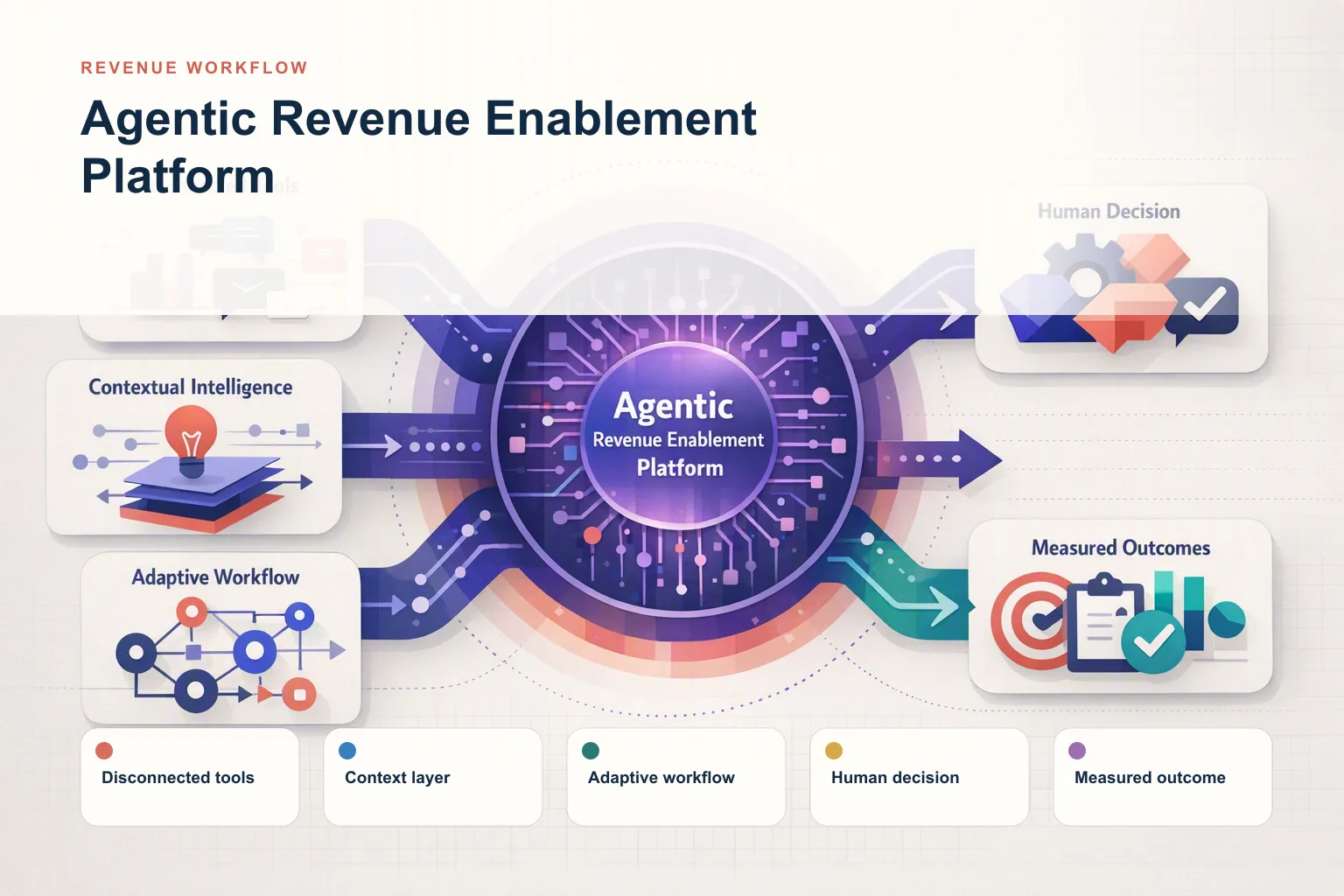
Let’s be honest: the phrase “sales enablement” has been stretched to mean almost everything. A shared Google Drive with decks. A CRM with some fields filled in. A training module someone clicked through in 2023. None of that is enablement – and in 2026, none of it will help you close a deal.
The category has evolved. Fast. The new benchmark is Agentic Revenue Enablement – an approach in which AI does not just surface information but uses context to recommend or perform bounded work.
From Tool to Co-Worker: What “Agentic” Actually Means
Traditional sales tools are passive. You ask, they answer. You search the content library, it returns results. You look at the CRM, it shows you data. The rep still does the cognitive and administrative work of connecting those results to a live deal.
Agentic AI changes that interaction. An agentic system can perceive the current deal state, reason about what needs attention, and act within defined permissions – for example, surfacing relevant content, flagging a disengaged stakeholder, recommending a next step, preparing a follow-up, or alerting a manager that a deal has gone cold.
The important distinction is not whether a product has a chat box. It is whether the system can use approved context, choose an appropriate action, explain the signal behind it, respect a human decision point, and record what happened.
In sales, the practical question is not simply whether AI will appear in the stack. It is whether the enablement operating model is ready for software that can act.
The Four Pillars of an Agentic Revenue Enablement Platform
Three-part explainer: From Tool to Co-Worker: What “Agentic” Actually Means, Why This Matters Right Now, and Revspire’s Take: Revenue Enablement Should Feel Alive.
A genuine agentic revenue enablement platform does not just tick feature checkboxes. It connects four capabilities around the same deal context.
1. Intelligent Deal Rooms
Not just a shared link. A living workspace where buyers and sellers co-own the deal, with content, timelines, mutual action plans, and stakeholder maps in one place. When a buyer opens a document or a new decision-maker joins, that signal can update the recommended next step. Explore how Revspire’s Digital Sales Rooms make every touchpoint count.
2. AI-Powered Content Intelligence
Agentic platforms can scan approved repositories, map assets to a deal stage or buyer need, and surface them in context. The point is not to generate more collateral. It is to reduce the time between a buyer question and a relevant, governed answer. See how Revspire’s Content Hub supports this workflow.
3. Buyer Intent Analytics
What buyers do can reveal risk and interest that CRM notes miss: which stakeholders engage, what they revisit, and where participation disappears. An agentic platform can combine those signals with milestones and stakeholder coverage, then prompt the rep to investigate. Engagement is evidence, not certainty; the rep still needs to interpret it in the deal’s context.
4. Continuous Sales Coaching
Agentic coaching can use live deal patterns to deliver timely practice and feedback rather than relying only on periodic courses. The system might identify a recurring discovery gap, recommend an approved playbook, or help a manager focus a coaching conversation. Revspire’s Sales Training module is designed to connect practice with the work reps are doing.
What Turns an AI Feature into an Agentic Workflow?
A useful agent does more than produce fluent text. Each workflow needs a trigger, trusted inputs, a bounded decision, an accountable owner, and an observable result.
Workflow element
Question to answer
Revenue example
Trigger
What change should cause the system to evaluate the deal?
A key stakeholder stops engaging or a milestone becomes overdue
Context
Which approved systems and signals may it use?
CRM stage, buyer activity, MAP status, and entitled content
Action boundary
May it observe, recommend, draft, or execute?
Recommend a follow-up rather than sending it automatically
Owner
Who is accountable for the workflow and its result?
A revenue operations leader owns the rule; the account executive owns the buyer decision
Exception
When should the system stop and ask?
The signal is ambiguous, a required source is missing, or the action changes a commitment
Evidence
How will a reviewer know the workflow helped?
The recommendation, rep response, next milestone, and final outcome are recorded
This operating contract prevents two common category errors: calling search “agentic” because it returns an AI summary, and automating a task before the team has agreed what a good decision looks like.
How to Operationalize Agentic AI in Revenue
Choose one measurable workflow
Begin with a recurring problem that has a clear owner and a reversible first action. Examples include identifying stale opportunities, recommending content after discovery, or preparing a manager brief before a pipeline review. Define the trigger, permitted data, expected output, human checkpoint, and success measure before choosing the automation.
Establish a recent-deal baseline
Review the previous six months of opportunities across reps, segments, deal sizes, and stages. Locate where deals stall, where stakeholder coverage disappears, which content questions recur, and how much time the current task consumes. Separate the data from the team’s narrative about the problem. A baseline makes it possible to tell whether the workflow changed anything.
Assign permanent ownership
Agentic enablement is an operating capability, not a one-time launch. Name a leader accountable for outcomes and a system owner accountable for data, permissions, reliability, and exceptions. Document what should happen at each stage and who reviews changes to the workflow.
Connect the systems without losing authority
The platform may need context from CRM, content, training, engagement, and deal-room systems. That does not mean every agent should have unrestricted access or write privileges. Preserve the authoritative source for each field, carry the user’s permissions into the workflow, and make consequential actions explicit.
Review live work, not just dashboards
Use the weekly operating cadence to inspect a sample of recommendations and the deals behind them. Ask what signal fired, what action was proposed, whether the rep accepted it, and what happened next. Deal-level review catches weak context and confusing guidance that an aggregate adoption rate can hide.
Measure Leading Signals and Revenue Outcomes Together
Activity counts can make an agent look busy without showing that it helped. Track the quality and use of the workflow alongside the downstream result.
Layer
Useful measures
What it reveals
Input quality
Data completeness, content currency, stakeholder coverage, eligible deals
Whether the agent has enough trustworthy context to work
Workflow quality
Recommendation relevance, acceptance or dismissal, exception rate, time to action
Whether the intervention is timely and usable
Deal progress
Milestone movement, time in stage, re-engagement, decision-date changes
Whether buyer progress changed after the intervention
Revenue outcomes
Win rate, sales-cycle length, forecast accuracy, average deal size
Whether the operating model is associated with better business results over time
Review leading measures weekly so the team can correct a workflow while a deal is still active. Review lagging outcomes over a longer window and by segment. Correlation is a prompt to investigate, not automatic proof that the agent caused the result.
Feed win/loss findings, rep feedback, buyer feedback, and exception patterns back into the playbook. A quarterly review can retire rules that create noise, adjust thresholds, and identify the next bounded workflow worth testing.
Five Mistakes to Avoid
- Bolting a chatbot onto a filing cabinet. A conversational interface does not fix stale content, missing permissions, or disconnected deal context.
- Starting with maximum autonomy. Begin with observation, recommendation, or drafting. Expand authority only when the data, controls, and review evidence support it.
- Automating an undefined process. If leaders cannot agree on the trigger, owner, desired action, and exception path, software will reproduce the ambiguity at scale.
- Confusing activity with progress. Generated emails, alerts, and tasks are outputs. Buyer-owned milestones, stakeholder coverage, and decisions are progress.
- Treating launch as the finish line. Models, content, buyer behavior, and sales processes change. Review live examples, learn from won and lost deals, and update the workflow deliberately.
A Practical 90-Day Rollout
Days 1–30: choose one workflow, establish the baseline, name its owners, define the action boundary, and document success and exception criteria.
Days 31–60: connect the minimum approved context, test the workflow against representative deals, and instrument recommendations, human responses, errors, and outcomes.
Days 61–90: pilot with a limited group, review examples every week, compare results with the baseline, and decide whether to revise, expand, or stop. A measurable 90-day review is more informative than a broad rollout built on enthusiasm alone.
Why This Matters Right Now
Your buyers are already using AI. They arrive at sales conversations more informed, more skeptical, and less patient with generic material. If reps still rely on disconnected decks, vague follow-ups, and manual pipeline updates, they spend their time assembling context instead of helping the buyer decide.
An agentic platform can narrow that gap by connecting approved knowledge, deal signals, coaching, and next actions. The value is not autonomous activity for its own sake. It is consistent execution with enough context and accountability to improve the buying experience.
Revspire’s Take: Revenue Enablement Should Feel Alive
At Revspire, we built our platform around a single conviction: every sale deserves to feel like a hyper-personal experience. Not because reps have more hours in the day, but because the platform works alongside them – curating content, reading engagement signals, preparing follow-ups, and keeping buyers invested in the deal.
This is what separates an agentic revenue enablement platform from a digital filing cabinet with a chatbot bolted on.
If you are evaluating your enablement stack in 2026, the right question is not “does it have AI?” Almost everything does now. The right question is: does the AI act usefully, within a process your team can measure and govern?
For a category-level shortlist before deeper platform diligence, compare these sales enablement tools for B2B teams.
See Revspire in action – book a 20-minute demo and watch the platform work a live deal.