AI Revenue Enablement Build vs Buy: Cost, Security, Governance, and Time to Value
A practical perspective for connecting this idea to your revenue team’s next move.
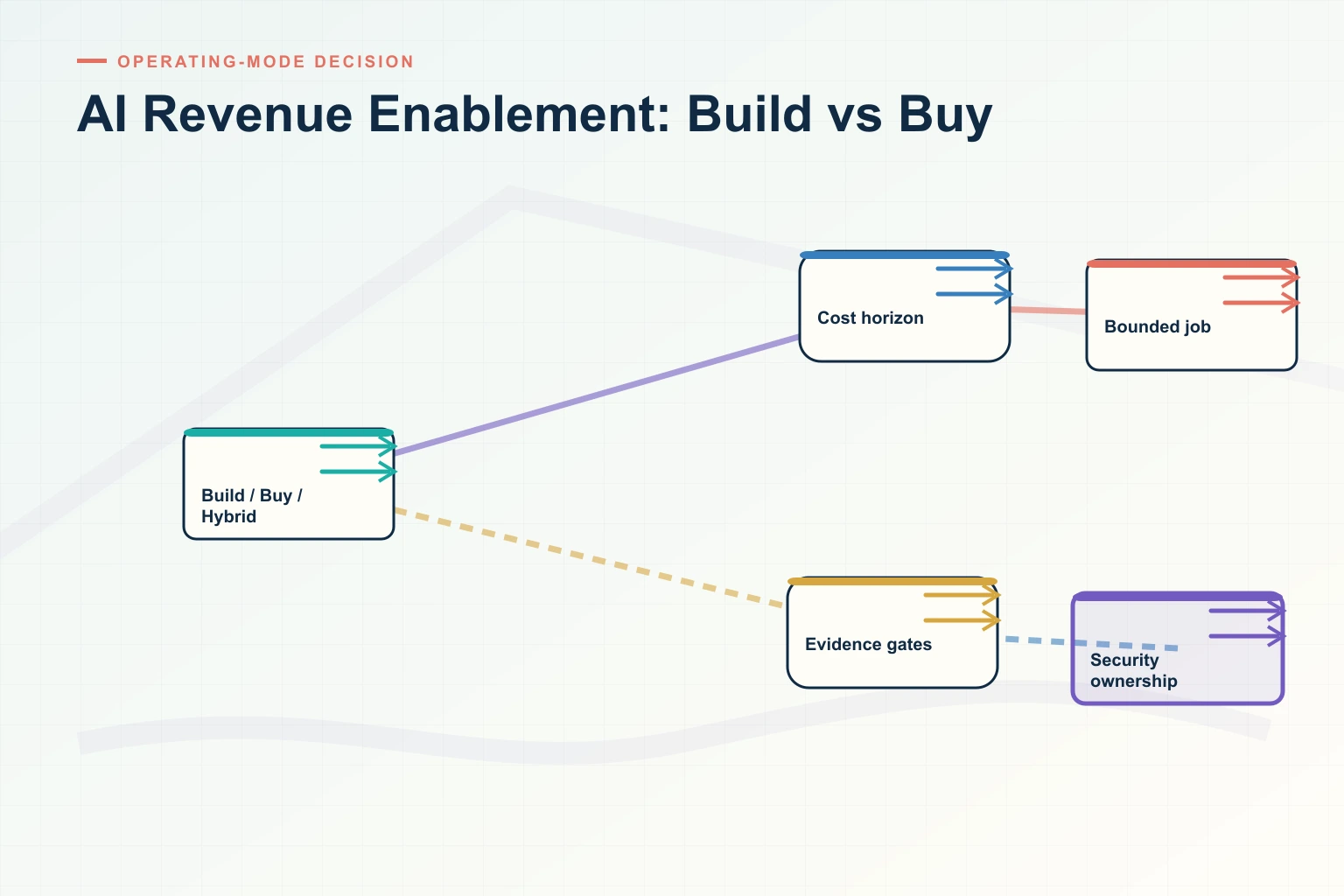
The decision is an operating model, not a license comparison
Building an AI revenue enablement system can look inexpensive in a prototype: connect a model, retrieve a few documents, and add a chat interface. Buying can look equally simple: compare subscriptions and choose the most complete demonstration. Both views omit the work that determines production value—identity, permissions, source governance, evaluation, integrations, support, incident response, change management, and continuous content ownership.
A visual summary of AI Revenue Enablement Build vs Buy: Cost, Security, Governance, and Time to Value.
The practical choice is rarely pure build or pure buy. Many teams buy a governed workflow and configure it around their content; others build a differentiated orchestration layer on managed infrastructure; some combine a commercial enablement platform with internal data services and policy controls. The right boundary depends on which capabilities are strategically unique and which are necessary but undifferentiated.
Use this framework to make those boundaries explicit. It does not provide universal cost or time benchmarks because labor rates, risk, data condition, integration complexity, and adoption vary widely. Build an estimate from your own work packages and test vendor assumptions with a bounded proof.
Before weighing build against buy, agree what the system has to enable. Our explainer on revenue enablement vs sales enablement sets out the definition, team roles, strategy steps and metrics that any build, buy or hybrid choice must support.
Define the three options precisely
Option
Your organization owns
Provider owns
Typical reason to consider it
Build
Experience, orchestration, retrieval, evaluation, security integration, reliability, support, and roadmap
Only selected cloud, model, or infrastructure services
The workflow is strategically differentiating and the organization can staff the product for its full life
Buy
Requirements, configuration, content, access design, adoption, vendor oversight, and appropriate human decisions
Packaged product, upgrades, core operations, and contracted controls/support
The required jobs are broadly available and speed plus operational maturity matter more than custom ownership
Hybrid
Distinctive data, policy, models, or workflow extensions plus integration governance
Commodity enablement experiences and platform operations within the contract
A commercial foundation meets most needs while a small set of capabilities remains proprietary
Do not label extensive custom code on top of an ill-fitting product as buy. Do not label a collection of model and cloud services as a complete build. Draw a context diagram showing every system, data flow, user, trust boundary, support owner, and vendor. That diagram is the object being compared.
Calculate total cost over the decision horizon
Compare both options over the same horizon, usage assumptions, geographies, service levels, and scope. A simple model is:
Total cost = initial delivery + recurring platform and labor + change and assurance + expected risk cost + exit cost.
Expected risk cost is not a prediction. It is a scenario input: probability range multiplied by impact range for events the team can reasonably model. Keep the range visible rather than hiding uncertainty in one precise-looking number.
Cost area
Build questions
Buy questions
Discovery and design
Product, architecture, threat modeling, UX research, data inventory
Requirements, vendor evaluation, proof, contract, implementation design
Core technology
Model and embedding use, storage, search, observability, environments, backup
Subscription, consumption limits, environments, add-ons, overage
Engineering
Frontend, backend, data, ML, platform, QA, security, release management
Configuration, extensions, connector work, data migration, identity integration
Knowledge operations
Ingestion, permissions, taxonomy, versioning, evaluation corpus, source ownership
The same content work; buying software does not make source material current
Assurance
Testing, review, documentation, penetration testing, privacy work, audits
Vendor diligence, configuration validation, shared-control evidence, monitoring
Run and support
On-call, incidents, capacity, model changes, defects, user support, training
Administration, support tier, vendor coordination, adoption, release review
Change
Rebuild for new models, policies, sources, regions, and workflows
Edition changes, professional services, connector changes, renewal uplift
Exit
Documentation gaps, component replacement, staff transition
Export, deletion verification, reimplementation, integration replacement, lock-in
The FinOps Foundation’s unit economics guidance recommends connecting technology cost to business value. For this decision, calculate units that expose the workload: cost per active user, practice attempt, retrieved answer, governed content object, or completed deal workflow. Include the human review and content-maintenance effort needed to make that unit reliable.
Compare security by responsibility, not by checklist count
Build does not remove third parties: cloud, identity, observability, and model providers still create a supply chain. Buy does not transfer accountability: your organization still configures access, selects data, manages users, reviews outputs, and decides which actions are appropriate. Create a shared-responsibility matrix at control level.
Control domain
Evidence for a build
Evidence for a vendor
Identity and access
SSO, provisioning, authorization tests, service identities, privileged access review
Supported identity flows, role model, tenant isolation, admin logs, tested configuration
Data lifecycle
Data map, classification, encryption, retention jobs, deletion tests, backups
Contracted purposes, subprocessors, regions, retention controls, deletion evidence
Application security
Secure development process, dependency controls, code review, testing, remediation
Assurance reports, testing scope, vulnerability process, remediation commitments
AI-specific risk
Prompt-injection defenses, grounding, evals, tool limits, model-change controls
Architecture answers, red-team evidence, configurable guardrails, release notices
Operations
Monitoring, incident response, recovery tests, capacity and model fallback
Service levels, incident terms, status history, recovery evidence, support escalation
Exit
Portable data and documented components
Export format, transition support, deletion certificate, residual backup terms
NIST’s Secure Software Development Framework describes practices for preparing the organization, protecting software, producing well-secured software, and responding to vulnerabilities. It is directly relevant to a build and useful for questioning a vendor’s development process. CISA’s Secure by Design guidance likewise emphasizes making customer security a core product requirement rather than an optional extra.
For AI-specific threat modeling, use the OWASP Top 10 for LLM Applications as one input. Test prompt injection, sensitive-information disclosure, poisoned knowledge, unsafe output handling, and excessive agency in the actual architecture. A procurement response that says controls exist is not the same as a test showing they work with your integrations and permissions.
Governance must survive weekly change
AI revenue enablement is coupled to two fast-changing systems: the technology and the GTM knowledge it uses. The operating model needs separate owners for product, source content, models, security, privacy, legal claims, integrations, and business adoption. It also needs a clear decision about who can release what.
Governance capability
Build test
Buy test
Knowledge ownership
Can owners approve, expire, supersede, and quarantine sources?
Does configuration preserve owner, version, permission, and effective date?
Evaluation
Can the team maintain representative and adversarial regression sets?
Can customers run their own cases, inspect evidence, and export results?
Model change
Are upgrades gated by evaluation, review, rollback, and documentation?
What changes with notice, what can be pinned, and what evidence is supplied?
Human authority
Are draft, recommend, approve, and execute separate permissions?
Can consequential actions be disabled or require explicit approval?
Incident response
Can the team trace source, prompt, output, policy, tool call, and reviewer?
What logs are available, how quickly, and under which retention rules?
Accountability
Is there a funded product owner after launch?
Is there an internal owner for configuration, vendor risk, content, and adoption?
The NIST Generative AI Profile is a useful reference for organizing risk work across the lifecycle. For assurance reports, the AICPA SOC suite overview explains the family of System and Organization Controls services. Review report scope, period, exceptions, subservice organizations, and customer responsibilities; a SOC label alone does not answer whether your proposed use is covered.
Model time to value with evidence gates
Time to first demonstration is not time to value. Define value as a user completing a target job with acceptable quality, safety, and operating effort. Then compare build and buy at the same gates:
- Requirements ready: one user group, one high-value job, success measures, prohibited outcomes, data owners, and integration boundary are approved.
- Technical proof: the workflow works with sanitized representative data; critical permissions and failure modes have been tested.
- Controlled pilot: intended users complete the job; managers can review evidence; support and incident paths operate.
- Production readiness: identity, retention, monitoring, evaluation, documentation, resilience, and contract controls pass review.
- Adoption: users repeatedly complete the job and the team can distinguish useful output from rework.
- Scale: new teams, regions, sources, and use cases can be added without breaking access or multiplying manual work.
Ask each option owner for a range at every gate, the assumptions behind it, the critical dependency, and the evidence required to exit. Buy may shorten product construction but still wait on identity, data cleanup, legal review, and adoption. Build may deliver a narrow proof quickly but take longer to establish reliability and support. The schedule should expose those differences rather than assume them.
Use a weighted scorecard plus non-negotiable gates
Dimension
Starting weight
Decision evidence
Workflow and user fit
20%
Target users complete representative jobs with acceptable effort and quality
Security and privacy
20%
Shared responsibilities, data lifecycle, access, assurance, and incident needs are met
Knowledge and AI governance
15%
Sources, outputs, models, evaluations, and approvals are traceable and controllable
Integration and architecture
10%
Required systems and trust boundaries work without fragile duplication
Time to measurable value
15%
Evidence-based ranges exist for proof, pilot, production, adoption, and scale
Total cost and capacity
15%
Comparable horizon includes technology, people, assurance, support, change, and exit
Strategic control and exit
5%
Ownership of differentiating logic, portability, roadmap influence, and transition are clear
Set gates before scoring. Examples include data residency, identity integration, deletion, accessibility, a prohibited-action control, or a maximum acceptable ongoing support load. An option that fails a mandatory control should not win through strengths elsewhere. Run sensitivity analysis by changing major weights and cost assumptions; if the winner flips easily, negotiate or gather more evidence before committing.
When build, buy, or hybrid is the more credible hypothesis
- Investigate build when the workflow or proprietary data advantage is central to strategy; commercial products cannot meet a material requirement; the organization has durable product, engineering, security, and operations capacity; and leadership accepts ongoing ownership.
- Investigate buy when the jobs are common, the vendor demonstrates required workflows and controls, internal differentiation comes from content and execution rather than software construction, and a viable contract and exit path exist.
- Investigate hybrid when a platform covers governed content, playbooks, training, or deal collaboration while internal services supply distinctive data, policy, or orchestration. Keep the extension boundary narrow and documented.
- Delay both when source content has no owner, access rules are unknown, success cannot be measured, or no team will operate the system. Technology will automate that ambiguity, not repair it.
If buying remains the credible option, use this sales enablement software business case to translate requirements, costs, risks, and expected outcomes into an internal decision. When that decision advances to a formal vendor evaluation, use the sales enablement RFP template and weighted vendor scorecard to standardize requirements, questions, evidence, and scoring.
A buyer evaluating Revspire can inspect the relevant workflows separately: the Content Hub for governed assets, Sales Training for practice and evaluation, and the Trust Center for available security and compliance materials. Validate only the combination in scope; adjacent features should not substitute for a required control.
Final diligence checklist
- The target job, users, evidence of value, and prohibited outcomes are written.
- Build and buy diagrams show the same scope, data flows, and service levels.
- Total cost includes internal labor, assurance, support, change, and exit.
- Usage ranges and unit costs are visible rather than hidden in one average.
- Security responsibilities are assigned at control level.
- Privacy purpose, data categories, regions, retention, and deletion are approved.
- Source knowledge has owners, permissions, effective dates, and a correction path.
- Representative and adversarial evaluations can be run before model or workflow changes.
- Human approval boundaries are enforced for external and commercial actions.
- Time estimates use common gates and name assumptions and dependencies.
- The contract covers service, change notice, data use, incident support, export, and deletion.
- The chosen team has funded ownership for the full decision horizon.
Choose the boundary your organization can operate
A build-versus-buy decision is sound when another reviewer can reproduce it from requirements, architecture, evidence, assumptions, and tradeoffs. The answer may differ by workflow. Buy the foundation and build the differentiator; build a narrow service and buy the surrounding workflow; or choose a product when ownership would distract from the revenue job.
To test Revspire against your scorecard and shared-responsibility requirements, request a Revspire demo. Bring one bounded use case, your mandatory controls, and the cost assumptions you intend to compare.