Revspire blog
How to Improve Forecasting Mistakes and Close More B2B Deals in 2026
A practical guide to auditing sales forecasts, addressing common mistakes, measuring buyer progress, and improving B2B deal execution.
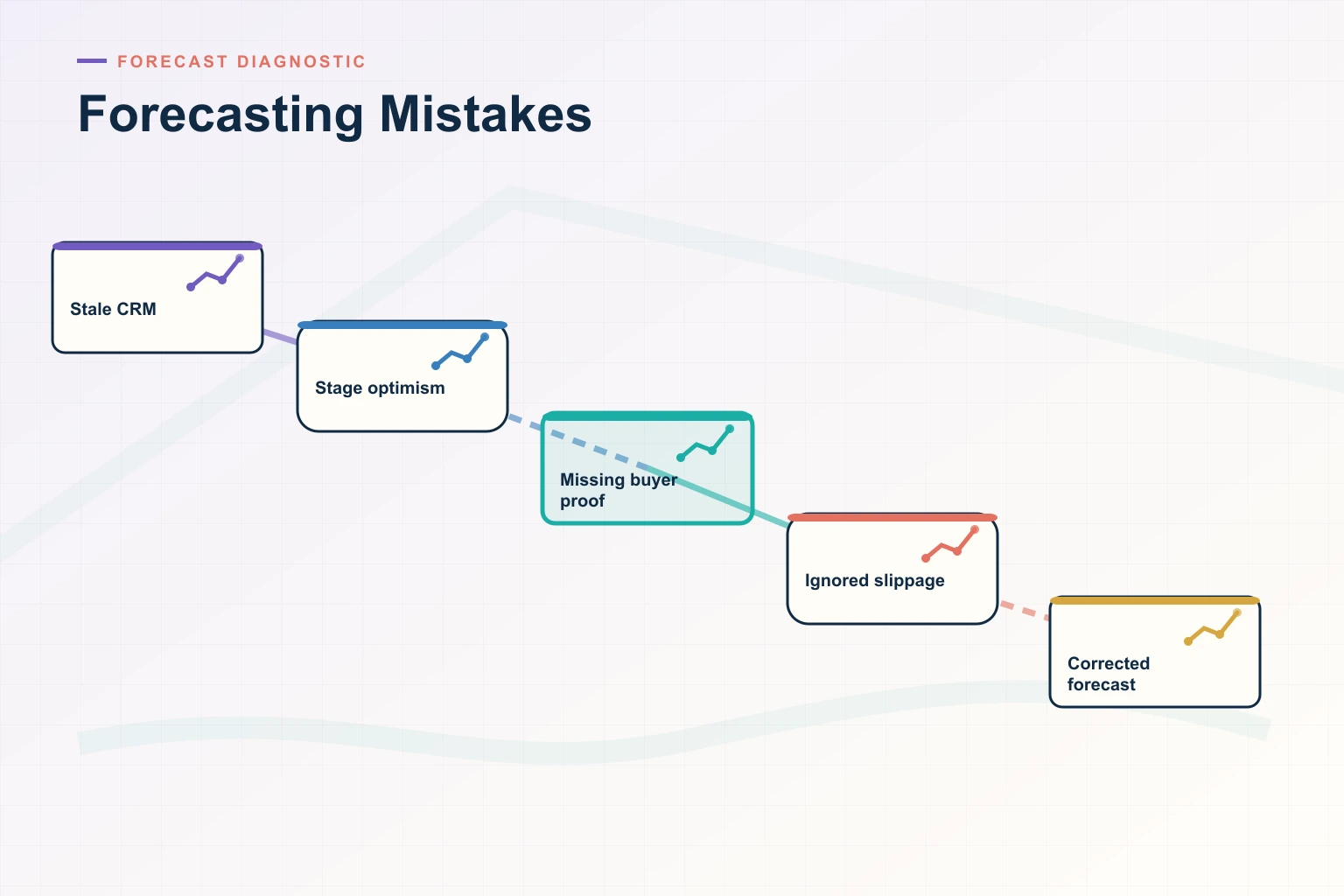
Sales forecasting should be treated as a continuous, data-driven discipline rather than a one-time initiative. Clear ownership, documented processes, buyer signals, and regular reviews can help revenue teams identify risk and improve deal execution.
Five Forecasting Mistakes to Address
- Treating forecasting improvement as a temporary project. Assign a permanent owner, define metrics, and connect the process to revenue outcomes.
- Relying on intuition instead of portfolio data. Compare the team’s narrative with deal-level evidence and investigate discrepancies.
- Depending on one stakeholder. Map the buying committee, assign coverage, and flag opportunities with only one active contact.
- Confusing activity with progress. Measure outcomes, not activities. Track stage progression, buyer engagement quality, and stakeholder coverage.
- Failing to learn from losses. Use structured win-loss reviews and update playbooks with the findings.
Audit the Current State
Start with an honest audit. Review recent opportunities to identify where deals leave the pipeline, stall, or lose momentum. Break the findings down by representative, segment, deal size, and stage.
Compare the available data with the team’s account of each deal. Look for opportunities that entered the pipeline without sufficient qualification, deals with limited stakeholder coverage, and late-stage opportunities with unresolved objections or procurement requirements.
Build the Operating Model
A forecasting operating model should define what actions happen, when they happen, and who is accountable. Document the milestones required for stage advancement and the evidence that demonstrates buyer progress.
Support the process with embedded workflows, manager reinforcement, and technology that reduces manual work. Learn about Revspire Deal Intelligence.
Three-part explainer: Audit the current state, Build the operating model, and Measure and improve.
Measure and Improve
If you cannot measure it, you cannot improve it. Combine lagging indicators such as win rate, cycle time, average deal size, and quota attainment with leading indicators that can reveal emerging risk.
Leading indicators may include stakeholder engagement, content consumption, mutual action plan progression, deal velocity, buyer engagement quality, and stakeholder coverage. Build a dashboard that shows both leading and lagging indicators, review it weekly, and connect it to coaching and territory reviews.
Seven Practices for More Consistent Forecasting
- Define expected execution. Write down what good execution looks like at each deal stage.
- Instrument every stage. Track leading indicators alongside completed outcomes.
- Use a weekly cadence. Discuss what needs to change during the next seven days, not only current status.
- Coach against live deals. Review active opportunities and work through specific execution gaps.
- Capture win-loss intelligence. Use post-deal interviews, CRM analysis, and structured reviews to inform playbooks and training.
- Align technology with the process. Ensure your tools talk to each other so data flows without manual intervention.
- Create feedback loops. Review metrics against targets, update playbooks when new patterns emerge, and request buyer feedback.