Revspire blog
The Complete 2026 Guide to Win Rate Improvement for Revenue Leaders
A practical guide for B2B revenue leaders covering win rate ownership, execution standards, deal coaching, measurement, win-loss feedback, and common mistakes.
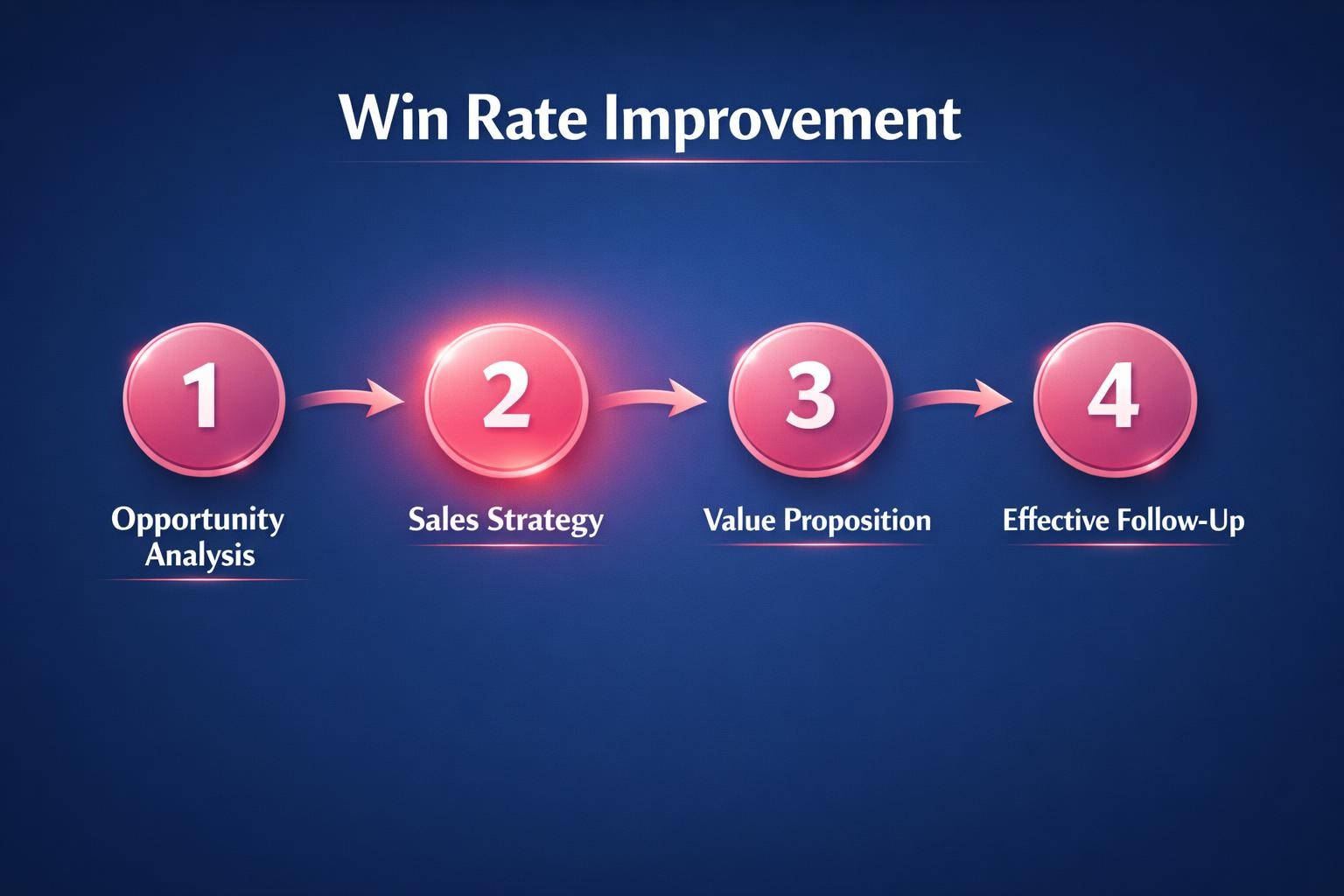
For B2B revenue leaders, sustainable win rate improvement is an ongoing operating discipline, not a one-time initiative. It requires clear ownership, documented execution standards, useful deal data, focused coaching, and feedback from won and lost opportunities.
This guide brings together a practical operating framework, seven improvement practices, five common mistakes, and a 90-day starting plan.
A framework for making win rate improvement a repeatable operating discipline.
Why win rate improvement requires a system
Revenue leakage can appear throughout the pipeline. Early-stage opportunities that should not advance consume capacity and distort the forecast. Qualified deals can stall when execution gaps are not identified. Late-stage deals can be lost when procurement issues, objections, or stakeholder concerns emerge too late.
The buying experience is another consideration. In markets where products are differentiated but not unique, teams can examine whether their sales process builds trust, reduces perceived risk, and helps buyers proceed with confidence.
The source material also identifies a talent dimension. It frames a structured win rate improvement environment as relevant to attracting strong revenue professionals, helping them develop, and encouraging them to stay longer. Revenue leaders should assess that proposition against their own hiring, development, and retention data.
Potential points of revenue leakage and areas for operational review.
Build the operating model
1. Audit the current state
Start with an honest audit. Review recent opportunity data and identify where deals fall out or stall. Break the results down by rep, segment, stage, and deal size, then compare the data with the team’s account of what happened.
Use the audit to select two or three priorities. Give each priority a clear owner, a measurable goal, and a defined review cadence.
2. Establish ownership
Assign a permanent owner who is accountable for outcomes. The owner should set goals, define metrics, coordinate playbook updates, and ensure that lessons from won and lost deals influence future execution.
An operating model for Win Rate Improvement answers three questions: what actions should happen, at what stage, and who is accountable.
3. Define execution standards
Document the milestones, evidence, and actions expected at each deal stage. A shared definition gives managers a consistent basis for inspection and gives reps a clear standard for evaluating opportunities.
Treat the playbook as a living operating document. Update it as deal data, buyer feedback, and win-loss reviews reveal new patterns.
4. Instrument the process
Track both leading and lagging indicators. Leading indicators can include stakeholder engagement, content consumption, mutual action plan progression, and deal velocity. Lagging indicators can include win rate, cycle time, and average deal size.
Technology should serve the win rate improvement B2B sales process, not define it. Evaluate whether each tool reduces friction and allows relevant data to move between systems without unnecessary manual work.
Revspire Win-Loss Intelligence is referenced in the source material as part of its technology-and-data discussion.
Three-part explainer: Audit the current state, Build the operating model, and Measure and improve.
Seven practices for improving win rates
- Define excellent execution. Write down what successful execution requires at each stage and apply the same standard across the team.
- Track leading indicators. Monitor signals that can reveal risk before the final outcome is known.
- Use a weekly cadence. Include win rate health in pipeline reviews and focus on what needs to change during the next seven days.
- Coach live deals. Review active opportunities with each rep, identify the execution gap, and work through a specific correction.
- Capture win-loss intelligence. Use post-deal interviews, CRM analysis, and structured reviews, then feed the findings into playbooks and training.
- Align technology with the process. Consolidate tools where appropriate and reduce manual intervention in data flows.
- Create feedback loops. Review metrics against targets, update playbooks when evidence changes, and solicit buyer feedback.
Seven practices for building and refining a repeatable win rate improvement system.
Five mistakes that can undermine the process
1. Treating improvement as a temporary initiative
A process can drift when it is not part of the team’s normal operating rhythm. Assign a permanent owner, hold standing reviews, and maintain recurring improvement goals.
2. Relying on intuition instead of portfolio data
Recent or memorable deals can distort judgment. Define a small set of indicators, review them consistently, and investigate situations in which the data and the team’s intuition disagree.
3. Building the relationship around one stakeholder
A single-threaded deal is vulnerable when the primary contact becomes unavailable, changes roles, or loses influence. Map the buying group, assign relationship coverage, and flag opportunities with only one active contact.
4. Confusing activity with progress
Measure outcomes, not activities. Calls, emails, and tasks do not necessarily mean that a deal is advancing. Give greater weight to stage progression, buyer engagement quality, and stakeholder coverage.
5. Failing to learn from losses
Conduct a structured review after significant losses. Identify the breakdowns that contributed to the result, document the findings, and update playbooks or coaching plans.
Three-part explainer: Recognize the leak, Correct the behavior, and Prevent repeat failure.
Measure and refine the system
If you cannot measure it, you cannot improve it. Build a dashboard that combines leading and lagging indicators. Review it weekly and connect the findings to pipeline inspection, coaching conversations, and territory reviews.
Use quarterly reviews to examine longer-term patterns, compare results with targets, and determine whether the operating model or playbook needs to change.
A practical 90-day starting plan
- Establish the baseline: Review recent opportunities and identify the stages, segments, and behaviors associated with losses or delays.
- Select priorities: Choose two or three changes with clear owners and measurable goals.
- Embed the process: Add the selected indicators and deal questions to weekly pipeline and coaching conversations.
- Review and refine: At the end of the period, compare results with the baseline, document lessons, and update the playbook.
The objective is a repeatable system that clarifies expectations, surfaces risk, and turns deal outcomes into useful feedback.