Sales Content Analytics: What to Measure Beyond Downloads and Views
A practical perspective for connecting this idea to your revenue team’s next move.
Downloads and views answer a delivery question, not a revenue question
A download proves that a file was requested. A view usually proves that a page or asset opened under a particular tracking rule. Neither event proves that a seller used the material well, that a buyer understood it, or that the content changed a decision. Treating those events as revenue impact encourages teams to optimize what is easy to count instead of what helps a deal.
A visual summary of Sales Content Analytics: What to Measure Beyond Downloads and Views.
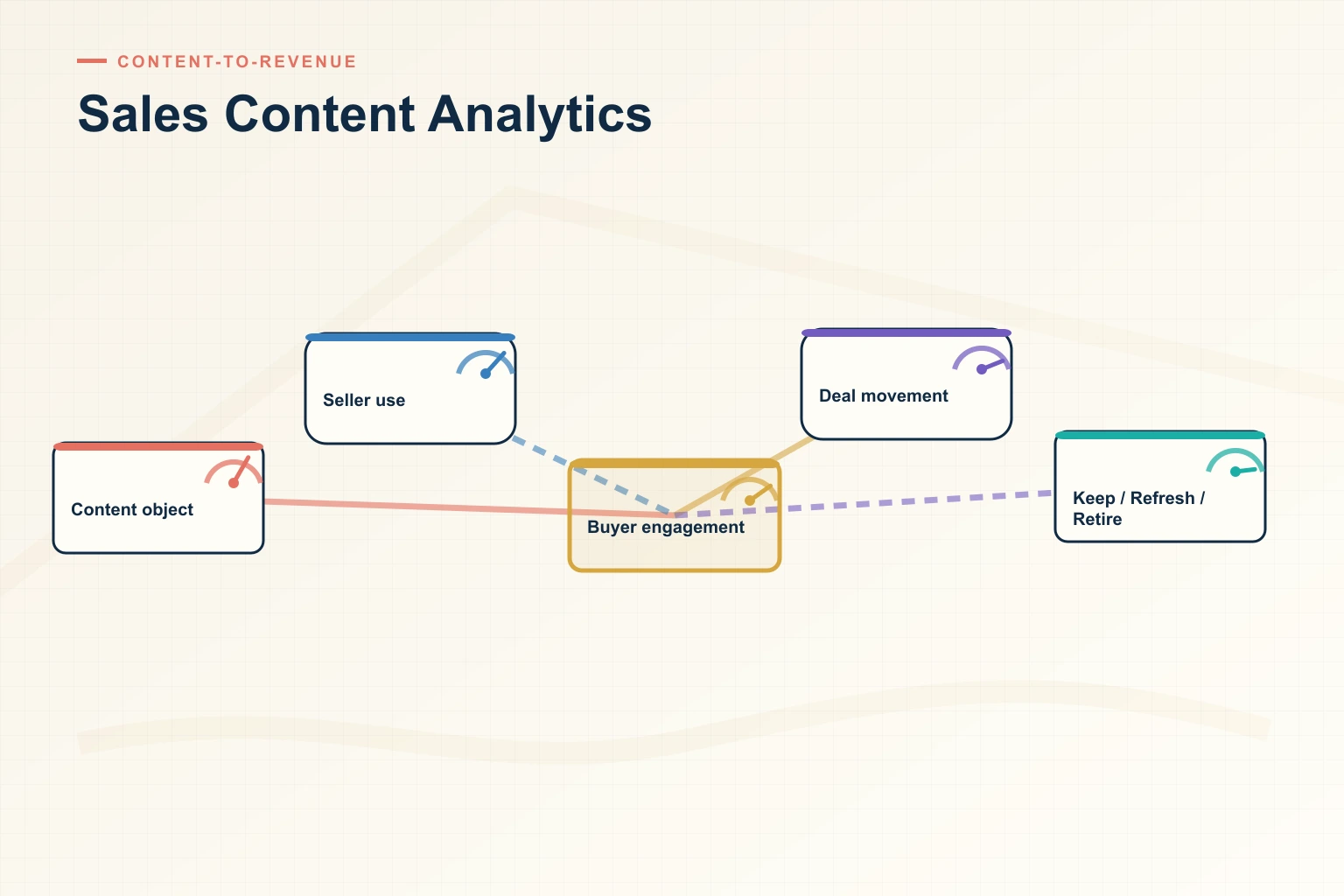
Useful sales content analytics begins with a chain of evidence. Was the right asset eligible for the user? Was it found and selected in the correct context? Did the seller adapt or share it appropriately? Did an entitled buyer engage with a relevant section? Did the interaction create a question, commitment, or next step? Did the opportunity later advance for buyer-backed reasons? Each link answers a different question and carries different uncertainty.
This article provides a measurement architecture rather than a universal benchmark. The event names, thresholds, and dashboards are starting points. Validate them against your sales motion, privacy obligations, content types, and CRM process. A content hub can supply asset and version context, while a deal room can provide permission-aware buyer interactions. The analytical work is joining those signals without pretending that correlation is causation.
Begin with decisions the measurement must support
Instrumentation should follow a decision. Otherwise the team accumulates events and later searches for a story. Write the operational question, decision owner, required evidence, acceptable delay, and action before asking engineers for another dashboard.
Decision
Evidence needed
Action the metric can support
What it cannot prove alone
Keep, revise, or retire an asset
Eligibility, search exposure, use by intended audience, qualitative feedback, version, and outcome context
Review content that is available but repeatedly ignored or abandoned
That low use means low quality; discovery or permissions may be broken
Coach a seller
Deal stage, buyer role, content selected, timing, message, and subsequent conversation
Ask why the asset was used and whether it supported the intended buyer job
That opening a document caused stage progression
Improve buyer experience
Navigation path, relevant-section engagement, questions, return behavior, sharing, and accessibility issues
Reduce friction and reorganize material around buyer tasks
Identity, intent, or sentiment when the data does not establish them
Allocate production effort
Demand by segment and use case, content gaps, reuse, maintenance cost, and field evidence
Fund high-value gaps and consolidate duplicative material
A precise financial return without a defensible comparison and cost model
Test a playbook
Assignment, exposure, compliant use, manager observation, and outcome measures defined in advance
Compare adoption and execution across a bounded cohort
That the playbook caused a difference when groups or timing were not comparable
Write metric definitions beside the decision. For example, active use could mean an entitled seller opened the current version from an opportunity workflow and then shared or presented it. That is different from a content administrator previewing the same file. A single event count that mixes both is not an adoption metric.
Use an event model with enough context to be interpretable
Google Analytics documents an event as a distinct interaction and allows parameters to describe it. The same pattern is useful for enablement analytics even when GA4 is not the system collecting the data. The official Google Analytics events documentation is a practical reminder that an event name without parameters loses important context.
Event
Minimum context
Interpretation
asset_eligible
User role, segment, region, stage, permission result, asset ID, version
The asset could legitimately have been shown to this user
asset_impression
Surface, query or recommendation reason, rank, timestamp
The system presented the asset; the user did not necessarily notice it
asset_opened
Actor type, surface, asset version, opportunity or session context
The asset opened under the defined tracking rule
section_engaged
Section ID, visible duration rule, interaction type, device constraints
A defined portion was visible or used; attention and comprehension remain unknown
asset_shared
Channel, entitled audience, link policy, deal context, sender
The seller made the asset available to a buyer or colleague
buyer_returned
Pseudonymous or consented identity, room, elapsed time, asset version
An entitled visitor returned; the reason is not established
buyer_question_added
Question category, source section, owner, response state
The content contributed to an observable information need
next_step_confirmed
Buyer-backed action, owner, due date, evidence source
A mutual commitment exists; content contribution still requires review
asset_feedback
Role, use case, structured reason, free-text handling, version
A user supplied direct evidence about usefulness or a defect
asset_superseded
Old and new IDs, effective date, owner, reason
Subsequent analysis should not combine versions without an explicit rule
Define deduplication, bot exclusion, time zones, internal traffic, previews, downloads from cached links, and anonymous access before launch. Record failed permission checks and missing identifiers as data-quality events rather than silently discarding them. A dashboard that shows only successful interactions can hide a broken content experience.
Preserve lineage from content object to business record
Content performance becomes difficult to audit when a title is reused, a PDF is replaced at the same URL, or a deck is copied into several rooms. Use an immutable content ID plus a version ID. Keep the parent playbook, campaign, audience, approval state, effective dates, and source owner attached to every event.
The W3C PROV-O Recommendation provides a formal vocabulary for describing entities, activities, agents, and their relationships. A revenue team does not need to implement the full ontology to use the principle: an analytical result should retain enough provenance to answer which version was used, by whom or by which authorized process, in which activity, and from which source.
Join content events to CRM or deal records through governed keys, not titles or email addresses copied into arbitrary tables. Store the relationship type as well: recommended for an opportunity, opened internally, shared to a room, viewed by a buyer, discussed in a call, or cited in a mutual plan. These are not interchangeable touches.
Measure four layers instead of one funnel
Layer
Example measures
Diagnostic question
Supply and governance
Current assets by use case; owner coverage; review status; duplicate rate; permission failures; time to correct
Can the intended audience reliably access an approved version?
Seller discovery and use
Eligible-to-impression rate; search success; recommendation acceptance; use by workflow; repeat use; field feedback
Can sellers find and apply the asset when the job occurs?
Buyer interaction
Stakeholder reach; relevant-section engagement; returns; shares; questions; accessibility failures; action-plan activity
Did the material support an observable buyer task?
Commercial evidence
Stage-exit evidence; time between buyer actions; agreed next steps; forecast changes; win/loss themes; renewal or adoption milestones
What changed in the deal, and what evidence connects content to that change?
Keep the layers visible together. A heavily used asset with frequent buyer questions may be valuable because it starts the right conversation, or defective because it creates confusion. A rarely opened security document may still be essential for a small set of late-stage opportunities. Median and distribution views are usually more informative than one global average, especially across segments with different sales cycles.
Use attribution language that matches the evidence
Prefer contributed to, preceded, was present in, or was associated with when the design is observational. Reserve caused for a credible experiment or evaluation design. Last-touch credit is especially weak for content because the final document may simply appear near a decision created by earlier work.
For a bounded test, define the eligible population before the intervention, choose a comparable group or staged rollout, capture baseline behavior, and keep other changes visible. Measure execution as well as outcome: if the test group never used the content, the result is an adoption failure rather than evidence about the asset’s commercial effect. If assignments differ by manager, region, or deal quality, report those differences.
Use qualitative evidence alongside events. Interview sellers and buyers about the job the material helped them complete. Review call or meeting excerpts only where access and purpose permit. Compare win/loss explanations with the observed content trail. These checks can expose a misleading metric faster than another chart.
Build privacy and access controls into the schema
The NIST Privacy Framework offers a structure for identifying and managing privacy risk. For organizations subject to the GDPR, Article 5 of the official regulation text includes principles such as purpose limitation, data minimization, accuracy, storage limitation, and security. Legal applicability and implementation require qualified review, but the design lesson is direct: collect only the interaction data needed for a stated decision and retain it only as long as justified.
- Document the purpose for seller, buyer, and administrator events separately.
- Use role-based access so content owners do not automatically see unnecessary personal detail.
- Distinguish authenticated identity, pseudonymous identity, and unknown visitors.
- Do not infer emotion, seniority, buying authority, or intent from a view event.
- Make consent, notice, opt-out, retention, deletion, and data-subject workflows testable where required.
- Restrict raw event export and prevent joins that recreate identities outside the approved purpose.
- Show data gaps, blocked tracking, and identity uncertainty in reports.
Operate analytics as a review loop
A useful dashboard ends in a decision queue. Each month, content owners can review assets with expiring approval, high failed-search demand, repeated negative feedback, or unexpected audience use. Enablement can inspect whether sellers reached the right content at the intended stage. Managers can coach the choice and application of content without turning buyer activity into a verdict about a rep.
Quarterly, review metric definitions, event quality, access, retention, and outcome assumptions. Sample records from source to dashboard. Reconcile asset and version counts. Challenge one apparent success and one apparent failure with qualitative evidence. Retire measures that no longer drive a decision.
Sales content analytics implementation checklist
- Every metric names a decision, owner, action, and interpretation limit.
- Events distinguish eligibility, impression, internal use, external share, and buyer interaction.
- Immutable asset and version IDs survive title, URL, and file changes.
- Actor, surface, workflow, audience, permission, and time context are retained.
- Internal previews, bots, duplicate events, cached downloads, and failed tracking are handled explicitly.
- Content events connect to deal records through governed keys and relationship types.
- Dashboards separate supply, seller use, buyer interaction, and commercial evidence.
- Observational associations are not presented as causal lift.
- Privacy purpose, notice, access, retention, deletion, and export controls are reviewed.
- Qualitative feedback and record sampling challenge the quantitative story.
- Version changes and metric-definition changes are documented.
- Every review ends with an owner, action, evidence target, and due date.
Measure whether content helps someone complete a job
The question beyond downloads and views is not which asset received the most activity. It is whether an approved piece of content reached the right person, in the right context, supported an observable seller or buyer job, and produced evidence worth acting on. A disciplined event model makes that question answerable without overstating what the data knows.
To examine how Revspire can connect governed content, buyer workspaces, and engagement context, request a Revspire demo. Bring one content journey and the decisions your current dashboard cannot support.