AI-Generated Sales Content: The Good, the Bad and How to Use It Well
A practical perspective for connecting this idea to your revenue team’s next move.
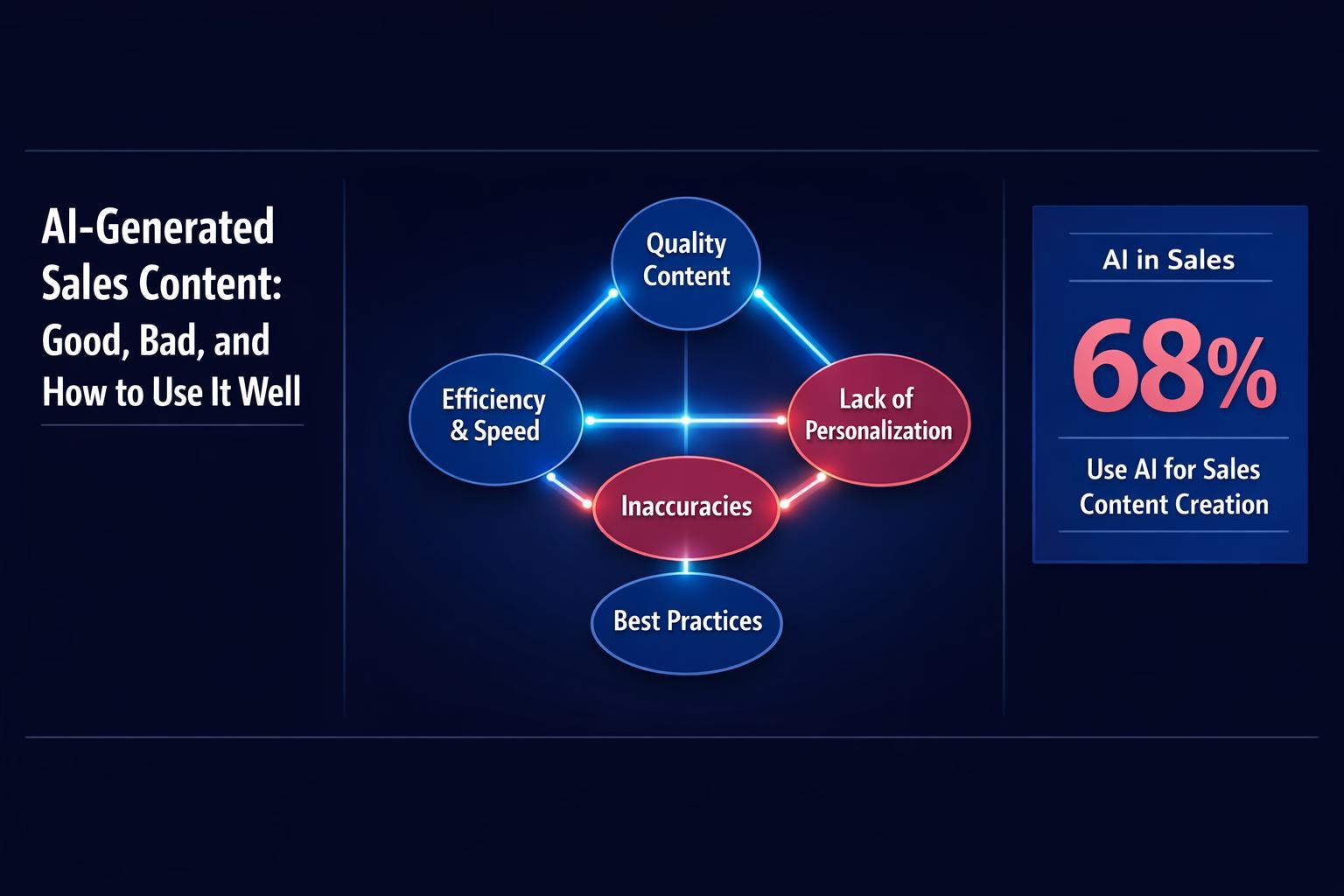
AI-generated sales content is any sales email, sequence, proposal, battlecard or follow-up drafted by a generative AI model. Used well, it speeds up research, first drafts and the reuse of approved material. Used badly, it produces generic, inaccurate or obviously automated messages that buyers ignore. The difference is human review, specific buyer context and approved sources.
This guide covers what AI-generated sales content is good for, where it goes wrong, how buyers actually spot bot-written messages, a review workflow, and the disclosure rules that apply. It reflects research, tools and regulation as of October 2026, including the EU AI Act transparency obligations that have applied since 2 August 2026.
Last updated: 17 October 2026
What counts as AI-generated sales content?
Any customer-facing or seller-facing sales material where a model wrote the first version. In most B2B teams that now includes outbound emails and sequences, meeting recaps, proposal and RFP answers, battlecards, objection responses and LinkedIn messages. The risk is not the same for each, so the review should not be the same either.
Content type
Where AI helps
Where it goes wrong
Minimum human check
Prospecting emails and sequences
Research summaries, first drafts, variants to test
Generic openers, false familiarity, volume without relevance
Rep rewrites the opener and the ask
Meeting recaps and follow-ups
Summarising notes, listing agreed next steps
Missed nuance, commitments nobody made
Rep checks every next step against the call
Proposals and RFP answers
Drafting from approved answer libraries
Outdated features, invented capabilities
Product or bid owner signs off
Battlecards and competitive positioning
Structuring win/loss notes and public information
Unverified competitor claims
Product marketing approves before publishing
Objection handling responses
Turning approved talk tracks into short replies
Overpromising on price, security or roadmap
Enablement approves the source talk track
Case studies and proof points
Tailoring an approved story to an industry
Made-up customers, quotes or metrics
Never generate; only adapt approved, attributed material
What is AI-generated sales content good for?
The strongest uses are the ones where the AI works from information you already trust and a person decides what to send:
- Answering product questions fast. Reps mostly use AI to find and phrase company knowledge, not to write prose from scratch. In Revspire’s seller search and AI assistant benchmark (aggregated Revspire customer data, 12 months), questions reps asked the AI assistant were about product and solution information (30%), competitive positioning (22%), industry and use-case content (18%), objection handling (15%), sales process and playbooks (9%) and other topics (6%). The quality of those answers depends on the source library behind the assistant, not on the prompt.
- First drafts and variants. A model can produce three versions of a follow-up in seconds, so reps spend their time choosing and editing instead of starting from a blank page.
- Research summaries. Condensing an annual report, a job post or a long discovery transcript into the three points that matter for the next call.
- Repurposing approved material. Turning an approved case study into an industry-specific one-pager, or a long security answer into a two-line email reply, without changing the facts.
- Notes and recaps. An AI note-taker (with the buyer’s consent to record) frees the rep to listen and ask follow-up questions instead of typing. Afterwards it drafts the summary and next steps while the conversation is fresh, for the rep to correct.
Buyers use AI too, which raises the bar for accuracy. In a Gartner survey of 645 B2B buyers (fielded August to September 2025, published 20 May 2026), 45% had used generative AI during a recent purchase, and 69% said they prefer to validate AI-generated insights with sales reps. If a buyer brings an AI-generated summary to a rep to check, the rep’s own AI-assisted answer has to be right.
Where does AI-generated sales content go wrong?
- Generic relevance. AI makes it cheap to send more messages, but not more relevant ones. In a Gartner survey of 632 B2B buyers (fielded August to September 2024, published 25 June 2025), 73% said they actively avoid suppliers who send irrelevant outreach. Scaling an untargeted message with AI scales the damage.
- Invented facts. Models fill gaps confidently: a feature you do not have, a customer you never signed, a percentage nobody measured. In sales content that becomes a promise the delivery team has to keep or a claim legal has to retract.
- Stale or off-brand messaging. A general-purpose model does not know last quarter’s pricing change, the new positioning or which competitor claims product marketing has approved.
- Content sprawl. Generating new assets is easy; getting them used is not. In Revspire’s content-to-revenue benchmark, 35% of active sales assets had no shares or opens in 90 days. Before generating another deck, check whether an approved one already exists.
- Misleading a buyer who checks. In the 2026 Gartner survey, buyers were split on where they were more likely to meet misleading information: 51% said generative AI and 49% said a sales rep. An AI-written email with an error confirms the worse of both.
How do buyers spot bot-written sales messages?
Mostly they do not detect AI as such; they notice generic, impersonal messages, whoever wrote them. Research shows people are poor at telling AI text from human text, and automated detectors are unreliable, so the practical goal is not to “beat detection” but to write messages that are specific enough that the question never comes up.
People are close to chance at detecting AI text
In six experiments with 4,600 participants, published in PNAS in March 2023, Jakesch, Hancock and Naaman found that people identified whether short self-presentations, the kind of text people write about themselves in job applications, dating profiles and Airbnb host profiles, were written by a person or by AI with only 50% to 52% accuracy in the main experiments. Participants relied on cues that misled them: they read grammatical mistakes as a sign of AI, yet flawed texts were 15% less likely to be AI-generated, and they read contractions and first-person, family-related content as human, although those cues did not reliably indicate a human author.
Two practical lessons follow. Adding deliberate typos to look human does not work, because readers tend to read errors as machine-made. And buyers judge authorship by impression, so anything that feels templated gets labelled “bot”, fairly or not.
Automated AI detectors are not reliable either
OpenAI released a classifier for AI-written text on 31 January 2023. In its own evaluation it labelled 26% of AI-written text as “likely AI-written” and wrongly labelled human-written text as AI-written 9% of the time; OpenAI withdrew it on 20 July 2023, citing its low rate of accuracy (OpenAI, 31 January 2023, updated 20 July 2023). Do not use detector scores to judge reps’ emails, and do not assume a buyer’s tool can prove anything either way.
The tells buyers actually notice
These are the patterns that make a sales message read as automated, based on how generic outreach typically looks. None proves AI authorship; each makes a message feel like it was not written for the reader:
- Compliments with no content: “I was impressed by your recent post” without saying which post or what was in it.
- Stacked buzzwords: verbs and nouns people rarely say aloud, such as spearheaded, cornerstone, streamline, supercharge, foster, unveil and deep dive, especially several in one email.
- Template rhythm: every paragraph the same length, lists of exactly three, and “it’s not just X, it’s Y” constructions.
- Wrong or stale facts: an old job title, the wrong product line, an industry the buyer left years ago.
- Channel mismatch: a LinkedIn message that reads like a press release, or a follow-up that ignores what the buyer said last time.
- A vague ask: “a quick 15-minute call to explore synergies” with no reason the buyer should care this week.
How do you keep AI-assisted sales content authentic?
- Start from approved sources. Ground the AI in your approved content library, talk tracks and product documentation rather than the open web, and require it to say which source it used. Never let it supply customer names, quotes, metrics or prices that are not in an approved source. Our sales content governance framework covers ownership, approval and expiry rules.
- Add one detail the AI could not know. Something from discovery, a previous call or a shared contact: the integration that failed last year, the regional launch, the person who joined the thread. One real detail does more than three generic compliments.
- Draft, then rewrite the edges. Let AI draft the body, but have the rep write the first line and the ask in their own words, or write rough bullet points and let AI tidy them.
- Read it aloud. If a word would sound odd said to the buyer in a meeting, cut it.
- Keep a banned-claims list. Unapproved metrics, competitor statements, roadmap dates and discount language that legal has not cleared.
- Send fewer, better messages. Use the time AI saves on drafting to research the account, not to triple the send volume.
- Measure replies and meetings, not output. Track positive reply rate and meetings booked per sequence, and retire templates that underperform.
Worked example: editing an AI first draft
An illustrative prospecting email to a fictional enablement leader, Priya, before and after a rep’s edit.
AI first draft: “Hi Priya, I hope this email finds you well. I came across your company and was impressed by your commitment to innovation. As teams look to streamline their workflows and supercharge productivity, our platform empowers organisations like yours to unlock growth. Would you be open to a quick 15-minute call next week to explore synergies?”
After the rep’s edit: “Hi Priya, I saw you’re hiring three account executives for the new Berlin office. Opening a region usually means getting new reps current pricing and security answers in German before their first calls. We put together a one-page checklist for that ramp; shall I send it over? If the timing is wrong, no need to reply.”
What changed: a real, checkable trigger replaced the compliment; the problem is the buyer’s, not the vendor’s; the buzzwords are gone; and the ask is small and specific. The AI still saved time on structure and the first pass.
A review workflow for AI-generated sales content
Match the review to the risk. A three-tier policy keeps low-risk drafts fast and high-risk claims controlled:
Tier
Examples
Who reviews
What they check
Green: rep self-check
Meeting recaps, scheduling, one-to-one follow-ups
The sending rep
Facts against call notes, tone, one specific detail
Amber: second reviewer
New sequence templates, proposals, industry one-pagers
Manager, enablement or bid owner
Approved sources used, current pricing and features, brand voice
Red: formal approval
Competitive claims, security and legal answers, customer references, pricing terms
Product marketing, legal or security
Every claim attributable; nothing generated that should be quoted
Tooling helps when it builds the workflow in. In Revspire, for example, the AI Playbook Engine drafts battlecards, objection plays and messaging grounded in approved revenue knowledge and routes them for approval, so reps reuse reviewed content instead of generating claims from scratch.
Do you have to disclose AI-generated sales content?
For an ordinary sales email that a person reviews and sends, none of the official sources below requires the sender to add an AI label. The rules change when an AI system talks to buyers on its own, and commercial email rules apply whoever wrote the message. This section summarises the official sources; it is not legal advice.
EU AI Act: Article 50 transparency obligations
Article 50 of the EU AI Act has applied since 2 August 2026 (European Commission FAQ, last updated 24 July 2026). Per the text of Article 50:
- AI that talks to people (Article 50(1)). Providers must design AI systems intended to interact directly with people so that those people are informed they are interacting with an AI system, unless that is obvious to a reasonably well-informed, observant and circumspect person. This is the rule to watch if an AI agent, not a rep, holds conversations with prospects.
- Machine-readable marking (Article 50(2)). Providers of systems that generate synthetic text, audio, images or video must mark outputs in a machine-readable format so they are detectable as artificially generated, with an exception for assistive functions for standard editing. The Commission says systems placed on the market before 2 August 2026 must meet this marking duty from 2 December 2026.
- Published public-interest text (Article 50(4)). Deployers must disclose AI-generated text published to inform the public on matters of public interest, unless it has undergone human review or editorial control and a person holds editorial responsibility for the publication.
The Commission’s FAQ does not address sales or marketing email directly. A one-to-one email drafted with AI and reviewed by a rep is not obviously “published to inform the public on matters of public interest”, but an autonomous AI agent replying to buyers may fall under Article 50(1). A voluntary Code of Practice on Transparency of AI-generated Content, whose final version the Commission lists under 10 June 2026 and which the Commission and the AI Board have assessed as adequate, sets out how providers can mark content and deployers can label it. Check your own use with counsel.
United States: FTC rules on commercial email and fake reviews
- CAN-SPAM applies whoever wrote the email. The FTC’s CAN-SPAM compliance guide (August 2023, checked 17 October 2026) says the law “makes no exception for business-to-business email”. Commercial messages need accurate header information and subject lines, must identify themselves as advertisements, include a valid physical postal address and a working opt-out, and opt-outs must be honoured within 10 business days. Using a vendor does not remove your responsibility, and each violating email can cost up to $53,088. AI sequencing at volume makes these basics more important, not less.
- No AI-generated testimonials. The FTC’s rule on consumer reviews and testimonials, announced on 14 August 2024, bans reviews and testimonials that misrepresent that they are by someone who does not exist, “such as AI-generated fake reviews”. Never let AI write a customer quote.
- Enforcement focus. On 22 December 2025 the FTC set aside its 2024 order against the AI writing service Rytr, saying the complaint did not meet the FTC Act’s legal requirements and the order unduly burdened AI innovation, while stating it will continue to hold accountable those who use AI to violate the law (FTC, 22 December 2025).
None of these FTC pages requires a label saying an email was drafted with AI; the obligations are about truthful claims, honest identification and opt-outs.
Frequently asked questions
Is AI-generated sales content effective?
It is effective for speed: research summaries, first drafts, recaps and adapting approved material. It is not effective as a substitute for relevance; Gartner found 73% of B2B buyers actively avoid suppliers who send irrelevant outreach. Use AI to draft from approved sources and buyer-specific notes, and keep a person responsible for what is sent.
Can buyers tell if a sales email was written by AI?
Not reliably. In a 2023 PNAS study of 4,600 participants, people identified AI-written self-presentations with 50% to 52% accuracy, close to chance. What buyers do notice is generic content: empty compliments, buzzwords, stale facts and vague asks, which they label as “bot” whoever wrote them.
Can AI detectors identify AI-written sales emails?
Not dependably. OpenAI’s own AI-text classifier caught 26% of AI-written text and flagged 9% of human text as AI in its evaluation, and OpenAI withdrew it in July 2023 for low accuracy. Treat detector scores as unreliable evidence in either direction.
Do you have to disclose that a sales email was written with AI?
None of the official EU or FTC sources cited above requires the sender to add an AI label to a reviewed, one-to-one sales email. Under the EU AI Act, AI systems that interact directly with people must make clear they are AI unless that is obvious, which matters for autonomous AI agents. In the US, CAN-SPAM rules on honest headers, identification and opt-outs apply to all commercial email, including B2B.
How do you make AI sales emails sound human?
Write the opening line and the ask yourself, add one detail the AI could not know, cut words you would not say aloud, and keep the message short. Do not add deliberate typos: readers tend to treat errors as a sign of AI, not of a human.
What should never be AI-generated in sales content?
Customer names, quotes, testimonials and results; prices and discount terms; security, legal and compliance answers; and claims about competitors. These should only be reused from approved, attributed sources, with the owning team’s sign-off.
For the wider evidence on how sales teams use AI, see our AI in sales enablement statistics.
Sources
- Gartner Survey Finds 69% of B2B Buyers Turn to Sales Reps to Validate AI-Generated Insights, Gartner, 20 May 2026 (accessed 17 October 2026)
- Gartner Sales Survey Finds 61% of B2B Buyers Prefer a Rep-Free Buying Experience, Gartner, 25 June 2025 (accessed 17 October 2026)
- Human heuristics for AI-generated language are flawed, Jakesch, Hancock and Naaman, PNAS, 7 March 2023 (accessed 17 October 2026)
- New AI classifier for indicating AI-written text, OpenAI, 31 January 2023, updated 20 July 2023 (accessed 17 October 2026)
- Article 50: Transparency obligations for providers and deployers of certain AI systems, European Commission AI Act Service Desk, Regulation (EU) 2024/1689 (accessed 17 October 2026)
- Transparency obligations under Article 50 of the AI Act, European Commission, last updated 24 July 2026 (accessed 17 October 2026)
- Code of Practice on Transparency of AI-generated Content, European Commission, 2026 (accessed 17 October 2026)
- CAN-SPAM Act: A Compliance Guide for Business, US Federal Trade Commission, August 2023, edited January 2024 (accessed 17 October 2026)
- Federal Trade Commission Announces Final Rule Banning Fake Reviews and Testimonials, US Federal Trade Commission, 14 August 2024 (accessed 17 October 2026)
- FTC Reopens and Sets Aside Rytr Final Order in Response to the Trump Administration’s AI Action Plan, US Federal Trade Commission, 22 December 2025 (accessed 17 October 2026)