Sales Enablement Framework: A Practical Model for B2B Teams
A practical perspective for connecting this idea to your revenue team’s next move.
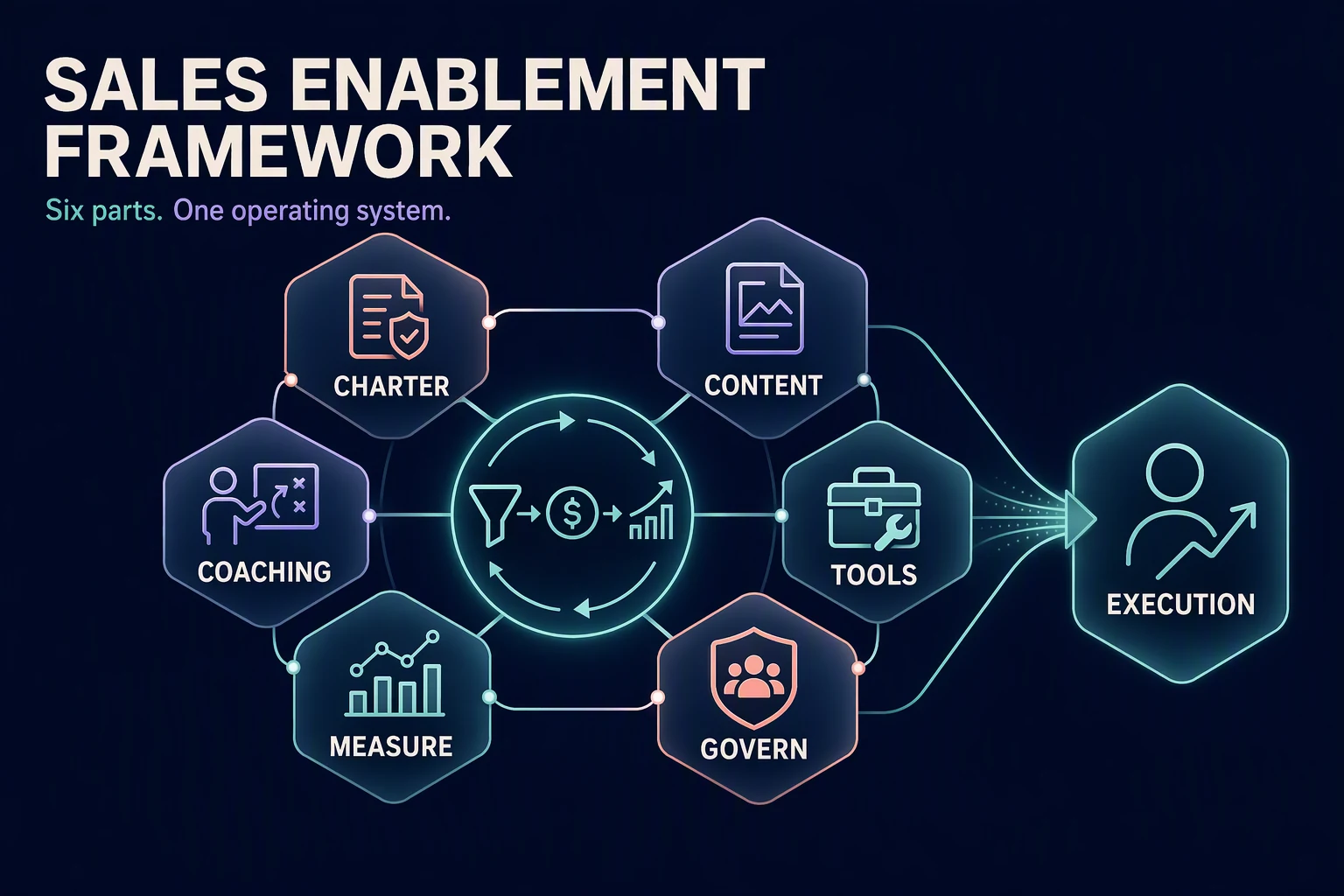
The best sales enablement framework for B2B teams has six connected components: a charter and scope, content, training and coaching, tools, measurement, and governance. Each component has a named owner, an observable standard and a metric tied to a revenue goal, and the team reviews the whole system against a four-stage maturity model every quarter.
This guide covers each component, a maturity model with criteria you can check, a summary of the 90-day build, the KPIs to report, a RACI for the roles involved, and how the framework changes between mid-market and enterprise teams.
Last updated: 16 October 2026
What is a sales enablement framework?
A sales enablement framework is the operating design for enablement: what the function is for, who it serves, what it delivers, how the work is run and how its impact is judged. A strategy sets priorities for a period and a plan schedules the work; the framework is the structure both sit inside, and it should outlast any one year’s priorities.
Published definitions agree on the scope. In a 2010 blog post, Forrester defined sales enablement as “a strategic, ongoing process that equips all client-facing employees” to hold valuable conversations with the right stakeholders at each stage of the buyer’s problem-solving life cycle. Gartner’s sales enablement page (undated, accessed 16 October 2026) calls it “the process of providing the sales organization with the information, content and tools” that help sellers sell more effectively. The Revenue Enablement Society’s certification with Florida State University goes further: it treats revenue enablement as aligning and improving people, processes, content, messaging, technology and insights across the revenue lifecycle, and it teaches charter creation and a functional maturity model as core skills.
If you need the basics first, start with our sales enablement definition. If you are deciding whether your scope should cover sales only or the whole revenue team, read revenue enablement vs sales enablement.
Why a framework, rather than a list of programs?
The evidence is correlational and some of it is old, but it points one way. In Miller Heiman Group’s CSO Insights 2019 Sales Enablement Report (900+ participants), only 15.8% of organisations ran enablement with a formal charter. That group reported a 55.1% win rate on forecast deals, against 39.2% for organisations whose enablement was random and a 46.4% study average. In the Sales Enablement PRO State of Sales Enablement Report 2022 (400+ respondents, 22 countries), 32% had a formal enablement charter, and having one was associated with a 44% higher likelihood that stakeholders were satisfied with enablement.
The execution gap is current. In Highspot’s 2026 Go-to-Market Performance Gap Report (450 GTM leaders, page modified 19 August 2026), organisations ran nearly six GTM initiatives a year, but only 52% were implemented and used consistently. A framework is how you decide which initiatives to run and how to make them stick.
The six components of a sales enablement framework
Each component below covers what it includes, what to write down, and a test that tells you it is in place.
1. Charter and scope
The charter is a one- or two-page document, signed by the CRO or VP Sales, that says what enablement is for. CSO Insights describes it as a business plan that defines vision, goals, strategies, roadmaps, services, investments and success measures. A working charter includes:
- Mission: one sentence tied to the revenue plan, for example “shorten time to first closed deal for new account executives and raise win rate in competitive mid-market deals”.
- Audiences in and out of scope: SDRs, account executives, solutions engineers, customer success managers, partners and frontline managers. Say explicitly who you do not serve yet.
- Top priorities for the next two quarters: no more than three, each linked to a CRO goal.
- Service catalogue: onboarding, content and messaging, plays, certification, coaching support, tool administration.
- Intake rule: how requests arrive, who prioritises them and how fast requesters get an answer.
- Decision rights: who approves messaging, who can publish content and who can retire it.
- Success measures and review date.
Test: any frontline manager can say what enablement will and will not do this quarter.
2. Content
Content is the approved material sellers use and share: pitch decks, case studies, battlecards, proposals, ROI tools, email templates and demo scripts. The framework standard is not volume. It is that the right asset exists for each buying stage and persona, has an owner, and is easy to find.
- Build a map with one row per buying stage and persona, listing the asset, owner and review date.
- Keep one source of truth. Copies in personal drives are where outdated pricing and claims survive.
- Track usage, and treat repeated searches that return nothing as content gaps.
- Give every asset an expiry or review date when it is published, not afterwards.
Test: a new account executive can find the current asset for a given stage and persona without asking anyone.
3. Training and coaching
Training builds knowledge and skill. Coaching makes the behaviour stick in live deals. The framework should connect the two with shared skill definitions.
- Role-based onboarding paths with ramp milestones (first meeting booked, first demo run, first opportunity created, first deal closed).
- Certification on the conversations that matter most: the core pitch, discovery, the top objections and the top competitors.
- Practice before high-stakes calls, with peers, managers or AI role-play.
- A manager coaching cadence that uses the same scorecard as training.
Manager time is the scarce input. Highspot’s State of Sales Enablement Report 2025 (350 respondents, 21 countries, fielded February to March 2025) says managers spend about 13 hours a week coaching reps. The framework’s job is to point those hours at the skills the charter prioritises.
Test: managers coach to the same skill definitions the training uses.
4. Tools
Tools deliver content, learning and data inside the seller’s workflow: the CRM, content management, learning and practice, conversation intelligence and digital sales rooms. Gartner notes that on average 22% of the sales enablement budget goes to technology, so tools are a real line item, but they come after the charter and the workflow, not before.
- Start from the workflow: where sellers prepare, send content and log activity.
- Integrate with the CRM so content, training and practice data join to opportunities.
- Prefer fewer, connected tools. Highspot’s 2025 survey found companies on a unified enablement platform were 42% more likely to report improved win rates. Treat that as a self-reported correlation from a vendor survey, not proof.
Enablement suites bundle several of these jobs. Revspire, for example, connects a governed Content Hub, an AI Playbook Engine, AI sales training and coaching, and digital sales rooms in one revenue workflow; Seismic (which merged with Highspot in 2026), Mindtickle and Allego are other options. Whichever you choose, check what each tool writes back to the CRM.
Test: sellers can do the task enablement supports without leaving the CRM or the tool they already use.
5. Measurement
Measurement is a contract agreed before a program launches: the baseline, the cohort, the leading behaviour you expect to change and the business outcome it should move. The measurement section below sets out the layers and the KPIs to report.
Test: every program in the service catalogue has a baseline and a named outcome metric before it starts.
6. Governance
Governance is the operating rhythm that keeps the framework current. Without it, content goes stale, messaging drifts and the team becomes a request queue.
- A monthly enablement council: a CRO delegate, product marketing, RevOps, two frontline managers and the enablement lead.
- An intake form, with requests scored by revenue impact and effort.
- A content lifecycle: owner, review date, expiry and retirement. See sales content governance for the full model.
- Messaging change control: when pricing, packaging or positioning changes, one owner updates every affected asset and play.
- A quarterly business review with sales leadership against the charter’s measures.
Test: outdated content is retired on schedule, and new requests get a yes or no within the time the charter promises.
The framework on one page
Component
Question it answers
Core artifact
Typical owner
Starter metric
Charter and scope
What is enablement for, and for whom?
Signed charter and service catalogue
Enablement lead, approved by the CRO
Share of enablement work tied to a charter priority
Content
What do sellers say and send at each stage?
Stage and persona content map
Product marketing, with enablement
Share of assets with an owner and a current review date
Training and coaching
Can sellers do it, and do they?
Onboarding paths, certifications, coaching scorecard
Enablement, with frontline managers
Certification coverage on current talk tracks
Tools
Where does enablement reach the seller?
Workflow and integration map
RevOps, with enablement
Weekly active use among eligible sellers
Measurement
Did it change behaviour and results?
Measurement contract per program
Enablement, with RevOps
Programs with a baseline before launch
Governance
How does it stay current?
Council charter, intake and content lifecycle
Enablement lead
Assets past review date
A summary of the six components. Owners vary by company; the RACI below assigns them in more detail.
Sales enablement maturity model: four stages with observable criteria
Score each component separately. Most teams are uneven: strong content and weak measurement is common. A component sits at the highest stage whose criteria it fully meets.
Component
Stage 1: Ad hoc
Stage 2: Defined
Stage 3: Scaled
Stage 4: Integrated
Charter and scope
No charter; work goes to whoever asks loudest
Written mission and audiences; priorities set once a year
Charter signed by the CRO; priorities tied to revenue goals and reviewed quarterly; service catalogue and intake rule published
Charter covers sales, customer success and partners; priorities set in the same planning cycle as the revenue plan
Content
Assets scattered across drives and inboxes; sellers build their own decks
One repository; key assets have owners
Stage and persona map; every asset has an owner and review date; usage tracked
Content use joined to opportunity outcomes; gaps fed by search and win-loss data
Training and coaching
Onboarding is shadowing plus a slide deck
Role-based onboarding path; annual training calendar
Certification on core talk tracks; practice before key calls; managers coach to one scorecard
Skill gaps found in call and deal data drive programs; readiness linked to performance data
Tools
Tools bought by different teams; little CRM integration
Core content and learning tools chosen; single sign-on and basic CRM links
Content and plays surface inside the CRM and email; usage flows into one report
Content, learning, practice and buyer-engagement data joined on the opportunity record
Measurement
Activity counts: sessions run, assets made
Adoption: logins, completions, content views
Baselines and cohorts; leading behaviour metrics; one outcome metric per program
Impact on ramp, win rate, cycle time and deal size reported to the CRO, with the attribution method stated
Governance
No intake or review; old content is never retired
Intake form; approvals handled case by case
Monthly council; content lifecycle with retirement; messaging change control
Quarterly business review with sales leadership; enablement roadmap reset with the revenue plan
Revspire’s four-stage model. Criteria are observable, so two people scoring the same team should reach the same stage.
Do not aim for Stage 4 everywhere at once. Move the lowest-scoring component up one stage per quarter, because the weakest component limits the rest. Content at Stage 3 is wasted if nobody measures whether it changes deals.
How this compares with published maturity models
CSO Insights’ 2019 study used four levels of formality: random, informal, formal, and formal with a charter. Win rates on forecast deals rose at each level, from 39.2% (random) and 43.3% (informal) to 48.4% (formal) and 55.1% (formal with charter). Highspot’s 2026 GTM Performance Gap Report uses a different scale. It placed 32% of respondents at Reactive, 29% at Structured, 23% at Connected and 16% at Strategic. The instruments differ, so do not compare the percentages directly, but in both only about one in six organisations reached the top level (15.8% formal with charter; 16% Strategic).
How to build a sales enablement framework in 90 days
Ninety days is enough to stand up the framework for one priority motion and prove it works, not to mature every component. Our 90-day sales enablement implementation plan covers each phase in detail, including the measurement contract, pilot design and an illustrative ROI calculation. In outline:
Days
Focus
Components built
Exit criterion
1 to 30
Diagnose and charter: interview the CRO, managers and a mix of top and struggling sellers; score the maturity model; capture baselines; pick one priority motion
Charter and scope, measurement
Charter signed; baseline captured for the priority motion
31 to 60
Pilot one motion, such as new-hire onboarding or one competitive play, with a bounded cohort
Content, training and coaching, tools
Pilot cohort uses the workflow every week; managers coaching to the scorecard
61 to 90
Measure against the baseline, set the governance rhythm and decide whether to scale
Measurement, governance
Quarterly review with the CRO; decision to scale, adjust or stop
How do you measure a sales enablement framework?
Measure in layers, from whether people used the program to whether revenue moved. The four levels of the Kirkpatrick Model (reaction, learning, behaviour, results) are a useful backbone, because enablement programs fail most often between learning and behaviour.
Layer
Kirkpatrick level
What it shows
Example metrics
Reach and adoption
1: Reaction
The right people used it and found it relevant
Share of eligible sellers active weekly; onboarding path completion; seller usefulness rating
Readiness
2: Learning
Sellers can do the skill
Certification pass rate on current talk tracks; role-play scores; time to certify
Behaviour
3: Behaviour
Sellers do it in live deals
Approved content shared in opportunities; talk-track use on recorded calls; mutual action plans in late-stage deals
Results
4: Results
The business moved
Ramp time to first closed deal; win rate in targeted motions; cycle length; deal size; quota attainment
Few teams measure this way. CSO Insights (2019) found that only 25.7% of organisations used both leading and lagging indicators, and 24.0% used a dashboard of tailored metrics to judge ROI. Pressure to prove impact is rising: in Seismic’s Generation Enablement Report (1 October 2024; 600 US managers and above, ±4%), 88% cited the ability to show enablement’s impact as a driver of their technology investment.
What KPIs should enablement report to the CRO?
- Ramp time to a defined productivity milestone, by hiring cohort.
- Win rate in the segments, motions or competitive deals the charter targets.
- Sales cycle length and stage conversion for the targeted motion.
- Average deal size or discount depth , where enablement targeted pricing and value conversations.
- Readiness coverage: the share of sellers certified on current talk tracks.
- Content and play use in won versus lost deals , labelled as an association, not proof.
These match what enablement teams say they are for: in the Sales Enablement PRO 2022 report, the top goals for the year ahead were increasing win rates (36%) and increasing revenue (31%). To separate enablement’s effect from everything else, compare cohorts or phase the rollout. Our guide to measuring sales enablement ROI covers attribution designs and the formula.
Who owns sales enablement? Roles and a RACI
Reporting lines vary, and they may matter less than clear roles. In the CSO Insights 2019 study, 49.2% of enablement teams reported to sales leadership, 22.6% to another C-level function and 17.1% to sales operations, and reporting structure showed no significant link to sales performance that year. Clear decision rights are the part you can fix this quarter.
Activity
CRO / VP Sales
Enablement lead
Product marketing
Frontline managers
RevOps
Subject experts (product, legal, CS)
Set charter and priorities
A
R
C
C
C
I
Define messaging and positioning
C
C
A/R
C
I
C
Build and maintain seller content
I
A
R
C
I
C
Onboarding and certification
I
A/R
C
C
I
C
Coaching in live deals
A
C
I
R
I
I
Tool administration and CRM integration
I
C
I
I
A/R
I
Measurement and reporting
I
A
C
C
R
I
Content approval and retirement
I
A
R
I
I
C
R = responsible, A = accountable, C = consulted, I = informed. One A per row.
Two rows cause most disputes. Messaging belongs to product marketing, but enablement turns it into talk tracks and practice, so both sign off on changes. Coaching belongs to frontline managers: enablement builds the scorecard but cannot coach every deal.
How does the framework differ for mid-market and enterprise teams?
The six components stay the same. What changes is scope, the number of audiences and how much governance you need. In this guide, mid-market means one sales organisation with one or two product lines; enterprise means several segments, regions, product lines or channels.
Dimension
Mid-market
Enterprise
Charter scope
Sales first, often new-hire ramp plus one motion
Several audiences: sales, solutions engineering, customer success and partners, with priorities per segment
Team shape
A small generalist team covering content, training and tools
Specialists by discipline (onboarding, content operations, programs, enablement operations) or embedded by segment
Content
One map for one buying motion
Maps by segment, region and language, with local owners under central standards
Training and coaching
Shared certifications; managers coach directly from one scorecard
Role and region variants; manager enablement becomes its own program
Tools
Fewer tools, deep CRM integration
Single sign-on, permissions, audit trails and regional data needs; integration with existing learning systems
Measurement
A few KPIs in the CRO’s weekly view
A standard measurement contract applied across business units, with RevOps owning the data model
Governance
Monthly council, light approvals
Tiered approvals (legal, brand, regional) and formal change control
Biggest risk
Becoming a request queue for whoever shouts
Inconsistent local versions of messaging and content
Enterprise frameworks should also plan for wider scope. Gartner’s sales enablement page says more than half of CSOs expect enablement to support marketing or customer success within three years, so write the charter’s out-of-scope list as “not yet” rather than “never”.
Frequently asked questions
What is the best sales enablement framework for B2B teams?
The best framework connects six components (charter and scope, content, training and coaching, tools, measurement and governance) and gives each an owner, a standard and a metric. Start with a signed charter, because it decides what the other five are for, then improve the weakest component first.
What is a sales enablement charter?
A sales enablement charter is a short business plan for the enablement function, approved by sales leadership. It sets the mission, audiences in scope, priorities, service catalogue, decision rights and success measures. CSO Insights’ 2019 study found only 15.8% of organisations ran enablement with a formal charter.
What is the difference between a sales enablement strategy and a framework?
The framework is the lasting structure: components, roles, standards and governance. The strategy is the set of priorities you pursue inside that structure for a given period, such as “cut ramp time” or “win more competitive deals”. You review the strategy every quarter and the framework about once a year.
How should a sales enablement team be structured?
Structure follows the charter. Mid-market teams usually start with a few generalists who cover content, onboarding and tools. Enterprise teams add specialists, such as onboarding, content operations, programs and enablement operations, or embed enablement managers in segments. Whatever the reporting line, use a RACI so messaging, coaching and tool ownership are clear.
How do you measure sales enablement success?
Measure four layers: reach and adoption, readiness, behaviour in live deals and business results. Agree a baseline and cohort before each program starts. Report a few KPIs to the CRO, such as ramp time, win rate in targeted motions, cycle length and readiness coverage, and state how you attributed the results.
Before you set targets, check what published research does and does not support: our sales enablement ROI statistics page lists the available benchmarks with sample sizes and caveats.
Sources
All pages were accessed on 16 October 2026.
- What is sales enablement and how did Forrester go about defining it?, Forrester (blog post dated August 2010 in its URL). Accessed 16 October 2026.
- Sales Enablement, Gartner (undated topic page). Accessed 16 October 2026.
- Certified Revenue Enablement Professional (CREP), Revenue Enablement Society with Florida State University College of Business (lists Fall 2026 cohort). Accessed 16 October 2026.
- 2019 Sales Enablement Report (Fifth Annual Sales Enablement Study), CSO Insights, Miller Heiman Group (October 2019; hosted by Highspot). Accessed 16 October 2026.
- State of Sales Enablement Report 2022, Sales Enablement PRO (2022; fielded 1 March to 13 April 2022). Accessed 16 October 2026.
- State of Sales Enablement Report 2025, Highspot (2025; fielded February to March 2025). Accessed 16 October 2026.
- 2026 Go-to-Market Performance Gap Report, Highspot (page modified 19 August 2026). Accessed 16 October 2026.
- Highspot and Seismic merger, Highspot by Seismic (announced 18 August 2026; page states the merger is complete). Accessed 16 October 2026.
- Seismic Releases Generation Enablement Report, Seismic via Business Wire (1 October 2024). Accessed 16 October 2026.
- The Kirkpatrick Model, Kirkpatrick Partners (undated). Accessed 16 October 2026.