Revspire blog
Sales Enablement Implementation Plan: A 90-Day Rollout for Adoption and Measurable ROI
A practical 90-day sales enablement implementation plan for defining scope, launching a bounded pilot, measuring adoption, and building an honest ROI case.
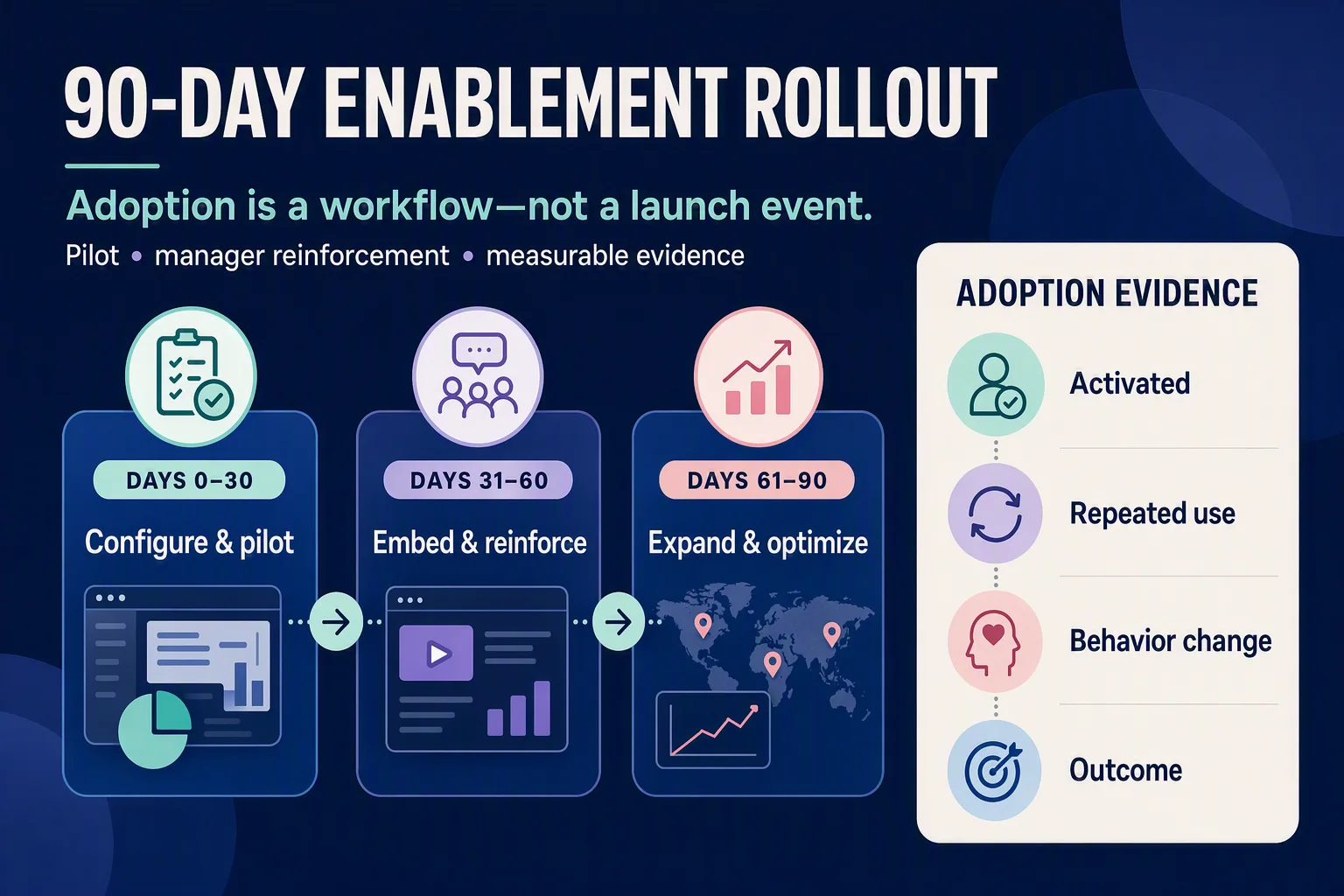
A 90-day sales enablement rollout should change work, not just launch software
A sales enablement implementation can produce a busy calendar without producing a better selling system. Teams configure a platform, migrate content, deliver training, and celebrate launch day while sellers continue using old files, managers coach inconsistently, and revenue leaders cannot connect the program to an outcome. The remedy is to treat the first 90 days as a controlled operating change with a narrow scope, explicit decisions, and evidence at every stage.
Ninety days is enough to establish a baseline, launch one useful workflow, observe adoption, and decide whether to scale. It is not enough to transform every role, region, sales motion, and content library. A credible plan therefore starts with one measurable revenue problem and one audience. It expands only after the team can show that the new behavior is usable, governed, and connected to an outcome.
Salesforce defines sales enablement as providing sales teams with the resources, tools, and training needed to sell more effectively. [1] That breadth is useful, but it also creates a boundary problem: a rollout can become a container for every sales complaint. Use Revspire’s guide to revenue enablement versus sales enablement to clarify which team owns the problem before assigning technology or content work.
Write the implementation charter before day one
The charter is a short agreement about the result the pilot is meant to create. It protects the rollout from becoming a sequence of feature demonstrations. Write it with the executive sponsor, enablement owner, frontline manager, revenue operations lead, and the owners of any affected content or systems.
Charter field
Decision to record
Example
Business problem
The observable constraint, not a proposed feature.
New account executives take too long to find approved proof for first discovery follow-ups.
Pilot audience
One role, segment, region, or motion.
Thirty mid-market account executives and their four managers.
Target workflow
The moment where behavior should change.
Prepare for discovery, locate approved proof, and build the follow-up.
Baseline
The current measure, period, source, and owner.
Median preparation time and approved-content reuse during the prior four weeks.
Desired evidence
Leading, behavior, quality, and business measures.
Weekly active use, correct asset selection, shorter preparation, and accepted next steps.
Constraints
Controls the pilot cannot bypass.
Existing identity, CRM ownership, content approvals, retention, and regional access.
Decision date
When leaders will scale, adjust, extend, or stop.
Day 90, with an interim design gate on day 30 and adoption gate on day 60.
Keep the pilot small enough to diagnose but important enough to justify investment. Choose a repeated job with visible cost or delay and an accountable manager who wants it improved.
Document where approved material lives before migrating it. A governed sales content hub can support discovery, while a sales playbook workspace can organize guidance around the seller’s decision. The charter should describe the job these surfaces support, not merely state that both will be deployed.
Define the measurement contract before activity begins
A measurement contract specifies what is counted, how it is calculated, its source and owner, and the decision it informs. Establish it before launch changes the baseline. HM Treasury’s Magenta Book provides guidance on designing evaluation. [5] Apply that discipline by deciding which evidence would change the rollout decision before collecting convenient activity data.
Layer
Question
Example measure
Common mistake
Availability
Could the intended user access the workflow?
Eligible users provisioned; required sources connected.
Counting an access failure as rejection.
Adoption
Did the intended user complete the target job?
Eligible weekly users completing the defined workflow.
Reporting logins or page views as adoption.
Behavior
Did work change in the intended direction?
Approved evidence used, preparation completed, manager standard followed.
Assuming course completion proves workplace use.
Quality
Was the output accurate and useful?
Sample-review pass rate, seller correction, buyer-facing defect, manager rating.
Optimizing speed while quality falls.
Business outcome
Did a downstream result move?
Stage progression, ramp milestone, cycle time, win-rate component, or retained value.
Claiming the entire change was caused by enablement.
Economics
Was the attributed benefit worth the full cost?
Realized benefit, modeled benefit, program cost, ROI, and payback period.
Excluding seller time, administration, or content maintenance.
The Kirkpatrick Model separates Reaction, Learning, Behavior, and Results. [3] CIPD’s guidance also distinguishes engagement, learning transfer, and organizational impact. [4] These layers prevent satisfaction from standing in for changed behavior. Use Revspire’s guides to sales enablement metrics and sales content analytics to design the operational dashboard.
Days 1 to 30: diagnose, baseline, and design the minimum useful system
The first month removes ambiguity that would otherwise appear as low adoption. Observe the target workflow, validate sources, and agree on what managers will reinforce.
- Week 1: align the owners. Confirm the sponsor, implementation lead, manager, systems owner, content owners, analyst, and support route. Ask representative sellers to show the target work rather than describe an ideal process.
- Week 2: capture the baseline. Measure a defined period and record the sample, exclusions, source, and gaps. Pair system data with artifact review or observation so the baseline includes quality.
- Week 3: prepare the minimum workflow. Select only the assets and guidance the pilot needs. Assign owners, validate claims, remove duplicates, define permissions, and set review dates. The sales content governance framework covers ownership, approval, versioning, and retirement.
- Week 4: test with managers and design users. Ask five to eight users to complete real examples. Fix blocking labels, permissions, search, integration, and process friction before inviting the cohort.
Finish day 30 with a working path through one job: a real trigger, an approved source, a recognizable seller output, and reviewable evidence. Record known exclusions.
Day-30 exit checklist
- The pilot audience, workflow, baseline period, and decision date are fixed.
- Every pilot asset has an owner, approval state, audience, version, and review trigger.
- Identity, permissions, required integrations, and support escalation have been tested.
- Managers can explain the expected behavior and identify acceptable evidence.
- The instrumentation distinguishes eligibility, access, completion, quality, and outcome.
- Design users have completed representative tasks without facilitator workarounds.
Days 31 to 60: pilot the workflow where sellers already work
The second month tests whether the design survives normal work. Launch to the bounded cohort with a clear reason, a short first task, manager reinforcement, and a visible way to report friction.
Prosci describes ADKAR through Awareness, Desire, Knowledge, Ability, and Reinforcement. [2] Use them as diagnostic questions. A seller who lacks access has a different adoption problem from one who prefers a trusted shortcut.
Observed signal
Likely question
Implementation response
Eligible users never start
Is the trigger, value, access, or expectation clear?
Verify provisioning, manager message, workflow timing, and the first-use path.
Users start but do not finish
Where does the task become slow or confusing?
Observe attempts; remove steps, missing sources, duplicate entry, or unclear decisions.
Completion rises but quality falls
Is the workflow rewarding speed rather than correct work?
Add a quality sample, approved-source check, or manager review at the risk point.
One manager’s team adopts faster
What reinforcement or operating habit differs?
Compare meeting cadence, examples, feedback, and accountability before copying tactics.
Champions succeed but peers do not
Does the design depend on expert knowledge?
Convert hidden champion steps into guidance and retest with an ordinary user.
Use office hours to resolve real tasks and publish a short feedback change log. Keep the workflow stable enough to evaluate. Managers should review one example in an existing meeting, inspect its evidence, name the next behavior, and route defects. A sales training workspace can support learning, but the plan must show how behavior appears in work. For onboarding, align the pilot with the sales onboarding program-design guide.
Days 61 to 90: prove the change and make a scale decision
The final month is for stabilization and evidence. Freeze material changes long enough to observe the workflow, resolve critical defects, and compare the pilot with its baseline.
Where feasible, use a before-and-after cohort, similar group, phased rollout, or matched workflow. Record differences in territory, tenure, seasonality, pipeline, manager behavior, and concurrent initiatives. The aim is an honest decision with visible assumptions.
Gate
Evidence required
Possible decision
Usability
Representative users complete the workflow without hidden expert support.
Scale, simplify, or redesign.
Adoption
Eligible-user completion is sustained and segmented by manager, role, and use case.
Expand, reinforce, or investigate access and value.
Behavior
A sample shows the intended behavior in work, not only training completion.
Advance, revise guidance, or add manager practice.
Quality and control
Material defects, stale sources, access exceptions, and support load are acceptable.
Scale, constrain, or pause.
Outcome
The target measure changed in a commercially useful direction, with caveats recorded.
Invest, extend measurement, or stop.
Economics
Cost, realized benefit, modeled benefit, attribution, and payback assumptions are visible.
Fund the next wave, adjust scope, or decline expansion.
Use revenue intelligence to connect enablement signals with the relevant opportunity or workflow context where appropriate, but keep the definitions auditable outside any dashboard. A chart should not be the only place where a stakeholder can discover how a metric was calculated.
Run one 30/60/90 operating scoreboard
A single scoreboard gives sponsors, managers, enablement, operations, and content owners a shared view without pretending every number belongs to one team. Review it weekly during the pilot and annotate changes to scope, definitions, sources, or workflow design.
Checkpoint
Operating evidence
Adoption evidence
Decision
Day 30
Owners, approved sources, access, support, baseline, and instrumentation are ready.
Design users complete representative tasks and blocking defects are closed.
Authorize the bounded cohort or continue design.
Day 60
Workflow is stable; feedback and exceptions have accountable owners.
Eligible-user completion, repeat use, quality samples, and manager reinforcement are visible.
Continue, correct a specific barrier, or pause the pilot.
Day 90
Controls, support load, cost, and ownership are sustainable for the next wave.
Target behavior and outcome are compared with baseline and relevant context.
Scale, adjust, extend the test, or stop.
The adoption evidence chain separates access, activation, repeat use, behavior change, and outcome.
Do not color every row green because a milestone date was met. A useful scoreboard preserves disagreement: strong adoption with weak quality, improved speed with higher support cost, or better behavior without enough outcome data. Those combinations tell the team what to investigate next.
Calculate ROI without pretending attribution is simple
Use a transparent equation: ROI = (attributed gross benefit – fully loaded program cost) ÷ fully loaded program cost × 100 . Separate realized benefit from modeled benefit. Realized benefit has already occurred and can be evidenced. Modeled benefit depends on assumptions about future volume, persistence, conversion, or contribution. Report both instead of adding them into one confident total.
Fully loaded cost should include software, services, integration work, content preparation, enablement administration, seller participation, manager review, analytics, support, and ongoing maintenance during the measured period. If existing employees performed the work, their time still had an opportunity cost.
Item
Calculation
Amount
Evidence status
Verified seller time released
35 sellers × 0.75 hours × 8 active weeks × $75 loaded hourly cost
$15,750
Realized if time samples and adoption records support it.
Avoided content rework
120 hours × $65 loaded hourly cost
$7,800
Realized if removed work is documented.
Attributed opportunity contribution
3 additional progressions × $12,000 historical expected contribution × 50% attribution factor
$18,000
Modeled; requires stated history and attribution rationale.
Gross attributed benefit
$15,750 + $7,800 + $18,000
$41,550
Mixed realized and modeled.
Fully loaded program cost
Technology, implementation, content, participant time, management, and support
$50,000
Cost ledger.
90-day ROI
($41,550 – $50,000) ÷ $50,000
-16.9%
Illustrative, not a Revspire or customer result.
A negative pilot-period ROI is not automatically failure. The implementation cost may be front-loaded while benefits recur, or the evidence may support a narrower second wave. It is also possible that the rollout should stop. Show a payback scenario only when the team has defensible persistence and volume assumptions. For a broader value model spanning the buying and customer lifecycle, use the guide to value selling and value realization.
Avoid the failure modes that make adoption data misleading
- Launching to everyone. A broad audience creates more activity but weaker diagnosis. Start with the chartered cohort.
- Migrating the whole library. Move only what the pilot workflow needs, with owners and approval evidence.
- Calling logins adoption. Measure completion of the target job by an eligible user.
- Training without manager reinforcement. Put a small review behavior into an existing management cadence.
- Changing the design every week. Fix critical defects, but preserve a stable measurement window.
- Claiming causal ROI from correlation. Record other changes, comparison limits, attribution factors, and uncertainty.
- Scaling around unresolved exceptions. An access, source, or support problem affecting a minority may become material at enterprise scale.
- Ending ownership on day 90. Name the funded owners, service expectations, and review cadence for the next phase.
Sales enablement implementation checklist
- One revenue problem, audience, workflow, sponsor, and day-90 decision are written.
- The current workflow has been observed and baselined before configuration changes it.
- Availability, adoption, behavior, quality, outcome, cost, and ROI have separate definitions.
- Metric formulas, sources, owners, segments, exclusions, and interpretation limits are documented.
- Pilot content is approved, permission-aware, versioned, owned, and subject to review.
- Managers know the behavior they are reinforcing and the evidence they should inspect.
- Design users have tested realistic tasks without facilitator-only shortcuts.
- The pilot has a support route, defect severity model, change log, and escalation owner.
- Feedback is classified as access, usability, content, process, training, or value rather than collected in one generic backlog.
- The team preserves a stable observation period before the day-90 comparison.
- ROI separates realized and modeled benefit and includes fully loaded cost.
- The scale decision can be “adjust,” “extend,” or “stop,” not only “expand.”
After day 90, expand one dimension at a time: a second role, workflow, or region. Preserve the measurement contract and record changes between waves. The rollout succeeds when the organization can repeat the operating model, not merely the launch event.
Sources
- Salesforce, “What Is Sales Enablement? A Complete Strategy Guide”. The guide defines sales enablement through the resources, tools, and training that support more effective selling.
- Prosci, “The Prosci ADKAR Model”. The official overview describes Awareness, Desire, Knowledge, Ability, and Reinforcement as elements of individual change.
- Kirkpatrick Partners, “The Kirkpatrick Model”. The official overview describes the four evaluation levels: Reaction, Learning, Behavior, and Results.
- CIPD, “Learning Evaluation, Impact and Transfer”. The factsheet reviews approaches to evaluating learning, transfer, and organizational impact.
- HM Treasury, “The Magenta Book”. The guidance sets out considerations for designing and using evaluation evidence.
Frequently asked questions
What should happen in the first 30 days of a sales enablement implementation?
Define one problem and audience, observe the workflow, capture a baseline, assign owners, prepare required content, test access and integrations, and validate the minimum workflow with design users. Day 30 should prove the bounded pilot is ready.
How do you measure sales enablement adoption?
Measure eligible users who complete the target job, then segment repeat use and quality by manager, role, and use case. Logins and page views show activity, not adoption or behavior change.
How do you calculate sales enablement ROI?
Subtract fully loaded cost from attributed gross benefit, divide by fully loaded cost, and multiply by 100. Separate realized from modeled benefit, document attribution, and include participant time, content, administration, integration, support, and maintenance.
How many users should be in a sales enablement pilot?
There is no universal number. Include enough representative users and managers to expose variation while keeping the cohort supportable. Define role, region, tenure, motion, eligibility, and comparison limits before launch.
What should a team do if the 90-day rollout does not show positive ROI?
Inspect availability, adoption, behavior, quality, outcome timing, attribution, and cost. Narrow the workflow, correct a barrier, extend measurement with a clear hypothesis, or stop. Do not hide a negative result with speculative benefit.
Ready to plan a bounded rollout? Request a Revspire demo and bring one target workflow, its baseline, and the decision your team needs to make at day 90.