Signal-Based Selling: A Framework for Acting on Buying Signals
A practical perspective for connecting this idea to your revenue team’s next move.
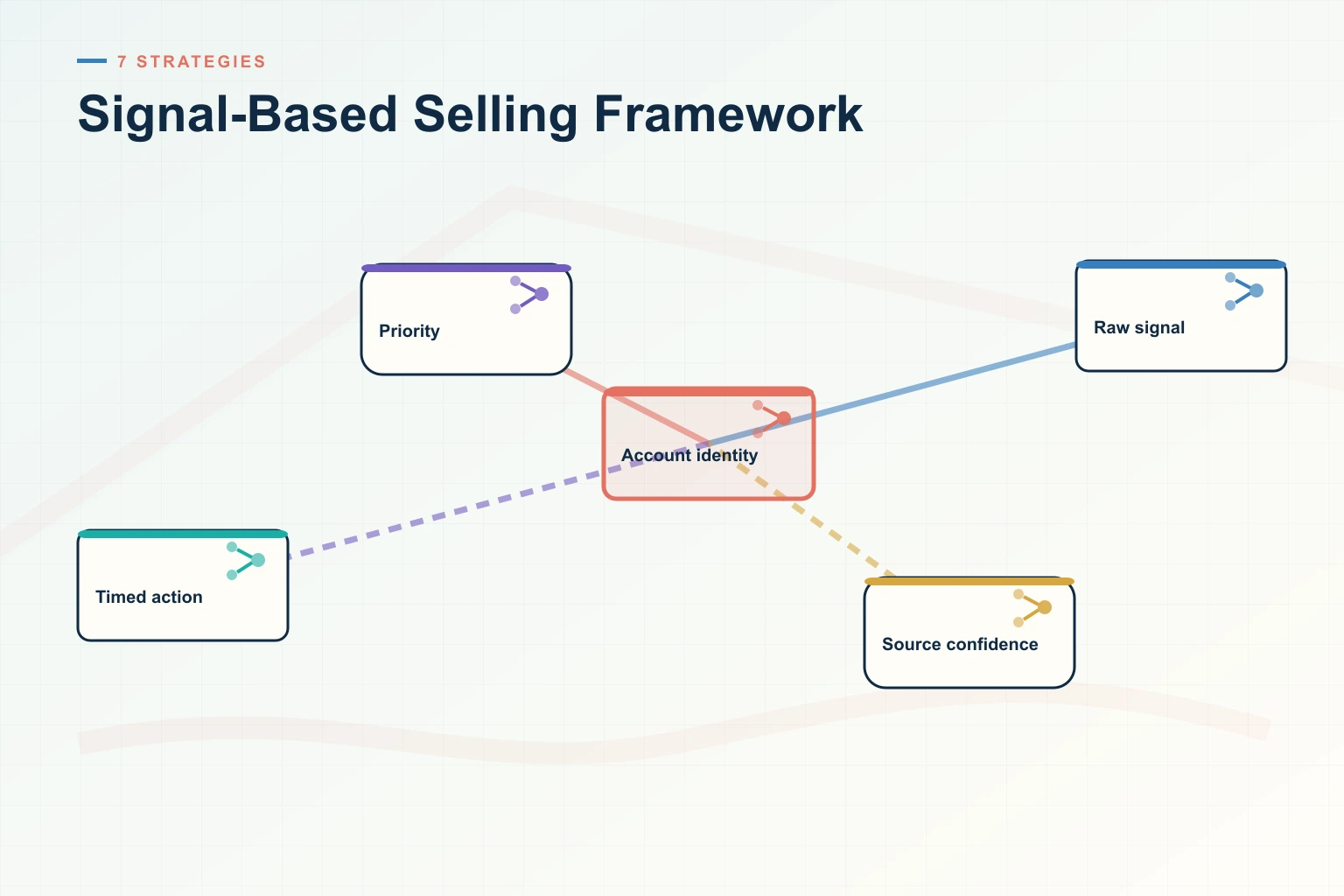
Signal-based selling is a B2B sales approach in which reps decide which accounts to contact, when and with what message from observable buying signals, such as repeated pricing-page visits, a new executive hire or a buyer forwarding a proposal, instead of working a static list in order. The framework has five steps: choose, score, route, act and learn.
Timing and relevance now decide whether outreach is welcome. In a Gartner survey of 632 B2B buyers, 73% said they actively avoid suppliers who send irrelevant outreach (Gartner, 25 June 2025). Below: the signal types worth tracking, a scoring model you can copy, a play for each signal, the in-deal signals most teams ignore, common mistakes and the metrics that show whether it works.
Last updated: 17 October 2026
The research cited dates from 2021 to 2026; vendor documentation was checked in October 2026.
What is signal-based selling?
Signal-based selling replaces “who is next on the list?” with “who has just done something that gives us a reason to talk?” A signal is any observable change in an account or a person suggesting that their readiness, intent or interest has moved. The rep’s job is to notice it quickly, judge how strong it is, and respond with something relevant to the problem it implies.
Good account executives have always watched for a new leader, a funding round or a champion who went quiet. What changed is volume: visitor identification, third-party intent data, job-change alerts and buyer engagement analytics now produce more signals than a rep can read. The work is choosing which ones matter and wiring each to an owner and a play.
Signals, trigger events and intent data: what is the difference?
The terms overlap and are often used interchangeably. This guide uses them as follows.
Term
What it means
Example
Buying signal
Any observable behaviour or change suggesting an account is closer to a purchase. The umbrella term.
Three people from one account read your pricing page this week
Trigger event
A change inside the account that creates a reason to buy or re-evaluate, whether or not they have engaged with you
New CRO hired, acquisition announced, funding round closed
Intent data
Research behaviour collected at scale, usually on third-party publisher or review sites, aggregated to the account
An account’s research on “sales enablement” rises well above its normal level
In-deal signal
Buyer engagement after the first conversation, with the materials of an open deal
The champion forwards your proposal to the CFO
Working definitions used in this guide.
For first-party and third-party intent sources, providers and accuracy in depth, see the intent data guide for B2B sales.
Is signal-based selling the end of cold outreach?
Not entirely, but it changes what cold outreach is for. Three pieces of evidence explain the shift:
- Few accounts are buying at any moment. Peter Weinberg and Jon Lombardo of LinkedIn’s B2B Institute describe a “95:5 rule”: only about 5% of B2B buyers are in market at a given time, based on research by Professor John Dawes of the Ehrenberg-Bass Institute (Marketing Week, 2 September 2021). Signals help you find that 5% sooner.
- Buyers shortlist before they talk to you. In 6sense’s 2025 Buyer Experience Report, a survey of more than 4,000 buyers, 94% of buying groups had ranked preferred vendors before first contact (6sense, 12 November 2025). Reaching an account while it is still researching matters more than reaching it often.
- Volume email has a hard ceiling. Since 1 February 2024, Google has required anyone sending more than 5,000 messages a day to Gmail accounts to authenticate with SPF, DKIM and DMARC, offer one-click unsubscribe on marketing messages and keep the spam rate in Postmaster Tools below 0.30% (Google, Email sender guidelines, accessed 16 October 2026). Untargeted volume raises complaints and puts the whole team’s inbox placement at risk.
Gartner’s Robert Blaisdell put the cost plainly: “Bad prospecting actively damages relationships with potential customers” (Gartner, 25 June 2025). Outbound to accounts with no signal still has a job, building awareness among the 95% who are not buying yet, but it should be lighter, more educational and measured separately.
List-based cold outreach
Signal-based selling
Who gets contacted
Everyone on a list that fits the ideal customer profile
ICP accounts showing a signal, ranked by strength
When
When the sequence says so
Within a set window after the signal
Message
Generic value proposition, light personalisation
The problem the signal suggests, with a relevant asset
People reached
One persona per account
Several people, matched to who showed the signal
Rep measures
Calls, emails, sequences enrolled
Response time, meetings and pipeline per signal
Main risk
Spam complaints and buyer fatigue
Signal overload and outreach that feels like surveillance
How the two motions differ in practice.
What are buying signals? Types and examples
Most useful signals fall into six families. The first four tell you who to start a conversation with; the last two tell you how an open deal is going.
Signal family
Examples
Typical source
Level
First-party engagement
Repeat pricing-page visits, security or integration page views, webinar attendance, trial activity
Your website, marketing automation, product analytics
Account, and person once known
Third-party research intent
Topic research surges; review-site profile, pricing, category, compare and alternatives page views
Intent data providers, review sites
Account
Trigger events
New executive, funding round, acquisition, hiring push in a relevant team, technology added or removed
News, job postings, data providers, CRM enrichment
Account
Relationship signals
A past champion or user joins a new company, a new connection to a buyer, a referral
CRM history, LinkedIn
Person
In-deal engagement
New stakeholders viewing shared materials, a proposal forwarded, buyer-owned plan milestones completed
Digital sales rooms, email and call data
Person
Risk signals
Buyer silence, a single active contact, the champion leaves, plan dates slipping
Deal rooms, CRM, conversation intelligence
Person and deal
Six families of buying signals.
Trigger events matter because purchases start with change: Gartner research notes that nearly all B2B purchases take place amid organisational change (Gartner, Help B2B Buyers Navigate Change Management for Complex Purchases, 9 January 2024). Relationship signals matter because people move: workers in management, professional and related occupations had a median tenure with their current employer of 4.9 years in January 2026 (US Bureau of Labor Statistics, Employee Tenure in 2026, 24 September 2026), so the contacts in a multi-year CRM keep turning over. Our guide to job change signals covers that family in detail.
The signal hierarchy: high, medium and low conviction
- High conviction: repeat pricing-page visits from more than one person, comparison or alternatives pages naming you and a competitor, a security questionnaire request, a buyer returning to a proposal, a former champion arriving at an ICP account.
- Medium conviction: several blog posts or case studies read in a week, webinar attendance, a category-level research surge, a relevant leadership hire.
- Low conviction: a single site visit, following your company page, one top-of-funnel download.
There is some evidence for this ordering. Dreamdata analysed G2 Buyer Intent data from its own customers and found an average of 63 days from a G2 compare-page session to closed-won, against 147 days for product-profile sessions and 174 days for category-page sessions (Dreamdata benchmark, dated 28 October with no year shown; vendor data). The same analysis is a reality check: only 12% of closed-won deals had a G2 signal before close. Third-party intent will touch a minority of your deals, so first-party and in-deal signals have to carry the rest.
Note also the level of each signal. Most third-party intent tells you which company is researching, not who: G2’s Buyer Intent data is company-level, with the visitor’s region and country but no role (G2 documentation, updated 2 September 2026). An account-level signal tells you to research the buying group, not which person to email.
The signal-based selling framework in five steps
The framework turns signals into a routine: choose the few that predict revenue for you, score them, route them to an owner with a response window, act with a defined play, and learn from what converts.
1. Choose signals from your own won deals
Start with evidence, not a vendor’s list. Pull 6 to 12 months of closed deals and note, for each, what happened in the 90 days before the opportunity was created and in the month before it closed: website activity, events attended, people who joined, trigger events at the account, materials the buyer opened. Signals that appear often in won deals and rarely elsewhere are your shortlist. Begin with three to five; more than that and nobody remembers the plays.
2. Score signals by fit, strength, recency and breadth
A simple points model is enough to start. The weights below are illustrative starting points to tune against your own conversion data, not benchmarks.
Factor
Points (illustrative)
Fit: tier A / B / C account
20 / 10 / 0
Strongest signal: high / medium / low conviction
30 / 15 / 5
Breadth: each additional person at the account showing a signal in the last 14 days
+10 (maximum +20)
Recency: halve the signal points after 14 days, drop them after 30
×0.5, then 0
Action threshold
50+ personal outreach; 25 to 49 targeted content; under 25 marketing nurture
A starting scoring model. Calibrate quarterly against which signals produced meetings and pipeline.
Worked example. A tier A account (20 points) has two people who viewed your pricing page this week (high conviction, 30; one additional person, +10). Total: 60, so it goes to the account owner for personal outreach. A tier B account (10) with a category research surge (medium, 15) scores 25: it gets a relevant guide from marketing and one insight-led email, with no meeting request. Had the tier A pricing views been 20 days old, the signal points would halve to 15 and the total fall to 45: still worth targeted content, no longer worth a call.
3. Route every signal to an owner with a response window
A signal nobody owns is decoration. For each signal type, decide who acts (SDR, account executive, customer success or marketing), where the alert appears (the CRM task queue or the team’s Slack or Teams channel, not a tool reps never open) and how fast they respond. A practical start: same or next business day for high-conviction signals, within a week for medium ones, no rep action for low ones. If two people could own a signal, write down who wins; duplicate outreach from one company looks disorganised.
4. Act with a play, not an alert
Each signal needs a short play: what it probably means, who to contact, what to send and what to avoid. The rules that make signal-led outreach welcome:
- Lead with the problem the signal suggests, never the signal itself. “I saw you were on our pricing page” tells the buyer they were watched; a note on how teams like theirs usually structure the decision gives them something useful.
- Send one relevant asset (pricing-model explainer, comparison, security pack, implementation outline) rather than a meeting request on first touch.
- Contact more than one person when the signal is account-level, matched to the roles likely to be involved.
- Rehearse openers for the top signals so reps sound like peers, not tracking software.
5. Learn: review weekly and retire signals that do not convert
Add ten minutes to the weekly pipeline meeting: which signals fired, how fast the team responded, what came of it, and which accounts went quiet. Each quarter, compare meetings and pipeline by signal type, adjust the weights, drop signals that create activity but no meetings, and add ones your win-loss reviews keep surfacing. Coaching reps against the signals they missed on live deals beats a generic call review.
Signal plays: what to do when each signal fires
Use this as a template for your own play library. Response windows are suggested starting points, not research findings.
Signal
What it may mean
Play
Window
Two or more people from one ICP account view pricing in a week
An evaluation with a budget conversation under way
Account owner emails the known contact with a pricing-model explainer and offers a short scoping call; SDR reaches one other likely stakeholder
Same or next business day
Review-site compare or alternatives page naming you and a competitor
A shortlist is forming
Send proof against that alternative (customer story, comparison page) to the likely evaluator; brief the AE from the battlecard
2 business days
Category research surge, no first-party activity
Early problem exploration
Marketing nurture plus one insight-led email about the problem; no meeting ask
Within a week
New sales, revenue or enablement leader hired
A new owner who may review processes and tools
A short point of view on the first decisions in that role, with a benchmark or template; ask for nothing yet
Within 2 weeks of the announcement
Funding round or acquisition announced
New targets, budget or integration work
Reference the stated plan (expansion, new market, integration), not the money raised
Within 2 weeks
Former champion joins an ICP account
A warm path into a new account
Personal note from the person who worked with them; offer help once they have settled in
Within a month
Buyer forwards the deal room or proposal to someone new
The champion is selling internally
Add an asset for the new viewer’s role (security pack for IT, business case for finance); ask the champion who else needs it
1 business day
Late-stage views concentrate on the proposal and implementation plan
Final checks on cost and rollout
Put the current proposal and a dated rollout plan at the top; prepare for procurement questions
Before the next call
No buyer view or reply for 20 days on an open deal
A stall, or a deal lost quietly
Re-engage the champion with something new (revised business case, rollout plan), check plan dates, reach a second contact
Immediately
A starter play library. Adapt the windows to your sales cycle.
Job change signals: champion moves and new executive hires
A job change signal fires when a person who matters to your pipeline changes role: a past champion joins a new company, a contact on an open deal leaves, or a target account hires an executive who owns the problem you solve. Each brings a relationship or a new decision owner, so job changes deserve their own plays.
They fire often. US employers made 5.2 million hires in August 2026 alone, a monthly hires rate of 3.3% (US Bureau of Labor Statistics, Job Openings and Labor Turnover Summary, 29 September 2026). A few years of won deals leave many champions at new employers.
Four job change signals and the first move for each
Signal
What it may mean
First move
Starting window
A former champion joins an ICP account
A warm path in, from someone who has seen you deliver
A personal note from the person who worked with them; no pitch
Congratulate early; offer help within the first month
Your champion leaves an open deal
Nobody is selling for you internally
Find who inherits the project; re-confirm process and dates with the economic buyer
The same week
A champion leaves a customer
Renewal risk, plus an opening at their next company
Customer success meets the successor; sales follows the champion
Successor within two weeks
A new sales, revenue or enablement leader is hired
A new owner who may review tools and vendors
A short point of view on the first decisions in that role
Within two weeks of the announcement
Suggested starting windows, consistent with the play library above, not research findings; test them on your own data.
When the champion leaves a customer, the renewal management guide covers rebuilding sponsorship before the renewal date.
How to detect job changes
- Your own systems first. Bounced emails, out-of-office replies naming a successor and contacts who stop joining meetings are the earliest warnings. Mark contacts “left company” rather than deleting them, so the history survives.
- Saved-lead alerts. LinkedIn says Sales Navigator alerts notify you “when the leads you’ve saved have important updates, like a job or role change” (LinkedIn, Sales Navigator Alerts, undated). They cover only people you save, so save the champions and sponsors from every won deal.
- Data providers. They re-check employment and update the CRM; spot-check a sample, because a wrong match turns a warm note into an awkward one.
- Executive announcements. Press releases, leadership pages and job postings; an advertised CRO opening often signals a change before the hire.
Review these changes in one weekly report, and give each line a named owner.
An outreach example (illustrative)
Subject: Congratulations on the new role Hi Priya, congratulations on joining Northwind as head of sales enablement. The onboarding rollout we worked on together was one of my favourite projects. No agenda: once you have settled in, I’m happy to share what we learned about getting new hires practising early, if that’s useful. Good luck with the first few months.
For a new executive you have never met, lead with their job: two lines and a useful checklist, no meeting request. Never mention how you found out beyond the public announcement, or reuse anything confidential from a previous employer.
Data-privacy limits
- It is personal data. The UK regulator says data protection law applies when an email address identifies a person, even in a business capacity (ICO, Business-to-business marketing, updated 22 May 2025), so you need a lawful basis; for business contacts that is often legitimate interests, which requires a documented three-part test.
- Say where the data came from. If a third party told you about the move, the same ICO guidance says privacy information is due no later than one month after you obtain the data, and the European Commission says people must be informed at the latest at the first communication (European Commission, undated). Put a privacy line in the first email.
- Objections follow the person. People can object to direct marketing at any time, and processing for that purpose must then stop (European Commission, undated). Suppress the person, not just the old address.
- Leave the old account’s data behind. Notes and phone numbers gathered for a previous customer belong to that relationship. Use public sources and a platform’s own alerts, not scraping.
In-deal signals: what buyer engagement tells you after the first meeting
Most signal-based selling advice stops at prospecting, yet the richest signals come from open deals, where you know who the people are and what you shared with them. They matter more as buying groups grow: Forrester’s 2026 buyer research says a typical buying decision includes 13 internal stakeholders and nine external influencers, and that procurement is a decision-maker in 53% of buying cycles (Forrester, 21 January 2026).
Revspire’s aggregated customer data, from about 40 B2B companies between October 2025 and September 2026, shows which in-deal signals tend to separate won and lost deals. These are observed patterns, not proof that any tool caused the result (Revspire digital sales room benchmark, 2026):
- Breadth: deal rooms engaged 15 unique buyer stakeholders, against 1 to 5 on deals run without a room. A room seen by one person many times is a champion with nobody to sell to.
- Forwarding: 80% of rooms gained a new viewer after the first share. When it happens, find out who the new person is and give them something written for their role.
- Late-stage focus: in the 14 days before a won deal closed, 80% of buyer views went to the proposal and implementation plan, a sign the buyer is checking cost and rollout.
- Silence: after 20 days without a buyer view, the win rate fell below half the overall rate, which makes 20 days a reasonable risk alert.
- Win rate: closed deals with an active room were won 35% of the time, against 28% without one. Teams may also put rooms on better-qualified deals, so treat this as an association.
Buyer-owned commitments are another strong signal. In Revspire’s mutual action plan benchmark (same period), buyers owned 20% of plan milestones and sellers the other 80%. A buyer completing their own milestone on time, such as scheduling the security review, says more than any page view.
Route risk signals the same way as positive ones: a single active contact, a champion who changes role or stops replying, plan dates that slip twice. The guide to AI deal coaching and deal risk signals covers how managers can inspect these consistently. Revspire Digital Sales Rooms combine buyer engagement analytics, stakeholder mapping and mutual action plans with owners and due dates, so in-deal signals sit next to the deal they describe.
Buying signal mistakes that cost deals
Most failures are not missing data. They are signals misread, ignored or acted on badly.
1. Treating every signal as hot
Alerting reps on every visit trains them to ignore alerts. Fix: apply the hierarchy and a score threshold, and cap high-priority alerts per rep per day.
2. Telling buyers you watched them
“I noticed you visited our website” makes the tracking the subject of the email, and it can raise privacy questions. Under the GDPR, IP addresses and cookie identifiers are online identifiers that can be used to profile and identify people (GDPR Recital 30), and HubSpot notes that its IP-based buyer intent feature may require a cookie consent banner (HubSpot Knowledge Base, updated 1 September 2026). Fix: refer to the problem, not the behaviour, and have legal review how visitor data is collected and used.
3. Signals with no owner or deadline
Signals routed to a shared dashboard decay while everyone assumes someone else acted. Fix: one named owner and one response window per signal type, visible in the CRM.
4. Reading an account signal as a person’s intent
A company-level surge does not mean the person you know is evaluating. Fix: use account signals to research and widen the buying group, and person-level signals for personal outreach.
5. Single-threaded signals
If every signal on a deal comes from one contact, you have a champion, not a buying group. Fix: track unique engaged stakeholders per opportunity, flag deals with only one, and practise multithreading before the champion goes quiet.
6. Measuring activity instead of response
If reps are judged on calls and emails sent, signals become one more list to blast. Fix: measure response time, meetings and pipeline per signal type, and coach on the quality of the first touch.
7. Never learning from losses or retiring signals
Teams add signals and never remove them, and rarely check which ones preceded lost deals. Fix: record in each win-loss review which signals appeared and when, and drop signals that predict nothing after a quarter.
How do you measure signal-based selling?
Track a small set of metrics weekly against your own baseline rather than an industry number.
Metric
How to calculate it
What it tells you
Signal coverage
New opportunities with at least one recorded signal before creation ÷ all new opportunities
Whether your signals see the deals you actually win
Response time
Median hours from a high-conviction signal to the first relevant touch
Whether routing and ownership work
Signal-to-meeting rate
Meetings booked ÷ signals actioned, by signal type
Which signals deserve rep time
Pipeline and win rate by signal
Pipeline created and win rate for signal-sourced vs other opportunities
Whether signals find better deals, not only more meetings
False-positive rate
High-conviction alerts with no reply or meeting in 30 days ÷ all high-conviction alerts
When to re-weight or retire a signal
Stakeholder breadth
Unique buyer contacts engaged per open opportunity
Single-threading risk
Days since last buyer engagement
Days since any buyer view, reply or meeting on an open deal
Stalls, before the forecast shows them
Core signal-based selling metrics.
Signal-based selling tools: what each source can and cannot see
Disclosure: Revspire publishes this guide and sells digital sales rooms, one of the categories below. Vendors are examples, listed alphabetically within each category and not ranked; third-party limitations come from each vendor’s own documentation.
Category
What it sees
Examples
Limitation to plan for
First-party visitor intent
Which companies visit which pages on your site
HubSpot buyer intent
Connects anonymous visitors to companies through IP addresses, and its timeframe filter covers only the last 90 days (HubSpot)
Third-party research intent
Topic research and review-site activity beyond your own site
Bombora; G2 Buyer Intent
Account-level: G2 gives the company plus visitor region and country, no role (G2); Bombora measures research by people from an organisation against their normal activity across a co-op of 5,000+ sites, resolved to businesses, not individuals (Bombora, undated)
Relationship and trigger alerts
Job changes, decision-makers joining or leaving, hiring trends
LinkedIn Sales Navigator
Alerts cover the leads and accounts you add and track, not your whole market (LinkedIn)
In-deal engagement
Who viewed, forwarded and acted on materials shared in a deal
Digital sales rooms, including Revspire
Sees buyers only after a room is shared, so it says nothing about accounts you have not engaged
Signal sources by category. Route all of them into the CRM, where reps act.
Where to start depends on the gap. If you struggle to find accounts before they contact you, begin with first-party visitor intent and one third-party source; a deal room adds nothing until a conversation is under way. If deals stall after the first meeting or die in procurement, in-deal signals will do more than another top-of-funnel intent feed.
A 30-day plan to roll out signal-based selling
- Week 1, audit: review 6 to 12 months of won and lost deals for the signals that preceded them, and list where each signal you can already capture lives today.
- Week 2, design: pick three to five signals, set the scoring weights and thresholds, and give each an owner and a response window.
- Week 3, pilot: write one play per signal, rehearse the openers, and run it with one team while the rest continue as before.
- Week 4, review: compare response time, meetings and false positives with the rest of the team, and adjust weights before expanding.
- Day 90: check signal-sourced pipeline and early win rates, retire weak signals, and add in-deal and risk signals to pipeline reviews.
Before you expand, check that every signal has an owner, a window and a play; alerts arrive where reps already work; no first touch mentions tracking; managers review signal response weekly; and someone owns the scoring model.
To see which members of a buying group are engaging and which are missing, start with the free stakeholder map template.
Frequently asked questions
What is the difference between intent data and buying signals?
Intent data is one source of buying signals: research behaviour collected across third-party sites and aggregated to the account. Buying signals also include first-party website activity, trigger events such as a new executive, relationship changes such as a champion switching jobs, and engagement inside open deals. Intent data tells you a company is researching; the other signals tell you who and why.
What are examples of buying signals in B2B sales?
Strong examples include several people from one account viewing your pricing page, a review-site comparison of you and a competitor, a security questionnaire request, a former champion joining an ideal-fit account, and a buyer forwarding your proposal to finance. A single blog visit or a social follow is a weak signal that justifies marketing nurture, not a sales call.
How many signals should trigger outreach?
One high-conviction signal at a good-fit account is usually enough for personal outreach; medium and low signals should add up before a rep acts. A scoring threshold, such as the illustrative model above, keeps this consistent across reps. Recalibrate it each quarter against the signals that produced meetings.
How do you follow up on a buying signal without being creepy?
Respond to the problem the signal suggests, not the behaviour you observed. Instead of mentioning a website visit, send something useful for the decision the buyer appears to be making, such as a pricing-model explainer or an implementation outline. Keep the first touch short, and ask for a meeting only when the signal is strong.
Can a small sales team use signal-based selling?
Yes, and small teams often gain most because they have the least time for cold lists. Start with sources you already have: website analytics, CRM history of past champions, job-change alerts and engagement on proposals already sent. Add paid intent data once you know which signals convert for you.
How do you track when a champion changes jobs?
Save the champions, users and sponsors from every won deal in a tool that alerts on job changes, such as LinkedIn Sales Navigator, and watch your own signals: bounced emails, out-of-office replies and contacts who stop joining meetings. Review new moves weekly and give each one to the person who knew the contact. Reach them through work channels and include a privacy line in the first message.
Sources
- Gartner Sales Survey Finds 61% of B2B Buyers Prefer a Rep-Free Buying Experience, Gartner, 25 June 2025. Accessed 16 October 2026.
- The Timeline for Influencing B2B Buyers Is Shrinking: Insights From 6sense’s 2025 Buyer Experience Report, 6sense, 12 November 2025. Accessed 16 October 2026.
- The 95:5 rule is the new 60:40 rule, Peter Weinberg and Jon Lombardo, Marketing Week, 2 September 2021. Accessed 16 October 2026.
- Email sender guidelines, Google, undated (requirements effective 1 February 2024). Accessed 16 October 2026.
- Help B2B Buyers Navigate Change Management for Complex Purchases (research summary), Gartner, 9 January 2024. Accessed 17 October 2026.
- Employee Tenure in 2026, US Bureau of Labor Statistics, 24 September 2026. Accessed 16 October 2026.
- Dreamdata Benchmarks: Measuring G2 Intent Data impact on B2B buying journeys, Dreamdata, dated 28 October (year not shown). Accessed 16 October 2026.
- Buyer Intent data reference, G2, 23 October 2025, updated 2 September 2026. Accessed 16 October 2026.
- Bombora data, Bombora, undated. Accessed 16 October 2026.
- Forrester’s 2026 Buyer Insights: GenAI Is Upending B2B Buying, Forrester, 21 January 2026. Accessed 16 October 2026.
- How to use buyer intent, HubSpot Knowledge Base, updated 1 September 2026. Accessed 16 October 2026.
- Recital 30: Online identifiers for profiling and identification, General Data Protection Regulation (EU) 2016/679, 2016. Accessed 16 October 2026.
- How to use LinkedIn Sales Navigator, LinkedIn, undated. Accessed 16 October 2026.
- Digital Sales Room Benchmark: Win Rate Data 2026, Revspire (aggregated customer data, October 2025 to September 2026), 16 October 2026. Accessed 16 October 2026.
- Mutual Action Plan Benchmark: Cycle & Win Rates, Revspire (aggregated customer data, October 2025 to September 2026), 16 October 2026. Accessed 16 October 2026.
- Job Openings and Labor Turnover Summary (August 2026 data), US Bureau of Labor Statistics, 29 September 2026. Accessed 17 October 2026.
- Sales Navigator Alerts, LinkedIn, undated. Accessed 17 October 2026.
- Business-to-business marketing, Information Commissioner’s Office, updated 22 May 2025 (under review after the Data (Use and Access) Act). Accessed 17 October 2026.
- Can data received from a third party be used for marketing?, European Commission, undated. Accessed 17 October 2026.
- What happens if someone objects to my company processing their personal data?, European Commission, undated. Accessed 17 October 2026.