Conversation Intelligence: How It Works, Uses and Call Review Coaching
A practical perspective for connecting this idea to your revenue team’s next move.
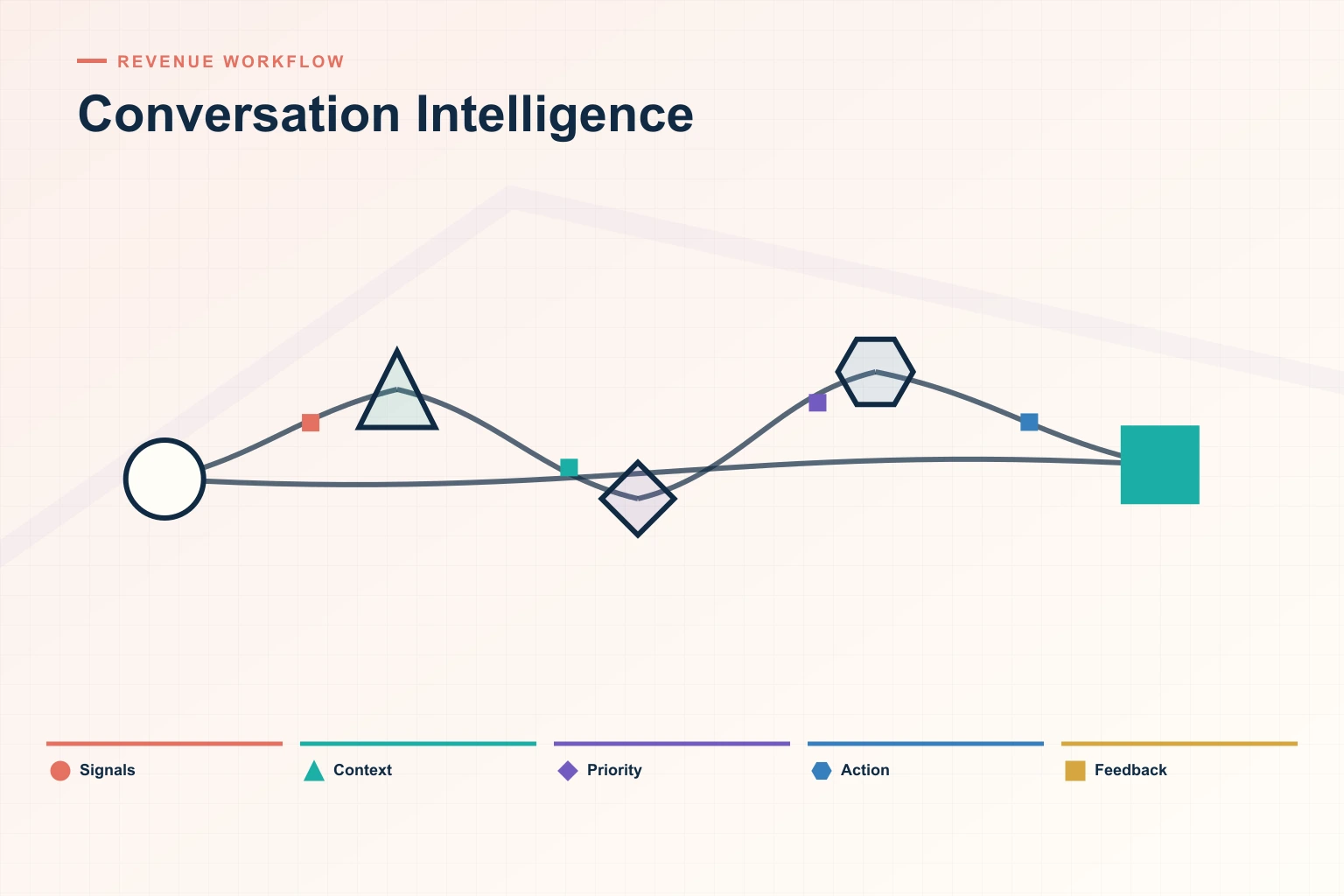
Conversation intelligence (CI) is software that records, transcribes and analyses sales calls and meetings, then turns them into searchable data such as topics, questions, objections, next steps and talk patterns. Revenue teams use conversation intelligence to coach reps from real calls, inspect deal risk, capture buyer feedback and update playbooks, provided calls are recorded with proper consent.
This guide explains how conversation intelligence works, the main use cases, what to check before you buy, the recording consent rules to know, and how to run call review coaching: what to review, a scoring rubric, how often, and how to turn findings into practice.
Last updated: 17 October 2026
What is conversation intelligence?
G2, which lists conversation intelligence as its own software category, defines it as software that records, transcribes and analyses sales conversations. To be listed, a product must automatically capture and transcribe sales calls into searchable data, analyse the interactions to surface topics, intent or patterns, generate summaries and next steps, and report call-level metrics (G2, Conversation Intelligence Software category). That is a useful minimum bar when you compare tools.
Conversation intelligence is often confused with neighbouring categories:
Category
What it does
Main question it answers
Call recording
Stores audio or video of calls
What was said on this call?
Conversation intelligence
Transcribes and analyses calls and meetings across the team
What happens in our conversations, and what should change?
Revenue intelligence
Combines conversation, email, CRM and activity data to assess deals and forecasts
Which deals will close, and which are at risk?
Conversational AI
Chatbots and voice agents that talk to buyers directly
Can software handle this conversation for us?
Many platforms span more than one row. Our guides to revenue intelligence and conversational AI for sales cover those categories.
How does conversation intelligence work?
Most conversation intelligence tools follow the same five steps, from capturing a call to putting insight in front of a manager or rep.
- Capture. A recorder joins scheduled video meetings through a calendar connection, and an integration with the phone system or dialer records calls. Some tools also capture email.
- Transcribe. Speech is converted to text and split by speaker, so the tool knows what the rep said and what the buyer said.
- Analyse. The tool detects topics and keywords you define (competitors, pricing, security), questions asked, talk and listen time, objections and next steps.
- Summarise and sync. It writes a call summary and action items, and pushes notes and activity to the CRM record.
- Surface. Managers and reps search calls, receive alerts, score calls against scorecards and save examples into libraries for onboarding and coaching.
The analysis is only as useful as what you ask it to track. Before rollout, agree the trackers that map to your sales process: the competitors you meet, the objections in your playbook, the stage-exit criteria you coach to.
What is conversation intelligence used for?
Use case
Main users
What to look for in calls
Typical output
Rep coaching
Frontline managers
Discovery depth, listening, objection handling, next steps
Scored call reviews and practice assignments
Deal inspection
Sales leaders, RevOps
Economic buyer present, timeline and budget discussed, competitors named
Risk flags before forecast calls
Onboarding
Enablement
Strong examples of each call type and stage
A call library new reps study before shadowing
Competitive and market insight
Product marketing
Competitor mentions, objections, feature requests
Updated battlecards and messaging
Win/loss analysis
Sales and product leadership
What was said in the calls of won and lost deals
Loss patterns tied to evidence
Renewal risk
Customer success
Unresolved issues, sponsor changes, budget concerns
Early renewal risk alerts
How to choose conversation intelligence software
Test any conversation intelligence tool on your own recorded calls before you sign, and judge it on these criteria:
Criterion
What to ask the vendor
Capture coverage
Which video platforms, dialers and email systems does it record? Which languages does it transcribe?
Transcription quality
How accurate is it on our accents, product names and jargon? Run a pilot on 20 to 30 of your calls.
CRM write-back
What does it write to our CRM, to which objects, and can we control it?
Coaching workflow
Does it support custom scorecards, timestamped comments, call libraries and coaching assignments?
Consent controls
Can recording announcements, opt-outs and recording rules vary by country or state? Can a participant stop the recording?
Retention and access
How long are recordings kept, can we auto-delete, and who can see which calls?
Security and AI use
Do you support SSO and data residency? Can we see your security reports? Is our data used to train your models, and can we opt out?
Pricing model
Is it per user, per recorder seat, a platform fee, or an add-on to another product? What are the minimums?
Connection to practice
How do call findings turn into training or practice for the rep?
Conversation intelligence vendors to know
Revspire publishes this guide. Revspire Conversation Intelligence is coming soon, so it is not described or compared here. The vendors below are listed alphabetically; each description and pricing note comes from the vendor’s own page, checked on 17 October 2026.
Vendor
What it is
Pricing (vendor page, 17 Oct 2026)
Consider it when
Avoma
Meeting assistant with a Conversation Intelligence add-on for call scoring, AI coaching and talk-pattern skills
Published: the CI add-on is $29 per seat per month billed annually ($35 monthly), on top of a base plan; 14-day trial (Avoma pricing)
You want published prices and can buy CI as an add-on
Chorus by ZoomInfo
Conversation intelligence platform that ZoomInfo agreed to buy for about $575 million in July 2021 (ZoomInfo, 13 July 2021)
Not checked
You already use ZoomInfo and want CI from the same vendor
Gong
Revenue AI platform, which Gong calls the Gong Revenue AI OS; its product navigation lists Gong Engage, Gong Forecast, Gong Enable, Gong Revenue Graph and Gong AI (Gong platform)
Quote-based: per-user licences plus a platform fee based on the number of users; no prices published (Gong pricing)
You want conversation data feeding forecasting and engagement from one vendor
Mindtickle Call AI
Conversation intelligence within Mindtickle’s revenue enablement platform, linking call insights to coaching and readiness (Mindtickle)
No prices on the page; demo request
You want call insights tied to training and readiness programmes
Salesloft Conversation Intelligence
Records and transcribes calls inside the Salesloft platform, turns coachable moments into rep tasks and flags at-risk deals (Salesloft)
No prices on the page
Your reps already run cadences in Salesloft
Is it legal to record sales calls? Consent and recording laws
Usually, if you get the right consent, but the rules depend on where every participant is. This is general information, not legal advice; check with counsel for the jurisdictions you sell into.
- US federal law (one-party consent): the Wiretap Act says it is not unlawful for a person to intercept a communication where they are a party to it, or where one party has given prior consent, unless the purpose is a criminal or tortious act (18 U.S.C. section 2511(2)(d), US Code 2021 edition, govinfo).
- All-party consent states: some states go further. California Penal Code section 632 applies to anyone who records a confidential communication intentionally and without the consent of all parties, punishable by a fine of up to $2,500 per violation, imprisonment, or both, and a fine of up to $10,000 per violation for a person with a prior conviction (California Legislature, AB 1671 as enrolled, September 2016; the 2025 code text is unchanged). A communication counts as confidential when a party could reasonably expect it to stay among the participants; the section excludes situations where parties may reasonably expect to be overheard or recorded. When participants are in different states, many teams apply the strictest rule to every call.
- UK employees: recording your own reps’ calls is workplace monitoring. The ICO says employers must tell workers about monitoring, its nature, extent and reasons, have a clearly defined purpose, use the least intrusive means to achieve it, and carry out a data protection impact assessment where monitoring is likely to be high risk (ICO, 3 October 2023).
A practical consent checklist
- Announce the recording at the start of every call and in the calendar invite.
- Name the recorder visibly, for example “[Company] Notetaker”, so participants know it is there.
- Stop or delete the recording if any participant declines, and make that easy for reps.
- Set recording rules by region in the tool rather than relying on each rep.
- Set a retention period and restrict who can access which calls.
- Use recordings only for the purposes you have told people about, such as coaching and deal review.
How do you roll out conversation intelligence without losing rep trust?
Present conversation intelligence as a coaching tool, not surveillance, and prove it in the first month. Reps have reason to be wary: in a Survation poll of 1,012 UK adults (1 to 3 August 2023) published by the ICO with its monitoring guidance, 78% said an employer recording audio and video would be intrusive (ICO, 3 October 2023).
- Explain what will be recorded, who can listen, and what it will and will not be used for.
- Start with a library of good calls, so the first thing reps see is peers being recognised.
- Let reps nominate their own calls for review.
- Keep call reviews developmental. If managers use clips to catch people out, reps will move conversations to unrecorded channels.
How to run call review coaching
Call review coaching means a manager and a rep review a recorded call against an agreed rubric, choose one or two behaviours to improve, and practise them before the next live call. Recordings make it possible; the coaching routine is what changes behaviour.
What calls should you review?
Choose calls on purpose rather than at random:
- Where the rep’s conversion drops: if a rep’s deals stall after discovery, review their discovery calls.
- Lost and stalled deals: the last two calls before a deal went quiet.
- New reps’ first calls: each call type once during ramp.
- Calls your trackers flag: a competitor or pricing objection, or a call with no agreed next step.
- Strong calls: wins and good recoveries, for the team library and so reviews are not only about mistakes.
A call review scoring rubric
Score each criterion from 1 to 5 and write one sentence of evidence with a timestamp. Calibrate across managers by scoring the same call separately and comparing; our coaching calibration rubric explains how.
Criterion
1: needs work
3: solid
5: excellent
Preparation and agenda
No agenda; rep learns basics on the call
Agenda stated; account researched
Agenda agreed with the buyer; call builds on prior research and the last call
Discovery
Few questions, mostly closed
Open questions about problem and impact
Follows up on answers to quantify impact and uncover who decides and how
Listening
Interrupts; long monologues
Lets the buyer finish; some summarising
Summarises the buyer’s words back and adjusts the call to what they said
Value
Feature tour
Links features to the buyer’s stated problem
Ties the solution to the buyer’s own metrics and priorities
Objection handling
Argues or skips the objection
Acknowledges and answers
Clarifies the real concern, answers with evidence and checks it is resolved
Stakeholders
Single contact only
Asks who else is involved
Maps the decision group and agrees how to involve them
Next step
“I’ll follow up”
Next meeting suggested
Specific, dated next step with owners, agreed by the buyer before the call ends
How often should managers review calls?
A workable starting cadence is two to three reviewed calls per rep per month for tenured reps, and one a week for new reps during ramp, plus a fortnightly team session on a single call. What matters most is speed and repetition. In Revspire’s sales practice and coaching benchmark (aggregated Revspire customer data, 12 months), AI role-play scores rose 0.7 points on a 1 to 5 scale when a manager gave feedback within 7 days, against 0.2 points with no feedback, and scores fell 0.2, 0.4 and 0.6 points after 30, 60 and 90 days without practice. These are observed patterns in practice sessions, not proof of cause or a measure of live calls, but they support giving feedback within a week and practising at least monthly. See also our definition of a sales coaching cadence.
A 30-minute call review agenda
- Rep self-review (5 minutes): what went well, and where would they replay the call?
- Listen to two moments (10 minutes): skip to the timestamps that matter, not the whole recording.
- Score and choose one behaviour (10 minutes): use the rubric, agree one behaviour to change, and write it down.
- Set practice and a check (5 minutes): what the rep will rehearse, by when, and which upcoming call will show the change.
How do you turn call review findings into practice?
- Turn the moment into a scenario. Use the buyer’s actual words from the call, such as the exact pricing pushback, as the practice prompt.
- Rehearse until it meets the bar. The rep practises with the manager, a peer or an AI role-play, and is scored against the same rubric criterion.
- Check it on live calls. Set a tracker or review the rep’s next relevant call to see whether the behaviour changed.
- Fix the system when the pattern is team-wide. If many reps miss the same objection, update the playbook, battlecard or talk track rather than coaching each rep one by one.
To judge whether call coaching is working, watch leading indicators first: more buyer stakeholders engaged per deal, mutual action plan steps completed on time, and buyers opening the content reps send after calls. Lagging indicators, such as stage conversion, win rate and sales cycle length, confirm the change but usually take a quarter or more to move.
Revspire’s AI Sales Training & Coaching supports this practice step with AI role-play of buyer conversations, deal-specific objection practice and instant scoring for clarity, confidence and objection handling.
Frequently asked questions
What is conversation intelligence in sales?
Conversation intelligence in sales is software that records, transcribes and analyses sales calls and meetings. It shows what reps and buyers say across the team, so managers can coach from real calls, leaders can inspect deals and marketing can track objections and competitors.
What is the difference between conversation intelligence and revenue intelligence?
Conversation intelligence analyses the calls and meetings themselves. Revenue intelligence combines that conversation data with email, CRM and activity data to judge deal health and the forecast. Many vendors sell both, but you can use conversation intelligence for coaching alone.
Is it legal to record sales calls?
Generally yes, with the right consent. US federal law allows recording when one party consents, but states such as California require the consent of all parties to a confidential communication, and recording your own staff in the UK must follow the ICO’s monitoring guidance. Announce every recording and follow the strictest rule that applies to the participants.
How many sales calls should a manager review each month?
Two to three per rep per month is a practical starting point for tenured reps, and about one a week for new reps. Reviewing fewer calls well, with feedback inside a week and a practice task, is worth more than skimming many.
What should a call coaching scorecard include?
Include preparation, discovery, listening, value, objection handling, stakeholder coverage and next steps, each scored 1 to 5 with timestamped evidence. Keep the criteria aligned with your sales methodology so call reviews and training measure the same things.
Want to turn call review findings into scored practice? Book a Revspire demo to see AI role-play and coaching.
Sources
- Conversation Intelligence Software category definition, G2, undated (accessed 17 October 2026)
- 18 U.S.C. section 2511, Interception and disclosure of wire, oral, or electronic communications prohibited, US Government Publishing Office, US Code 2021 edition (accessed 17 October 2026)
- AB 1671, Confidential communications: disclosure (amending Penal Code section 632), California Legislature, enrolled September 2016 (accessed 17 October 2026)
- California Penal Code section 632 (2025 California Code), Justia, amended by Stats. 2016, ch. 855 (AB 1671), effective 1 January 2017 (accessed 17 October 2026)
- ICO publishes guidance to ensure lawful monitoring in the workplace, UK Information Commissioner’s Office, 3 October 2023 (accessed 17 October 2026)
- Avoma pricing, Avoma (accessed 17 October 2026)
- ZoomInfo to acquire conversation intelligence leader Chorus.ai, ZoomInfo, 13 July 2021 (accessed 17 October 2026)
- Gong platform and Gong pricing, Gong (accessed 17 October 2026)
- Mindtickle Call AI, Mindtickle (accessed 17 October 2026)
- Salesloft Conversation Intelligence, Salesloft (accessed 17 October 2026)
- Sales practice and coaching benchmark, Revspire, aggregated customer data (accessed 17 October 2026)