Value Realization and Value Selling: How to Prove ROI
A practical perspective for connecting this idea to your revenue team’s next move.
What is value realization?
Value realization is the post-sale work of confirming that a customer achieved the outcomes its business case relied on. The baseline agreed before signature is measured again with the same formula, the change is explained honestly, and the result decides whether to correct delivery, expand, renew or stop. The British spelling, value realisation, means the same thing.
It is the second half of one evidence system: value selling builds the case before commitment, and value realization tests it afterwards. Several related terms are used loosely as synonyms, but each answers a different question.
Term
Question it answers
When
Usually owned by
Value selling
Is there a credible, buyer-owned reason to change, and is this option worth the investment?
Before signature
Seller, with the buyer’s sponsor and finance
ROI selling
What return does the purchase produce for its cost?
Before signature, usually at proposal stage
Seller or value consultant, often with a calculator
Value realization
Did the agreed change happen, and did it produce the outcome in the business case?
After go-live, through renewal
Customer outcome owner, supported by the vendor’s delivery or customer success team
Benefits realization
Are the benefits that justified a program or project being delivered?
During and after the program
Senior responsible owner and named benefit owners in the organization running the program
Price realization
How much of list or target price does the seller actually invoice?
On every transaction
The seller’s pricing or finance team
ROI selling is a narrower form of value selling: it leads with the return calculation, and it breaks when the inputs are the vendor’s rather than the buyer’s. Benefits realization is the program-management version of the same discipline, seen from inside the buying organization. Guidance from Northern Ireland’s Department of Finance on programme and project benefits realisation (updated 3 October 2024) describes a benefits management strategy as setting out how a programme or project will manage “the delivery of the benefits on which the investment decision was made.” Value realization applies that idea to a commercial purchase, with the vendor supporting the measurement but not grading itself. Price realization is a pricing metric, not a customer outcome; the FAQ below explains the difference.
Value is a claim until the buyer owns the evidence
Value selling is often reduced to inserting a large number into a proposal. Value realization is often reduced to a quarterly slide after implementation. Both shortcuts fail for the same reason: they separate the number from the buyer’s baseline, operating change, accountable owner, and measurement method.
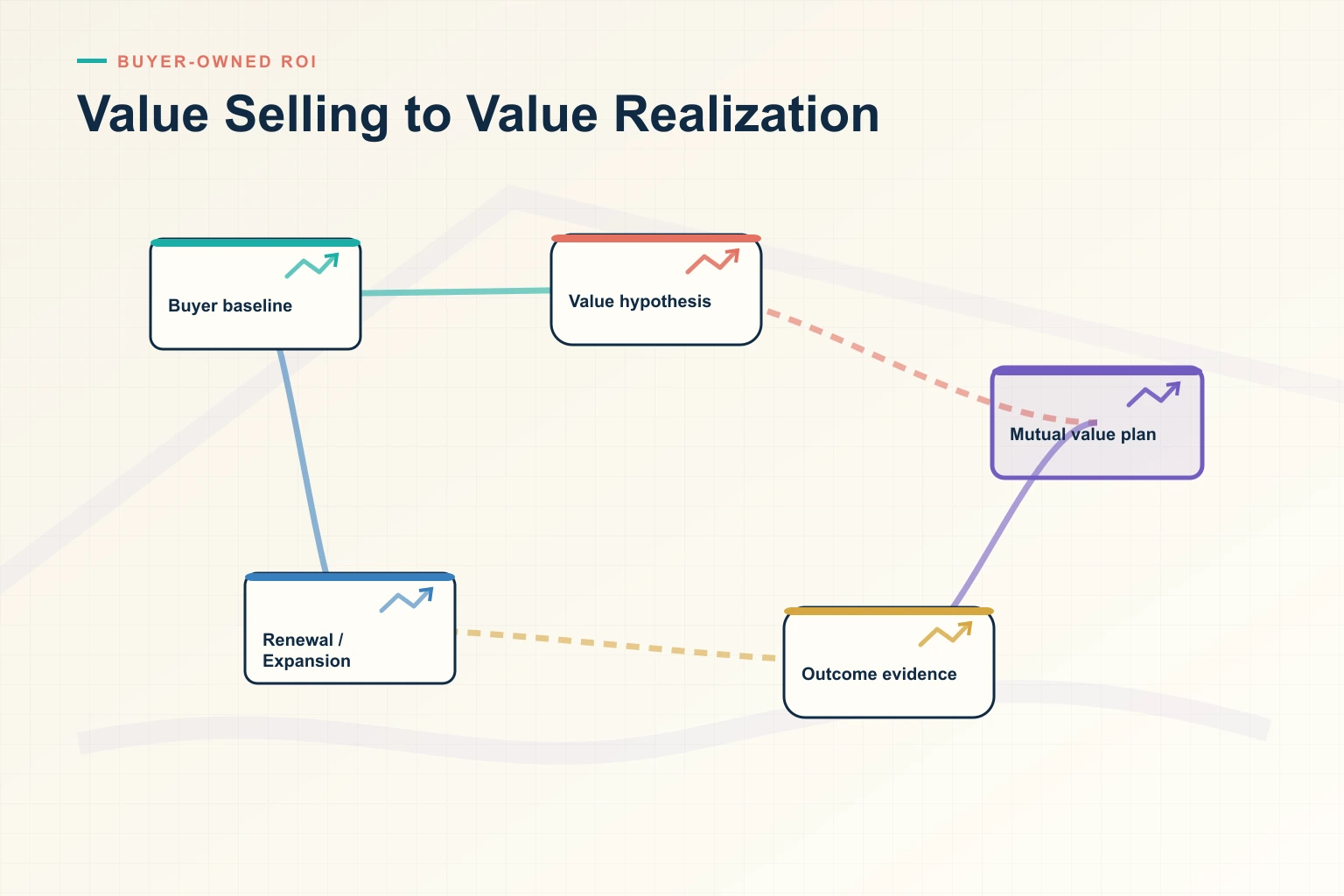
A visual summary of Value Selling and Value Realization: How to Prove ROI Before and After the Sale.
Before the sale, the seller can build a value hypothesis and help the buyer test it. The buyer decides whether the problem, inputs, assumptions, and decision criteria are credible. After the sale, the customer and provider can compare observed results with the agreed baseline and explain variance. The pre-sale case and post-sale review should be one evidence system, not two unrelated presentations.
Once the buyer has tested the value case, Revspire’s sales-closing techniques and AI practice guide explains how to choose a commitment appropriate to the remaining decision gap and rehearse that moment safely.
This article provides a practical framework, not a promise that any product will create a stated return. Financial treatment, tax, accounting, procurement, and investment decisions require the buyer’s qualified owners. Use ranges, preserve uncertainty, and distinguish measured results from estimates.
Separate value selling from value realization
Dimension
Value selling before commitment
Value realization after commitment
Primary question
Is there a credible reason to change, and which option merits investment?
Did the agreed change occur, what contributed, and what should happen next?
Evidence state
Baseline, buyer data, assumptions, benchmarks used cautiously, and scenarios
Observed measures, implementation records, adoption, costs, confounders, and variance
Owner
Buyer sponsor with finance, operations, procurement, and affected teams
Customer outcome owner with delivery, operations, finance, and executive sponsor
Seller role
Facilitate discovery, structure the model, document sources, and expose uncertainty
Support measurement, adoption, issue resolution, and evidence review without grading itself
Decision
Proceed, test, change scope, select another option, or do nothing
Correct delivery, improve adoption, revise assumptions, expand, renew, or stop
Common failure
Vendor-owned calculator built from generic assumptions
Declaring success from usage or anecdotes without the agreed outcome measure
The word prove needs care. Before implementation, a team cannot prove a future return; it can make the case testable. After implementation, it can measure agreed outcomes and assess contribution, but other changes may have influenced the result. Strong value work makes those limits visible.
Build a value chain that can be audited
Move from the buyer’s problem to financial or strategic value through explicit links. If one link is missing, keep the claim as a hypothesis.
Link
Question
Evidence
Failure to avoid
Business objective
Which outcome matters, to whom, and by when?
Buyer-owned goal, decision record, or operating plan
Replacing the buyer’s objective with the seller’s feature
Current baseline
What happens now, at what volume, cost, quality, and variation?
Defined period, system report, sample, process map, and owner
Using an industry average when buyer data exists
Constraint
What causes the gap, and which part is addressable?
Workflow evidence, interviews, error analysis, and dependencies
Assuming all observed loss is recoverable
Operational change
Which behavior, decision, or process will change?
Future-state design, adoption requirement, and accountable owner
Claiming value from installation rather than use
Value driver
How does that change affect time, volume, cost, risk, revenue, or experience?
Formula, units, data source, range, and attribution boundary
Counting the same benefit under several labels
Investment
What must the buyer spend and operate?
Price, implementation, integration, internal labor, change, support, and exit
Ignoring internal capacity and recurring administration
Timing and risk
When do costs and benefits occur, and what could prevent them?
Milestones, dependencies, scenario ranges, and risk owner
Presenting one precise forecast with no sensitivity test
Realization evidence
Who will measure what after launch?
Metric definition, baseline, system, cadence, reviewer, and decision rule
Waiting until renewal to decide how value should be measured
A simple chain might be: reduce manual proposal rework, measured as approved labor time per representative quote; achieve the change through governed templates and approval rules; translate released capacity only where the buyer has a credible plan for that time; subtract implementation, software, administration, and change costs. Do not turn every saved minute into revenue unless the operating link is demonstrated.
Use a value model with transparent arithmetic
Keep the model inspectable. Common components include:
- Incremental contribution: additional eligible volume multiplied by the change in conversion, contribution per outcome, and an attribution factor supported by the evaluation design.
- Cost avoided: expected future cost under the baseline minus expected cost under the proposed state, excluding costs merely shifted elsewhere.
- Capacity released: time reduced multiplied by fully loaded unit cost, labeled separately from cash savings unless headcount or external spend actually changes.
- Risk-adjusted loss avoided: change in event probability multiplied by credible impact, shown as a range and reviewed by the risk owner.
- Total investment: purchase, implementation, integration, internal labor, training, operation, assurance, change, and exit costs over the same horizon.
When appropriate to the buyer’s standards, a basic ROI expression is net benefit divided by total investment, where net benefit equals benefits minus costs. Payback is the point when cumulative benefits equal cumulative costs. These calculations are only as credible as their inputs, timing, and boundary. Show the undiscounted cash flow by period as well as any summary.
The UK government’s Green Book provides formal guidance for appraisal and evaluation in the public sector, including attention to costs, benefits, risk, uncertainty, and optimism bias. U.S. Office of Management and Budget Circular A-94 provides federal guidance on benefit-cost and cost-effectiveness analysis and discounting. A private purchase is not automatically governed by either document, but both reinforce useful disciplines: define the baseline and alternatives, use a consistent horizon, disclose assumptions, and test uncertainty.
Create three cases, not one forecast
Case
Purpose
Input rule
Decision use
Conservative
Test whether the investment remains acceptable under weak adoption or delayed benefits
Lower supported benefit, slower ramp, fuller cost, and visible dependencies
Set downside tolerance and risk response
Expected
Represent the buyer’s current best estimate
Most supportable inputs with named owners and sources
Plan resources and approval
Upside
Show potential if specific additional conditions occur
No benefit without a corresponding action, owner, and leading measure
Define expansion tests, not promise the outcome
Run sensitivity analysis on inputs that can change the decision: adoption, eligible volume, conversion, labor cost, implementation delay, ongoing administration, price, and benefit duration. Show which input drives the result. If a small unsupported change flips the decision, the next action is evidence gathering or a bounded pilot, not prettier formatting.
Make discovery produce a buyer-owned baseline
Value discovery should not feel like extracting numbers for a calculator. Ask how the buyer currently measures the job, where the data lives, what period is representative, which population is affected, what workarounds exist, and who trusts the measure.
- Define the unit. A seller, quote, opportunity, support case, launch, renewal, or another observable unit.
- Define the population. Segment, region, role, product, channel, and exclusions.
- Define the baseline period. Include seasonality, unusual events, and data-quality limits.
- Trace the process. Identify wait time, work time, rework, errors, handoffs, and approvals.
- Confirm consequence. Separate inconvenience from material cost, delay, risk, or lost opportunity.
- Name the owner. The buyer role that can validate the input and act on the result.
Mark every input as buyer-observed, buyer-estimated, vendor-supplied, external benchmark, or unknown. Do not silently replace an unknown with an industry statistic. If the buyer cannot establish a material baseline, the honest conclusion may be that a financial ROI case is premature.
Turn the business case into a mutual value plan
A spreadsheet is not an operating plan. Move the agreed hypothesis into a shared deal room and mutual action plan with owners, evidence, and dates. The plan should continue through procurement, implementation, adoption, outcome review, and renewal rather than stop at signature.
Milestone
Owner
Leading evidence
Outcome evidence
Decision
Baseline approved
Buyer process and finance owners
Definitions, source extracts, exclusions, and sign-off
Stable reference period
Proceed with model or collect more data
Solution validated
Buyer technical and business owners
Required workflow and controls pass agreed tests
Pilot quality and operating effort
Proceed, change scope, or stop
Implementation ready
Delivery owner
Integration, data, training, support, and change plan
Production acceptance
Launch or remediate
Adoption established
Operational leader
Eligible users performing target behavior correctly
Coverage, quality, exceptions, and sustained use
Coach, redesign, or expand
Outcome review
Customer value owner
Current measurements and confounders documented
Change versus baseline and scenario range
Correct, continue, expand, renew, or retire
Keep commercial configuration and approval in the authoritative CPQ workflow. The value model may inform packaging and tradeoffs, but it should not create an unauthorized price, discount, contractual promise, or accounting conclusion.
Design post-sale evaluation before signature
The UK government’s Magenta Book is official guidance on evaluation design and methods. Its public-sector context differs from a customer program, but the underlying discipline is relevant: decide what question the evaluation must answer, how change will be measured, and which other explanations must be considered.
Define the measurement plan while baseline access and stakeholder attention are available. Specify the metric formula, source system, collection interval, data owner, quality checks, comparison, confounders, review date, and action threshold. Preserve the original hypothesis and every approved revision.
Separate implementation, adoption, operational outcome, and financial result. A system can launch on time but have weak adoption. Adoption can be strong without changing the constrained process. An operational measure can improve while a market shift obscures the financial result. The review should diagnose the chain, not force every result into one percentage.
Post-sale value realization: a 30-60-90 day review plan
A post-sale value realization plan turns the measurement plan agreed before signature into dated reviews: day 30 confirms the baseline and readiness, day 60 checks adoption against leading indicators, and day 90 compares the first outcome reading with the baseline and decides what changes. Count the days from go-live, not from signature.
For many purchases 90 days is too early to read a financial result, so the day-90 review usually judges operational outcomes and sets the dates for later readings. The quarterly row carries the case through to renewal.
Checkpoint
Question to answer
Evidence to bring
Owner
Decisions available
Handoff, before go-live
Does the delivery team have the hypothesis, baseline, formulas and owners from the sale?
Business case, approved baseline, mutual value plan, measurement plan
Account executive handing over to the delivery or customer success lead
Accept the handoff or return the gaps
Day 30
Is the baseline still valid, and is the solution live for the agreed population?
Baseline re-check, implementation status, teams live, data feed working
Customer outcome owner with delivery
Fix data or scope gaps; confirm review dates
Day 60
Is adoption on track for the change the case depends on?
Usage by the target population, process steps followed, early operational measures
Operational leader
Act on adoption, retrain, or revise the timing assumption
Day 90
Is the first outcome reading moving in the direction and size the case expected?
Outcome measure against baseline using the same formula, confounders noted, variance explained
Customer outcome owner and executive sponsor
Confirm, narrow or revise the case; set the next reading
Each quarter after day 90
Is the realized value holding, and what should renewal be judged on?
Trend against baseline, costs incurred, adverse and neutral results
Executive sponsor with finance
Renew, expand, change scope or stop
When a checkpoint misses, decide at the stage where the miss occurred:
- The baseline no longer holds (a reorganization, a new system): re-baseline with the buyer’s approval, record the revision and restart the clock for the affected measures.
- Adoption is behind plan: fix adoption before judging outcomes, and move the outcome review rather than reporting an early result.
- Adoption is on track but the outcome is flat: revisit the value driver; the constraint may sit elsewhere in the process.
- The outcome is ahead of plan: check for confounders and double counting before the figure goes into an expansion case.
The plan is most fragile at the handoff, when the people who built the case are not the people who measure it. A structured sales-to-customer-success handoff and a mutual action plan template that carries the review dates past signature keep the two connected.
Govern claims and prevent double counting
- Every input has a unit, period, population, source, owner, and confidence label.
- Benefits and costs use the same scope, currency basis, and time horizon.
- Capacity released is not called cash savings without an approved realization action.
- Revenue, margin, cost, and risk benefits remain distinct.
- The same volume or conversion change is not credited to several initiatives without an allocation rule.
- Vendor benchmarks remain labeled and do not override buyer data.
- Tax, accounting, legal, and regulatory treatment is owned by qualified buyer functions.
- Scenario and sensitivity ranges remain visible in approval material.
- Changes to assumptions record actor, reason, date, and effect on the decision.
- Post-sale reviews report adverse and neutral results as well as favorable ones.
Use a governed value-selling playbook for questions, formulas, evidence standards, and escalation paths. Do not hard-code one model for every segment. A cost-reduction case, growth case, risk case, and strategic-capability case require different evidence and owners.
Value-selling and realization checklist
- The buyer’s objective and decision are stated before solution benefits.
- The baseline has a defined unit, population, period, source, owner, and exclusions.
- The addressable constraint and required operating change are explicit.
- Every value driver has transparent arithmetic and avoids double counting.
- Total investment includes internal labor, implementation, integration, operation, change, assurance, and exit.
- Conservative, expected, and upside cases use documented input rules.
- Sensitivity analysis identifies assumptions that can change the decision.
- Financial, risk, operational, and strategic benefits are not mixed without explanation.
- A pilot has pre-agreed success, failure, and stop criteria.
- The mutual plan carries the value hypothesis through adoption and outcome review.
- Post-sale evaluation methods, data access, confounders, cadence, and owners are agreed before signature.
- Commercial and contractual decisions remain in their authorized systems and approval paths.
Make value a shared measurement practice
A defensible ROI story does not begin with a calculator or end with a signature. It begins with a buyer-owned problem and baseline, makes the proposed change and uncertainty testable, and continues through adoption and outcome review. The result may confirm the case, narrow it, reveal a different benefit, or show that the investment should change.
To explore how Revspire can connect governed value guidance, shared deal plans, and controlled commercial workflows, request a Revspire demo. Bring one buyer-approved baseline and the assumptions that most influence the decision.
Frequently asked questions
What is the difference between value realization and price realization?
Value realization asks whether the customer got the outcomes its business case promised. Price realization is a pricing metric that asks how much of its list or target price the seller actually invoices. Pricefx’s knowledge base calculates it as the sum of invoice price times quantity divided by the sum of list price times quantity, so a result under 100% means the seller realized less than list price; Pricefx describes the measure as tracking that erosion and the impact of discounts, negotiations and commercial conditions (Price Realization (%), Pricefx, accessed 18 October 2026). The two can move independently: a heavily discounted deal can still deliver strong value to the customer.
Is ROI selling the same as value selling?
ROI selling is one form of value selling. It leads with a return-on-investment calculation, while value selling also covers the buyer’s baseline, the operating change, the risks and who owns each number. An ROI figure is only as credible as its inputs, so use the buyer’s own data and show the arithmetic.
When should post-sale value realization start?
Before signature. The baseline, metric formulas, data owners and review dates need agreeing while the buyer still has the stakeholders and data access assembled for the decision. In the plan above, the first formal review after go-live comes at day 30.
How do you measure value realization?
Re-measure the baseline metric with the formula, source system and period length agreed in the business case, then compare. Separate implementation, adoption, operational outcome and financial result, note other changes that could explain the movement, and record adverse and neutral results alongside positive ones.
Who owns value realization after the sale?
The customer should. A named outcome owner on the buyer side approves the baseline and each reading, with finance confirming any financial result. The vendor’s delivery or customer success team supports the measurement, but a vendor grading its own outcomes is not evidence.
Sources
- Programme and project benefits realisation, Department of Finance (Northern Ireland), published 16 June 2015, updated 3 October 2024 (accessed 18 October 2026)
- Price Realization (%), Pricefx Knowledge Base, undated (accessed 18 October 2026)