Account-Based Selling: How to Build a Strategy That Closes B2B Deals
A practical perspective for connecting this idea to your revenue team’s next move.
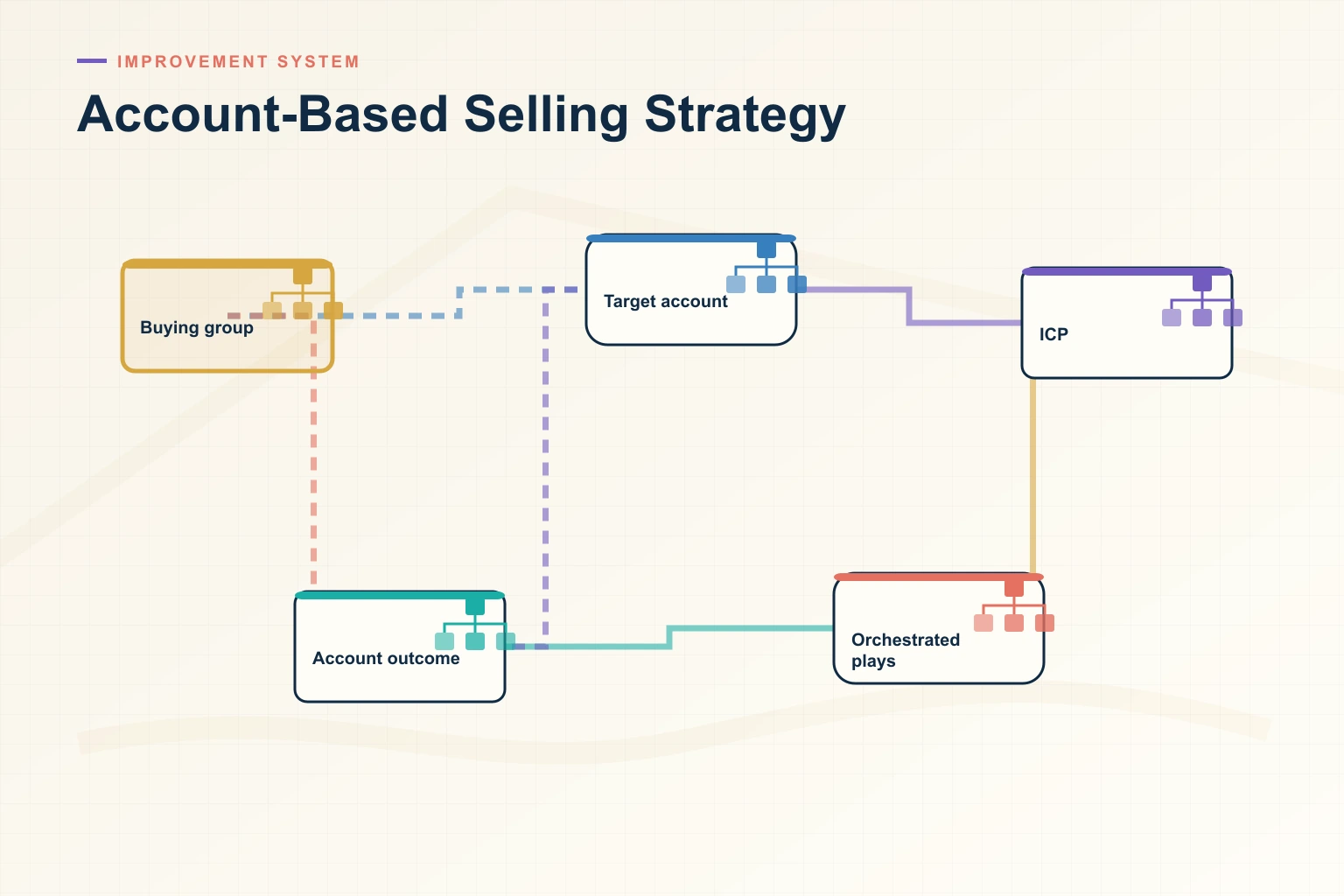
Account-based selling (ABS) is a B2B sales strategy in which sales, marketing and customer success pick a short list of high-value target accounts and sell to each one as a market of one: researching its business, mapping its buying committee and running a coordinated, tailored plan from first contact through close and expansion.
A working account-based selling strategy has six parts: a tiered target account list, a one-page plan for each priority account, a map of each buying committee, an account team with named roles, stage-by-stage plays, and a weekly review of account-level metrics. This guide covers each part, how ABS differs from traditional sales and from ABM, the KPIs and tools, and a 90-day rollout plan. It draws mainly on buyer research published in 2025 and 2026.
Last updated: 16 October 2026
What is account-based selling?
Account-based selling treats the company, not the individual lead, as the unit of sales work. The team chooses accounts first, on fit and timing, then finds and engages the people inside each account who will shape the decision. Salesforce’s guide to the approach puts it as “instead of fishing with a net, you use a spear” (Salesforce, 11 March 2024).
The approach grew out of account-based marketing. Wikipedia dates account-based selling to the mid-2010s, as the sales-side development of ABM (Wikipedia, “Account-based selling”), a term coined in 2003 by Bev Burgess at the Information Technology Services Marketing Association, ITSMA (Wikipedia, “Account-based marketing”; both accessed 16 October 2026).
Three things define it in practice:
- Accounts are chosen, not received. A target account list, built from your ideal customer profile (ICP) and timing signals, decides where sellers spend proactive time, instead of whichever leads arrived this week.
- A team sells, not a single rep. The account executive leads, but SDRs, marketing, solutions engineers, customer success and an executive sponsor work from the same account plan.
- Relevance is earned through research. Outreach and content start from the account’s own priorities: a growth target in its annual report, a new leader, an acquisition, or a system it is replacing.
Why does account-based selling work for complex B2B deals?
Four findings from recent buyer research explain why focusing on fewer accounts pays off when deals and buying committees are large.
Buying groups are large and cross-functional
In a survey of 632 B2B buyers, Gartner found that buying groups range from five to 16 people across up to four functions (Gartner, 7 May 2025). Forrester’s 2026 buyer research puts the typical decision at 13 internal stakeholders and nine external influencers, with procurement acting as a decision-maker in 53% of buying cycles (Forrester, 21 January 2026). One rep with one contact cannot reach that many people; an account team working from a stakeholder map can.
Buyers pick a favourite before they talk to you
In 6sense’s 2025 Buyer Experience Report, based on about 4,000 buyers, 94% of buying groups ranked their preferred vendors before first contact, and the preliminary favourite won 77% of the time (6sense, 12 November 2025). First contact came 61% of the way through the journey, down from 69% in 6sense’s earlier research, and buyers initiated 79% of engagements (6sense report page, 2025). Account-based selling is how you reach a target account’s shortlist before it is written: marketing builds familiarity across the group, and sellers act when signals show the account has started looking.
Few accounts are in market at any one time
The 95:5 rule, from research by the LinkedIn B2B Institute with Professor John Dawes of the Ehrenberg-Bass Institute, holds that only about 5% of B2B buyers are in market at any given moment (Marketing Week, Peter Weinberg and Jon Lombardo, 2 September 2021). That is the case for tiering: put deep, one-to-one effort on accounts showing timing signals and keep lighter, scalable coverage on the rest, so you are remembered when they enter the market. Gartner research finds that nearly all B2B purchases happen amid organisational change and uncertainty (Gartner, 9 January 2024), which tells you which signals to watch.
Irrelevant outreach is punished, and so is the wrong kind of personalisation
Gartner’s June 2025 survey found that 73% of B2B buyers actively avoid suppliers who send irrelevant outreach, and 61% prefer a rep-free buying experience overall (Gartner, 25 June 2025). Its May 2025 study adds a nuance that matters for ABS: content tailored to the buying group as a whole raised consensus by 20%, while content tailored only to individuals had a 59% negative impact on group consensus (Gartner, 7 May 2025). Personalise to the account’s problem first and each role second, so every stakeholder hears the same story with different proof.
Revspire’s own customer data adds context. In the Revspire B2B SaaS win rate and sales cycle benchmark (about 40 B2B companies, October 2025 to September 2026), win rates fell from 35% on $10k-$20k deals to 30% on deals above $100k. Nine in ten deals had a named competitor, and those were won 30% of the time against 35% without one. These are observed patterns, not proof of cause, but they show that most deals face a named competitor and that the larger deals ABS targets are harder to win.
Account-based selling vs traditional sales: what changes?
Traditional, lead-based selling starts with leads and works them through a funnel. Account-based selling starts with chosen accounts and works the people inside them. The table compares the two on the points that change a seller’s week.
Dimension
Traditional (lead-based) selling
Account-based selling
Starting point
Inbound leads, territory lists, marketing-qualified leads
A target account list chosen on ICP fit and timing signals
Unit of work
The lead or contact
The account and its buying group
Who sells
One rep, with hand-offs from marketing and SDRs
An account team working from one account plan
Outreach
Sequences to many contacts, light personalisation
Researched, account-specific outreach to several roles at once
Content
Standard deck, case studies, pricing sheet
An account point of view, a business case and role-specific proof
Qualification question
Does this lead fit, and is there budget?
Is this the right account, and are we reaching enough of its committee?
Measurement
Activities, lead volume, lead-to-opportunity conversion
Committee coverage, account engagement, pipeline and win rate in target accounts
Time horizon
This quarter’s deal
The first deal plus expansion over several years
How account-based selling differs from lead-based selling, by dimension.
When traditional selling is the better choice
ABS costs research time for every account, so it is not always worth it. Lead-based selling usually wins when deals are small, one or two people decide, cycles are short and your market has thousands of similar buyers. The Starr Conspiracy, a B2B marketing agency, offers a rule of thumb: if your ACV is under $25,000 or your sales cycle is under 90 days, rethink whether an account-based motion is right at all (The Starr Conspiracy, 26 May 2026). Many teams run both: ABS for a named list of strategic accounts and a lead-based motion for the rest of the market.
Account-based selling vs account-based marketing (ABM)
ABM and ABS share a target account list and a goal; they differ in who runs them and which work they cover. ABM is marketing’s half: account-level advertising, events, content and web personalisation that build awareness and engagement across the buying group. ABS is the sales half: research, outreach, discovery, multi-threading and deal execution that turn that engagement into pipeline, revenue and expansion.
- Owner: marketing runs ABM; sales leadership runs ABS, with the account executive as account owner.
- Main output: ABM produces engaged accounts and meetings; ABS produces opportunities, wins and expansion.
- Typical channels: ABM uses ads, email, events and personalised web pages; ABS uses calls, meetings, executive outreach, workshops and shared deal rooms.
- Shared artefacts: the target account list, the tiers, the account plan and the stakeholder map.
The hand-off is where programmes fail. In Demand Gen Report’s 2025 ABM Benchmark Survey, 71% of practitioners used an ABM strategy, but aligning sales and marketing was a top challenge for 43% and proving ROI for 47% (Demand Gen Report, 23 December 2025). Treat ABM and ABS as one programme with one account list, one plan per priority account and one shared scorecard.
How to build an account-based selling strategy in seven steps
1. Define your ideal customer profile and build the target account list
Start from closed-won data, not opinion. Pull the last year or two of won and lost deals and look for what your best customers share: industry, size, region, the systems they run, the problem they bought to solve and how quickly they expanded. Then score candidate accounts on three things:
- Fit: firmographics and technographics that match your best customers.
- Timing: signs that change is under way, such as a new executive, funding or an acquisition, hiring in the function you serve, a system being replaced, or research activity on your category. Our guide to intent data for B2B sales covers the signal types.
- Access: existing relationships, former customers who moved there, partners, and whitespace in current customers.
Agree the list with marketing and sales leadership, and write down why each top-tier account is on it. A list nobody can explain gets ignored by the second quarter.
2. Tier accounts by the effort each deserves
The three tiers below mirror the three types of ABM: strategic one-to-one, “ABM lite” one-to-few, and programmatic one-to-many (Wikipedia, citing Burgess and Munn, 2021).
Tier
Treatment
Research depth
Who is involved
Example plays
Tier 1 (one-to-one)
A dedicated account plan and bespoke plays
Deep: annual report, earnings calls, org chart, current vendors
AE, SDR, solutions engineer, marketing, executive sponsor
Point-of-view memo, executive briefing, discovery workshop
Tier 2 (one-to-few)
Plays shared by a cluster of similar accounts (same industry or trigger)
Medium: cluster priorities plus key contacts
AE, SDR, marketing
Industry content, peer roundtables, role-based sequences
Tier 3 (one-to-many)
Programmatic coverage personalised by segment
Light: firmographics and intent signals
SDR, marketing automation
Targeted ads, segment emails, webinars; promote to Tier 2 on a signal
Account tiers for account-based selling, from most to least effort per account.
Worked example (illustrative numbers, use your own): size Tier 1 by capacity, not ambition. Suppose an AE has about 10 hours a week for proactive account work, and keeping one Tier 1 plan current, with weekly research and multi-threaded outreach, takes about two hours. That AE can run five Tier 1 accounts well, not 30. The next group of accounts goes into Tier 2 clusters, and the rest to programmatic coverage. The point is to derive the number from hours, then revisit it each quarter.
3. Write a one-page account plan for each Tier 1 account
The account plan is the shared brief the whole team works from. Keep it to one page and update it after every meaningful conversation:
- The account’s top two or three business priorities, in its own words (annual report, earnings call, leadership interviews, job posts).
- The change or trigger that makes now the moment.
- Your hypothesis of value: the problem you solve for them and what it is worth, to be tested in discovery.
- Current state: incumbent vendors, systems, contracts and any renewal dates you know.
- The buying committee map (step 4) and your entry point.
- Whitespace: where a first deal could expand.
- Risks: competitors, budget timing, a sceptical stakeholder.
- The next 30 days: three actions, each with an owner and a date.
Our account planning guide goes deeper on the template and review rhythm.
4. Map the buying committee and multi-thread early
List every role that can approve, influence or block the decision: economic buyer, champion, the operational leader who owns the problem, technical evaluator, end-user representative, finance, procurement, legal and security. For each, record what they care about, what they have seen from you, how strong the relationship is and who on your team owns it. A rule such as “a Tier 1 opportunity cannot leave discovery until three roles, including the economic buyer or a delegate, have engaged directly” turns multi-threading from advice into a stage gate.
Revspire’s digital sales room benchmark (October 2025 to September 2026) shows how far a deal’s audience spreads: deals run in an active room reached 15 unique buyer stakeholders, against 1 to 5 on deals without one, and 80% of rooms were forwarded inside the buyer’s organisation. That is an observed pattern, not proof that a room wins a deal, but it shows your material reaches people you have not met, so write it to make sense without you in the room.
5. Assign the account team and name every role
- Account executive: owns the account plan, the opportunity and the forecast.
- SDR or BDR: researches contacts and reaches the roles the AE is not yet talking to.
- Marketing: runs account-level ads, events and content, and reports account engagement.
- Solutions engineer: leads technical discovery, demos and proof.
- Customer success: owns expansion in existing accounts and supplies references.
- Executive sponsor: builds a peer relationship with the buyer’s executive on Tier 1 accounts.
- Enablement and RevOps: keep content, plays and data current.
Put a name against each role on every Tier 1 account. “Marketing will support” is not an owner.
6. Plan plays by stage and personalise in layers
Write plays once per tier, then adapt them per account. Personalise in three layers: the account’s business problem (the same for everyone), the buying group’s decision (what they must agree on), and each role’s proof (security detail for IT, a cost model for finance, workflow for users).
- First touch: a short point-of-view note tied to a priority the account has stated publicly, sent to two or three roles in the same week rather than one after another.
- Discovery: test the value hypothesis, confirm who decides and how, and ask how the last comparable purchase was approved.
- Evaluation: a demo built on their workflow, plus role-specific proof each stakeholder can forward.
- Consensus: one written business case the whole group can react to, which is the group-level relevance Gartner links to consensus.
- Procurement and legal: bring security, legal and procurement in before the verbal yes, with documents ready.
7. Run each opportunity on a mutual action plan
A mutual action plan lists every step to a signed contract and go-live, with an owner and a date on each, on both sides. In Revspire’s mutual action plan benchmark (October 2025 to September 2026), deals with a plan were won 35% of the time against 28% without one, and deals with a plan closed sooner in each deal-size band: a median of 20 against 25 days under $10k, 42 against 60 at $10k-$50k, and 85 against 120 above $50k. Buyers owned only 20% of plan milestones. Teams may write plans for their better-qualified deals, so read this as a pattern, not proof. The practical lesson is to give the buyer real owners for security review, legal and procurement. A digital sales room keeps the plan, the content and stakeholder activity in one shared place.
Account-based selling for enterprise deals: what changes?
Enterprise ABS involves more people, more approvals and longer cycles, so the operating rules must be written down, not carried in managers’ heads. Three changes matter most.
Define exit criteria for each stage
Judge progress by evidence the buyer has given, not by seller activity. A shared table of exit criteria gives reps, managers and forecasters the same vocabulary:
Stage
Exit evidence from the buyer
Owner
Target
Account is on the agreed list with a written reason and a trigger
AE and marketing
Engaged
Two or more roles have replied, met or engaged with content
SDR and AE
Discovery
The owner of the problem confirms the problem, its impact and the decision process
AE
Solution
The technical evaluator confirms fit; the champion has shared the business case internally
Solutions engineer and AE
Consensus
The economic buyer accepts the business case; the buyer agrees the mutual action plan
AE and executive sponsor
Commit
Security, legal and procurement steps are scheduled with named buyer owners
AE and deal desk
Expand
Adoption reviewed with the customer; next team or use case identified
Customer success and AE
Example stage exit criteria for enterprise account-based selling. Adapt the stage names to your CRM.
Bring procurement, security and legal in early
With procurement a decision-maker in 53% of buying cycles in Forrester’s 2026 research (Forrester, 21 January 2026), a security questionnaire or vendor-onboarding process found late is a common reason enterprise close dates slip. Ask in discovery how the last similar purchase was approved, and put each of those steps on the mutual action plan with a buyer-side owner.
Review Tier 1 accounts weekly, and every significant loss formally
Add a short review of each Tier 1 account to the weekly pipeline meeting: what changed, which roles engaged, who is missing, and the one action for the next seven days with its owner. After every significant loss or no-decision, run a structured review with the account team, and with the buyer where possible. Feed what you learn back into the ICP, the tiers and the plays, so the strategy improves each quarter instead of being relaunched each year.
Which account-based selling metrics and KPIs should you track?
Track a small set of leading indicators weekly and lagging results monthly or quarterly, and compare target accounts with a matched group of non-target accounts. TechTarget’s list of 12 ABM metrics (TechTarget, Griffin LaFleur, 31 July 2023) is a useful cross-check; the table keeps the ones that matter most to sales.
Metric
How to calculate it
Type
What it tells you
Target account coverage
Tier 1 accounts with a current plan and an engaged contact ÷ all Tier 1 accounts
Leading
Whether the team is actually working the list
Buying committee coverage (account penetration)
Roles engaged in the last 30 days ÷ roles mapped, per opportunity
Leading
Single-threading risk
Account engagement
Engaged contacts and meaningful interactions per account, as a 30-day trend
Leading
Which accounts are warming or cooling
Opportunity creation rate
Target accounts with a new qualified opportunity ÷ target accounts, per quarter
Leading
Whether ABS creates pipeline, not just activity
Account progression rate
Accounts that moved up a stage ÷ accounts in that stage, per month
Leading
Where accounts stall
Mutual action plan progress
Milestones completed on time ÷ milestones due
Leading
Whether the buyer is still investing effort
Pipeline from target accounts
Open pipeline value in target accounts, and its share of total pipeline
Lagging
Whether the list can carry the number
Win rate
Won ÷ (won + lost), target vs non-target opportunities
Lagging
Whether focus improves outcomes
Average deal size
Median ACV, target vs non-target
Lagging
Whether ABS lands larger deals
Sales cycle length
Median days from opportunity created to closed-won
Lagging
Whether deals move faster or slower
Net revenue retention
Revenue from target customers 12 months later ÷ their starting revenue
Lagging
Whether land-and-expand is working
Account-based selling KPIs, with leading indicators first.
Three rules keep the numbers honest:
- Compare like with like. Put deals into deal-size bands before comparing them. In Revspire’s win rate and sales cycle benchmark, the median won deal closed in 20 days under $10k ACV, 45 days at $10k-$50k and 90 days above $50k, so a large-deal ABS programme should not be judged against small-deal cycle times.
- Measure against a control group. In SiriusDecisions’ 2019 State of ABM study, only 53% of organisations could report on ABM ROI; of those, 89% said ABM accounts achieved higher ROI than a control group of accounts without ABM support (Forrester blog on the SiriusDecisions study, 2019). The data is old, but the method holds: choose a matched set of non-target accounts at the start, or you will not know what ABS added.
- Prefer outcomes to activity. Emails sent and calls logged say little about progress; stage movement, committee coverage and buyer-owned milestones do. Our deal velocity metrics guide shows how win rate, deal size and cycle length combine.
What technology supports account-based selling?
Technology should make the process easier to run, not define it. Before adding a tool, ask three questions: which step of the ABS process does it support, what information does it give the account team that they lack today, and which manual steps does it add or remove? A tool that makes reps enter the same data in two places will not be used.
Disclosure: Revspire publishes this guide and sells sales enablement and digital sales room software. Revspire appears once below. Example vendors in each row are listed alphabetically, are not ranked and are not a complete list.
Layer
Job in account-based selling
Examples
Question to ask
CRM
System of record for accounts, contacts, tiers, opportunities and the forecast
HubSpot, Microsoft Dynamics 365, Salesforce
Can it hold tiers, buying roles and stage exit criteria without workarounds?
Account data, intent and ABM orchestration
Firmographic, contact and intent data to build and prioritise the list; account-level advertising
6sense, Demandbase, ZoomInfo
How fresh is the data for your segment, and do signals reach the account owner?
Sales engagement
Sequences, calls and email, tracked at account level
Outreach, Salesloft
Can it run one play to several roles in the same account at once?
Conversation intelligence
Records and analyses calls for risks, competitors and next steps
Gong
Does it roll insights up to the account, not just the call?
Content, enablement and coaching
Approved content, plays and practice for each role and stage
Mindtickle, Seismic
Can sellers find role-specific proof in seconds, and can you see what was used in won deals?
Digital sales rooms and mutual action plans
A shared space for the plan, content and stakeholder engagement
Aligned, Dock, Revspire
Does it show which stakeholders engaged, and does activity reach the CRM?
Technology layers for account-based selling. Examples are alphabetical within each row and not ranked.
Where to invest first: if your ABS programme is mostly about getting into new accounts early, account data, intent signals and ABM orchestration matter more than a deal room. If your problem is late-stage deals stalling in large committees, invest first in stakeholder mapping, mutual action plans and a shared deal room. If sellers cannot find the right proof for each role, fix content before buying more data.
A 90-day plan to launch account-based selling
Start with a pilot, not a reorganisation. The plan below assumes one pilot team and a small Tier 1 list.
Phase
What to do
Output
Days 1-30: baseline and list
Review six months of won and lost deals by segment, deal size and stage; agree the ICP; choose the Tier 1 list and a matched control group; name the account team for each account
Agreed list, control group, named owners
Days 31-60: plans and plays
Write one-page account plans; map each buying committee; launch first-touch plays; add the Tier 1 review to the weekly pipeline meeting
Plans, committee maps, first meetings
Days 61-90: run and measure
Put each new opportunity on a mutual action plan; track coverage, engagement and opportunity creation against the control group; review every loss
A scorecard and the first lessons
Day 90 review
Keep, change or drop each element; adjust tiers; decide whether to extend to more teams
A decision to scale or adjust
A 90-day account-based selling pilot.
The fastest first step is a committee map for each Tier 1 account. Use our free stakeholder map template (copy it, or download Excel or Word with no sign-up) to record each person’s buying role, influence, stance and relationship owner.
Choosing software for the marketing side of ABM? Target-account selection, account-based ads and engagement measurement are compared in our guide to the best ABM platforms.
Frequently asked questions
What is an example of account-based selling?
A finance-software vendor sees that a target manufacturer has hired a new CFO and announced an ERP replacement. The account team writes a one-page plan; the AE sends the CFO a short point of view on closing the books during an ERP migration, the SDR reaches the controller and the IT lead in the same week, and marketing invites the finance team to a peer roundtable. Every touch tells one story, adapted to each role.
What is the difference between account-based selling and account-based marketing?
Account-based marketing is the marketing-led half of an account-based programme: advertising, events, content and personalisation aimed at a chosen list of accounts. Account-based selling is the sales-led half: research, outreach, discovery, multi-threading and deal execution with those same accounts. They work best as one programme with one account list and a shared scorecard.
What are the steps of account-based selling?
Build a target account list from your ideal customer profile, tier it, write a one-page plan per top account, map each buying committee, name the account team, plan plays by stage and run each opportunity on a mutual action plan. Then review top accounts weekly and feed win and loss lessons back in.
How many target accounts should you have in account-based selling?
Work it out from capacity: the hours each seller can give to proactive account work, divided by the hours one Tier 1 account needs each week. For programme-wide scale, The Starr Conspiracy reports that the enterprise ABM programmes it has audited run 50 to 200 accounts at the one-to-one tier and 200 to 1,000 at one-to-few (The Starr Conspiracy, 26 May 2026). Those are counts across a whole account team, not per-rep quotas.
What KPIs measure account-based selling success?
Review leading indicators weekly: target account coverage, buying committee coverage, account engagement, opportunity creation and mutual action plan progress. Judge results on pipeline, win rate, deal size, cycle length and net revenue retention in target accounts, compared with a matched group of non-target accounts.
Is account-based selling the same as key account management?
Not quite. Key account management focuses on retaining and growing a company’s largest existing customers, usually through a dedicated account manager. Account-based selling covers new-logo accounts as well as expansion, and uses a cross-functional team from first contact. Many companies apply ABS methods, such as account plans, committee maps and mutual action plans, to their key accounts.
Sources
- Gartner Sales Survey Finds 74% of B2B Buyer Teams Demonstrate “Unhealthy Conflict” During the Decision Process, Gartner, 7 May 2025. Accessed 16 October 2026.
- Gartner Sales Survey Finds 61% of B2B Buyers Prefer a Rep-Free Buying Experience, Gartner, 25 June 2025. Accessed 16 October 2026.
- Help B2B Buyers Navigate Change Management for Complex Purchases, Gartner, 9 January 2024. Accessed 17 October 2026.
- Forrester’s 2026 Buyer Insights: GenAI Is Upending B2B Buying As Leaders Face Mounting Pressure To Justify Every Dollar Spent, Forrester, 21 January 2026. Accessed 16 October 2026.
- The Timeline for Influencing B2B Buyers Is Shrinking: Insights From 6sense’s 2025 Buyer Experience Report, 6sense, 12 November 2025. Accessed 16 October 2026.
- The B2B Buyer Experience Report for 2025, 6sense, 2025 (no publication date shown). Accessed 16 October 2026.
- The 95:5 rule is the new 60:40 rule, Peter Weinberg and Jon Lombardo (LinkedIn B2B Institute), Marketing Week, 2 September 2021. Accessed 16 October 2026.
- 2025 Demand Gen Report Year in Review Surveys: Insights on AI, ABM, and Events, Demand Gen Report, 23 December 2025. Accessed 16 October 2026.
- Account-Based Marketing Budgets Demystified: Findings From SiriusDecisions’ Latest Study, Forrester (SiriusDecisions), 2019 (no publication date shown). Accessed 16 October 2026.
- 12 essential ABM metrics and KPIs to measure success, Griffin LaFleur, TechTarget, 31 July 2023. Accessed 16 October 2026.
- Account-Based Marketing Strategy Analysis, JJ La Pata, The Starr Conspiracy, 26 May 2026. Accessed 16 October 2026.
- The Secret of Successful Account-Based Selling? Going After the Big Fish, Donald Kelly, Salesforce, 11 March 2024. Accessed 16 October 2026.
- Account-based selling, Wikipedia. Accessed 16 October 2026.
- Account-based marketing, Wikipedia. Accessed 16 October 2026.
- Revspire research (aggregated Revspire customer data, October 2025 to September 2026; observed patterns, not proof of cause): B2B SaaS win rate and sales cycle benchmark, Digital sales room benchmark and Mutual action plan benchmark, Revspire, 2026. Accessed 16 October 2026.