Revspire blog
Why Buying Committee Mapping Is the Highest-Leverage Move in B2B Sales
A practical framework for auditing stakeholder coverage, assigning ownership, tracking indicators, coaching live deals, and improving buying committee mapping.
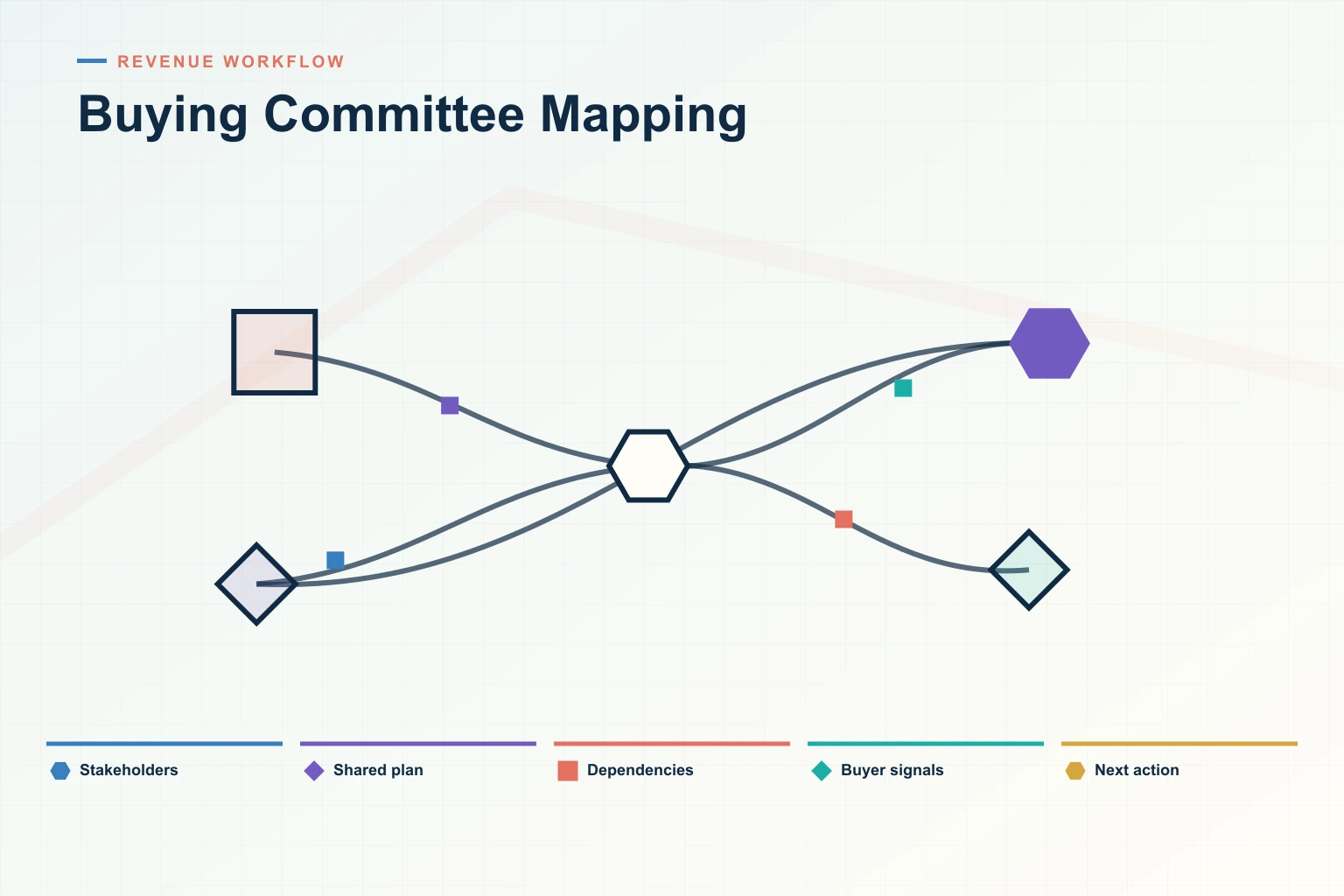
Buying committee mapping gives revenue teams a structured way to review stakeholder coverage, engagement, ownership, and deal risk. It should be managed as an ongoing operating discipline rather than a one-time initiative.
Why Buying Committee Mapping Matters
Poor buying committee mapping can affect opportunities throughout the funnel. Early-stage deals may consume capacity, qualified deals may stall, and late-stage deals may encounter procurement surprises, unstated objections, or stakeholder concerns.
A documented approach gives representatives, managers, and revenue leaders a shared standard for evaluating stakeholder coverage. It also creates a clearer basis for pipeline reviews, coaching, and process improvement.
Three-part explainer: Expose the hidden cost, Build the business case, and Start where it matters.
A Practical Buying Committee Mapping Framework
1. Audit the Current State
Start with an honest audit. Before you can improve Buying Committee Mapping, you need an honest baseline.
Review recent opportunities by representative, segment, deal size, and stage. Identify where deals stalled or were lost, which stakeholders were known, and where engagement or coverage was limited. Use the findings to prioritize two or three improvements, then give each improvement an owner, a measurable goal, and a review cadence.
2. Define the Operating Model
An operating model should state what actions happen, at what stage, and who is accountable. Document the standard, establish a shared vocabulary, and assign leadership ownership for outcomes.
Embed buying committee mapping into pipeline calls, coaching, territory reviews, and planning. A simple model that teams consistently follow is more useful than a sophisticated playbook that remains unused.
3. Map Stakeholders and Relationship Coverage
Do not build an opportunity around one contact. Map the stakeholders involved in the purchase, assign relationship coverage, and monitor engagement across the group. Treat an opportunity with only one active contact as a visible risk.
Learn about Revspire Stakeholder Intelligence.
4. Track Leading and Lagging Indicators
Lagging indicators such as win rate, cycle time, average deal size, and quota attainment describe completed outcomes. Leading indicators may include stakeholder engagement, content consumption, mutual action plan progression, and deal velocity.
Measure outcomes, not activities. Use stage progression, engagement quality, stakeholder coverage, and conversion rates as inputs to coaching and pipeline reviews.
5. Coach With Live Opportunities
Use deal-level coaching to review missing stakeholders, weak relationships, stalled decisions, and the next action needed to improve coverage. This connects coaching to current revenue work.
Build a System That Improves Over Time
Capture insights from won and lost deals through post-deal interviews, CRM analysis, and structured reviews. Feed those findings back into playbooks, training, metrics, and strategy.
The technology layer for Buying Committee Mapping should reduce friction, not add it. Technology should serve the buying committee mapping enterprise process, not define it. Evaluate whether each tool makes the process easier and more consistent and whether relevant data can move between systems without unnecessary manual work.
Common Buying Committee Mapping Mistakes
Treating It as a One-Time Initiative
Maintain permanent ownership, recurring reviews, defined metrics, and improvement goals so the process remains part of the operating cadence.
Relying on Intuition Alone
Define a focused set of indicators, review them consistently, and investigate when portfolio data conflicts with the prevailing narrative.
Single-Threading the Relationship
If the only active stakeholder goes silent, changes roles, or leaves the company, the team may have no fallback. Require broader relationship coverage and flag single-contact opportunities as risks.
Confusing Activity With Progress
Email, call, and task counts can appear healthy while an opportunity makes little progress. Review stakeholder engagement and stage progression rather than requesting more activity by default.
Failing to Learn From Losses
After a significant loss, document the buying committee and process breakdowns that contributed to the result. Update playbooks and coaching with the findings.
How to Start
- Establish a baseline: Review recent deals and identify recurring stakeholder coverage gaps.
- Assign ownership: Make one leader accountable for outcomes, metrics, and playbook maintenance.
- Define the standard: Document the stakeholder information and engagement evidence expected at each stage.
- Add a review cadence: Include mapping health in pipeline reviews and deal coaching.
- Measure progress: Track a focused set of leading and lagging indicators.
- Close the feedback loop: Use win-loss findings to revise the process.
To explore how Revspire supports stakeholder visibility and deal execution, See a demo.