Revspire blog
Finding Hidden Stakeholders in B2B Sales: A Practical Guide
A practical guide to finding hidden stakeholders, reducing single-threaded deal risk, measuring coverage, and building a repeatable sales process.
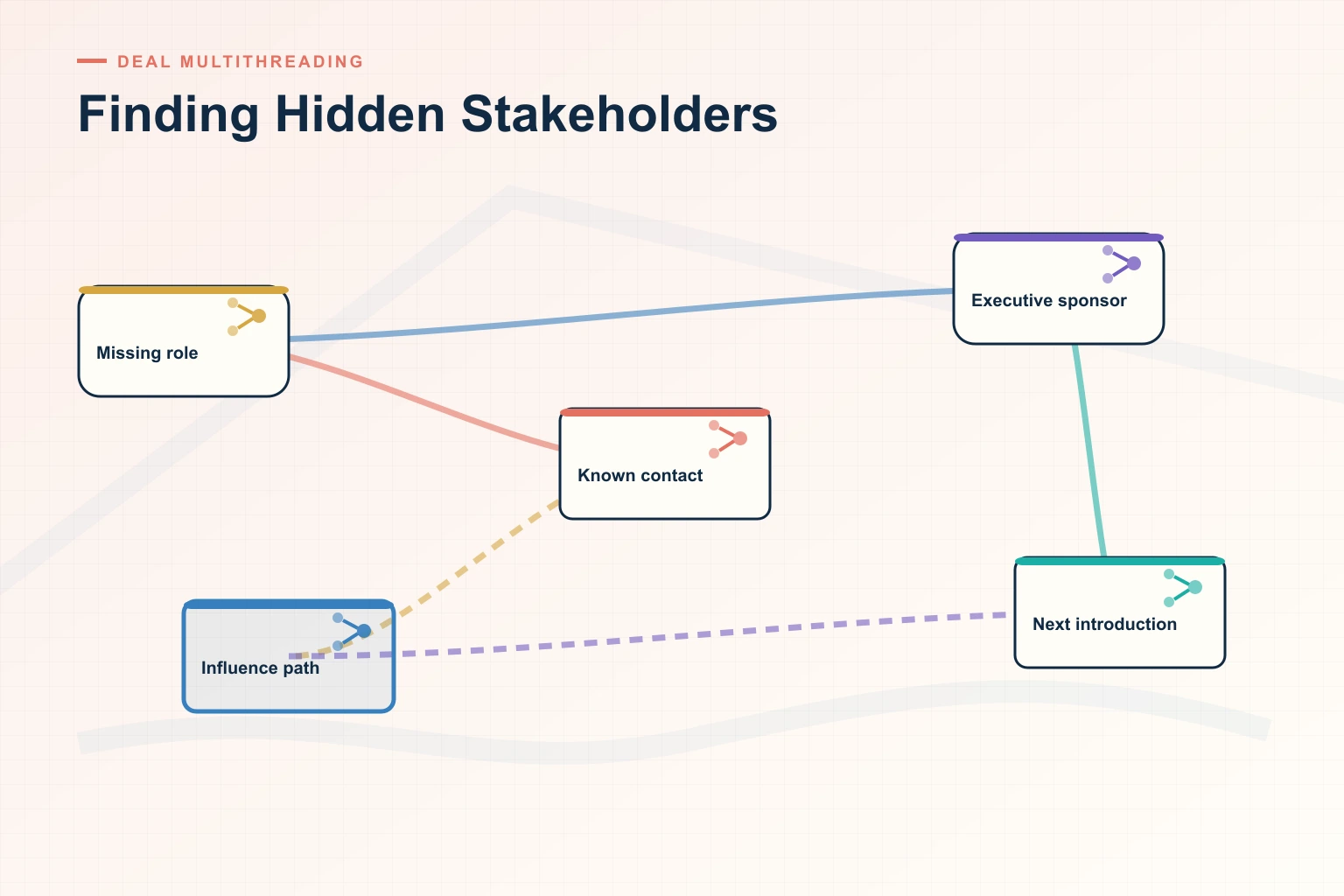
Treat finding hidden stakeholders as a continuous operating discipline rather than a one-time event. A practical system combines clear ownership, documented expectations, deal-level data, regular coaching, and feedback from won and lost opportunities.
Why stakeholder coverage matters
When a seller builds an entire relationship around one stakeholder, the opportunity becomes vulnerable if that contact goes quiet, is reorganized, or leaves the company. Mapping the wider buying group and tracking engagement with each participant gives the revenue team a clearer view of stakeholder coverage.
Poor stakeholder coverage can surface at several points in a deal. Early opportunities may consume capacity despite weak qualification. Qualified deals may stall when key participants have not been identified or engaged. Late-stage opportunities may encounter procurement surprises, unstated objections, or concerns that were not surfaced earlier.
For a related product resource, see Revspire Stakeholder Intelligence.
Three-part explainer: Expose the hidden cost, Build the business case, and Start where it matters.
Build a repeatable stakeholder-discovery system
1. Audit the current state
Start with an honest audit. Review recent opportunities, identify where stakeholder discovery broke down, and compare the available deal data with the team’s account of what happened. Segment the findings by representative, market segment, deal size, and sales stage to identify recurring problems.
2. Define ownership and expectations
An operating model for Finding Hidden Stakeholders answers three questions: what actions should happen, at what stage, and who is accountable. Define what strong stakeholder coverage looks like at each stage and what evidence is required before an opportunity advances.
3. Make stakeholder health part of weekly work
Include stakeholder health in weekly pipeline reviews. Focus the discussion on coverage gaps, engagement quality, and what should change next. Use live opportunities for deal-specific coaching rather than relying only on generic training.
4. Align technology with the process
Technology should serve the process, not define it. Each tool should reduce friction or help representatives spend more time on high-value work. Data should move between the CRM, engagement platform, and deal room with as little manual intervention as possible.
5. Measure outcomes
Measure outcomes, not activities. Email, call, and task volumes do not necessarily show that an opportunity is progressing. Review stakeholder engagement, coverage breadth, and stage velocity alongside lagging indicators such as win rate, cycle time, and average deal size.
Build a dashboard that shows both. Review it weekly.
6. Learn from wins and losses
Use structured reviews, CRM analysis, and post-deal interviews to document what helped or harmed stakeholder coverage. Feed the findings into playbooks, coaching, and strategy so the operating system can improve over time.
Three-part explainer: Audit the current state, Build the operating model, and Measure and improve.
Three-part explainer: Define the system, Operationalize the workflow, and Measure the impact.
Common mistakes to correct
- Treating stakeholder discovery as a one-time initiative. Assign a permanent owner and make review and improvement part of the operating cadence.
- Relying on intuition instead of data. Define a focused set of indicators and investigate when the evidence conflicts with the prevailing narrative.
- Single-threading the relationship. Map the buying group, assign coverage, and flag opportunities that have only one active contact.
- Confusing activity with progress. Prioritize engagement quality, coverage breadth, and stage progression over raw activity counts.
- Failing to learn from losses. Conduct structured reviews, document stakeholder-related breakdowns, and update playbooks accordingly.
Practices for scaling the discipline
- Define excellent execution at every deal stage.
- Instrument each stage with leading indicators.
- Review stakeholder health in the weekly pipeline cadence.
- Use deal-specific coaching to close skill gaps.
- Capture Win-Loss Intelligence Systematically
- Align technology with the process and reduce manual friction.
- Create feedback loops that improve metrics, playbooks, and the buyer experience.
Where to start
Choose two or three improvements with the clearest connection to revenue outcomes. Assign an owner, set measurable goals, and establish a 90-day review cadence. Keep the operating model simple enough for the team to follow consistently.