Sales Qualification: Frameworks, Process and Signs of a Bad Lead
A practical perspective for connecting this idea to your revenue team’s next move.
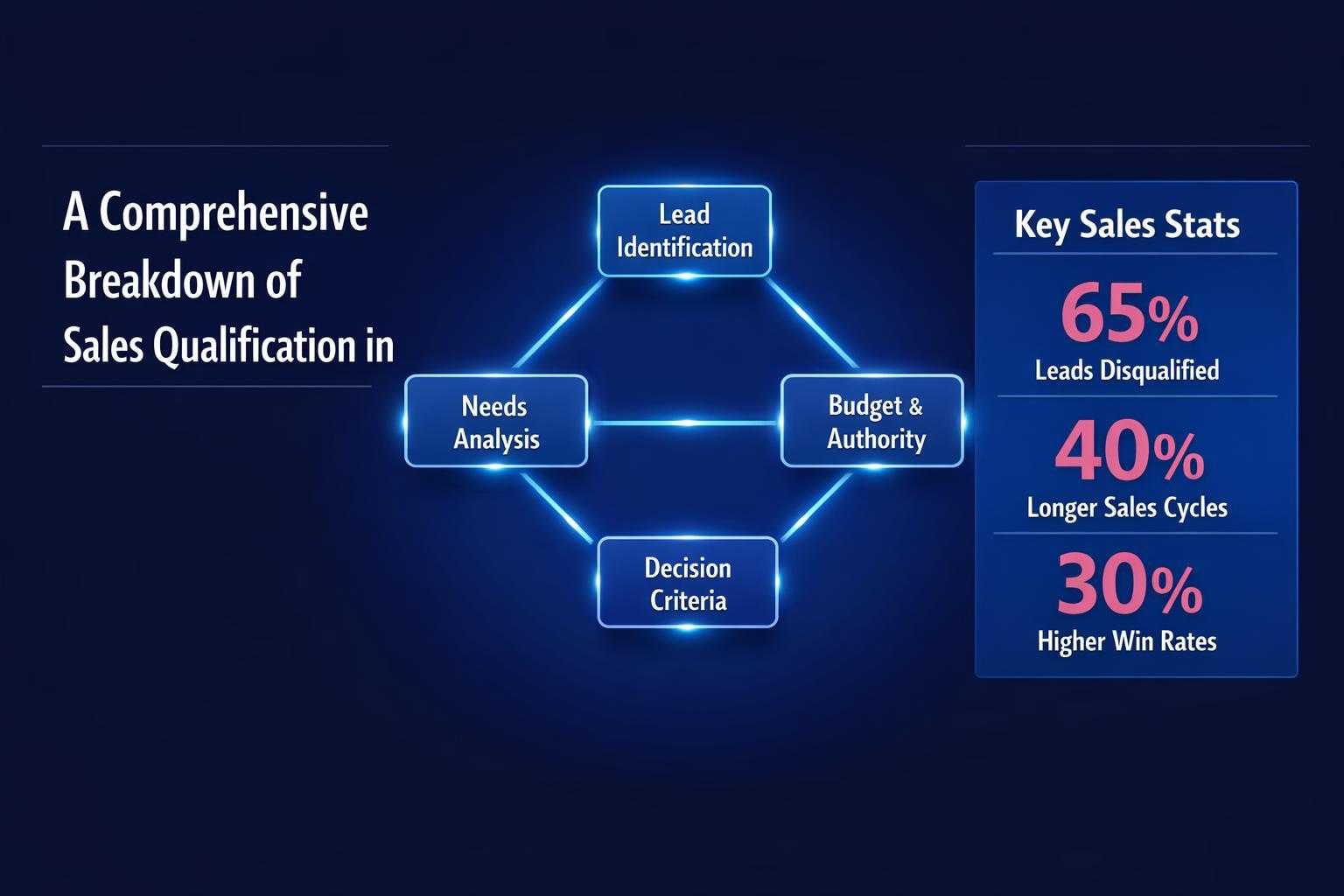
Sales qualification is the process of deciding whether a lead or opportunity deserves a seller’s time. It tests three things: the account fits your ideal customer profile, it has a problem worth solving now, and you can reach the people who will decide. Frameworks such as BANT, CHAMP, GPCTBA/C&I and MEDDPICC turn those tests into shared questions.
This guide explains lead versus opportunity qualification, compares the main frameworks in one table, sets out a seven-step qualification process with a question bank, lists the signs you are chasing the wrong leads, and works through one lead with two frameworks. It reflects research and practice current to October 2026.
Last updated: 17 October 2026
What is sales qualification?
Sales qualification is a series of go or no-go decisions made on evidence. At each stage a seller asks whether the next hour on this account is better spent here or somewhere else. Done well, it does two jobs: it moves good-fit buyers forward faster, and it removes poor-fit ones before they consume a forecast slot, a demo team and a proposal.
Lead qualification vs opportunity qualification
- Lead qualification happens before or during the first conversation, usually run by an SDR or BDR. The question is “should we take a meeting and open an opportunity?” It leans on fit (company size, industry, systems), a trigger and basic interest. The output is a sales-qualified lead (SQL) or a booked meeting.
- Opportunity qualification runs across the whole deal, usually owned by the account executive. The question is “can we win this, and when?” It needs evidence about the buyer’s metrics, decision process, economic buyer, paperwork and alternatives. The output is a stage, a close date and a forecast category you can defend.
Most teams use a light framework for the first and a heavier one for the second. Mixing them up causes two familiar failures: SDRs quizzing a prospect about procurement on a first call, and AEs forecasting deals that were never more than a friendly meeting.
Qualifying in and qualifying out
Qualifying in looks for reasons to pursue: a trigger, a sponsor, a measurable problem. Qualifying out looks for reasons to stop: no budget owner, no deadline, a requirement you cannot meet. Both matter, but qualifying out is the habit most teams lack, because closing a file feels like losing a deal. It is not. It frees time for a deal you can win.
Why does sales qualification matter?
Three pieces of research show why qualification deserves as much attention as closing technique.
- Well-qualified deals win far more often. Ebsta’s Sales Qualification Report highlights (page last updated 26 July 2025) say deals with strong qualification were won 50% of the time against 8% for poorly qualified deals, about 6.3 times more often, and closed 21.6% faster. The same page says only 36% of deals that pass discovery carry full qualification data. Ebsta does not publish its sample or method on that page, so treat the size of the gap as indicative rather than exact.
- More people decide than your contact suggests. Forrester’s 2026 buyer insights release (21 January 2026) says the typical buying decision now includes 13 internal stakeholders and nine external influencers, and that procurement professionals are decision-makers in 53% of business buying cycles. A lead who loves your product is one voice in a large group.
- Buying groups often disagree. A Gartner survey of 632 B2B buyers (published 7 May 2025, fielded August to September 2024) found that 74% of buyer teams showed unhealthy conflict during the decision, and that groups which reached consensus were 2.5 times more likely to call their deal high quality. Qualification has to test the group, not only the person you speak to.
Revspire’s own B2B SaaS win rate and sales cycle benchmark (about 40 companies, October 2025 to September 2026) puts closed-deal win rates at 35% for $10k to $20k deals, falling to 30% above $100k. Only 10% of lost deals in that data carried a “no decision” reason in the CRM, which the benchmark treats as a floor, because sellers tend to record a competitor or price instead. If your win rate sits well below those figures for your deal size, weak qualification is the first place to look.
Sales qualification frameworks compared
A qualification framework is a memorable list of the questions that predict whether a deal will close. None is complete, and each puts the weight on a different risk. The table compares the five families most teams use.
Framework
Stands for
Best for
Strength
Blind spot
BANT
Budget, authority, need, timing
High-volume, short-cycle lead qualification
Quick to learn and to apply
Assumes one decision-maker and an existing budget
CHAMP
Challenges, authority, money, prioritisation
SDR and first-call qualification
Starts with the buyer’s problem, not their budget
Light on the decision process and paperwork
ANUM and FAINT
Authority, need, urgency, money; funds, authority, interest, need, timeline
Teams that think in BANT but want a different emphasis
Puts urgency (ANUM) or interest (FAINT) on the list
Same single-buyer assumption as BANT
GPCTBA/C&I
Goals, plans, challenges, timeline, budget, authority, consequences and implications
Consultative, inbound-led sales
Ties the deal to the buyer’s goals and the cost of doing nothing
Long, and easy to run as a script
MEDDIC and MEDDPICC
Metrics, economic buyer, decision criteria, decision process, paper process, identify (or implicate) pain, champion, competition
Enterprise and multi-stakeholder opportunities
Forecast-grade evidence on how the buyer decides and signs
Too heavy for a first call; needs coaching to apply well
BANT
BANT asks whether the prospect has budget, whether you are speaking to someone with authority, whether there is a need, and whether there is a timeline. It is the fastest framework to teach and still works for short, transactional sales where one person decides. Its weakness in complex B2B sales is the order of its questions: opening with budget puts buyers on the defensive, and many good opportunities have no budget line yet because nobody has built the case. Use BANT as a final check rather than an opening script.
CHAMP
CHAMP rearranges similar ideas so the conversation starts with the buyer: challenges first, then authority, money and prioritisation, as set out in Outreach’s guide to opportunity qualification (updated 23 April 2026). Leading with the problem makes the first call feel like a discussion of the buyer’s situation rather than a credit check, which is why many SDR teams prefer it. Prioritisation is the useful addition: a real problem that sits fifth on the buyer’s list will not close this quarter.
ANUM and FAINT are variations on BANT: ANUM puts authority and urgency ahead of money, and FAINT adds interest, which helps with outbound leads who did not ask to talk to you.
GPCTBA/C&I
GPCTBA/C&I was developed by HubSpot, according to the same Outreach guide, and stands for goals, plans, challenges, timeline, budget, authority, and consequences and implications. The last two letters do the real work: what happens if the buyer does nothing, and what changes if they succeed. Those answers become the business case, which makes the framework a good fit for consultative selling where the seller helps the buyer define the problem.
MEDDIC and MEDDPICC
According to MEDDICC’s explainer, MEDDIC was created inside PTC in 1996; the page credits Dick Dunkel and Jack Napoli. It covers metrics, economic buyer, decision criteria, decision process, identify pain and champion. MEDDICC adds competition, and MEDDPICC adds the paper process: the legal, security and procurement steps between a verbal yes and a signed contract. It is the usual choice for enterprise opportunity qualification because every letter asks for evidence a forecast can rest on. Our MEDDIC and MEDDPICC guide covers each element, the questions to ask and how to roll it out, so this page does not repeat it.
How to choose a framework
- Match it to deal complexity. One decision-maker and a short cycle: BANT or CHAMP is enough. A buying group, a security review and a procurement step: MEDDPICC.
- Use two, in sequence. Many teams qualify meetings with CHAMP and opportunities with MEDDPICC. The SDR’s notes become the AE’s starting point, so the handover carries evidence rather than a note that the call “went well”.
- Define what counts as evidence. “Has budget” is an opinion. “The VP Operations confirmed a line in next year’s plan on the 4 March call” is evidence. Write the standard for each letter.
- Keep the names your team already uses. Switching frameworks costs months of habit. If reps already know BANT, adding a consequences question and a decision process question may fix more than a new acronym would.
How do you qualify a lead? A seven-step process
- Write down your ideal customer profile and your disqualifiers. List the fit criteria (industry, size, region, systems, the problem you solve) and, just as important, the conditions under which you walk away: an integration you lack, a deal size below your cost of sale, a region you cannot support. Our ICP definition guide shows how to build the profile.
- Score fit before anyone calls. Check company data and the systems the account runs against the profile. A lead that fails on fit does not need a discovery call; it needs a nurture track or a polite no.
- Find the trigger. Look for the reason the account might act now: a new leader, a funding round, an acquisition, a new regulation, a failed project. No trigger usually means no timeline.
- Run discovery against your framework. Ask open questions that map to each element, starting with the problem and what it costs. Our list of sales discovery questions covers the full cycle.
- Agree exit criteria for each stage. A lead becomes an opportunity when, for example, a confirmed problem, a named sponsor and an agreed next meeting are all recorded. An opportunity reaches the proposal stage only when the economic buyer and the decision process are known.
- Record evidence, not impressions. Make the qualification fields required at each stage, with the source of each answer (who said it, and when). Pipeline reviews can then ask “what is the evidence?” instead of “how do you feel about it?”
- Re-qualify at every stage and review your losses. Qualification is not a gate you pass once. Check the framework again at each stage change, and compare closed-lost deals with the evidence they had. If many losses had an empty decision process field, that field is where your pipeline leaks.
A qualification question bank
Use these questions in any framework. The third column is the standard to record; the fourth is the answer that should make you slow down.
Element
Ask
Evidence that counts
Red flag
Problem (pain, challenges)
“What happens if this is still unsolved in six months?”
A cost or risk the buyer states in their own numbers
“It would be nice to improve”
Priority and timing
“Where does this sit against your other projects this quarter?”
A date tied to an event: a renewal, launch, audit or board meeting
“No rush, we’re just exploring”
Economic buyer (authority)
“Who signs off on a purchase like this, and what do they need to see?”
A named person and their criteria, ideally a meeting with them
“I make the decision” from someone with no budget
Budget (money, funds)
“How have you funded projects like this before?”
A budget line, or a known process to create one
Wants a price before describing the problem
Decision process and criteria
“Walk me through how you’ll decide, and who’s involved at each step.”
Steps, owners and dates, written down
“We’ll know it when we see it”
Paper process
“What do security, legal and procurement need, and how long do they usually take?”
The review steps and their typical duration
Procurement unknown until the proposal
Champion
“Who else would benefit if this worked, and would you introduce us?”
Introductions made; the contact argues your case internally
The contact shares nothing internally
Competition and status quo
“What else are you considering, including leaving things as they are?”
Named alternatives and why they fall short
“Nothing else” in a crowded category
Signs you are chasing the wrong leads
You are chasing the wrong lead when activity keeps happening but commitment does not: meetings without next steps, interest without introductions, questions without a problem behind them. Eight signs come up again and again. Any one of them is a reason to ask a harder question; three or more usually mean the lead should be parked or closed.
1. Always interested, never committing (the window shopper)
The prospect says the right things (“this looks great”, “send me more”) but will not book a next step, introduce a colleague or open what you send. Interest that costs the buyer nothing tells you very little. Check the engagement data before the next call: if the proposal or pricing you shared has never been opened, the interest is not real yet. Ask directly what would need to be true for them to take the next step, and who else needs to see it.
2. Silent for weeks, then back with a casual check-in (the ghost)
Enthusiasm on the first call, a month of silence, then a “just touching base” email from either side. A buyer with urgency does not disappear for weeks. Revspire’s digital sales room benchmark found that after 20 days with no buyer view of the deal room, the win rate fell below half the overall rate. When a lead goes quiet, re-engage once with something new, then stop sending reminders and wait for a re-engagement signal, such as the buyer reopening what you sent or a colleague viewing it. Our guide to signals that a deal is going dark covers the early warnings.
3. Your contact cannot sign and will not introduce someone who can (the fan)
A keen user with no budget authority can produce months of pleasant meetings and no contract. Ask early who else is involved and invite your contact to bring them in. In the same Revspire deal room data, deals whose room was viewed by one buyer were won 22% of the time, against 36% with four to six viewers and 45% with eleven or more. The data shows association, not cause, but one-person deals are fragile, and multithreading is the fix.
4. No cost to doing nothing
If the buyer cannot say what the problem costs or what happens if it continues, the status quo will win. These deals rarely end in a clear no; they drift. Ask the consequences question from GPCTBA/C&I, and if the honest answer is “not much”, qualify out or move the lead to nurture.
5. Price before problem
A lead that wants a quote before describing its situation is often benchmarking an incumbent, or completing a procurement template for a decision already made. Give a range if you must, then ask what prompted the request and what they are comparing you with.
6. Outside your profile, with a list of exceptions
Custom integrations, unusual contract terms, a region you do not serve, a team far smaller than your typical customer. Each exception sounds small; together they predict a long cycle and an unhappy customer. Check the lead against your written disqualifiers before you invest more time.
7. A decision process nobody can describe
If your contact cannot explain who decides, in what order and on what criteria, you cannot forecast the deal. Security and procurement are where this shows: in Revspire’s mutual action plan benchmark, security and legal review completion was the milestone most often overdue, in 34% of plans. Ask about the paper process before the proposal, not after it.
8. Scope grows, commitment does not
Every call adds a requirement, a stakeholder to “loop in later” or another demo, but the decision date never gets closer. Growing scope without commitment usually means the buyer is gathering information for a decision they have not made, or for someone else’s decision.
Fix, park or close: what to do with a doubtful lead
Situation
What to do
One sign, otherwise a strong fit
Ask the direct question for that sign on the next call and record the answer
Two or three signs, good fit
Agree a dated next step with the buyer; if it slips, move the lead to a nurture sequence
Fails your written disqualifiers
Close it as unqualified with the reason, so marketing can learn from it
Quiet for three weeks or more
Send one message with something new and an easy way out, then close or park it
The easy-way-out message works because it lowers the cost of honesty. For example: “I don’t want to crowd your inbox if this has slipped down your list. Shall I close this out for now and check back next quarter, or is there still something you need from me?” A clear “not now” is worth more than three more months of polite silence, and it often prompts a real reply.
Worked example: one lead, two frameworks
This is an illustrative scenario, not a customer case. A 600-person logistics software company requests a demo through your website. The SDR runs a CHAMP call:
- Challenges: New sellers take too long to find current pricing and case studies, and the head of sales enablement wants it fixed before the next hiring wave.
- Authority: The enablement head leads the project; the CRO will approve it.
- Money: No budget yet; the enablement head will build a case for next year’s plan.
- Prioritisation: The hiring wave starts in two quarters, which gives a real date.
Verdict: qualified for a meeting. There is a real problem, a deadline tied to an event and a route to the approver. The missing budget is normal at this stage, not a reason to disqualify.
Three weeks later the AE reviews the same deal against MEDDPICC and finds the gaps:
- Metrics: Not yet quantified. Next step: agree with the enablement head how to measure new hires’ time to first deal today.
- Economic buyer: The CRO, not yet met. Next step: ask for a short review with the CRO once the metric exists.
- Decision criteria and process: Partly known (a CRM integration is required); the steps after the CRO’s approval are unknown.
- Paper process: Unknown, but the company sends every new vendor a security questionnaire. Next step: request it now rather than at the proposal stage.
- Pain, champion, competition: Pain confirmed; the enablement head is acting as a champion; one competitor and the status quo (a shared drive) are in play.
Verdict: a real opportunity, not yet forecastable. The AE keeps it in discovery until the CRO meeting and the security questionnaire are booked, and writes both as dated steps in a shared plan. Our mutual action plan template is a starting point for that plan.
How to make qualification stick across a team
- Inspect evidence in pipeline reviews. With the fields required in the CRM, managers ask for the source of each answer (“who told you, and when?”), and deals without it move back a stage.
- Practise the awkward questions. Asking about budget, authority or the cost of doing nothing feels uncomfortable until it has been rehearsed. Role-play the question bank above before reps use it on live calls.
- Put the buyer’s steps in a shared plan. A mutual action plan exposes qualification gaps, because every milestone needs an owner and a date. In Revspire’s mutual action plan benchmark, deals with a plan were won 35% of the time against 28% without one (teams that write plans may also qualify harder), and buyers owned only 20% of plan milestones. Ask the buyer to own theirs.
- Close the loop with marketing. Share closed-unqualified reasons every month, so targeting and lead scoring improve.
Frequently asked questions
What is sales qualification?
Sales qualification is the process of deciding whether a lead or opportunity is worth pursuing, based on evidence about fit, need, timing and the people who decide. It happens at the first conversation (lead qualification) and again at every stage of the deal (opportunity qualification). Its goal is to spend selling time on deals you can win.
What is the difference between BANT and MEDDIC?
BANT checks four things (budget, authority, need, timing) and suits short sales with one decision-maker. MEDDIC asks for evidence about metrics, the economic buyer, decision criteria, the decision process, pain and a champion, which suits complex deals with buying groups. Many teams use BANT or CHAMP to qualify meetings and MEDDIC or MEDDPICC to qualify opportunities.
What is the best sales qualification framework?
The best framework is the one that matches your deal complexity and that your team applies consistently. CHAMP or BANT works for SDR qualification and short cycles; MEDDPICC works for enterprise deals with security, legal and procurement steps. Defining what counts as evidence for each element matters more than the acronym you pick.
What does GPCTBA/C&I stand for?
GPCTBA/C&I stands for goals, plans, challenges, timeline, budget, authority, and consequences and implications. Outreach’s qualification guide credits HubSpot with developing it, and it suits consultative selling. The consequences and implications questions (what happens if the buyer acts, and if they do not) give you the substance of the business case.
How do you know if a lead is not qualified?
A lead is not qualified when it fails your written fit criteria, or when commitment never follows interest: no next step, no introductions, no stated cost of the problem and no date. One weak signal calls for a direct question; several together mean the lead should be moved to nurture or closed with a recorded reason.
Most qualification gaps are people you have not met yet. Map the buying group, with each person’s role and influence, using our stakeholder map template.
Sources
External pages were accessed on 17 October 2026.
- Highlights of the Sales Qualification Report, Ebsta, page last modified 26 July 2025 (sample and method not published on the page). Accessed 17 October 2026.
- Forrester’s 2026 Buyer Insights: GenAI Is Upending B2B Buying As Leaders Face Mounting Pressure To Justify Every Dollar Spent, Forrester, 21 January 2026. Accessed 17 October 2026.
- Gartner Sales Survey Finds 74% of B2B Buyer Teams Demonstrate “Unhealthy Conflict” During the Decision Process, Gartner, 7 May 2025. Accessed 17 October 2026.
- The complete guide to sales opportunity qualification (with 8 proven frameworks), Outreach (Maria Akhter), published 9 September 2025, updated 23 April 2026. Accessed 17 October 2026.
- What is MEDDIC / MEDDICC / MEDDPICC?, MEDDICC, no date shown on page. Accessed 17 October 2026.
- B2B SaaS win rate and sales cycle benchmark, Revspire, 2026 (customer data, October 2025 to September 2026). Figures checked against Revspire’s benchmark data on 17 October 2026.
- Digital sales room benchmark, Revspire, 2026 (aggregated customer data, 12 months). Figures checked against Revspire’s benchmark data on 17 October 2026.
- Mutual action plan benchmark, Revspire, 2026 (aggregated customer data, 12 months). Figures checked against Revspire’s benchmark data on 17 October 2026.