ICP Definition: Criteria, Template, and 7 Practical Strategies
A practical perspective for connecting this idea to your revenue team’s next move.
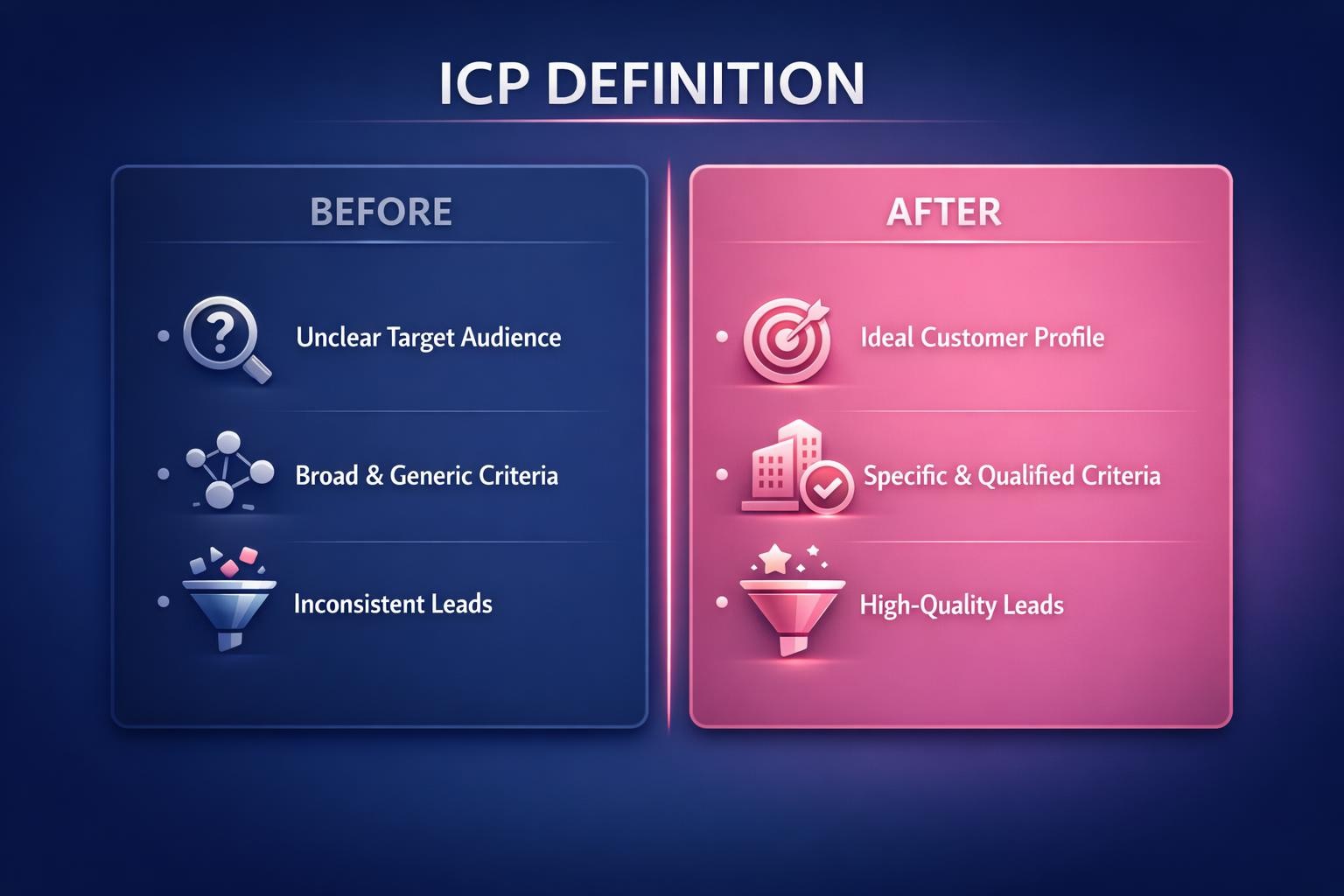
An ideal customer profile (ICP) is a description of the type of company that is the best fit for your product or service. An ICP definition identifies account-level fit, while a buyer persona can separately describe the people involved in evaluating or using the solution. A useful ICP helps revenue teams decide which accounts to prioritize, why they fit, and which evidence should change that judgment.
Salesforce’s guide to ideal customer profiles identifies firmographic, technographic, behavioral, and environmental characteristics as useful inputs. Those inputs become practical when they are documented, owned, applied in the workflow, and revised from customer and deal evidence. The seven strategies below cover that full cycle.
Strategy 1: Define the company, not a fictional individual
Start with the account you want the business to serve. Describe the company characteristics that affect fit, the problem the company needs to solve, the outcome it wants, and the conditions that make adoption realistic. Keep buyer roles in a separate persona or buying-group document so the ICP does not become a list of job titles.
Write the definition in language that sales, marketing, customer success, and product teams can apply consistently. The goal is not to describe every company that could buy. It is to identify the types of companies most likely to receive meaningful value from the solution and support a durable commercial relationship.
Strategy 2: Build the criteria from evidence
Analyze current customers before choosing attributes. Review CRM data, revenue, sales-cycle patterns, product usage, retention, and customer feedback. Look for characteristics shared by customers that are a strong product fit, use the product successfully, and remain valuable over time. Compare those patterns with lost or poor-fit accounts so the definition includes evidence about exclusion as well as inclusion.
Run a six-month opportunity audit to test how the current definition performs. Break results down by segment, deal size, and representative, and compare the data with the narrative used in pipeline discussions. Select two or three clear improvements, give each one an owner and measurable goal, and review the result after 90 days.
Strategy 3: Document positive and negative ICP criteria
A complete set of criteria should cover more than company size. Record the firmographic attributes that matter, such as industry, geography, revenue range, employee count, and growth profile. Add technographic fit, including the systems or integration environment that affect adoption. Then document the business problem, desired outcome, relevant buying trigger, and any environmental or regulatory condition that changes fit.
State disqualifiers explicitly. Examples might include an unsupported geography, a required integration the product cannot meet, no relevant business problem, or a delivery model that conflicts with the offer. These are examples of how to express a boundary, not universal rules. Each criterion should reflect evidence from the company’s own customers and product constraints.
Strategy 4: Use a practical ICP template
Keep the profile concise enough to use in account selection and qualification. A working template can contain the following fields:
- Segment name and owner: the specific ICP version and the leader responsible for maintaining it.
- Firmographic fit: industry, geography, company size, revenue or employee range, and growth characteristics that matter.
- Technographic fit: relevant systems, integrations, data environment, and technical constraints.
- Problem and outcome: the business problem the offer addresses and the outcome the customer is trying to achieve.
- Buying trigger and barrier: evidence that the need is active and conditions that may prevent progress.
- Positive evidence: the CRM, product-usage, customer-feedback, or market evidence supporting the criterion.
- Exclusion criteria: conditions that make the account a poor fit even when other attributes match.
- Review date: when the team will compare the profile with new wins, losses, retention, and product evidence.
If the business serves materially different segments or use cases, maintain separate profiles rather than stretching one ICP until it stops guiding decisions. Use consistent fields across profiles so results can still be compared.
Strategy 5: Assign ownership and embed the ICP
Name one leader who is accountable for the definition, its measures, and its revision. That owner should coordinate input from sales, marketing, customer success, and product, while keeping final decisions and review dates visible. A permanent owner prevents the ICP from becoming a workshop artifact that no one maintains.
Translate the profile into the workflow. At the relevant stage, specify which fit fields must be known, what evidence supports them, and who is accountable for resolving gaps. Teach the standard, reinforce it in manager reviews, and make the current version available where representatives research and qualify accounts.
Strategy 6: Measure fit without confusing activity with evidence
Track outcomes by ICP segment rather than assuming the definition works. Useful lagging measures include stage conversion, win rate, cycle time, average deal size, retention, and product usage where those data are available. Earlier signals can include stakeholder engagement, content consumption, mutual action plan progress, and deal velocity.
Email, call, and task volume alone do not prove fit. When activity rises but opportunities do not progress, inspect the account criteria, buyer evidence, and stakeholder coverage. Review live opportunities with representatives so managers can distinguish an unclear ICP rule from a coaching, qualification, or execution problem.
Use connected CRM and engagement data to make the evidence easier to review. Teams evaluating that workflow can explore Revspire Account Intelligence.
Strategy 7: Refine the ICP from outcomes
Capture evidence from won and lost deals through CRM analysis, post-deal interviews, structured reviews, and feedback from customers. Document which criteria correctly predicted fit, which criteria excluded a valuable account, and which supposed signals did not hold up. Feed those findings into the profile, qualification guidance, training, and account-selection process.
Review the selected measures against their targets each quarter, but avoid changing the definition because of one memorable deal. Look for a repeated pattern across accounts and segments. When a change is justified, record the evidence, owner, decision date, and next review date so the team knows which version is current and why it changed.
An effective ICP is therefore both a clear definition and a maintained decision tool: company-level criteria, explicit exclusions, evidence, ownership, workflow rules, and a feedback loop. Request a Revspire demo to discuss how to operationalize that approach.