Revspire blog
AI CRM Enrichment: 7 Strategies the Top Revenue Teams Use in 2026
Use seven AI CRM enrichment strategies to define useful sales signals, connect source systems, check CRM records, coach live deals, and improve workflows.
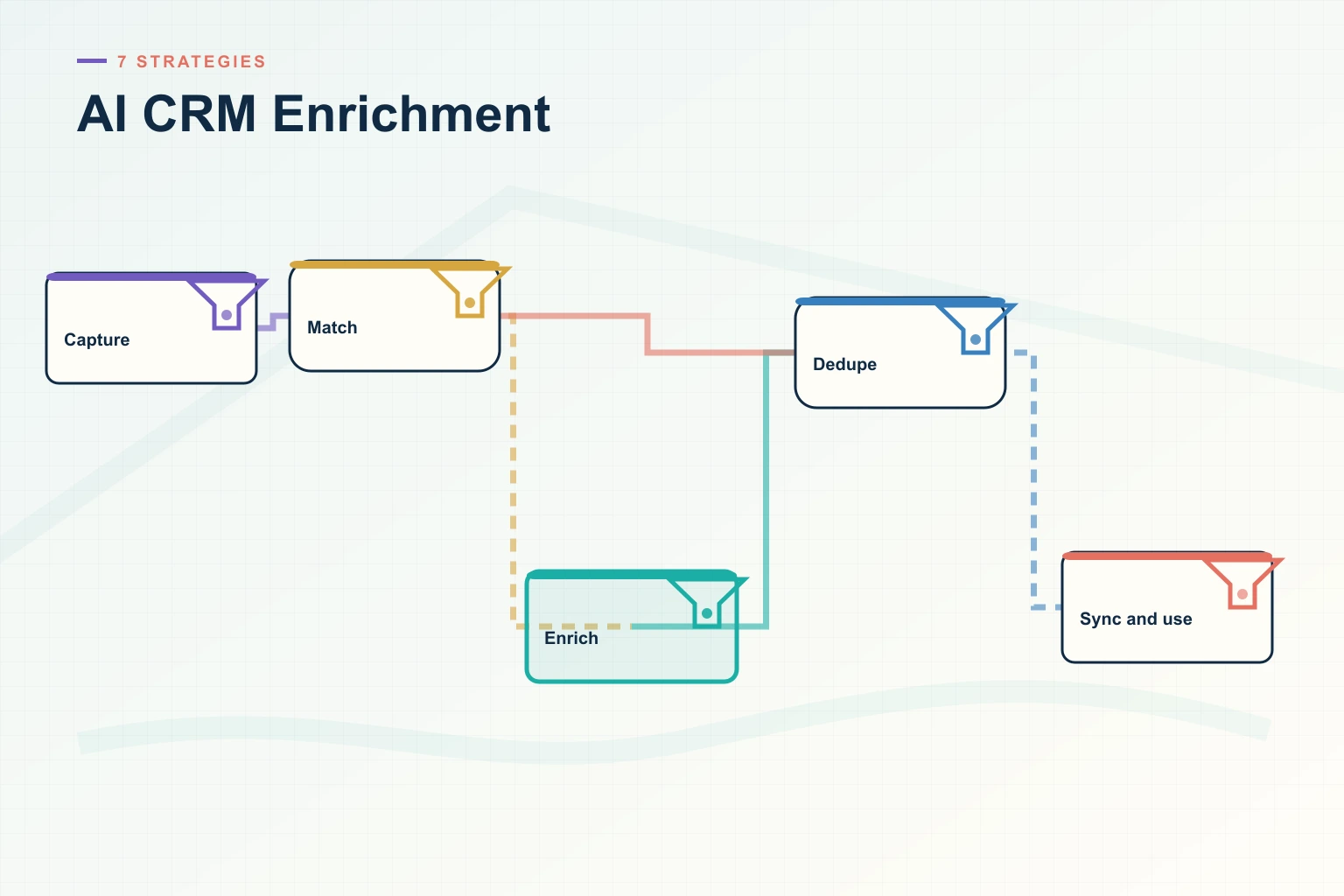
The supplied evidence does not include a comparative study, performance definition, or methodology proving that these practices are unique to top-performing revenue teams. The preserved title reflects the canonical source title; the article itself presents seven evidence-backed operating strategies without claiming verified performance superiority.
Here, AI CRM enrichment means selecting useful CRM and deal signals, connecting the systems that supply them, checking the resulting records against deal evidence, and using that information in sales execution. The sources support this operational scope. They do not document external data vendors, record-matching algorithms, enrichment models, or other technical AI implementation details.
1. Define the Fields and Signals That Matter
Begin with the decisions the enriched CRM record must support. An operating model for AI CRM Enrichment answers three questions: what actions should happen, at what stage, and who is accountable.
Translate those questions into a documented field and signal set. The supplied sources identify stakeholder engagement, content consumption, mutual action plan progression, deal velocity, conversion rates, time in stage, and stakeholder coverage as useful inputs. For each input, document its meaning, its stage relevance, and the person responsible for acting on it. This establishes practical governance without collecting fields that have no defined use.
2. Connect the Systems That Supply the Record
Technology should serve the AI CRM data enrichment sales process, not define it. The source material identifies CRM, engagement-platform, and deal-room systems as parts of the data flow.
Data should flow automatically between systems — CRM, engagement platform, deal room — so that leaders always have a current, accurate view of what is happening across the portfolio. Document which system supplies each signal, which system owns the working record, and where manual updates remain. Review any manual handoff that delays or obscures the information used during a deal.
For more information about the company and its approach, see Revspire AI Intelligence.
3. Establish a Baseline and Check Record Quality
Before you can improve AI CRM Enrichment, you need an honest baseline. Pull the last six months of deal data, map opportunities against the sales stages, and identify where deals fall out.
Break the review down by representative, segment, and deal size. Compare CRM fields and recorded signals with the team’s account of each opportunity. When the record and the deal narrative disagree, inspect the underlying opportunity before changing the process. This check helps identify missing, stale, or inconsistently interpreted information while preserving a defined baseline for later comparison.
4. Pair Leading Signals With Outcome Measures
Lagging metrics like win rate and quota attainment tell you what happened. Leading indicators provide earlier evidence about deal activity and movement.
Define three to five leading indicators for AI CRM Enrichment and track them weekly. Pair them with relevant outcome measures, including conversion rate, cycle time, average deal size, forecast accuracy, representative ramp time, or customer acquisition cost. Build a dashboard that shows both. Review it weekly. Tie it directly to coaching conversations and territory reviews.
A weekly review also provides a practical freshness check: if a required signal has not changed when the deal has moved, the team can examine the record and its source system rather than assuming the data is current.
5. Apply Enriched Information During Deal Coaching
Use enriched CRM and deal information in the weekly pipeline cadence. Managers can review stage movement, stakeholder engagement, content consumption, mutual action plan progression, and stakeholder coverage for each live opportunity.
Generic training rarely moves the needle on AI CRM Enrichment. Deal-level coaching makes the discussion specific: the manager and representative can identify which signal is missing, which recorded detail conflicts with the opportunity, and what should change during the next seven days.
Three-part explainer: Set the standard, Embed the practice, and Scale what works.
6. Feed Win-Loss Findings Back Into the Record and Playbook
Every won and lost deal contains insights about what works and what does not in your approach to AI CRM Enrichment. Capture those findings through post-deal interviews, CRM data analysis, and structured win-loss reviews.
After a significant loss, spend thirty minutes with the representative reviewing the relevant sales-process breakdowns. Record the findings consistently, determine whether an existing field or signal was missing or misread, and update the playbook when a recurring pattern supports a change.
7. Maintain Ownership and a Recurring Improvement Loop
Assign a permanent owner to the enrichment process. Review the selected metrics against targets, update playbooks when the team learns something new, and solicit buyer feedback about the sales experience.
Use the assessment to prioritize two or three improvements rather than changing every field and workflow at once. Deploy them with a clear owner, a measurable goal, and a 90-day review cadence. At the review point, compare the results with the baseline and document the next adjustment.
Common AI CRM Enrichment Execution Risks
Three-part explainer: Recognize the leak, Correct the behavior, and Prevent repeat failure.
Do Not Confuse Activity With Progress
Measure outcomes, not activities. Track stage progression velocity, buyer engagement quality, and stakeholder coverage breadth. When activity is high but deal outcomes remain weak, inspect the opportunity and its recorded signals instead of simply requesting more activity.
Do Not Depend on One Active Contact
Map the stakeholders involved in the deal, assign coverage, and track engagement with each person. Flag opportunities where only one contact is active so the team can review the relationship risk.
Do Not Let Definitions Drift
Keep field meanings, ownership, stage criteria, and review rules in the documented playbook. When teams interpret the same signal differently, the CRM record becomes less dependable even if every field is populated.
Do Not Treat Enrichment as a Finished Project
Keep enrichment in the operating cadence and revise the process when recurring deal evidence supports a change. This maintains a feedback loop between source systems, CRM records, coaching, and measured outcomes.
Ready to apply the seven strategies? Book a Revspire demo.