Revspire blog
Customer Acquisition Cost: Seven Sales-Execution Practices to Review
A source-bounded review of seven sales-execution practices associated with Customer Acquisition Cost, with CAC calculation and evidence limits stated clearly.
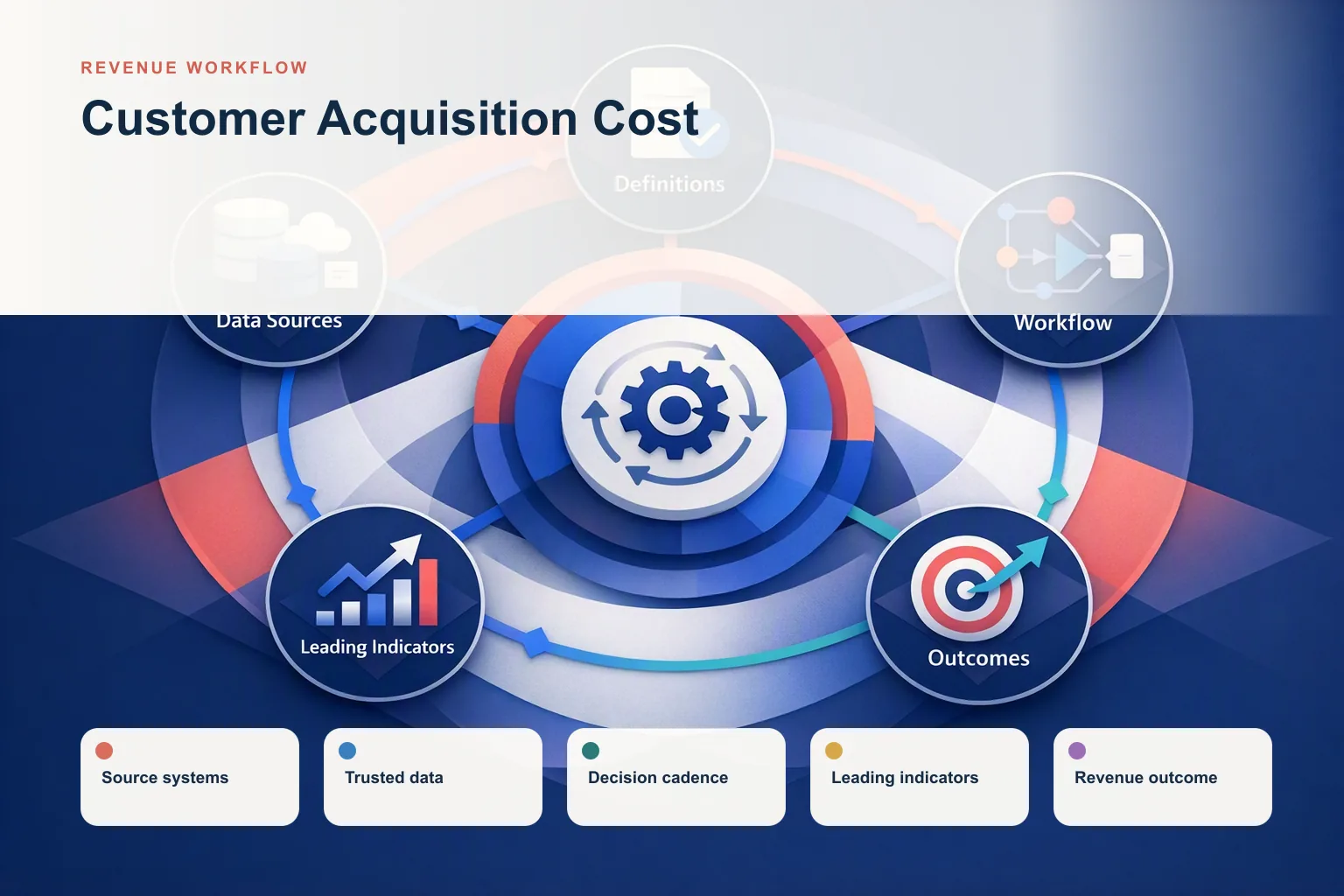
The supplied sources discuss Customer Acquisition Cost alongside deal stages, pipeline reviews, coaching, stakeholder engagement, win-loss analysis, and sales technology. The practices below are presented as sales-execution guidance, not as a CAC formula or a CAC-payback calculation.
Seven Practices From the Source Set
1. Establish an Honest Baseline
Before you can improve Customer Acquisition Cost, you need an honest baseline. The source recommends reviewing the last six months of deal data and identifying where opportunities leave the process.
Start with an honest audit. Compare the available data with the team’s narrative and prioritize a limited number of improvements.
2. Document the Operating Model
An operating model for Customer Acquisition Cost answers three questions: what actions should happen, at what stage, and who is accountable. Document this explicitly.
3. Track Leading and Lagging Indicators
Lagging metrics such as win rate and quota attainment describe what happened. The target source presents stakeholder engagement, content consumption, mutual action plan progression, and deal velocity as possible leading indicators. These are deal-execution indicators in the supplied material, not a calculation of CAC or CAC payback.
Three-part explainer: Audit the current state, Build the operating model, and Measure and improve.
4. Review the Indicators Weekly
Build a dashboard that shows both. Review it weekly. Tie it directly to coaching conversations and territory reviews.
5. Use Deal-Level Coaching and Outcome Measures
The target source recommends reviewing live opportunities with each representative, identifying where execution breaks down, and working through the next action in context. Measure outcomes, not activities. The supplied material applies this principle to stage progression, buyer engagement, and stakeholder coverage.
6. Capture Win-Loss Findings
The Fix: Implement a structured loss review process. After a significant lost deal, the source recommends documenting the findings and updating playbooks accordingly.
7. Evaluate Technology and Feedback Loops
The technology layer for Customer Acquisition Cost should reduce friction, not add it. The source discusses data movement across CRM, engagement, and deal-room systems.
The source set also includes a reference to Revspire Revenue Analytics. No product-capability or comparative-performance claim is made here.
Three-part explainer: Trace spend to customers, Compare CAC and payback, and Shift to efficient growth.
Measurement Limitation
This article does not define a standard CAC formula, specify which acquisition costs to include, establish a measurement period, or define CAC payback. Approved evidence is required before those elements can be added. The unsupported claim that top SaaS companies achieve CAC payback in under 12 months has been omitted.