Best Buyer Enablement Tools and Software in 2026: 11 Tools by Buyer Job
A practical perspective for connecting this idea to your revenue team’s next move.
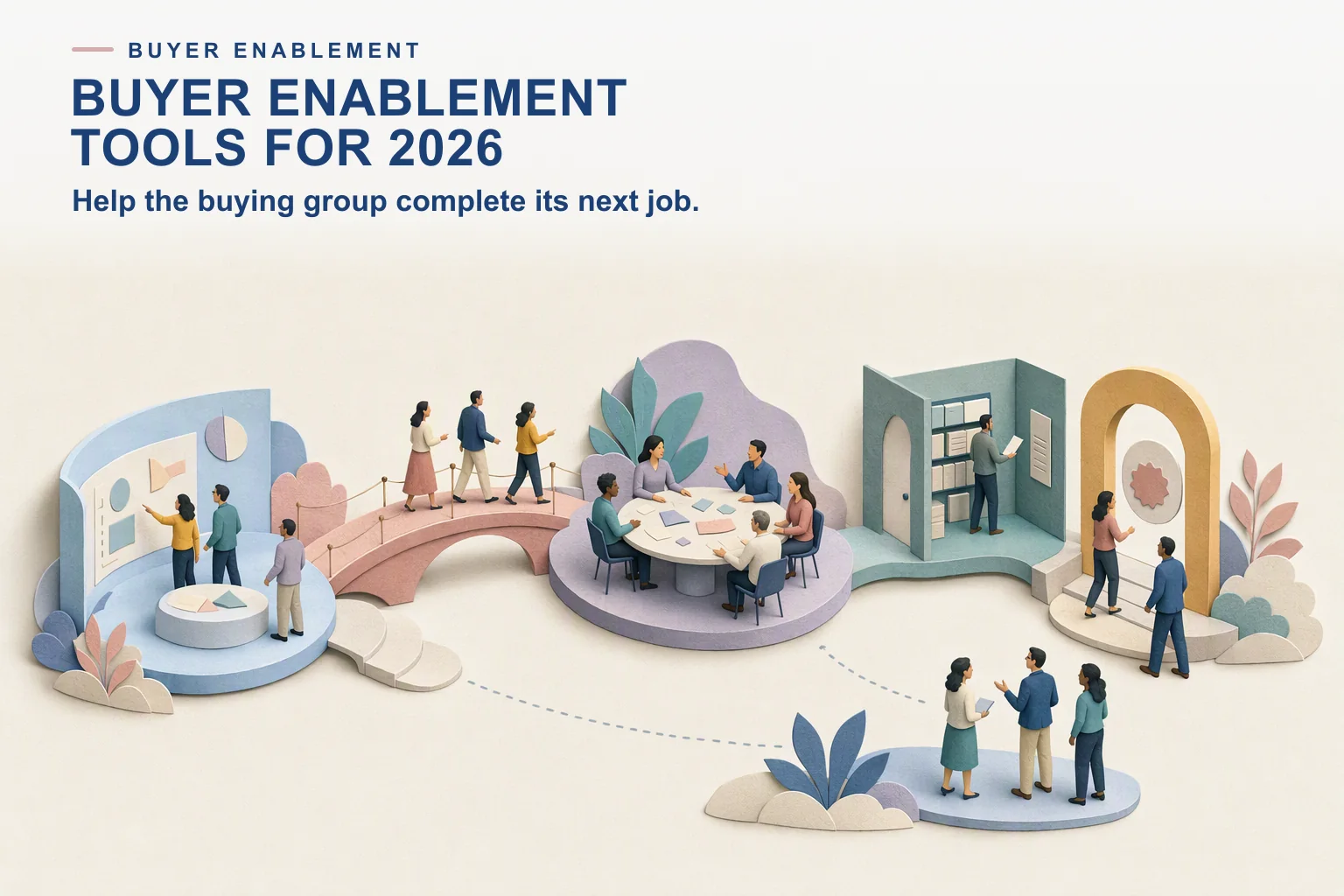
The best buyer enablement tools depend on the job the buyer is stuck on. To explore the product alone, look at Navattic or Storylane. To build a business case, Cuvama or Ecosystems. To align the buying group, a deal room such as Aligned, Dock, Trumpet or Revspire. To review documents, DocSend or Papermark. To approve a proposal, Qwilr.
Buyer enablement means giving buyers what they need to make a decision without waiting for a seller. Most buyer enablement software lists are written by one category of vendor. This guide groups 11 tools by the buyer’s job, with published pricing, one limitation each and when to choose them.
Last updated: 27 October 2026
Disclosure: Revspire publishes this list. Revspire has one entry, in the buying group alignment group, and is not ranked above other tools. Tools are grouped by buyer job and listed alphabetically within each group. Every price and feature below was checked on the vendor’s own website on 27 October 2026.
Buyer enablement software compared: summary table
Tool
Buyer job
Best for
Published pricing (checked 27 Oct 2026)
Navattic
Explore the product alone
Website and sales demos
Free Starter; Base and Growth prices not shown
Storylane
Explore the product alone
Published tiers
Free; Starter $50, Growth $625, Premium $1,500 a month (monthly billing)
Cuvama
Build the business case
Value cases from discovery
Quick-Start Packs from $10k; platform fee not shown
Ecosystems
Build the business case
Collaborative value assessments
Not published (request form)
Aligned
Align the buying group
Low per-seat deal rooms
Free; Basic $29, Pro $49 per seat a month (annual)
Dock
Align the buying group
Rooms through onboarding
Free; Standard $350 a month (5 users); Premium $1,000 a month (10 users)
Revspire
Align the buying group
Large buying committees
Per module, unlimited user licenses; about $25,000 USD a year
Trumpet
Align the buying group
Interactive rooms and widgets
Free; Pro $45, Scale $100, Elite $160 per user a month
DocSend
Review documents
Tracked document links
Personal $10, Standard $45 per user a month; Advanced $150 a month (3 users)
Papermark
Review documents
Low-cost data rooms
Free; Pro €24, Business €59, Data Rooms €99 a month
Qwilr
Approve the proposal
Interactive web proposals
Starter $35, Growth $55, Scale $75 per user a month (annual)
List prices from each vendor’s site, 27 October 2026 (Papermark shows euros). Entries below link each page.
What is buyer enablement software, and why now?
Buyer enablement software helps the buying group learn, evaluate and agree on their own time. The case for it comes from how buyers say they want to buy. Gartner’s survey of 646 B2B buyers (August to September 2025) found 67% prefer a rep-free experience and 45% used AI during a recent purchase; Gartner names “value clarity” as the enablement priority (Gartner, 9 March 2026).
Buying groups also struggle to agree. In Gartner’s survey of 632 B2B buyers (August to September 2024), 74% of buyer teams showed unhealthy conflict during the decision, and buying groups that reached consensus were 2.5 times more likely to report a high-quality deal (Gartner, 7 May 2025). That is an association, not proof that any tool creates consensus, but it explains why so many buyer enablement tools focus on the group rather than one contact.
Map tools to the buyer’s jobs rather than to your sales stages:
- Explore the product alone before or between calls.
- Build a business case the champion can defend to finance.
- Align the buying group on content, steps and dates in one place.
- Review documents securely, from security packs to contracts.
- Approve the proposal and sign without another meeting.
Our guide to B2B buyer enablement covers strategy; this page covers the tools.
Tools for exploring the product alone
Interactive demos let buyers click through the product without a call. Our interactive demo software guide and Navattic vs Storylane go deeper.
Navattic
- What it does: interactive demos buyers explore on their own schedule, with personalised paths by product area, persona or use case; Navattic Agents guide and qualify prospects, answer questions and demo workflows (Navattic).
- Pricing: Starter free (1 seat, 1 demo); Base (5 seats) and Growth (10 seats) billed annually with no price shown; Enterprise custom; Agents is an add-on billed by conversations and agents (Navattic pricing, checked 27 October 2026).
- Limitation: sandbox demos and SSO appear from Growth up, not on Base.
- Choose it when: buyers should self-qualify on your website before talking to sales.
Storylane
- What it does: interactive demos with account reveal and, from Growth, HTML demos, personalisation tokens and deal intelligence; Premium adds Hubs, which Storylane describes as buyer deal rooms (Storylane pricing).
- Pricing: Free (1 seat, 1 published demo); Starter $50 a month (1 seat); Growth $625 a month (5 seats); Premium $1,500 a month (10 seats); yearly billing is shown as 20% off; Enterprise custom (checked 27 October 2026).
- Limitation: sandbox demos are listed only on Enterprise, and the Salesforce integration starts at Premium.
- Choose it when: you want to start small at a published price.
Tools for building the business case
Champions have to sell internally. Value tools turn discovery into a quantified case the buyer can share. Our business case template is a free starting point.
Cuvama
- What it does: an AI-native discovery and value case platform; the value case updates as assumptions are confirmed, champions can circulate it internally, and CRM integration shows sellers their next step (Cuvama).
- Pricing: Quick-Start Packs from $10k, then $250 per Discovery Case and $500 per Value Case, with no annual commitment; the unlimited Platform Fee model has no price shown; indicative annual ranges run from $65k to $450k and are labelled “not quotes” (Cuvama pricing, checked 27 October 2026).
- Limitation: at the indicative ranges shown, it is a significant budget line, aimed at teams that run a value motion across the pipeline.
- Choose it when: deals are lost because the buyer cannot justify the spend.
Ecosystems
- What it does: a value selling platform with a Collaborative Value Assessment to “co-create an interactive business case”, ROI and TCO models, a web value calculator for buyers, and value tracking after the sale (Ecosystems).
- Pricing: not published; the pricing page is a request form (Ecosystems pricing, checked 27 October 2026).
- Limitation: no prices or tiers are shown before a sales conversation.
- Choose it when: customer success also needs to prove value after the sale.
Tools for aligning the buying group
A digital sales room gives the whole group one link for content, a mutual action plan and questions. Our digital sales room comparison covers more rooms.
Aligned
- What it does: deal rooms with mutual action plans and a stakeholder map on every plan; Pro adds AI Client Assist and AI room generation (Aligned pricing).
- Pricing: Starter free; Basic $35 a seat a month or $29 on annual billing; Pro $60 or $49; Enterprise custom; buyer stakeholders never cost a seat (checked 27 October 2026).
- Limitation: full two-way Salesforce and HubSpot sync is Enterprise only.
- Choose it when: you want rooms in every deal at a low per-seat cost.
Dock
- What it does: shared workspaces with a content library, playbooks, courses and order forms (Dock pricing); its mutual action plan template adds milestones, owners on both sides and engagement tracking (Dock MAP template).
- Pricing: Free; Standard $350 a month with 5 users; Premium $1,000 a month billed annually with 10 users; extra seats $50 a month; Enterprise custom; external collaborators free (checked 27 October 2026).
- Limitation: the free plan excludes the Salesforce and HubSpot integrations.
- Choose it when: one workspace should run from evaluation to onboarding.
Revspire
- What it does: Revspire is an AI sales enablement platform. Its Digital Sales Rooms give each deal a branded, secure room with mutual action plans that have owners and due dates, AI stakeholder mapping that flags deal risks, AI content recommendations by deal stage and stakeholder role, and real-time engagement analytics. Rooms draw on approved, current assets from Content Hub, and CPQ is available as an add-on module for quotes and proposals.
- Pricing: priced by module with unlimited user licenses; about $25,000 USD a year on average (Revspire pricing).
- Limitation: Revspire’s site describes no interactive demo or buyer-facing ROI calculator feature, so pair it with a tool from those groups if buyers expect to explore the product or model value alone.
- Choose it when: large buying committees need curated, governed content and a shared plan in one room.
Trumpet
- What it does: rooms (“Pods”) with mutual action plans, video, voice and notes, stakeholder mapping, and Canvas widgets such as ROI calculators; integrations include Salesforce, HubSpot, Gong, Slack and DocuSign (Trumpet).
- Pricing: Free; Pro $45 a user a month or $450 a year; Scale $100 or $1,000; Elite $160 or $1,600 (Trumpet pricing, checked 27 October 2026).
- Limitation: Copilot and the full AI suite are on Elite only.
- Choose it when: you want interactive elements, not only documents, in the room.
Tools for reviewing documents
Sometimes the buyer only needs a secure link to a security pack or contract, with page-level analytics for the seller. DocSend vs Papermark compares the two.
DocSend
- What it does: tracked document links with analytics, eSignature, file requests and, from Advanced, lightweight data rooms (Spaces), visitor email authentication, watermarking and NDA gating (DocSend pricing).
- Pricing: Personal $10 and Standard $45 per user a month; Advanced $150 a month and Advanced Data Rooms $180 a month, each with 3 users; 14-day trial of Advanced Data Rooms (checked 27 October 2026).
- Limitation: data rooms start at the $150 Advanced plan, and the page shows monthly prices only.
- Choose it when: buyers review sensitive documents and you want to see who read what.
Papermark
- What it does: document sharing with page-by-page analytics on every plan, custom domains from Business and unlimited data rooms with NDAs and watermarks on Data Rooms; the code is on GitHub and a self-hosted option is listed for Enterprise (Papermark pricing).
- Pricing: Free (50 documents); Pro €24 a month; Business €59 a month with 3 users; Data Rooms €99 a month; annual billing shown as saving up to 35% (checked 27 October 2026).
- Limitation: prices are shown in euros, and the page is inconsistent about whether lower plans include data rooms.
- Choose it when: you want low-cost data rooms or a self-hosting option.
Tools for approving the proposal
Qwilr
- What it does: web-based proposals with interactive quote blocks, an ROI calculator, e-sign and analytics on every plan; Scale adds the Salesforce integration, AI Prefill and conditional content (Qwilr pricing).
- Pricing: Starter $35 a user a month annual or $49 monthly; Growth $55 annual only, minimum 5 seats; Scale $75 annual only, minimum 10 seats; 14-day Starter trial (checked 27 October 2026).
- Limitation: the Salesforce integration is only on Scale, with a 10-seat minimum.
- Choose it when: buyers should adjust options and accept the proposal on one page.
Sales enablement vs buyer enablement: what is the difference?
Sales enablement prepares sellers: content, training, playbooks and coaching. Buyer enablement prepares the buying group: what they see, explore and share without the seller in the room. The two meet in the deal room, where approved content from the seller’s library reaches the buyer. If your sellers cannot find the right asset, fix sales enablement first, because a buyer-facing room filled with outdated content does not help anyone.
How do you choose buyer enablement tools?
- Ask lost buyers where they stalled. Product understanding, budget justification and internal agreement each point to a different group above.
- Count the buyer seats. Aligned and Dock do not charge for buyers or external collaborators; confirm the rule in writing for any tool you shortlist. Revspire includes unlimited user licenses on every plan, sellers included.
- Check what the champion can forward. A login wall may protect content but stop it spreading through the buying group.
- Keep content governed. Rooms and demos should pull from the current approved version, not a copy. In Revspire, rooms draw on the approved asset in Content Hub, and versioning keeps links already shared pointing at the current version.
- Measure the buyer, not the rep. Track which stakeholders engaged and when, not only how many rooms were created.
If buying committees are where your deals stall, book a Revspire demo of digital sales rooms.
Frequently asked questions
What is buyer enablement software?
Buyer enablement software helps buyers make a decision on their own time: interactive demos, business case tools, digital sales rooms, secure document sharing and interactive proposals. It focuses on the buying group rather than on the seller.
What is a buyer enablement platform?
Usually a digital sales room that combines content, a mutual action plan, stakeholder engagement and messaging in one shared space for each deal. Some platforms add interactive demos or business case tools; most teams combine two or three tools.
What is the difference between sales enablement and buyer enablement?
Sales enablement equips sellers with content, training and playbooks. Buyer enablement equips buyers with what they need to evaluate and agree. The two connect where sellers share approved content with buyers.
What does Gartner say about buyer enablement?
Gartner’s March 2026 release reports that 67% of B2B buyers prefer a rep-free experience and names value clarity as the enablement priority. It recommends AI agents that serve buyers and sellers, modular content and enablement built into the tools sellers already use.
What are examples of buyer enablement tools?
Interactive demo tools such as Navattic and Storylane, value tools such as Cuvama, digital sales rooms such as Aligned, Dock and Trumpet, document sharing such as DocSend and Papermark, and proposal tools such as Qwilr.
Sources
- Gartner Sales Survey Finds 67% of B2B Buyers Prefer a Rep-Free Experience, Gartner, 9 March 2026, accessed 27 October 2026
- Gartner Sales Survey Finds 74% of B2B Buyer Teams Demonstrate Unhealthy Conflict During the Decision Process, Gartner, 7 May 2025, accessed 27 October 2026
- Navattic homepage and Navattic pricing, Navattic, undated, accessed 27 October 2026
- Storylane pricing, Storylane, undated, accessed 27 October 2026
- Cuvama homepage and Cuvama pricing, Cuvama, undated, accessed 27 October 2026
- Ecosystems homepage and Ecosystems pricing, Ecosystems, undated, accessed 27 October 2026
- Aligned pricing, Aligned, undated, accessed 27 October 2026
- Dock pricing and Dock mutual action plan template, Dock Labs, undated, accessed 27 October 2026
- Trumpet homepage and Trumpet pricing, Trumpet, undated, accessed 27 October 2026
- DocSend pricing, DocSend, undated, accessed 27 October 2026
- Papermark pricing, Papermark, undated, accessed 27 October 2026
- Qwilr pricing, Qwilr, undated, accessed 27 October 2026