Mutual Action Plans: The Secret Weapon for Shortening Your B2B Sales Cycle
A practical perspective for connecting this idea to your revenue team’s next move.
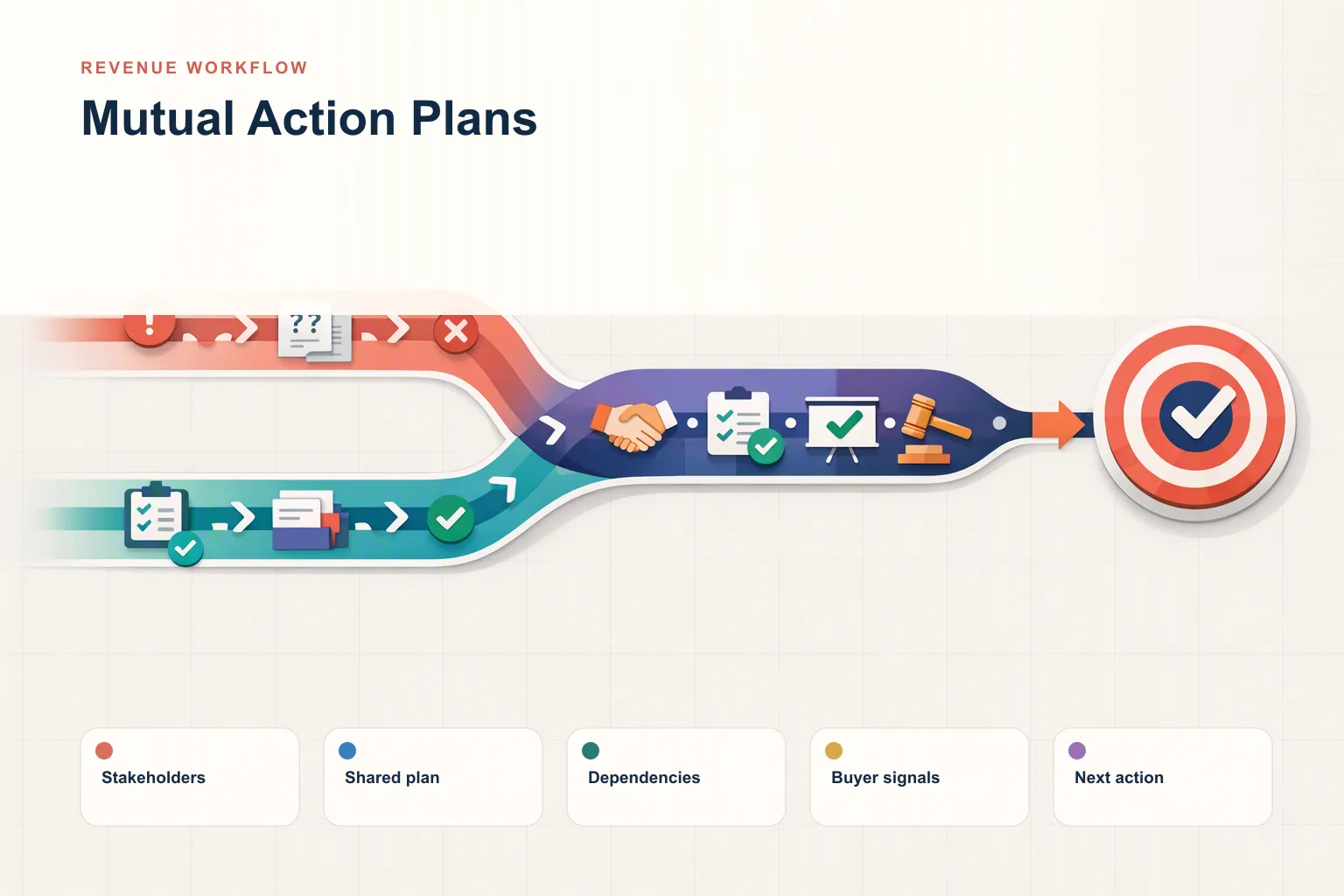
For many sales leaders, vague next steps are a recurring warning sign in deals. “I will check with my team.” “We are still in the internal evaluation phase.” “Things are moving but we need a bit more time.” These are not objections – they are symptoms of a deal with no shared structure. And the fix is not more follow-up emails. It is a Mutual Action Plan.
What a Mutual Action Plan Actually Is
A Mutual Action Plan (MAP) is a shared, co-owned document between buyer and seller that defines the steps, owners, dependencies, and dates required to reach an agreed business outcome. It covers both sides of the deal: the seller’s commitments and the buyer’s internal decisions, reviews, and approvals.
Done well, a MAP transforms the sales process from a seller-led pitch sequence into a collaborative project with joint accountability. The buyer is not watching you present your roadmap. They are contributing to theirs.
This is not a polished follow-up email or a seller’s private close plan. A useful MAP gives everyone one current answer to five questions: what outcome are we working toward, what has to happen next, who owns it, when is it due, and what could block it?
A MAP supplies the shared evidence and next-step structure; the seller still needs to ask for the right commitment at the right moment. Use Revspire’s guide to closing a sale and practicing closing techniques with AI to rehearse that decision conversation.
Why MAPs Compress Sales Cycles
Three-part explainer: What a Mutual Action Plan Actually Is, How to Build a MAP That Actually Gets Used, and MAPs in Practice: What Top Teams Observe.
Sales cycles stretch for three primary reasons: unclear next steps, invisible internal processes, and diffuse accountability. MAPs address all three.
Clarity eliminates stalling
When both parties have agreed that Legal will complete security review and Procurement will return the redlined MSA by a specific date, the next step is observable. A missed date becomes a signal to resolve a dependency, not a surprise discovered three weeks later in a pipeline review.
Visibility exposes the buyer’s real decision process
Most deals do not stall because the champion suddenly changed their mind. They stall because procurement, legal, finance, security, or an executive approver has a process the seller never mapped. A MAP prompts that conversation early: Who must be involved? What evidence will each person need? What is the normal review sequence? Which dates are fixed? Building those answers into the plan prevents a hidden six-week process from appearing in month four.
Shared ownership changes the working relationship
When buyers contribute milestones and accept ownership, the plan reflects their route to a decision rather than the seller’s desired close date. That shared authorship creates practical accountability: both parties can see what they committed to, what changed, and what needs attention.
The Anatomy of a Useful MAP
A MAP should be detailed enough to guide the deal but short enough for buyers to use. These elements make the difference between a working plan and a decorative checklist:
Element
What to capture
Why it matters
Buyer outcome
The operational result and target go-live date the buyer cares about
Keeps the plan anchored to business value rather than the seller’s quarter
Decision path
Decision criteria, required stakeholders, approvals, and review sequence
Makes the internal buying process visible before it becomes a delay
Milestones
Six to eight meaningful outcomes, such as technical validation or contract approval
Shows progress without turning the MAP into a 47-line project plan
Owners
One named buyer or seller owner for every milestone
Prevents responsibility from disappearing into “the team”
Dates and dependencies
Due dates, prerequisite work, and fixed events
Reveals the critical path and the consequence of a slip
Completion evidence
The decision, document, sign-off, or result that marks a milestone complete
Separates real progress from calls, emails, and other activity
How to Build a MAP That Actually Gets Used
Most MAPs fail because the seller builds one alone, sends it as a static attachment, and asks the buyer to follow it. Build the first version during a live conversation instead. The buyer’s language, dates, and owners should appear in the plan from the beginning.
- Start with the outcome and work backward. A target such as “live before the summer renewal window” is more useful than “close by the end of Q2.” Identify the last responsible decision date, then sequence the approvals and validation work needed to reach it.
- Map the buying committee. Do not build the plan around one enthusiastic contact. Name the people responsible for business approval, technical validation, security, legal, procurement, and executive sign-off. If an important role has no owner or engagement, make that gap visible.
- Use milestones, not seller activity. “Send case study” records an action; “Finance validates the business case” records progress. Reserve the MAP for outcomes that change the state of the decision.
- Give both sides work. Seller tasks may include providing security evidence or a revised proposal. Buyer tasks may include confirming success criteria or scheduling a committee review. A plan containing only seller tasks is not mutual.
- Keep it in the shared deal environment. When the MAP lives in a Digital Sales Room, the buyer sees the current plan alongside the content and conversations it depends on. Revspire embeds MAPs directly in the Deal Room, so both sides can return to the same working version.
- Update it together. Dates will move and stakeholders will change. Review the consequences, assign the next action, and record the change while both sides are present. A stale plan creates false confidence.
Common MAP Failure Modes and Their Fixes
The plan is seller-owned
If a buyer never edits, validates, or accepts the plan, treat that as a signal. Reopen the discussion around their outcome and internal process. Mutuality is demonstrated by participation, not by putting the word “mutual” in the document title.
The deal is single-threaded
A plan owned through one champion can collapse when that person goes quiet, changes roles, or lacks authority. Track coverage across the buying committee and flag a deal when a required role has no engaged owner. The goal is not to contact everyone indiscriminately; it is to make sure every necessary decision has a responsible participant.
Activity is mistaken for progress
Emails, calls, and document views can be useful signals, but they are not completed buyer milestones. Review stage progression, milestone completion, buyer engagement quality, stakeholder coverage, and unresolved dependencies together. High activity paired with no buyer-owned progress is a reason to diagnose the deal, not to schedule more activity.
Legal and procurement appear too late
Ask about security, legal, finance, and procurement during discovery, then place their expected reviews on the plan. If the customer cannot yet name a date or owner, record the open question instead of inventing precision.
The plan is launched and forgotten
A template is only the starting point. Assign an owner for the MAP operating model, define what good execution looks like at each stage, and keep the playbook current with evidence from real deals.
How Revenue Leaders Operationalize MAPs
Start with a baseline rather than an opinion. Review the previous six months of opportunities by segment, deal size, stage, and rep. Identify where plans were introduced, which milestones commonly slipped, where stakeholder coverage was incomplete, and how those patterns differed across won, lost, and stalled deals. This is a diagnostic exercise, not proof that the MAP alone caused an outcome.
Use leading and lagging measures together:
Measure type
Examples
Management question
Plan quality
Buyer-validated outcome, named owners, dated milestones, documented dependencies
Is this a shared decision plan or a seller checklist?
Leading deal signals
Buyer-owned milestone completion, stakeholder coverage, overdue critical-path items, meaningful engagement
What is likely to block the next decision?
Progress measures
Time in stage, milestone velocity, decision-date movement
Is the deal advancing or merely active?
Lagging outcomes
Win rate, sales-cycle length, forecast accuracy, deal slippage
Are better MAP practices associated with better portfolio outcomes?
Bring MAP health into the weekly deal cadence. A useful review asks what changed, which buyer-owned milestone is next, which dependency is unresolved, and whether the target outcome or date is still credible. Coach from a live opportunity rather than a generic classroom example.
Close the loop after significant wins and losses. Compare the plan with what actually happened, capture missing stakeholders or milestones, and update the template and coaching guidance. Review the aggregate measures quarterly so the operating model evolves without forcing a new process onto reps every week.
MAPs in Practice: What Top Teams Observe
Revenue teams that consistently use embedded MAPs in their deal rooms report two recurring benefits: deals can close faster, and forecast conversations become more evidence-based. When both parties have committed to a timeline in writing, a slip is more likely to surface while there is still time to address it.
The Bottom Line
A Mutual Action Plan is not a paperwork exercise. It is a compact operating system for a complex B2B decision: one buyer outcome, a visible path, named owners, meaningful milestones, and a cadence for resolving risk.
If your Digital Sales Room does not have MAPs built in, you are leaving deal velocity on the table. Pair this with how top teams use DSRs and buyer intent analytics for a complete picture of modern deal management.
See how Revspire embeds Mutual Action Plans in live deal rooms – book a demo.