Revspire blog
How to Close a Sale: 12 Closing Techniques to Practice With AI
A practical guide to 12 ethical B2B closing techniques, buyer-aligned commitments, and an AI practice loop that keeps human judgment in control.
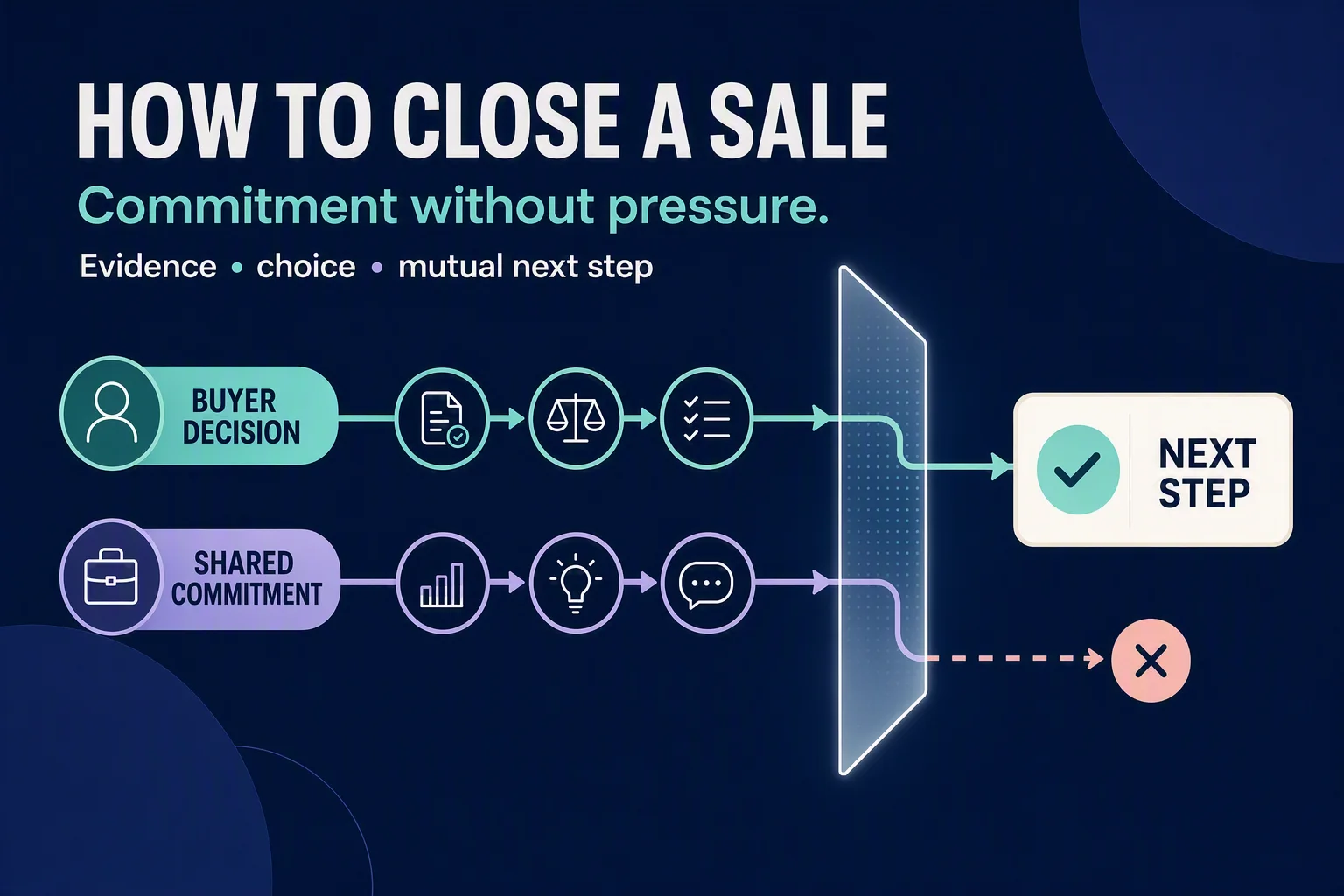
Closing a sale means helping the buyer make a clear, voluntary commitment
Learning how to close a sale in B2B does not begin with a perfect line at the end of a call. It begins by making the decision easier to understand. The seller confirms the buyer’s desired outcome, tests whether the evidence supports the proposed fit, exposes unresolved work, and asks for a commitment that both sides can accurately describe. That commitment may be a technical validation, an introduction to an approver, an agreed decision meeting, a bounded pilot, or a signed agreement.
A closing technique is therefore a decision prompt, not a device for manufacturing consent. It works only when discovery was credible, claims were supported, the right people can participate, and the buyer can say “not yet” or “no” without being punished. This buyer-enablement view is explored more broadly in Revspire’s guide to B2B buyer enablement; here, the focus is narrower: twelve ethical ways to ask for commitment and a disciplined method for practicing those moments with AI.
Closing-technique names are not guarantees. Treat each technique as a hypothesis to test in context. AI can vary responses and accelerate review, but a person must judge what the buyer actually said and whether another ask is appropriate.
A closing technique is ethical only when it preserves buyer choice
Ethical closing reduces ambiguity without hiding material information. It does not invent scarcity, pretend that silence means agreement, bypass a buying policy, or turn a tentative comment into permission. The UK’s Business Protection from Misleading Marketing Regulations prohibit advertising that misleads traders and affects their economic behavior. [1] Legal duties vary by market and situation, so qualified counsel should set the applicable rules; the practical baseline is simpler: claims, dates, options, and constraints must be truthful.
Decision element
Buyer-aligned practice
Pressure pattern to reject
Urgency
Use a real deadline, explain its source, and show what changes after it.
Invent expiring capacity, pricing, executive attention, or another consequence.
Choice
Present viable paths, including pausing or declining, with material tradeoffs.
Offer false alternatives that assume a purchase or conceal a reasonable option.
Agreement
Ask the authorized buyer to confirm scope, owner, date, and decision.
Treat politeness, document opens, silence, or an informal comment as consent.
Evidence
Separate verified facts, buyer estimates, assumptions, and open questions.
Use unsupported ROI, selective proof, fake consensus, or certainty about outcomes.
Autonomy
Leave room for questions, internal review, correction, and a clear no.
Use shame, confusion, fatigue, or repeated escalation to wear resistance down.
The UK Competition and Markets Authority’s evidence review on online choice architecture discusses scarcity cues and information that makes choices harder to evaluate. [2] Its consumer context is not a universal B2B rule, but the ethical warning applies: obstructing evaluation or refusal is not a better close.
Readiness matters more than the wording of the ask
A closing question cannot repair missing discovery, unproven value, or an absent approver. First confirm that the buyer has enough information and organizational coverage. Seller confidence is not buyer readiness.
Readiness check
Evidence to confirm
If the evidence is missing
Problem and outcome
The buyer has stated the change, affected group, priority, and decision consequence.
Return to focused discovery rather than summarizing the seller’s assumptions.
Fit and proof
Required capabilities and constraints have been tested against agreed criteria.
Name the proof gap and agree how the buyer will validate it.
Value
Inputs, assumptions, costs, risks, and expected outcomes have buyer owners.
Keep the case a hypothesis and avoid presenting estimated value as a promise.
People
Users, reviewers, approvers, blockers, and implementation owners are represented.
Ask for the missing perspective instead of asking one contact to speak for everyone.
Process
The buyer has described evaluation, security, legal, procurement, and approval steps.
Map the decision path before attaching a seller-created close date.
Commercial clarity
Scope, price, dependencies, responsibilities, and material terms are understood.
Resolve the ambiguity through the authorized process; do not smuggle it into the ask.
Use Revspire’s sales discovery questions to strengthen the first check and the value-selling and value-realization framework to keep claims connected to buyer-owned evidence. For a complex committee, a documented stakeholder map is more reliable than assuming a supportive contact has final authority.
The smallest truthful commitment is usually the strongest close
In a complex sale, the useful commitment is the smallest one that resolves a real decision dependency. A signature before technical proof creates pressure; another vague meeting creates motion without progress. The right step has a decision purpose, relevant owners, a date, required evidence, and an explicit result.
Commitment level
Buyer-owned outcome
A complete next step
Clarify
Correct the shared understanding of a need or criterion.
The process owner validates the baseline and exclusions by Thursday.
Validate
Test a material claim or workflow.
Security reviews the named controls and returns questions in the shared record.
Include
Bring a required perspective into the decision.
The champion invites finance and the implementation owner to the decision review.
Plan
Agree the path, owners, evidence, and dependencies.
Both teams approve the mutual action milestones and escalation route.
Decide
Authorize, reject, pause, or change the proposed commitment.
The authorized group records its decision after reviewing the agreed evidence.
Do not climb this ladder automatically. A completed validation may uncover a reason to pause or stop. That is a useful decision, not a failed technique. When the path spans several functions, a mutual action plan can keep buyer and seller commitments visible without turning the seller’s target date into the buyer’s obligation.
The 12 techniques solve different commitment problems
Select a technique from the buyer’s decision need, not a favorite script. Practice its intent and boundary; natural wording will change with context.
Technique
Use it when
Buyer-aligned example
Boundary
1. Needs-summary close
Several agreed needs must be brought together.
“You need regional controls, a June launch, and an auditable approval path. Is that accurate, and does this approach meet those requirements?”
Invite correction; never present seller assumptions as buyer agreement.
2. Direct close
The evidence is complete and the authorized buyer is ready to decide.
“Are you ready to approve this scope, or is there a reason we should not proceed?”
Ask once, plainly, and make either answer legitimate.
3. Question close
You need the buyer’s assessment of fit.
“Based on the criteria your team set, where does this still fall short?”
Do not disguise a leading claim as an open question.
4. Trial close
You need to test readiness before a larger commitment.
“If the security evidence is accepted, would the team be ready for a final decision review?”
Treat the answer as diagnostic, not as advance consent.
5. Conditional close
One named dependency appears decisive.
“If we can support that requirement within the agreed scope, what decision would become possible?”
Confirm that other dependencies have not been silently excluded.
6. Alternative-path close
Two genuinely viable routes have different tradeoffs.
“Would a bounded pilot or a full technical validation fit your process better, or should we pause?”
Include a no-action path; never offer two versions of the same forced yes.
7. Next-step close
A specific action can resolve the next question.
“Can we schedule the architecture review with your security owner for Tuesday and send the evidence pack beforehand?”
A calendar event is useful only if its decision purpose is clear.
8. Evidence close
The buyer needs to decide whether proof meets a criterion.
“We tested the three agreed workflows. Which result is still insufficient for your decision?”
Show contrary findings and limits, not only favorable evidence.
9. Stakeholder close
A missing role owns part of the outcome or approval.
“Who else needs to test this recommendation before your team can decide, and what will they need?”
Do not use escalation to bypass or embarrass the current contact.
10. Pilot close
A reversible test can resolve material uncertainty.
“Shall we define a four-week test with your success, stop, data, and ownership criteria before either side commits further?”
A pilot needs a decision rule, not an open-ended route to presumed purchase.
11. Mutual-action close
Several dependencies require shared coordination.
“Can we confirm each milestone, owner, evidence requirement, and decision date together?”
The plan must contain buyer priorities and seller obligations, not just buyer tasks.
12. Implementation close
The buyer has chosen a target outcome and must test feasibility.
“Working backward from your September readiness date, do these approvals and resources make the plan achievable?”
Use the buyer’s real target; do not reverse-engineer artificial urgency.
The stakeholder close becomes more precise when sellers understand the roles described in Revspire’s guide to B2B decision-makers. After agreement, a digital sales room can hold evidence and shared actions, but a workspace does not create commitment by itself. The technique remains a respectful question, and the buyer’s answer remains the source of truth.
AI should rehearse the decision moment, not decide what the buyer means
Practice separates the selected closing technique, observable response, human review, and controlled retry.
AI is useful as a practice and review aid. It can present a synthetic buyer brief, vary expressions of uncertainty, transcribe an attempt, locate the ask, and compare observable behavior with an approved rubric. It should not infer a real buyer’s intent, declare a deal “ready,” authorize terms, fabricate facts, or treat simulation as field proof.
NIST’s AI Risk Management Framework emphasizes validity, reliability, transparency, explainability, privacy, and fairness as characteristics of trustworthy AI. [3] Its generative-AI profile identifies confident false output, privacy harm, bias, and inappropriate human reliance. [4] In practice, a fluent simulation may reward a poor claim, invent approval, or misread a pause. People must be able to inspect and reject its output.
Practice stage
AI may assist with
Human judgment must decide
Set up
Instantiate an approved synthetic brief and defined buyer role.
Whether the situation, facts, language, and difficulty match the target behavior.
Rehearse
Respond with bounded variation and preserve the transcript.
Whether the seller should ask, pause, clarify, or stop in that moment.
Review
Highlight the ask, buyer reply, interruptions, unsupported claims, and missing next-step fields.
Whether the evidence supports the observation and which behavior matters most.
Retry
Replay the decision point with one controlled change.
Whether the new response preserves choice and improves clarity rather than merely scoring higher.
Transfer
Suggest a reflection prompt or approved practice assignment.
What applies to a real account and what must never be inferred from simulation.
Use sanitized or synthetic inputs unless an approved system, purpose, access model, and retention rule permit customer data. The Information Commissioner’s Office guidance on AI and data protection stresses accountability, transparency, lawfulness, fairness, security, and individual rights across an AI lifecycle. [5] Applicable requirements depend on the organization and jurisdiction; privacy, legal, security, and records owners should define the practice environment.
A repeatable practice loop turns techniques into judgment
Practice one decision moment at a time. Use a brief with the buyer’s stated outcome, role, authority, available evidence, open dependency, and acceptable commitments. Choose one fitting technique. Predefine critical failures such as unsupported claims, false urgency, assumed consent, bypassed authority, or an ignored no.
- Attempt without a script. The seller listens, selects the technique, makes one concise ask, and leaves space for the reply.
- Review observable evidence. Locate the exact summary, question, claim, buyer response, and next-step fields in the transcript.
- Separate fact from interpretation. Record what happened before judging why it happened or what it predicts.
- Choose one correction. Improve the largest gap: readiness, clarity, evidence, autonomy, ownership, or timing.
- Retry with controlled variation. Change the buyer response or one dependency while holding the target behavior stable.
- Debrief transfer. State where the technique fits, where it fails, and what real-account context a manager must review.
A score can organize review, but it should not replace evidence. The sales readiness scorecard framework explains how to define observable criteria and critical errors. The process for turning approved playbooks into AI practice can help keep facts and guidance current without making the AI the final judge.
Managers should review calibration and transfer, not reward one magic phrase
Managers should sample attempts across techniques, roles, speaking styles, and valid buyer responses. Reviewers need a shared standard for whether the seller confirmed readiness, used supported evidence, made an understandable ask, preserved autonomy, captured the reply accurately, and agreed a complete next step. Disagreement should return to the transcript and brief rather than to personal preference.
Do not optimize sellers for an AI score or a single canonical sentence. A concise direct close may be right after complete validation and wrong when authority is absent. A next-step close may show excellent judgment if it resolves the only open dependency, even though no commercial agreement occurs. Revspire’s collection of sales training techniques offers adjacent ways to reinforce practice; the assessment here should remain confined to closing behavior.
Track transfer cautiously. Look for a later, comparable moment in which the seller chooses an appropriate commitment, avoids prohibited behavior, and records the buyer’s response. More meetings, faster signatures, or higher win rate do not prove that one technique caused the result; many commercial factors affect outcomes.
A good close leaves both sides with the same next step
The test of a close is not whether the seller delivered a named technique. It is whether the buyer could make an informed choice and both sides left with an accurate record. The commitment should say what decision or action comes next, why it matters, who owns it, which evidence is required, when it will happen, and what pause or failure means.
When readiness is absent, clarify or stop. When one dependency remains, ask for the smallest step that resolves it. When evidence and authority are complete, ask directly without pressure. AI can provide repetitions and review evidence; people remain responsible for truth, context, consent, and commercial judgment.
Sources
- UK Government, “The Business Protection from Misleading Marketing Regulations 2008”. The regulations address advertising that misleads traders and the conditions for comparative advertising.
- UK Competition and Markets Authority, “Online Choice Architecture: How Digital Design Can Harm Competition and Consumers”. The evidence review examines choice design practices and potential harms.
- National Institute of Standards and Technology, “AI Risk Management Framework”. NIST provides a voluntary framework for managing AI risks and improving trustworthy use.
- National Institute of Standards and Technology, “Artificial Intelligence Risk Management Framework: Generative Artificial Intelligence Profile”. The profile identifies generative-AI risks and suggested risk-management actions.
- UK Information Commissioner’s Office, “Guidance on AI and Data Protection”. The guidance covers accountability, transparency, lawfulness, fairness, security, and rights in AI systems.
Frequently asked questions
What does it mean to close a sale in B2B?
It means obtaining a clear, voluntary commitment that advances or completes the buyer’s decision. In a complex sale, that may be agreement to validate evidence, include an approver, run a bounded pilot, adopt a mutual plan, or sign an authorized agreement. The commitment should have a purpose, owner, date, evidence requirement, and explicit outcome.
Which closing technique works best?
No technique is universally best. Use a needs-summary or evidence close when the buyer must confirm fit, a trial or conditional close when readiness is uncertain, a stakeholder close when authority is incomplete, and a direct close when evidence and approval are complete. The buyer’s decision need should determine the technique.
How do you close a sale without being pushy?
Confirm readiness, state supported facts, ask one clear question, allow silence, and make “not yet” or “no” acceptable. Never invent urgency, hide tradeoffs, assume consent, or keep escalating after a refusal. If a dependency remains, agree the smallest useful next step instead of demanding a premature final decision.
How can AI help sellers practice closing techniques?
AI can simulate bounded buyer responses, preserve transcripts, identify the ask and reply, and compare observable behavior with an approved rubric. Use synthetic or properly governed inputs. A seller or manager must validate the feedback, decide whether the technique fit the context, and prevent simulation output from becoming a claim about a real buyer.
What should be documented after a closing conversation?
Record the buyer’s actual decision, any conditions, the next action, buyer and seller owners, date, required evidence, dependencies, and what happens if the step is missed. Distinguish confirmed statements from seller interpretation. If the buyer declined or paused, preserve that outcome accurately rather than converting it into an assumed follow-up.
Ready to help your team practice buyer-aligned closing moments? Request a Revspire demo and bring one decision point, the evidence available, and the commitment your sellers need to ask for clearly.