Revspire blog
Remote Sales Onboarding: Seven Practical Strategies for Revenue Teams
A practical guide to remote sales onboarding standards, ownership, measurement, coaching, stakeholder coverage, technology, and continuous improvement.
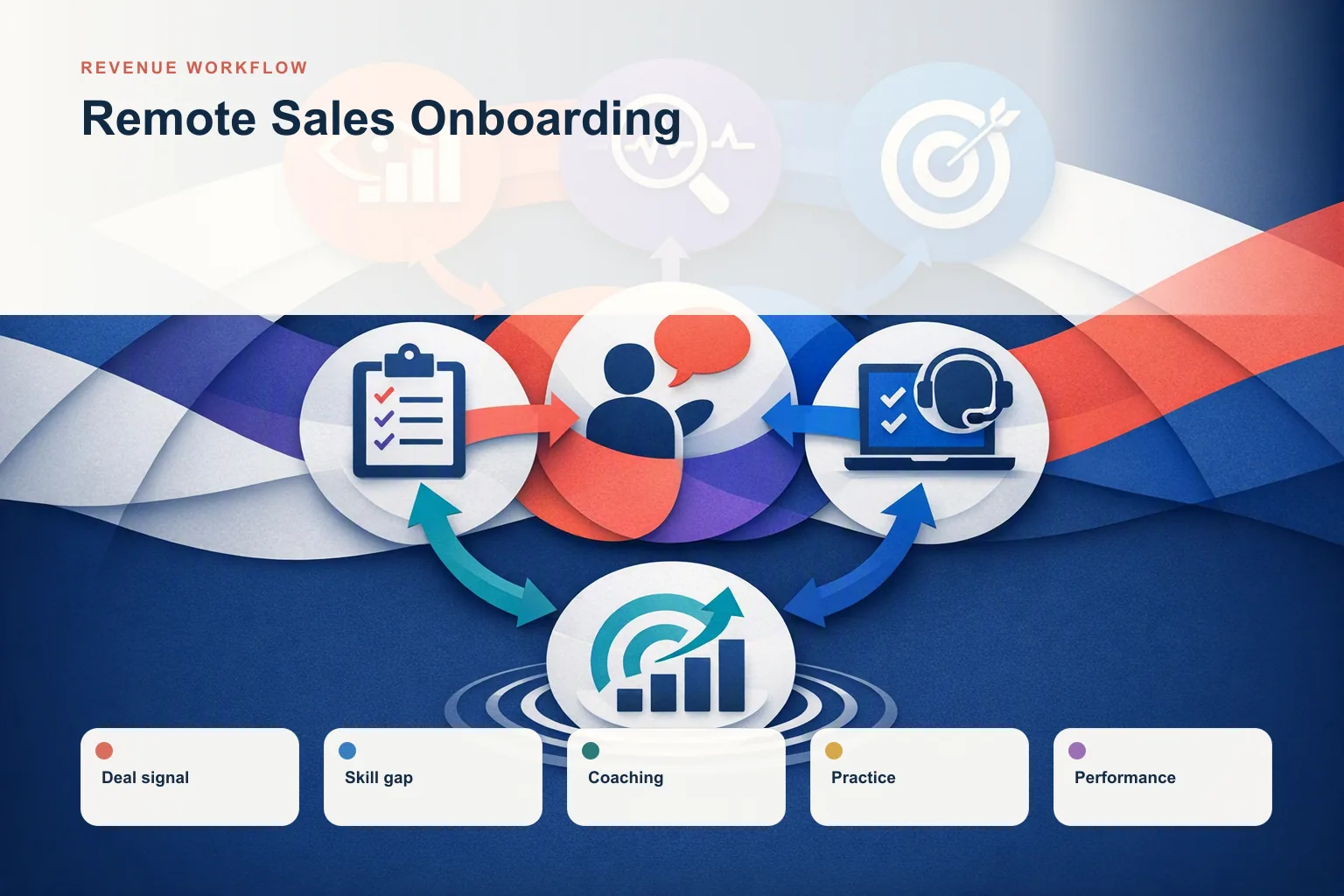
This guide uses remote sales onboarding in a broad operational sense: developing remote representatives while improving the deal workflows, coaching, data, and feedback used in active opportunities. This scope extends beyond new-hire orientation.
1. Define the standard and assign ownership
Document what strong execution looks like, which milestones matter, and who owns the results. An operating model for Remote Sales Onboarding answers three questions: what actions should happen, at what stage, and who is accountable.
Assign a permanent owner to Remote Sales Onboarding outcomes. Include the process in standing reviews and give the owner defined metrics and improvement goals.
2. Audit the current state
Start with an honest audit. Review recent deal data by representative, segment, deal size, and stage. Identify where opportunities leave the pipeline and compare the data with the team’s explanation of what happened.
Prioritize two or three specific improvements, assign an owner, define a measurable goal, and review the changes after 90 days.
Use an audit to identify where the current process is working and where it is breaking down.
3. Make the playbook an ongoing operating process
Document the process, teach it, reinforce it through managers, and update it with lessons from actual opportunities. Add a structured review to weekly pipeline and coaching conversations instead of treating onboarding as a project with a fixed end date.
A working system connects ownership, process, playbooks, technology, data, and measurement.
4. Use leading and lagging indicators
Leading indicators can support earlier intervention, while lagging indicators confirm what happened. Measures identified in the source material include stakeholder engagement, content consumption, mutual action plan progression, deal velocity, win rate, cycle time, average deal size, and quota attainment.
Measure outcomes, not activities. Review the indicators weekly and use them to make coaching conversations more factual.
5. Coach through active opportunities and review stakeholder coverage
Use live opportunities to identify skill gaps and work through corrective actions with each representative. Deal-specific coaching connects development to current work.
Map every stakeholder in the buying committee, assign coverage, and track engagement with each one. Flag opportunities where only one contact is active as high risk.
Three-part explainer: diagnose the gap, coach and practice, and measure improvement.
6. Align technology and data with the process
The technology layer for Remote Sales Onboarding should reduce friction, not add it. Evaluate tools by whether they make execution more consistent, improve visibility, or reduce manual work.
Systems should share useful data without requiring representatives to maintain disconnected records. The Revspire Sales Onboarding platform is presented in the source material as a way to surface deal-level signals.
7. Capture win-loss intelligence and maintain feedback loops
Every won and lost deal contains insights about what works and what does not in your approach to Remote Sales Onboarding. Capture those insights through structured reviews, CRM analysis, representative conversations, and buyer feedback. Apply the findings to playbooks, training, metrics, and strategy.
Review performance against targets regularly and update the process when the evidence identifies a recurring gap.
Three-part explainer: set the standard, embed the practice, and scale what works.
Common mistakes to avoid
- Treating onboarding as a one-time initiative. Assign a permanent owner and maintain a recurring review cadence.
- Relying only on intuition. Compare assumptions with portfolio and opportunity data.
- Depending on one stakeholder. Map the buying committee and review coverage risks.
- Confusing activity with progress. Use outcome measures such as stage progression, engagement quality, and stakeholder coverage.
- Failing to learn from losses. Implement a structured loss review process, document the findings, and update the playbook.
Review ownership, evidence, stakeholder coverage, outcome measurement, and loss analysis when diagnosing process gaps.
Include the talent perspective
Treat talent as a separate evaluation lens. Ask whether the onboarding environment supports representative development and retention while keeping that question distinct from active-deal workflow guidance.
A practical implementation sequence
- Establish a baseline from recent performance and opportunity data.
- Select two or three priority problems.
- Assign an accountable owner and measurable goals.
- Document expected actions, milestones, and review intervals.
- Connect the process to weekly coaching and pipeline conversations.
- Review the initial changes after 90 days and update the playbook.