Revspire blog
The Complete 2026 Guide to Sales Methodology Onboarding for Revenue Leaders
A practical guide to sales methodology onboarding with clear ownership, documented playbooks, deal-level coaching, useful metrics, and feedback loops.
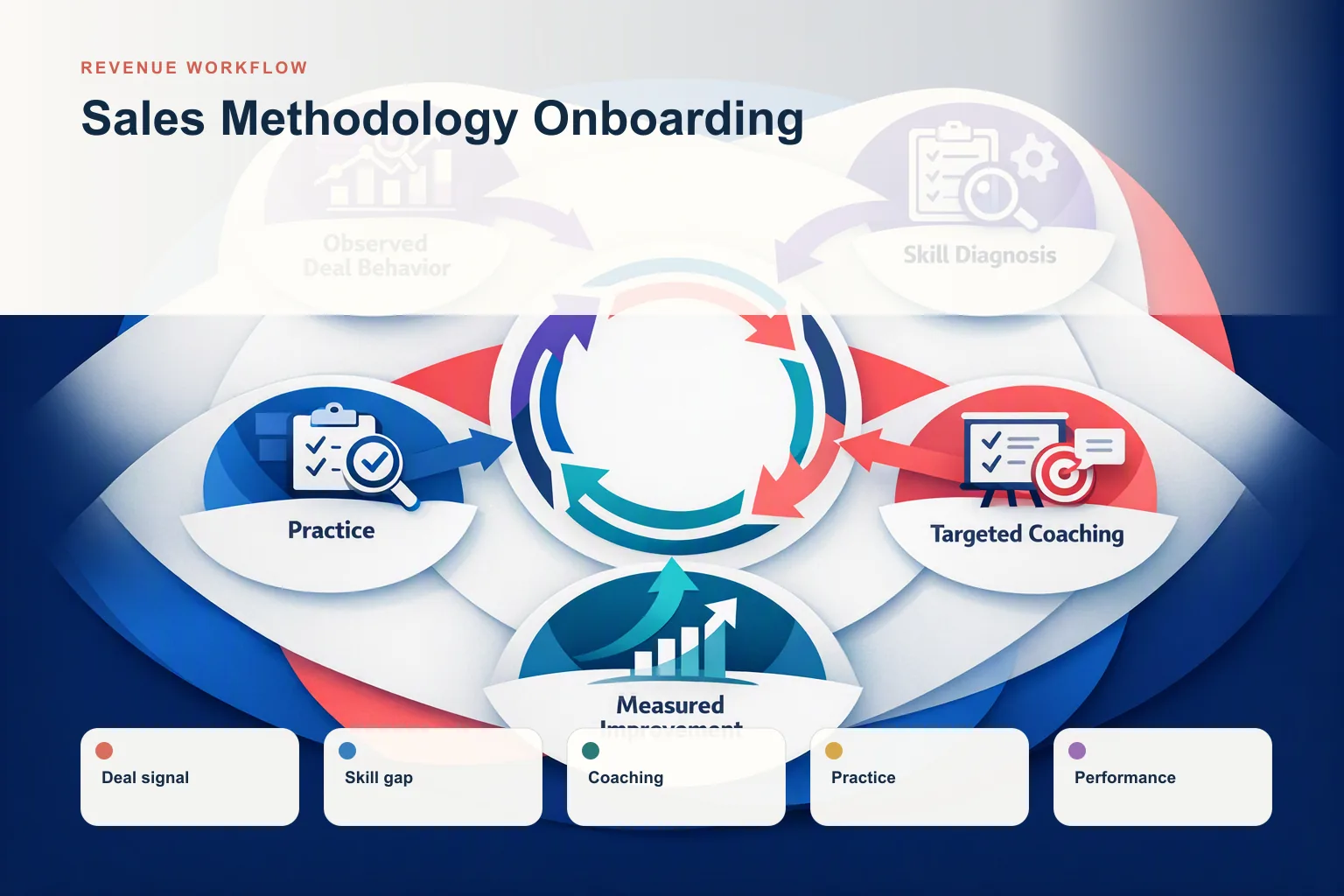
This guide treats sales methodology onboarding as the initial enablement and ongoing reinforcement of a chosen sales methodology. MEDDIC may inform a team’s process, but this guide does not use MEDDIC as a synonym for onboarding.
The practical framework covers ownership, documented standards, deal-level coaching, technology, measurement, and feedback from won and lost opportunities.
Build the Operating Foundation
Three-part explainer: Define the system, Operationalize the workflow, and Measure the impact.
Assign ownership
Assign a permanent owner to Sales Methodology Onboarding outcomes. Give that owner responsibility for goals, metrics, operating reviews, and updates to the team’s guidance.
Document the operating model
An operating model for Sales Methodology Onboarding answers three questions: what actions should happen, at what stage, and who is accountable.
Document the qualification criteria, milestones, required evidence, stakeholder coverage, and next actions for each stage. Treat the playbook as working guidance that can be updated when coaching, buyer feedback, and win-loss reviews reveal a useful change.
Align technology with the process
Technology should serve the sales methodology onboarding MEDDIC process, not define it. Evaluate tools according to whether they reduce friction, support the documented workflow, and make relevant deal information available to managers and representatives.
Teams evaluating platform support can review Revspire Sales Onboarding.
Audit and Implement the Framework
Three-part explainer: Audit the current state, Build the operating model, and Measure and improve.
1. Establish a baseline
Start with an honest audit. Before you can improve Sales Methodology Onboarding, you need an honest baseline.
Review recent opportunities against the documented stages and identify where deals stall or exit. Segment the review by representative, market, and deal size when those distinctions are relevant.
2. Define actions and accountability
Specify the actions expected at each stage, the evidence required for progression, the person accountable, and the review cadence. Keep the model concise enough to use during active opportunities.
3. Track useful indicators
For Sales Methodology Onboarding, leading indicators might include stakeholder engagement rates, content consumption, mutual action plan progression, or deal velocity at each stage.
The right metrics for Sales Methodology Onboarding sit at the intersection of leading and lagging indicators. Review both kinds of measures during coaching and pipeline discussions.
A framework for reviewing sales methodology onboarding.
4. Apply seven operating practices
Seven practices for reinforcing a sales methodology.
- Define the standard: Document what expected execution looks like at each stage.
- Monitor leading indicators: Select signals that help managers review active opportunities.
- Use a weekly cadence: Discuss methodology health during regular pipeline reviews.
- Coach active deals: Connect coaching to specific opportunities and skill gaps.
- Capture win-loss findings: Feed structured findings into playbooks and training.
- Align technology: Reduce unnecessary manual work and support the documented process.
- Create feedback loops: Review metrics, buyer feedback, and operating guidance regularly.
Avoid Common Implementation Mistakes
Common implementation mistakes and corrective actions.
Treating onboarding as a one-time project
Keep ownership, review meetings, metrics, and improvement goals in the operating cadence after the initial rollout.
Relying only on intuition
Review portfolio data alongside management judgment. Investigate discrepancies rather than allowing recent or memorable deals to define the entire process.
Depending on one stakeholder
Map the buying group, assign stakeholder coverage, and identify opportunities that depend on a single active contact.
Confusing activity with progress
Measure outcomes, not activities. Review stage progression, buyer engagement, deal velocity, and stakeholder coverage instead of relying only on counts of calls, emails, or tasks.
Failing to learn from losses
Use structured loss reviews to document methodology breakdowns and determine whether the playbook or coaching guidance should change.
Make Improvement Ongoing
Select two or three improvements from the audit rather than attempting to change every part of the system at once. Deploy them with a clear owner, a measurable goal, and a 90-day review cadence.