Sales Coaching Cadence: How to Build One That Survives a Busy Quarter
A practical perspective for connecting this idea to your revenue team’s next move.
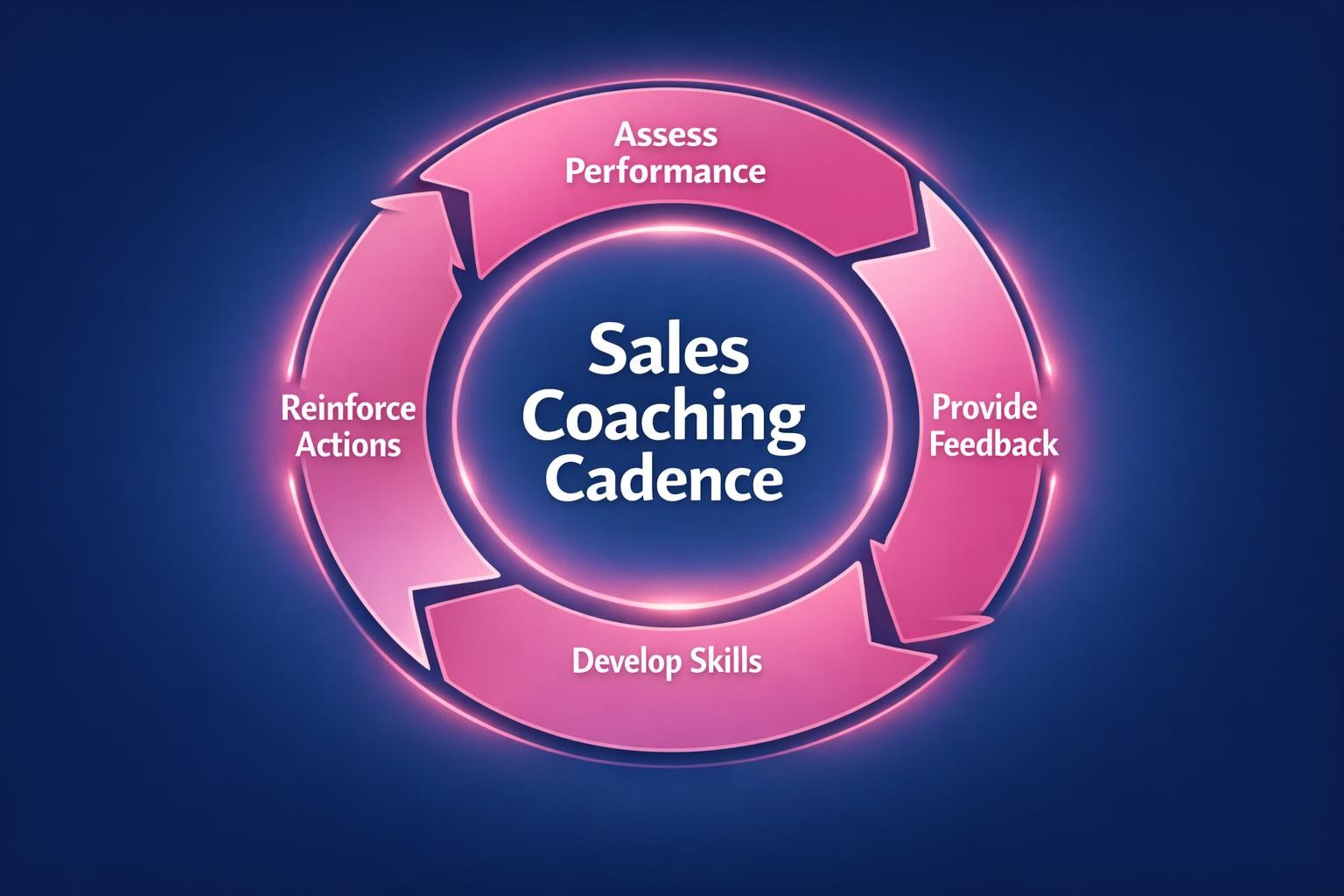
A sales coaching cadence is the fixed rhythm of coaching between sales managers and reps: typically a weekly one-to-one on one skill, a weekly or fortnightly deal review, a monthly call or role-play review and a quarterly development plan. It sets how often each happens, who runs it, how long it takes and how follow-up is tracked.
Below: a cadence table for frontline managers, second-line managers and enablement, a worked time budget, agendas for the one-to-one and the deal review, four coaching frameworks, adjustments for remote and global teams, what the research says about frequency, and the mistakes that quietly kill a cadence by week ten of the quarter.
Last updated: 16 October 2026
What is a sales coaching cadence?
A cadence turns coaching from something that happens when there is time into a calendar commitment with an agenda (see our sales coaching cadence definition). It usually mixes three kinds of conversation, each on its own schedule:
- Skill coaching: how a rep sells, such as discovery, multithreading or handling a pricing objection. It applies across every deal.
- Deal coaching: how to win one opportunity: stakeholders, decision process, risks and the next step.
- Pipeline and forecast review: which deals will close and when. This is managing, not coaching. It belongs in the cadence, but it should not replace the other two.
The test of a coaching conversation is whether the rep leaves with a behaviour to change and a date to show it. A forecast call that ends with “push harder on Acme” is inspection, not coaching.
What does the research say about coaching frequency?
The published evidence is stronger on how structured coaching is than on how often it happens:
- Structure correlates with win rates. CSO Insights’ 2019 study (900+ participants) reported average win rates of 41.8% where coaching was left to individual managers (“random”), 47.8% for informal, 48.9% for formal and 55.2% for “dynamic” coaching, meaning formal coaching aligned with the enablement program. In 2019, 42.9% of organisations were in the random group and 12.6% were dynamic (CSO Insights, 2019 Sales Enablement Report). These are correlations, not proof of cause.
- Reported coaching time varies widely. Highspot’s 2025 report, based on a survey of 350 go-to-market professionals fielded February to March 2025, states that managers spend 13 hours a week coaching reps (Highspot, State of Sales Enablement 2025). Alexander Group benchmarks put the average first-line sales manager at 16% of their time coaching, against a best practice of 28% (Alexander Group, undated).
- Few managers coach well. Objective Management Group data on about 9,000 sales managers found 10% are good at coaching; 63% fall into the weak group, and just over half of those spend 10% or less of their time on it (Kurlan & Associates, 2018).
- Short and frequent beats long and rare. Gallup recommends a meaningful manager conversation every week and reports that brief 15 to 30 minute conversations held regularly have more impact than 30 to 60 minute ones held less often (Gallup, 29 May 2023, updated 16 February 2026). This is workforce-wide research, not sales-specific.
- Older but still cited: CEB Sales Executive Council research reported that effective coaching can lift overall sales team success by up to 19%, and that reps with star coaches show an 8% increase in performance against goal compared with reps whose coaches are ineffective; the sample is not stated in the public post (Brent Adamson, CEB, 10 April 2012).
The practical reading: a written, consistent cadence matters more than any single frequency number. Every figure we found, with sample sizes, is on our sales coaching statistics page.
The sales coaching cadence by role: weekly, monthly and quarterly
Use this as a starting template. The time budgets are Revspire’s suggested starting points for a team of about eight reps, not published benchmarks.
Role
Weekly
Monthly
Quarterly
Starting time budget
Frontline sales manager
30-minute one-to-one per rep (one skill, one deal); team deal review; one recorded call or role-play reviewed per rep, asynchronously
Team skill clinic on the weakest shared skill; call-scoring calibration with peer managers
Development plan per rep; skill/will review to set each rep’s coaching approach
About 8 hours a week
Second-line manager (director, RVP)
30-minute one-to-one with each frontline manager about their coaching, not their forecast; join one team deal review
Observe or review the recording of one one-to-one per manager; review coaching completion
Cross-team calibration; decide which skill themes to fund next quarter
About 4 to 6 hours a week
Enablement and sales readiness
Prepare coaching data (scores, gaps) before one-to-ones; publish practice scenarios tied to live deals
Report sessions held vs planned and skill trends; refresh role-plays from win-loss themes
Certifications; manager coaching training; program review with sales leadership
Program owner, part of the role
Seller
Bring one call clip and one deal to the one-to-one; complete assigned practice; log the commitment
Self-assess against the rubric before the clinic
Agree development goals with the manager
About 1 to 2 hours a week
Suggested cadence by role. Adjust frequency by rep tenure and span of control (see below).
How much time should sales managers spend coaching?
Work it out from the cadence rather than picking a number. Worked example for a frontline manager with eight reps, close to the Alexander Group average span of 8.5 direct reports:
- Eight 30-minute one-to-ones: 4 hours
- One team deal review: 1 hour
- Asynchronous review of one call or role-play per rep at about 15 minutes each: 2 hours
- Preparation and written follow-up: 1 hour
That is 8 hours, or 20% of a 40-hour week: above Alexander Group’s 16% average and below its 28% best practice, and lower than the 13 hours a week cited in Highspot’s 2025 report. With a larger span the arithmetic breaks. Alexander Group’s range runs from 2 to 38 direct reports, and it notes inside sales models can support 20% to 80% more reps per manager than field models. On the SDR side, The Bridge Group reports 6.4 SDRs per leader in 2025, down from 8 in 2021 to 2023 (The Bridge Group, 6 February 2025). Above about twelve reps, move tenured reps to fortnightly one-to-ones and keep weekly sessions for new hires and reps on a development plan.
Agendas: the weekly one-to-one and the deal review
A 30-minute sales coaching one-to-one
- Last commitment (3 minutes): did it happen, and what did the buyer do differently?
- One skill (12 minutes): a call clip or role-play score as evidence, then work through it with GROW questions (below).
- One live deal (10 minutes): apply the same skill to a real opportunity this week.
- New commitment (5 minutes): one action, how it will be evidenced, written down by the rep.
Keep forecast numbers out of this meeting; they have their own review. For a version with AI-prepared evidence, see our AI-assisted one-on-one coaching agenda.
A deal review: 10 to 15 minutes per deal
- Buyer commitments since the last review: what the buyer did (a meeting booked, a security review started), not what the rep did.
- Stakeholders: who is engaged, who is missing, and whether the deal depends on one contact.
- Decision process: criteria, competition and the risk of no decision.
- Next step: owner, date, and where it sits on the mutual action plan.
- The ask: what the rep needs from the manager or an executive.
Choose deals by evidence: the largest open opportunities plus any that have not moved stage since the last review. Reviewing every deal every week turns coaching back into inspection.
Which sales coaching framework should you use?
A framework gives every manager the same question sequence, which makes coaching consistent across teams and easier to calibrate. Four that fit different slots in the cadence:
Framework
Steps
Origin
Best slot in the cadence
GROW
Goal, Reality, Options, Will (or Way Forward)
Sir John Whitmore and peers, late 1980s to early 1990s; popularised in Coaching for Performance
Weekly skill coaching; quarterly development plans
OSKAR
Outcome, Scale, Know-how, Affirm + Action, Review
Mark McKergow and Paul Z. Jackson, The Solutions Focus (2002)
Experienced reps; quick progress checks on a 0 to 10 scale
Skill/will matrix
Direct, Guide, Excite, Delegate, by the rep’s skill and will for a task
Max Landsberg, The Tao of Coaching
Quarterly: deciding how to coach each rep
Observe, practise, apply
Observe a call, pick one behaviour, practise it, apply it in a live deal, review
A common coaching loop, not a single named model
Weekly skill work between one-to-ones
Sources: Performance Consultants (GROW); Mind Tools (OSKAR); Mind Tools (Skill/Will Matrix).
A GROW sales coaching example
A rep keeps losing deals at the business-case stage. In the one-to-one:
- Goal: “By the end of the month, every proposal includes a cost-of-inaction figure the buyer agreed to.”
- Reality: play the clip where the CFO asked about payback, then ask: “What did you have ready, and what was missing?”
- Options: rebuild the discovery questions on cost, borrow a peer’s ROI worksheet, or rehearse the CFO conversation in a role-play.
- Will: the rep chooses the role-play and the new questions, with a target date and the deal it will be used on.
For the practise step, Revspire’s AI Sales Training & Coaching runs AI role-plays of buyer conversations and scores them instantly for clarity, confidence and objection handling, so the next one-to-one can start from a score rather than a hunch.
How do you prioritise which reps to coach?
Coaching time is finite, so decide who gets what each quarter, from evidence rather than from who asks loudest:
- New hires: weekly one-to-ones, mostly skill coaching, until they pass your readiness checks.
- Reps on a development plan: weekly, with one measurable behaviour per cycle and written evidence each week.
- The middle of the team: the largest group and usually the most room to move; give them a protected weekly or fortnightly slot rather than leftover time.
- Top performers: fortnightly, focused on stretch deals, strategy and peer coaching. In skill/will terms, delegate and act as a sounding board.
- High skill, low will: find what changed before adding more skill coaching; the skill/will matrix calls this “excite”.
When requests exceed hours, use a triage rule rather than cancelling at random; our coaching capacity triage guide sets one out.
How to set up deal coaching cadences globally
Remote and multi-time-zone teams need the same cadence with different mechanics. What changes:
- Put one-to-ones in the rep’s working hours. The manager absorbs the awkward time slot, or the team rotates it; reps should not always take the early or late call.
- Run deal reviews by region. Hold one per region at a local time, plus a monthly cross-region review of the largest deals, with a written pre-read so the meeting is spent on decisions.
- Move call review to asynchronous. Managers leave time-stamped comments on recordings and the rep replies before the next one-to-one, which removes the need for a shared live slot.
- Use one rubric everywhere and calibrate monthly. Without it, a “3” in one region is a “4” in another; our coaching calibration rubric shows how to run the session.
- Let local managers coach in the local language and style, while second-line managers hold every region to the same cadence and track sessions held against sessions planned.
- Keep cameras on for skill one-to-ones, and record sessions only where company policy and local law allow.
Distance does not have to weaken coaching. Gallup found that 80% of employees reporting meaningful feedback in the past week were fully engaged, whatever their number of office days (Gallup, 2023).
How do you build a coaching cadence that survives a busy quarter?
Most cadences die in the last three weeks of the quarter, so decide the minimum version in advance:
- Shorten one-to-ones to 15 minutes focused on the rep’s most important deal; do not cancel them.
- Keep asynchronous call review, which needs no shared slot.
- Postpone the monthly clinic, not the one-to-ones.
- Never cancel two sessions in a row with the same rep.
- Restart the full cadence in the first week of the new quarter, with the quarterly development review.
Common sales coaching cadence mistakes
- Letting the forecast call replace coaching. Keep pipeline review and coaching as separate meetings with separate agendas.
- Cancelling in crunch time. Shrink sessions instead; Gallup’s finding that short regular conversations beat longer occasional ones applies here.
- Coaching five things at once. One skill per cycle, carried until the evidence shows it changed.
- No written commitment. Without one, every session starts from zero.
- Coaching only the bottom of the team. The middle and the top lose interest, and the cadence becomes a remediation process.
- Uncalibrated scoring. If managers score the same call differently, reps get mixed signals and comparisons across teams mean nothing.
- Ignoring why deals are lost. Take the next skill theme from buyer feedback, not only from manager opinion; our guide to automated win-loss analysis shows how to feed findings into coaching.
- Measuring sessions only. Sessions held is an input; behaviour change is the output.
How do you measure whether the cadence works?
- Sessions held against sessions planned, per manager, each month.
- Share of reps with a written development goal.
- Share of commitments completed by the next session.
- Change in skill or role-play scores on the focus skill between cycles.
- Deal indicators linked to the skill, such as stage conversion or the share of deals with more than one engaged stakeholder.
- Win rate and cycle length over at least two quarters, read alongside everything else that changed.
Choosing software to support this? Our comparison of AI sales coaching software looks at AI role play, call feedback and manager workflows.
Frequently asked questions
How often should sales managers coach?
No published benchmark sets one frequency. A practical default is a weekly 30-minute one-to-one per rep plus a weekly deal review, moving tenured top performers to fortnightly. Gallup’s research favours short weekly conversations over longer, less frequent ones.
How much time should sales managers spend coaching?
Alexander Group benchmarks show first-line sales managers spending 16% of their time coaching on average, against a best practice of 28%. Highspot’s 2025 report cites 13 hours a week. A cadence of weekly one-to-ones, one deal review and asynchronous call review for eight reps takes about 8 hours a week, or 20% of a 40-hour week.
How many reps can one manager coach effectively?
Alexander Group puts the average first-line sales manager at 8.5 direct reports, with a range of 2 to 38, and The Bridge Group reports 6.4 SDRs per leader in 2025. No study we found identifies the span at which coaching quality drops. Above about twelve reps, weekly one-to-ones for everyone rarely fit.
What is the GROW model in sales coaching?
GROW stands for Goal, Reality, Options and Will (or Way Forward). Sir John Whitmore developed it with peers and popularised it in Coaching for Performance . In sales, a manager sets one skill goal, reviews a real call for the current reality, lets the rep propose options and ends with a dated commitment.
How do you coach a remote sales team?
Keep the same cadence, but hold one-to-ones in each rep’s working hours, run deal reviews by region with written pre-reads, and move call review to time-stamped asynchronous comments. Use one scoring rubric across regions and calibrate it monthly.
What percentage of sales managers are good at coaching?
In Objective Management Group’s assessment of about 9,000 sales managers, published by Kurlan & Associates in 2018, 10% were good at coaching. The data is from one assessment provider and is several years old.
For every coaching statistic we found, with sample sizes and evidence strength, read what the research says about sales coaching.
Sources
All pages were accessed on 16 October 2026. Publication or update dates are shown where the page gives one.
- 2019 Sales Enablement Report: Fifth Annual Sales Enablement Study, CSO Insights (Miller Heiman Group), 2019 (PDF hosted by Highspot)
- The State of Sales Enablement Report 2025, Highspot, fielded February to March 2025
- What is the right span of control for first line sales managers (FLSMs)?, Alexander Group, undated
- The Latest Data Shows That Sales Managers Are Even Worse Than I Thought, Dave Kurlan, Kurlan & Associates (Objective Management Group data), 18 June 2018
- A Great Manager’s Most Important Habit, Gallup, 29 May 2023, updated 16 February 2026
- Are Your Managers Effective Coaches?, Brent Adamson (CEB Sales Executive Council), 10 April 2012
- SDR Models, Motions & Metrics: 2025 Research Report, The Bridge Group, 6 February 2025
- A Complete Guide to the GROW Coaching Model, Performance Consultants, updated 24 June 2026
- The OSKAR Coaching Framework, Mind Tools, undated
- The Skill/Will Matrix, Mind Tools, 7 October 2024