What Is Revenue Intelligence? How It Works, Signals and Platforms
A practical perspective for connecting this idea to your revenue team’s next move.
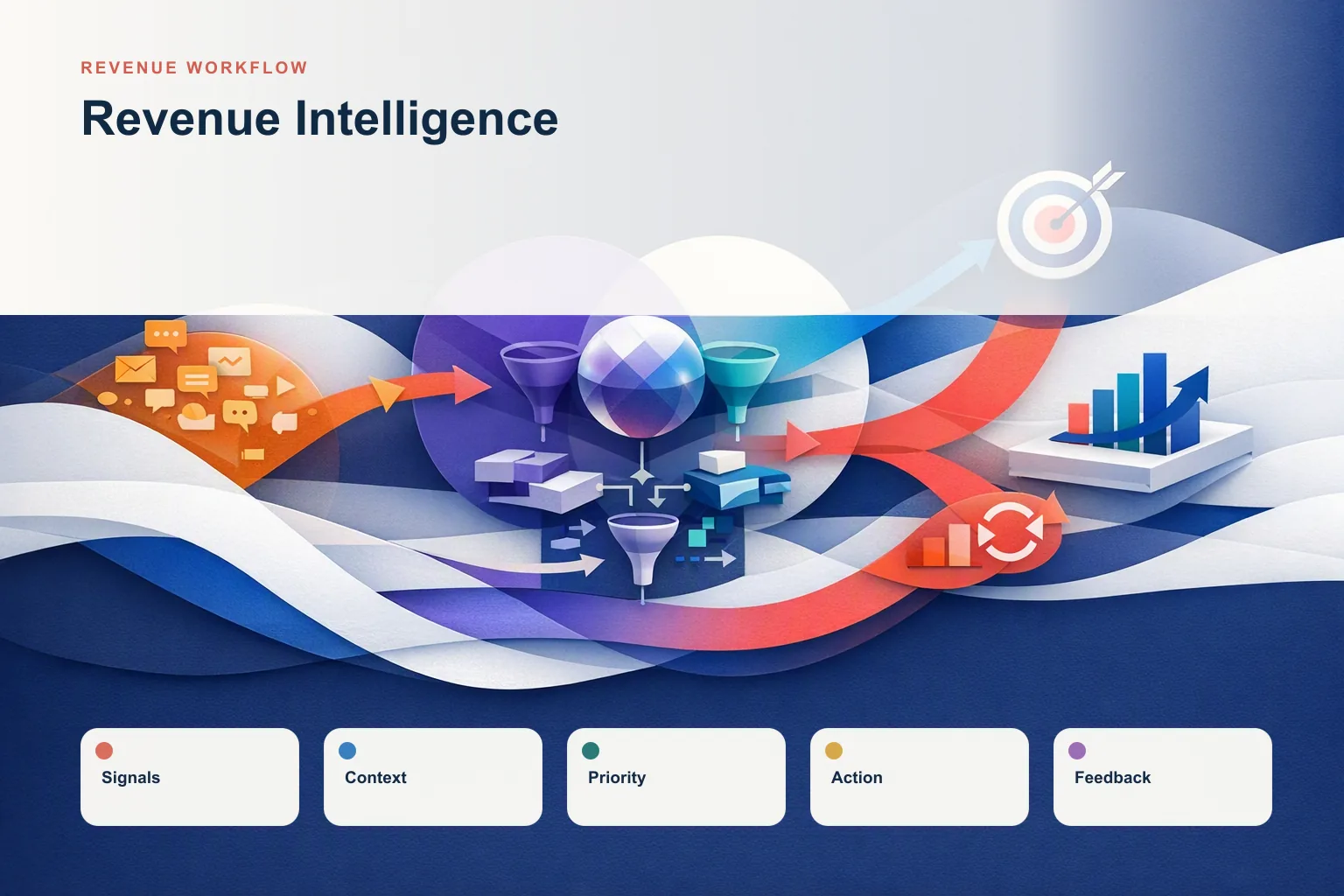
Revenue intelligence is the practice, and the software category, of capturing buyer interactions (CRM records, emails, meetings, calls and content views), connecting them to deals and accounts, and using AI to show which deals are real, which are at risk and what the forecast should be. It replaces seller-entered guesses with recorded buyer behaviour.
This guide explains what revenue intelligence captures, how it differs from conversation intelligence, sales intelligence and the newer revenue orchestration category, which signals are worth acting on, how to roll it out in 90 days, and how five platforms package and price it. Vendor pages and research were checked in October 2026.
Last updated: 16 October 2026
What is revenue intelligence?
A CRM tells you what sellers typed in. Revenue intelligence tells you what happened: who the seller met, who replied, what the buyer said about a competitor, who opened the proposal and how long the deal has been quiet. The software does four jobs:
- Capture. It records activity automatically from email, calendars, call and video meetings and the CRM’s field history, so nobody logs it by hand.
- Connect. It matches each email, meeting and contact to the right account and opportunity, which is how it knows a large deal has one engaged buyer rather than five.
- Interpret. Models and rules turn the record into deal risk flags, opportunity scores, forecast projections and coaching insights.
- Prompt action. Alerts and deal-review views put each finding in front of the seller or manager who can act on it.
The case for it is mostly about trust in the forecast. In Gong’s Reality of Forecasting survey of 928 sales and revenue professionals (July 2022), just 24% of sales leaders trusted their reps’ forecast commitments, and organisations using insights from customer interactions were twice as likely to report accuracy within 5% of their monthly forecast as those relying on seller-entered data (22% against 11%). Gong sells revenue intelligence software, so read that as vendor evidence. The logic holds anyway: a recorded meeting with the economic buyer is harder to overstate than a close date a seller typed in.
What data does a revenue intelligence platform use?
- CRM records and their history: amount, stage, close date, forecast category and contact roles, plus every change to them, which is where close-date pushes show up.
- Email and calendar activity: who was emailed, who replied and who attended which meeting. Stakeholder coverage is calculated from this.
- Conversations: call and meeting recordings and transcripts, searched for topics, competitors, pricing questions and agreed next steps.
- Buyer engagement with content: views of proposals, business cases and digital sales rooms, including by people the seller has never met. Email and call capture do not record this; it comes from the tool that hosts the shared content (see buyer engagement analytics).
How does revenue intelligence work? A worked example
Take a hypothetical $80,000 annual contract value (ACV) deal in commit for this quarter, at the proposal stage, closing in five weeks. In the CRM it looks healthy. A revenue intelligence platform adds what the CRM does not hold:
Evidence
What the platform shows
What it suggests
Deal age
160 days since the opportunity was created
Older than three in four won deals of this size in Revspire’s benchmark (below)
Stakeholders
One buyer contact active in the last 30 days
Single-threaded: if the champion stalls, so does the deal
Economic buyer
Invited to the last two meetings, attended neither
No evidence the budget holder is engaged
Conversation
Buyer asked how pricing compares with a named competitor
Active competitive evaluation, late in the cycle
Close date
Moved twice, with no reason from the buyer
The date is the seller’s, not the buyer’s
Proposal
Opened once, by the champion
Nobody else in the buying group has seen the price
The age comparison comes from Revspire’s B2B SaaS win rate and sales cycle benchmark (about 40 B2B companies, October 2025 to September 2026): the median won deal above $50k ACV closed in 90 days, and a quarter of those deals took longer than 150 days. Use your own won deals for the real threshold.
No single row is decisive. Together they move the deal to best case and set the manager’s agenda: get the economic buyer into a 30-minute business case review, resend the proposal with a dated implementation plan the champion can forward, and prepare the competitive comparison. The deal review stops re-reading status and decides what changes in the next seven days. Our guide to sales forecasting methods shows how to turn this kind of evidence into forecast category rules.
Revenue intelligence vs conversation intelligence, sales intelligence and revenue orchestration
These labels overlap, and vendors increasingly sell them together. The quickest way to separate them is by the question each one answers.
Category
Question it answers
Main data
Typical owner
Sales intelligence
Who should we sell to, and how do we reach them?
Company, contact and intent data
SDR leaders, marketing ops
Conversation intelligence
What was said on calls, and how well was it handled?
Call and meeting recordings, transcripts
Front-line managers, enablement
Revenue intelligence
Which deals will close, which are at risk, and what will we book?
CRM history, email and calendar activity, conversations
CRO, RevOps, sales managers
Revenue orchestration (Gartner: revenue action orchestration)
What should each seller do next, and can the system do some of it?
All of the above, plus sequences and AI agents
CRO, RevOps
Sales enablement (where Revspire sits)
What should sellers say and send, are they ready, and what do buyers do with it?
Content usage, playbooks, practice scores, deal room engagement
Enablement, product marketing
Analysts now fold sales engagement, conversation intelligence and revenue intelligence into a single revenue orchestration market. Forrester called revenue orchestration platforms a “supergroup” of sales engagement, conversation intelligence and revenue operations and intelligence platforms (Forrester, 2024) and published its first Wave of the category in Q3 2024. Gartner’s first Magic Quadrant for Revenue Action Orchestration is dated 15 December 2025; Gong’s announcement (18 December 2025) says Gartner evaluated 12 vendors in a market formed as sales engagement and revenue intelligence converged, with Gong a Leader, and a joint Clari and Salesloft release (Business Wire, 16 December 2025) says Clari was a Leader and Salesloft a Visionary. Those two had announced an agreement to merge on 5 August 2025 (Business Wire) and completed the merger on 3 December 2025 (Salesloft); since 2 September 2026 the combined company uses the Salesloft brand, with Clari Forecast keeping the Clari name (Salesloft).
So revenue intelligence is increasingly sold as the forecasting and deal-risk layer of a larger platform, or as a CRM add-on. If your question is mainly about call recording and coaching, read our guide to conversation intelligence.
What problems does revenue intelligence solve?
Revenue leaks out of a pipeline at three points. Revenue intelligence helps at each one, if someone owns the response.
Deals that should not be in the pipeline
Opportunities created after one friendly call, with no second meeting, no other contact and no agreed next step, inflate coverage and absorb seller time. Set a re-qualification rule: for example, a new opportunity with no second buyer contact and no meeting booked within your normal first-stage window goes back to the seller for a decision instead of into the forecast.
Qualified deals that stall
The buyer had a real problem, but the champion went quiet, a security review stalled or nobody owned the next step. Silence is the signal, measured against your own won deals. In Revspire’s digital sales room benchmark (about 40 B2B companies, October 2025 to September 2026), once a deal room went 20 days without a buyer view, the win rate fell below half the overall win rate. That is an observed pattern, not proof of cause, but it is a usable alert threshold to test on your own pipeline.
Late-stage losses
These deals reached the proposal and still lost, to a competitor or to the buyer doing nothing. Two things make them hard to learn from. First, competition is normal: in Revspire’s win rate and sales cycle benchmark, 90% of closed deals had a named competitor recorded, and those deals were won 30% of the time against 35% without one. Second, the CRM undercounts “no decision”: only 10% of lost deals in the same data carried a no-decision or status-quo loss reason, which the benchmark treats as a floor because sellers tend to record a competitor or price instead. Conversation data, where the buyer’s own words are on record, is a better input to win-loss analysis than a loss-reason drop-down.
Which revenue intelligence signals should you act on?
Start with the few signals that change a decision. Leading indicators are buyer behaviours that change before the outcome does; lagging indicators (win rate, cycle length, deal size, forecast accuracy) tell you whether acting on them worked. Count buyer actions, not seller activity: 40 emails to one contact is a single-threaded deal, not a busy one.
Signal
Source
Usually means
What to do this week
One engaged buyer contact on an above-median deal
Email and calendar
Single-threaded
Ask the champion who else must approve, and give each a reason to meet
Economic buyer absent by the proposal stage
Calendar, contact roles
Price not yet approved
Request a short executive review; give the champion a one-page business case
Close date moved twice without a buyer reason
CRM history
Slipping
Move it down a forecast category and agree dated next steps
No buyer-initiated activity for longer than your typical stage
Email, meetings, deal room views
Stalling
Re-engage with something new (revised business case, rollout plan), not “checking in”
Competitor named on a call
Conversation intelligence
Active comparison
Use the battlecard before procurement raises it
New contacts viewing pricing and implementation material
Deal room and content views
Buying group evaluating
Put the current proposal and a dated implementation plan where all can find them
Deal older than three in four of your won deals in its size band
CRM history
Unlikely to close as forecast
Re-qualify: invest deliberately or close it out
The sixth row is often a buying sign rather than a risk. In the same Revspire digital sales room benchmark, 80% of buyer views in the 14 days before a won deal closed went to the proposal and the implementation plan. For how AI picks risk out of the questions buyers ask, see our guide to AI deal coaching and deal risk signals.
How do you roll out revenue intelligence? A 90-day plan
Days 1-30: define, baseline and connect
- Write buyer-verifiable exit criteria for each stage, such as “the economic buyer has attended a meeting” before a deal enters the proposal stage.
- Baseline your last four closed quarters by deal size, segment and rep: win rate, median won cycle, close-date slip rate, share of single-threaded deals and forecast accuracy. Compare it with the team’s story; if leaders blame price but deals stall after the first demo, the fix is qualification, not discounting.
- Connect email, calendar and meeting capture, agree call-recording consent wording with legal for each country you sell into, and clean the CRM fields the platform depends on.
- Choose three to five leading signals from the table above. With more, nobody acts on any of them.
Days 31-60: put the signals into the weekly rhythm
- Run the pipeline review from the platform’s deal view. For each commit and best-case deal ask: what changed, what does the buyer evidence say, and what will we do in the next seven days?
- Coach on live deals: each manager reviews one recorded call and one at-risk deal per rep per week.
- Send alerts where sellers already work (the CRM, Slack or Teams), with one owner per signal type.
- When the data and a seller disagree, investigate the gap instead of overriding either side.
Days 61-90: close the loop
- Review a sample of won and lost deals each month with the recordings and, where possible, a buyer interview, and record the real loss reason.
- Feed findings into playbooks, battlecards and training: if one competitor keeps appearing in late-stage calls, its battlecard and role-play scenarios change this month.
- Compare the forecast call with the platform’s projection weekly, and at day 90 keep or drop each leading signal depending on whether acting on it changed the lagging numbers.
What are the most common revenue intelligence mistakes?
- Treating it as a software rollout. The dashboards go live and nothing changes. Give it one owner (usually RevOps), a weekly review that depends on it, and quarterly goals for the signals you chose.
- Measuring seller activity instead of buyer progress. Track stakeholders engaged, buyer-initiated replies, time in stage and buyer-owned milestones completed, not emails sent.
- Seeing only the people on the calls. Email and call capture record the contacts the seller talks to, and many buyers would rather not talk to one: in a Gartner survey of 632 B2B buyers (published 25 June 2025), 61% said they prefer a rep-free buying experience overall. Finance, IT and procurement reviewers you never meet show up only in what they open and forward. In Revspire’s digital sales room benchmark, rooms engaged 15 unique buyer stakeholders, against 1 to 5 on deals run without one.
- Adding another screen to an overloaded stack. In Gartner’s survey of 1,026 B2B sellers (published 16 September 2024), 50% said they were overwhelmed by the amount of technology their job requires, and overwhelmed sellers were 45% less likely to attain quota. Put findings inside the CRM and chat tools sellers already use, and retire the reports the platform replaces.
Revenue intelligence platforms compared
Revspire publishes this list. Revspire is a sales enablement platform, not a revenue intelligence platform, so it is not in the table; where it fits is explained below. Vendors are listed alphabetically, and pricing comes only from each vendor’s own pages, checked on 17 October 2026. Where a vendor publishes no prices, the table says so.
Platform
What it covers (vendor’s pages)
Published pricing (checked 17 Oct 2026)
One limitation
Choose it when
Gong
Gong Forecast, Engage, Enable, Revenue Graph and Gong AI
No prices published; per-user licences plus a platform fee based on user count (Gong pricing page)
The platform fee comes on top of seats, with no list price to budget from
Conversation data is your foundation, with coaching and forecasting on one record
Microsoft Dynamics 365 Sales
CRM with conversation intelligence, relationship analytics and predictive scoring (Enterprise, Premium); predictive forecasting (Premium)
Enterprise $105, Premium $150 per user per month, paid yearly (Microsoft pricing page)
Predictive forecasting is listed only in Premium; conversation intelligence capacity is not stated
Dynamics 365 is already your CRM
Outreach
Sequences and dialer, deal health and alerts, conversation intelligence, AI agents, forecasting
Quote-based: per-user pricing plus AI credits, no platform fee (Outreach pricing page)
Forecasting is listed only in the top Amplify Pro package, and credits make cost depend on usage
You want engagement and deal inspection in one tool and accept usage-based credits
Salesforce Revenue Intelligence
Revenue insights dashboards and AI insights; feature tables cover opportunity scoring, forecasting and pipeline inspection
$220 per user per month billed annually, $250 with Tableau; included in Salesforce’s Max Edition (Salesforce pricing page)
Built for teams on Salesforce; the Tableau edition requires an annual contract
Salesforce is your system of record and you want it native
Salesloft (merged with Clari)
Clari Forecast, Inspect (pipeline inspection), Analytics and Signals; Cadence (engagement), Conversation Intelligence, Deals and Rhythm; AI agents (Salesloft and Clari product page)
No prices published on the vendor’s site; UsagePricing’s pricing-page tracker found on 28 September 2026 that its pricing page leads to a “book time” form
The vendor’s site still lists separate log-ins for Salesloft, Clari Forecast, Conversations, Drift and Groove, so confirm which products a quote includes and how they connect
Forecasting and pipeline inspection come first and you want engagement from the same vendor
Where Revspire fits
Revspire’s published modules do not include forecasting or call recording, so it replaces none of these platforms. It covers what email and call capture see least: what the buying group does with what you share. Revspire Digital Sales Rooms give buyers one branded room with a mutual action plan, a stakeholder map and the current proposal, and show which stakeholders viewed what and when. Revspire integrates with Salesforce, HubSpot, Microsoft Dynamics 365 and Gong, among others. Choose a platform from the table for the forecast; add a deal room when the buyers you never meet are your blind spot.
How do you choose a revenue intelligence platform?
Ask every vendor the same questions, ideally answered in a demo on your own data.
- System of record. Which CRMs does it support, does it write data back, and what happens to the data if you leave?
- Capture coverage. Which sources are captured automatically (email, calendar, calls, content and deal room views), and which need another tool?
- Explainability. Can a seller see which signals drove a risk flag or forecast projection? Unexplained scores get ignored.
- Your process. Can you configure stages, exit criteria and forecast categories to match how you sell?
- Where findings appear. In the CRM, Slack or Teams, or only in the vendor’s own app?
- Governance. Recording consent controls, data residency, retention, access roles, and what customer data trains the vendor’s AI.
- Total cost. Seats, platform fee, usage credits, implementation and renewal terms over three years, minus features you already pay for in other tools.
- Ownership. Who in RevOps will run it, and how much of their week will it take?
Before you buy, measure your baseline. Compare your own win rates and cycle lengths by deal size with the Revspire B2B SaaS win rate and sales cycle benchmark, so you know which leak a platform needs to fix.
Comparing platforms? Our guide to the best revenue intelligence software sets out nine platforms with published pricing and one limitation each.
Frequently asked questions
What is a revenue intelligence platform?
A revenue intelligence platform is software that automatically captures sales activity from email, calendars, calls and the CRM, links it to accounts and opportunities, and uses AI to flag deal risk, score opportunities and project the forecast. Leaders use it to inspect pipeline; managers use it to coach on live deals.
What is the difference between revenue intelligence and conversation intelligence?
Conversation intelligence analyses recorded calls and meetings: what was said, by whom and how well. Revenue intelligence uses those conversations as one input, alongside CRM history and email and calendar activity, to judge whether deals will close and what the forecast should be. Several of the platforms compared above sell both.
Is revenue intelligence the same as revenue orchestration?
Not quite. Revenue orchestration (Gartner’s term is revenue action orchestration) combines revenue intelligence with sales engagement and, increasingly, AI agents, so the platform both identifies what should happen on a deal and helps do it. Gartner’s first Magic Quadrant for it is dated 15 December 2025, per Gong’s announcement (18 December 2025).
How much does revenue intelligence software cost?
Gong, Outreach and Salesloft (which now includes Clari) price by quote. CRM-native options list prices: Salesforce Revenue Intelligence is $220 per user per month billed annually, and Dynamics 365 Sales Premium is $150 per user per month paid yearly (vendor pages checked 17 October 2026). Budget for the platform fee Gong charges on top of seats and for Outreach’s usage-based AI credits.
Do you need revenue intelligence if you already have a CRM?
A CRM stores what sellers enter; revenue intelligence adds what actually happened, captured automatically. If your forecast rests on seller judgment and deal reviews are status updates, that evidence is the point. If deals are short, the team is small and the CRM is well kept, its own forecasting and reports may be enough to start.
Sources
- As Economic Headwinds Grow Stronger, Only 24% of Sales Leaders Are Confident In Their Team’s Revenue Forecast (Reality of Forecasting report), Gong, 19 July 2022. Accessed 17 October 2026.
- A New Supergroup For Revenue Technology Emerges: Revenue Orchestration Platforms, Forrester, 2024 (undated page; it announces Forrester’s Q1 2024 revenue orchestration Landscape). Accessed 17 October 2026.
- The First Forrester Wave Evaluation Of Revenue Orchestration Platforms For B2B Is Live, Forrester, Q3 2024 (page undated). Accessed 17 October 2026.
- Gong Named a Leader in 2025 Gartner Magic Quadrant for Revenue Action Orchestration, Gong, 18 December 2025. Accessed 17 October 2026.
- Clari Recognized as a Leader and Salesloft a Visionary in the First 2025 Gartner Magic Quadrant for Revenue Action Orchestration, Clari + Salesloft via Business Wire, 16 December 2025. Accessed 17 October 2026.
- Clari and Salesloft Announce Agreement to Merge, Clari and Salesloft via Business Wire, 5 August 2025. Accessed 17 October 2026.
- Clari and Salesloft Complete Merger and Appoint Steve Cox as CEO to Build the First Predictive Revenue System, Salesloft newsroom, 3 December 2025. Accessed 17 October 2026.
- Salesloft Moves Forward as One Company, Unveiling New Brand Identity for Next Chapter, Salesloft newsroom, 2 September 2026. Accessed 17 October 2026.
- Gartner Sales Survey Finds 61% of B2B Buyers Prefer a Rep-Free Buying Experience, Gartner, 25 June 2025. Accessed 17 October 2026.
- Gartner Sales Survey Reveals Sellers Who Partner with AI Are 3.7 Times More Likely to Meet Quota, Gartner, 16 September 2024. Accessed 17 October 2026.
- Salesloft and Clari Are Now One Company, Salesloft, undated vendor page (© 2026). Accessed 17 October 2026.
- Salesloft: Advanced and Elite packages removed (pricing-page change log, 28 September 2026), UsagePricing, 28 September 2026. Accessed 17 October 2026.
- Gong pricing, Gong, undated vendor page. Accessed 17 October 2026.
- Dynamics 365 Sales pricing, Microsoft, undated vendor page. Accessed 17 October 2026.
- Outreach pricing, Outreach, undated vendor page. Accessed 17 October 2026.
- Revenue Intelligence pricing, Salesforce, undated vendor page. Accessed 17 October 2026.
- B2B SaaS Win Rate and Sales Cycle Benchmark (2026), Revspire, 16 October 2026 (data October 2025 to September 2026). Accessed 17 October 2026.
- Digital Sales Room Benchmark: Win Rate Data 2026, Revspire, 16 October 2026 (data October 2025 to September 2026). Figures checked against Revspire’s published benchmark data on 17 October 2026.