Revspire blog
The Complete 2026 Guide to Conversation Intelligence for Revenue Leaders
Build a practical conversation intelligence program with AI analysis, secure tool selection, stakeholder buy-in, team training, coaching, and ROI metrics.
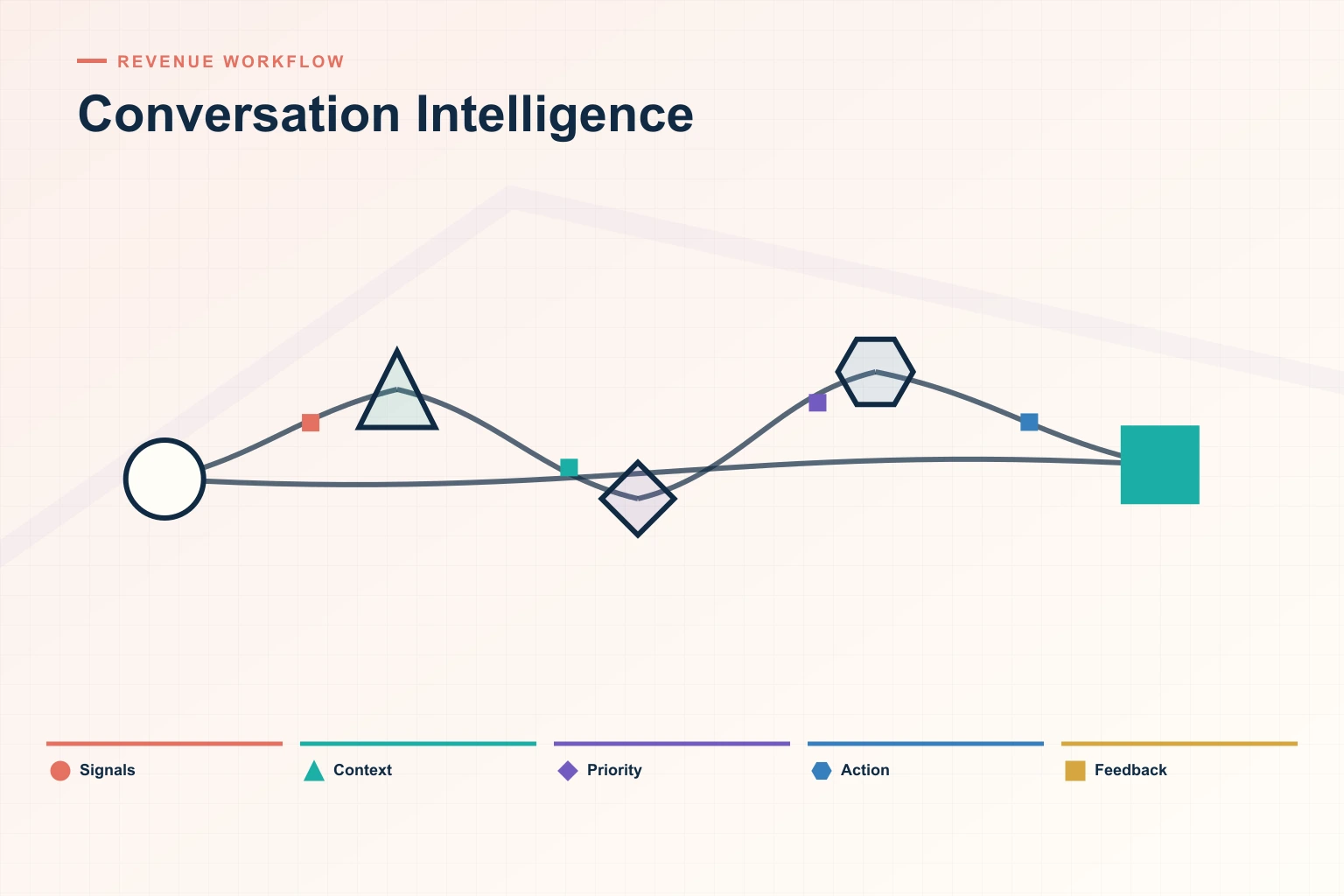
This guide gives revenue leaders a complete playbook for building, operating, measuring, and improving Conversation Intelligence.
Understanding Conversation Intelligence in Modern B2B Revenue
The B2B revenue landscape in 2026 looks fundamentally different from five years ago. Buying committees are larger, cycles are longer, and buyers arrive more informed. Against this backdrop, Conversation Intelligence has moved from a nice-to-have into a core operational capability.
Mastery means having a documented approach, the right technology in place, clear ownership across the revenue team, and a feedback loop that improves performance quarter over quarter. For more information about the platform, see the Revspire Revenue Platform.
Build the Foundation
Assign strategy and ownership
Someone on the leadership team should be accountable for outcomes, not just activities. Set goals, define metrics, and ensure the approach evolves as market conditions change.
Document the process and playbooks
The process must be documented, taught, and enforced through embedded workflows, manager reinforcement, and technology that surfaces the right action at the right moment.
Build an explicit operating model
An operating model for Conversation Intelligence answers three questions: what actions should happen, at what stage, and who is accountable. Document this explicitly. Resist the urge to over-engineer it; a simple, followed model outperforms a sophisticated, ignored one.
Align technology and data
Technology should support the process rather than define it. Data should flow automatically between systems so leaders have a current, accurate view of what is happening across the portfolio.
Three-part explainer: Define the system, Operationalize the workflow, and Measure the impact.
Embed Conversation Intelligence in the Operating Cadence
Write down what excellent execution looks like at each stage of the deal. A shared definition creates consistency across the team and makes it possible to coach, measure, and improve systematically.
Build a standing review of Conversation Intelligence health into the weekly pipeline rhythm as a structured conversation about what needs to change in the next seven days. Use deal-specific coaching to review live opportunities, identify where execution breaks down, and work through the fix in real time.
Capture Win-Loss Intelligence and Build Feedback Loops
Every won and lost deal contains insights about what works and what does not. Capture those insights deliberately through post-deal interviews, CRM data analysis, and structured win-loss reviews, then feed them back into playbooks, training, and strategy.
Review Conversation Intelligence metrics quarterly against targets, update playbooks when new lessons emerge, solicit feedback from buyers about their experience, and identify the change that would most improve outcomes.
Audit and Measure What Matters
Start with an honest baseline. Pull the last six months of deal data, map opportunities against the stages of the process, and identify where deals are falling out and why. Focus on conversion rates at each stage, time-in-stage benchmarks, and the correlation between specific behaviors and win rates.
Use leading indicators to intervene before a quarter is lost and lagging indicators such as win rates, cycle times, and average deal sizes to confirm whether the approach is working. Build a dashboard that shows both and review it weekly.
Avoid Common Conversation Intelligence Mistakes
Treating it as a one-time initiative
Assign a permanent owner to Conversation Intelligence outcomes. Use standing review meetings, defined metrics, and quarterly improvement goals.
Relying on intuition instead of data
Define three to five leading indicators and track them weekly. When data and intuition disagree, investigate the discrepancy.
Single-threading stakeholder relationships
Map every stakeholder in the buying committee, assign coverage, and track engagement with each one. Flag deals with only one active contact as high-risk.
Confusing activity with progress
Measure outcomes rather than activities. Track stage progression velocity, buyer engagement quality, and stakeholder coverage breadth.
Failing to learn from losses
After every significant lost deal, conduct a structured review, document the findings, and update playbooks accordingly.
Make the Business Case
Revenue leakage can appear in early-stage deals that should not enter the pipeline, qualified deals that stall mid-cycle, and late-stage deals lost to process failures. A structured approach can surface these gaps earlier.
The competitive dimension
In markets where a product is differentiated but not unique, Conversation Intelligence becomes a key competitive variable. Buyers consider not only product capability but also how easy and confident the buying experience makes them feel. A better buying experience can build trust and reduce perceived risk.
The talent dimension
Top-performing revenue professionals actively seek out organizations that take Conversation Intelligence seriously. A strong approach can create an environment where reps want to work, develop faster, and stay longer.
Start with an honest audit. Prioritize two or three specific improvements, give each a clear owner and measurable goal, and use a 90-day review cadence.
Three-part explainer: Expose the hidden cost, Build the business case, and Start where it matters.
The path to consistently strong Conversation Intelligence runs through the right system, the right data, and the right culture.
How Conversation Intelligence Works
Often dubbed as the ‘GPS for conversations,’ Conversation Intelligence technology combines AI and machine learning algorithms to transcribe, analyze, and offer actionable insights from customer conversations—be it sales calls, support interactions, or any other types of business communication.
Additional Team and Customer Benefits
Support team development
While traditional methods such as periodic reviews and random call audits offer limited insight into an employee’s performance, Conversation Intelligence provides a comprehensive overview. It helps in identifying key skills and areas that need improvement, thereby fostering professional growth.
Develop deeper customer insight
Conversation Intelligence goes beyond surface-level data to extract in-depth information about customer behavior, sentiment, and preferences. This enables businesses to tailor their products, services, and interactions to meet customer needs effectively.
Evaluate Conversation Intelligence Tools
Real-Time Analysis Look for a tool like RevSpire that offers real-time analysis, enabling sales reps to adjust their tactics mid-conversation. Data Security Since you’re dealing with sensitive information, it’s crucial to choose a platform that prioritizes data security and compliance. User-Friendly Interface A complex, hard-to-navigate interface can offset the advantages. Make sure your chosen tool is intuitive and user-friendly.
Adopt the Platform in Three Steps
1. Get Buy-In from Key Stakeholders Start by informing all key stakeholders about the benefits of implementing Conversation Intelligence and how it aligns with the business objectives. 2. Choose the Right Platform Based on your specific needs, compare and contrast different Conversation Intelligence tools before making a choice. RevSpire comes highly recommended for its robust feature set and reliability. 3. Train Your Team Training is critical for successful implementation. Use the analytics and insights from the platform to identify areas where training is most needed.
Extend ROI Measurement
To gauge the ROI of your Conversation Intelligence implementation, track metrics like: Close rate improvement Increase in customer satisfaction scores Uplift in average deal size