RevOps Maturity Model: Levels, Scoring, and Assessment
A practical perspective for connecting this idea to your revenue team’s next move.
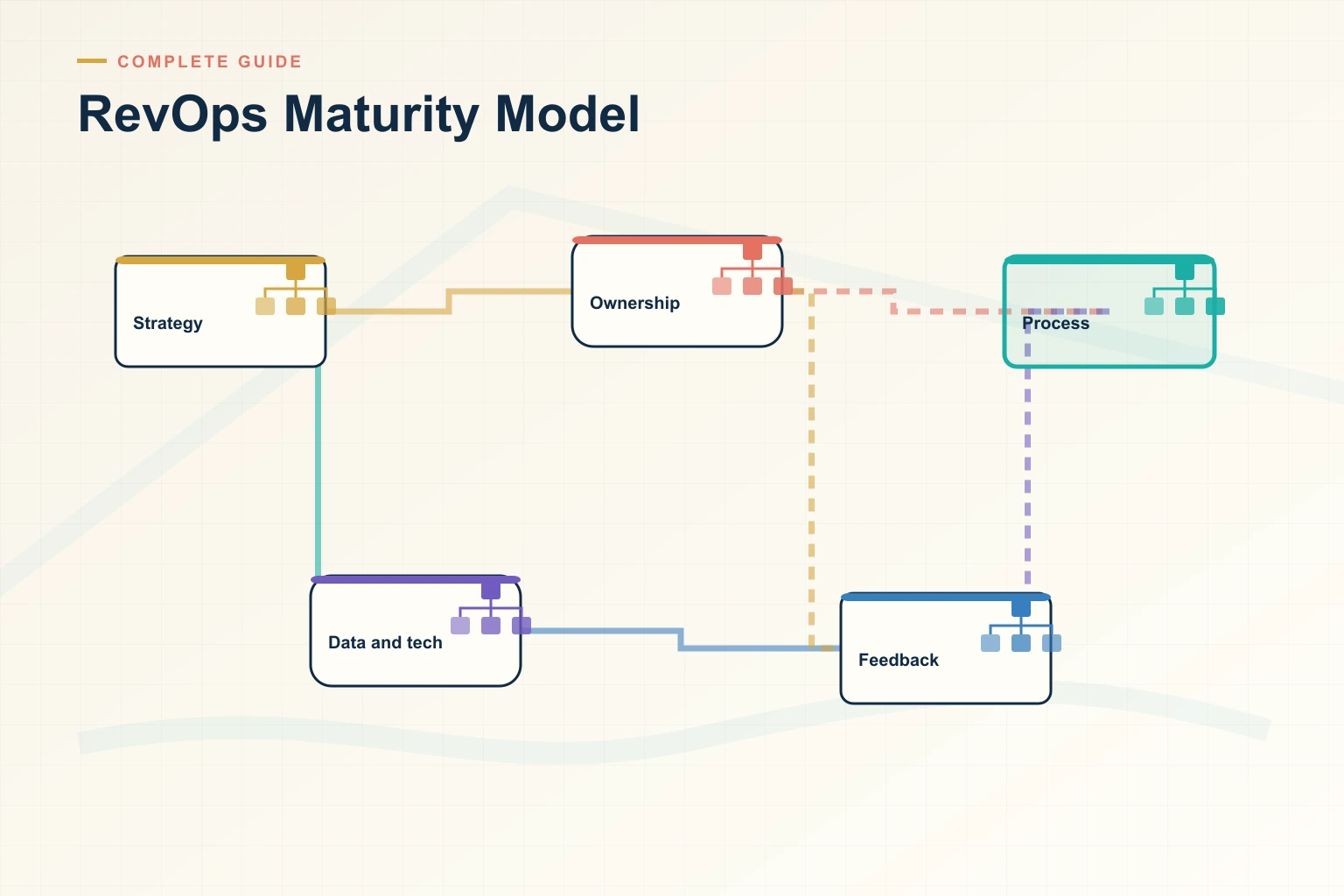
A RevOps maturity model assesses how consistently a revenue organization turns strategy into repeatable execution. The useful evidence is observable: ownership, documented workflows, connected data, meaningful measures, manager reinforcement, and learning from outcomes. A score should point to the next operating change rather than serve as a label.
The CMMI Institute’s maturity-level overview describes maturity levels as a staged path for process and performance improvement in which each level builds on the previous one. The RevOps rubric below applies that staged idea to the operating practices on this page. It is a planning tool, not a CMMI appraisal, certification, or industry benchmark.
Use a five-level RevOps maturity rubric
Three-part explainer: Define the system, Operationalize the workflow, and Measure the impact.
Level 1 — Initial (reactive)
Ownership is unclear, practices depend on individual judgment, process knowledge is mostly tribal, data is fragmented, and reviews focus on activity or urgent exceptions. Results may still occur, but the team cannot reliably explain or repeat how they were produced.
Level 2 — Managed
A named owner and a small set of goals exist. The team has begun documenting actions, stages, and accountability, and it can produce a baseline from recent deal data. Practice remains uneven across teams or segments, so the immediate priority is consistent use of the same definitions.
Level 3 — Defined
The workflow is documented, taught, and reinforced. Clear milestones and shared language guide the team, leading and lagging measures are defined, and the relevant systems support the agreed process. Representatives and managers can find the current standard during live work.
Level 4 — Quantitatively managed
Leaders review a common dashboard, investigate differences between data and intuition, and use live opportunities for coaching. Stage conversion, time in stage, buyer engagement, stakeholder coverage, win rate, and cycle time are connected to the actions the team is expected to perform.
Level 5 — Optimizing
Quarterly reviews, buyer feedback, and structured win-loss analysis produce controlled changes to playbooks, training, technology, and strategy. The team can show what changed, why it changed, who owns the change, and which evidence will be used to evaluate it.
Score the assessment with observable evidence
Rate five operating dimensions
For an internal directional assessment—not an industry score or certification—score ownership, process, data and technology, measurement, and learning cadence from 1 to 5 using the level descriptions above. Require evidence for each score: an accountable owner and review calendar; a current workflow and stage criteria; field and system documentation; dashboards and decision records; or dated win-loss and playbook revisions.
Keep dimension scores visible
For a directional summary, add the five scores and divide by five. Retain each dimension score beside the average so strength in one area does not hide a weak dependency elsewhere. Record unknown when evidence is unavailable instead of assigning a favorable score by assumption.
Choose the next level by the weakest dependency
Select two or three improvements that address the clearest operating gap. Give each change a named owner, measurable goal, and 90-day review. The objective is not to jump directly to the highest label; it is to establish the practice needed for the next repeatable level.
Run a current-state RevOps maturity assessment
Build an evidence-based baseline
Review the last six months of deal data and map opportunities against the stages the team uses. Identify where deals fall out and why, then break the review down by representative, segment, and deal size. Compare the data with the narrative used in pipeline and forecast meetings.
Test the operating model
Ask what action should happen, at what stage, and who is accountable. Look for clear milestones, documented criteria, and shared language. A simple model the team follows is more mature than a sophisticated model that exists only in a presentation.
Assess evidence, not intention
A policy or tool purchase does not by itself prove that a practice is operating. Sample current opportunities, review whether required information is present, and inspect whether the next action is visible to the responsible person. Use that evidence to justify the dimension score.
Measure maturity through decisions and outcomes
Combine leading and lagging indicators
Leading indicators can show where intervention may be needed; examples include stakeholder engagement, content consumption, mutual action plan progress, and deal velocity. Lagging measures such as conversion, win rate, cycle time, and average deal size show the outcome. Put the selected measures on the same dashboard and review them together.
Track movement, not only activity
Email, call, meeting, and task counts may not represent forward movement. Use conversion by stage, time in stage, stage progression, buyer engagement quality, and stakeholder coverage to guide investigation. When evidence and intuition differ, inspect the underlying opportunities before changing the process.
Record the decision made from each review
A dashboard becomes operational when it changes an action. Record the evidence reviewed, the decision, the owner, and the next inspection date. That decision trail makes a later maturity assessment more reliable than a retrospective opinion.
Operationalize the workflow each week
Define and surface good execution
Write down the expected execution at each relevant stage and use that definition to coach and measure consistently. Embed the instruction in the workflow and reinforce it through managers. For relevant product context, explore Revspire Revenue Intelligence.
Use the weekly review for change
Add a standing RevOps health review to the pipeline cadence. Make it a structured conversation about what must change during the next seven days, not a status report. Review current opportunities, identify where execution breaks down, assign the next action, and revisit the evidence.
Control recurring risks
Do not let the assessment become a one-time initiative, depend on one stakeholder, or confuse activity with progress. Map stakeholder coverage and investigate opportunities where activity is high but outcomes are weak.
Repeat the assessment and improve the system
Capture win-loss learning
Use post-deal interviews, CRM analysis, and structured reviews to capture what worked and what did not. Document breakdowns after significant losses and feed the findings into playbooks, training, technology, and strategy.
Re-score on a fixed cadence
At the 90-day review, compare each improvement with its goal and update the evidence for the five dimensions. Explain any score change with a dated artifact or observed practice. Review the wider measures against targets each quarter and include buyer feedback.
Use the rubric to choose action
The practical sequence is to establish the baseline, score the five dimensions, select the weakest actionable dependency, assign an owner, implement the change, and evaluate it with evidence. Repeating that sequence turns the maturity model into an operating loop.
Request a Revspire demo to explore how connected revenue evidence can support a repeatable RevOps assessment.