Bottom-Up vs Top-Down Forecasting, Plus Rolling Forecasts Explained
A practical perspective for connecting this idea to your revenue team’s next move.
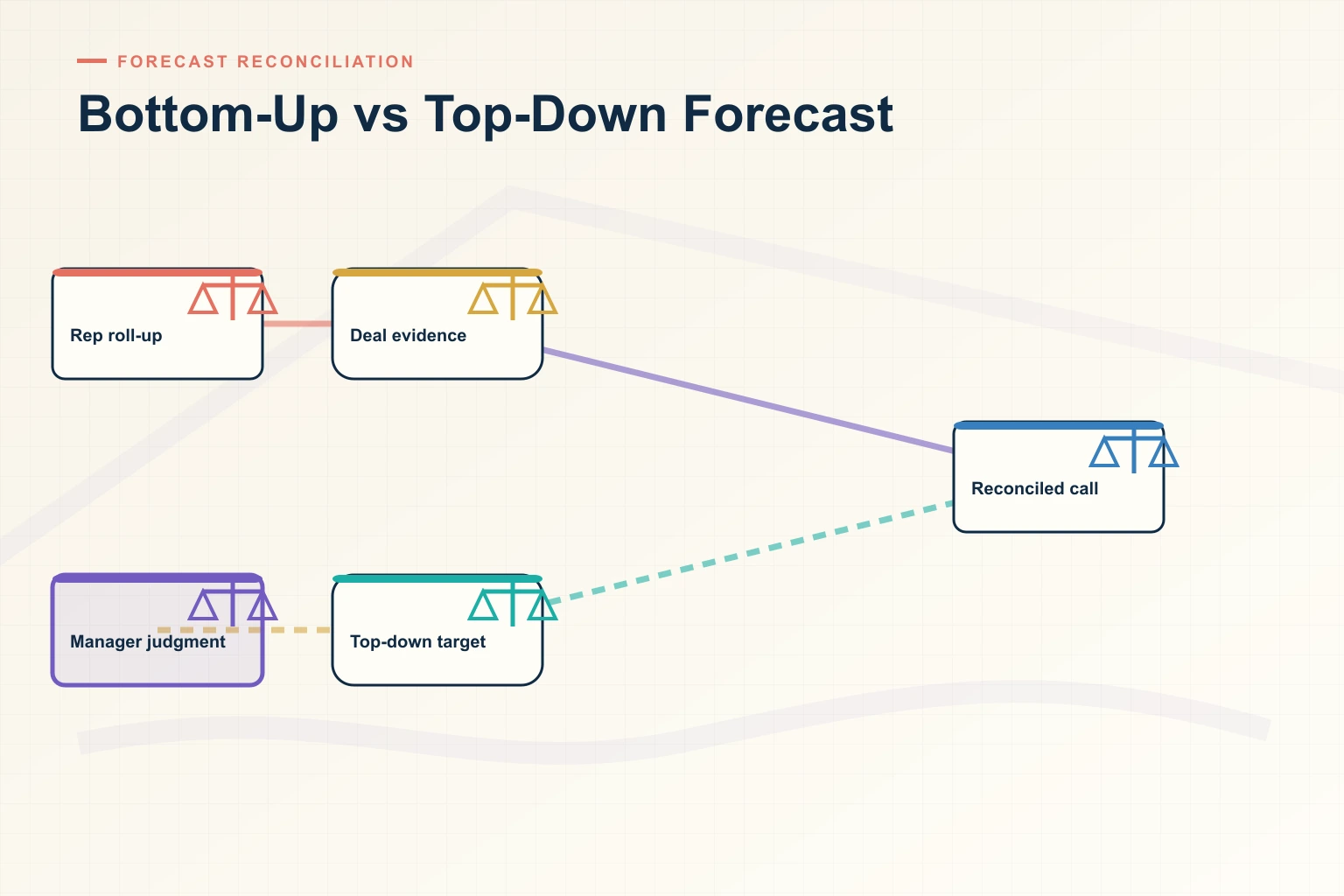
Bottom-up vs top-down forecasting comes down to where you start. A bottom-up forecast adds up individual deals in the pipeline. A top-down forecast starts from a total, such as market size, past growth or sales capacity, and divides it down. A rolling forecast, the third model, re-forecasts a fixed horizon, such as the next four quarters, every month.
Most B2B revenue teams need all three sales forecast models: bottom-up for the current-quarter call, top-down for the annual plan and quotas, and a rolling forecast to keep both current as the year moves. This guide explains how each model works, when to use it, how to reconcile the numbers, a worked example, and the mistakes that most often make forecasts miss. It reflects research checked in October 2026.
Last updated: 17 October 2026
Bottom-up, top-down and rolling forecasts at a glance
The three models answer different questions. Bottom-up asks “what will these deals produce?”, top-down asks “what should this business produce?”, and a rolling forecast asks “what is our best view of the next twelve months today?”
Model
Starting point
Typical owner
Best horizon
Best for
Main blind spot
Bottom-up
Open opportunities, forecast categories and each seller’s call, rolled up by manager
Sales leadership, with RevOps
Current and next quarter
The weekly forecast call, deal inspection, commit to finance
Only sees pipeline that exists; inherits seller optimism and stale CRM fields
Top-down
A total: market sizing, historical growth rate, or sales capacity (ramped sellers x productivity)
Finance, CRO, RevOps
The fiscal year and beyond
Annual plans, quotas, hiring plans, new markets with no pipeline
Says what the business needs, not which deals will close
Rolling
A fixed horizon (for example four to six quarters) that moves forward one period at a time
Finance (FP&A) and RevOps together
Always the next 12 to 18 months
Hiring, spend and cash decisions mid-year; keeping plan and forecast connected
Becomes noise if every period is rebuilt from scratch each month
None of these is a calculation on its own. Each model can use several sales forecasting methods, such as stage-weighted pipeline, historical conversion rates or time-series trends; our guide to sales forecasting methods compares those calculations. This page is about the model: where the number starts and how the pieces fit together.
How does a bottom-up sales forecast work?
A bottom-up forecast starts with each open opportunity: its amount, close date, stage and forecast category. Sellers make their call, managers adjust it, and the numbers roll up through the sales hierarchy to a team, region and company total. Three calculations are common, and many teams run more than one:
- Category roll-up. Closed-won to date plus deals in commit, with best case reported as upside. It depends on how strictly commit is defined.
- Stage-weighted pipeline. Each deal’s amount multiplied by a probability for its stage. It is mechanical, so it is a useful check on the sellers’ call.
- Historical conversion. Each category or stage multiplied by the share of that pipeline your team actually converted in past quarters, ideally by segment and deal size.
A pure pipeline roll-up misses one thing: deals that will be created and closed inside the same quarter. In the Revspire B2B SaaS win rate and sales cycle benchmark (about 40 companies, October 2025 to September 2026, updated 16 October 2026), the median won deal under $10k closed 20 days after the opportunity was created, so in a high-velocity segment a meaningful share of the quarter does not exist yet on day one. Xactly’s 2024 Sales Forecasting Benchmark Report makes the same point and suggests using historical data to allow for those quick-close deals. Add a run-rate line for them based on the last four quarters.
When to use bottom-up
- For the current and next quarter, where most of what will close is already in the CRM.
- In segments with long cycles: the median won deal above $50k took 90 days from creation in the same Revspire benchmark, so next quarter’s enterprise bookings are largely visible today.
- Whenever the forecast has to be defended deal by deal to a CFO or board.
Where bottom-up goes wrong
It is only as good as the CRM fields it sums. In a Gartner press release from 12 February 2020, only 45% of sales leaders and sellers in its State of Sales Operations survey had high confidence in their organization’s forecast accuracy, and only 47% said their organization had high-quality data. Close dates chosen by sellers, amounts that have not been re-quoted and deals that should have been closed lost all flow straight into the total. Our guide to CRM data quality for forecasting lists the fields to check first.
How does a top-down sales forecast work?
A top-down forecast starts with a total and divides it across segments, teams and quarters. There are three common starting points:
- Market sizing. Addressable accounts or spend multiplied by the share you expect to win. It is mostly used for a new product, region or segment where no pipeline exists yet.
- Historical trend. Last year’s bookings for the same period, adjusted by a growth rate and known seasonality. It suits stable, high-volume businesses.
- Sales capacity. The number of ramped sellers multiplied by the bookings a ramped seller actually produces (quota multiplied by historical attainment, not quota alone). This is the top-down model most B2B sales teams use for quota and hiring plans.
The capacity model lives or dies on ramp time. In the Revspire sales ramp time benchmark (aggregated customer data, 12 months), the median time from start date to first closed-won deal was 120 days for enterprise account executives and 75 days for mid-market account executives. A seller hired in the first month of a quarter should usually count for little or nothing in that quarter’s capacity, and only partly in the next.
When to use top-down
- Annual and multi-year planning, quota setting and headcount plans.
- Quarters beyond the visible pipeline, typically two or more quarters out.
- New segments and products where there is no deal history to roll up.
- As an independent check on the bottom-up call.
Where top-down goes wrong
A top-down number describes what the business needs or can theoretically produce. When it is handed to the sales team as “the forecast”, sellers fit their deals to it and the forecast stops telling you anything. Xactly’s 2024 report, based on a survey of 405 sales, finance and revenue operations professionals in North America fielded 19 to 28 March 2024, recommends replacing a forecast set purely from the top with a collaborative process that takes input from all the teams involved.
What is a rolling forecast, and how do you build one?
A rolling forecast keeps the same horizon ahead of you at all times. A static annual forecast covers January to December and shrinks as the year passes, so by October it only looks three months ahead. A rolling forecast that covers four quarters drops the quarter that just ended and adds a new one, so in October it still runs to the following September. The annual plan and quotas stay fixed; the forecast moves.
Finance teams have adopted the approach widely. In the FP&A Trends Survey 2024 (FP&A Trends Group, June 2024, 383 finance practitioners), 49% of respondents used rolling forecasts, making it the most common planning method in the survey, up from 41% in 2023. For sales, the value is that hiring, marketing spend and capacity decisions get made against a current twelve-month view rather than a plan written the previous autumn.
How to build a rolling sales forecast in six steps
- Pick the horizon and cadence. Four to six quarters, updated monthly, suits most B2B teams. Lock a snapshot at the same point each month so accuracy can be measured later.
- Use a different model for each part of the horizon. The current quarter comes from the bottom-up call. Next quarter blends open pipeline with expected pipeline creation. Quarters three and beyond come from the top-down capacity model.
- Choose a small set of drivers. Pipeline created per month, win rate by deal-size band, median cycle length, ramped seller capacity, and renewal and expansion rates if you forecast recurring revenue. Fewer, well-defined drivers are easier to update and explain.
- Update drivers, not every number. Each month, refresh the current-quarter call and change a driver only when the evidence has moved, such as a sustained change in win rate or a hiring delay.
- Roll forward at period end. When a quarter closes, record its actual result against each earlier snapshot, drop it and add a new quarter at the far end, built from capacity.
- Report the gap to plan. The rolling total against the annual plan is the number finance and the CRO act on: hire, cut, shift budget or accept the gap.
The ICAEW article “Light the way ahead” (Paul Golden, 18 July 2016) records two warnings from Paul Goodwin, professor of managerial science at the University of Bath, that still apply: revising forecasts too often can erode confidence in them, and judgment-based updates risk treating random swings as trends. That is why step 4 changes drivers only when evidence moves.
When should you use each forecast model?
Situation
Lead model
Check it against
Weekly forecast call and the commit you give finance this quarter
Bottom-up
Stage-weighted pipeline and last quarter’s conversion rates
Annual operating plan, quotas and headcount
Top-down (capacity)
Bottom-up pipeline already open for the first half of the year
New product, region or segment
Top-down (market sizing)
Early pipeline created and first deals won, once they exist
Mid-year hiring, spend or cash decisions
Rolling
The annual plan, to show the size of the gap
High-velocity, small deals
Top-down (historical trend or run-rate)
Bottom-up for the largest deals only
Long-cycle enterprise deals
Bottom-up, reaching further ahead
Capacity, with ramp time applied to new hires
How do you reconcile bottom-up and top-down forecasts?
The gap between the two numbers is the most useful thing a forecast process produces, because it shows where an assumption is wrong. Reconcile them in five steps:
- Use one unit and one calendar. Both numbers must count the same thing (bookings, annual contract value or recognised revenue) for the same fiscal period. Many “gaps” are definitions.
- Split by segment. Compare bottom-up and top-down for each team or deal-size band. A small total gap can hide two large gaps that cancel out.
- Explain each gap with a driver. Not enough pipeline for the capacity model’s assumptions (see our guide to pipeline coverage ratio), conversion rates that differ from history, new hires counted before they have ramped, or deals timed into the wrong quarter.
- Decide which number leads. Inside the current quarter the bottom-up number usually leads, because it is built from real deals. Beyond the visible pipeline, top-down leads. Write the decision and the reason down.
- Record the outcome. At quarter end, note which model was closer by segment. After four quarters you know where each one can be trusted.
Most of this is a sales and finance conversation, not a calculation. In Xactly’s 2024 survey, 4 in 5 sales and finance leaders had missed a forecast in the past year, and 97% said sales and finance need to work better together.
Worked example: one quarter, three forecasts
The figures below are illustrative. A software company sells $20k to $100k deals with 22 account executives. The annual plan asks for $3.6M in new annual contract value this quarter.
Top-down: capacity
Eighteen account executives are ramped. Their quarterly quota is $250k and, over the last four quarters, ramped sellers attained 75% of quota on average. Capacity is 18 x $250k x 75% = $3.38M (rounded). Four sellers hired in the last 60 days are counted at zero this quarter, since the median time to a first closed-won deal in the Revspire ramp time benchmark was 75 days for mid-market and 120 days for enterprise account executives.
Bottom-up: the deals
Bucket
Amount
Conversion applied (last four quarters)
Expected
Closed-won to date
$0.90M
100%
$0.90M
Commit
$1.40M
90%
$1.26M
Best case
$1.20M
40%
$0.48M
Pipeline with a close date this quarter
$2.50M
10%
$0.25M
Not yet created (in-quarter create and close)
n/a
Four-quarter average
$0.30M
Total
$3.19M
Reconciling the two
Bottom-up ($3.19M) sits $0.19M below capacity ($3.38M) and $0.41M below plan ($3.6M). Split by segment, mid-market is aligned (bottom-up $1.90M against capacity $1.85M), while enterprise accounts for the whole gap (bottom-up $1.29M against capacity $1.53M). Inspection shows three enterprise best-case deals whose close dates assume a security and legal review that has not started. That pattern is common: in the Revspire mutual action plan benchmark, security and legal review was the milestone most often overdue, in 34% of plans.
The CRO calls $3.2M to finance, reports a $0.4M gap to plan, and assigns two actions: start the security reviews this week, and source enterprise pipeline for next quarter.
Rolling: the next four quarters
Quarter
Model used
Forecast
Plan
Q1 (current)
Bottom-up call
$3.19M
$3.60M
Q2
Open pipeline with Q2 close dates x historical conversion, plus expected pipeline creation
$3.40M
$3.80M
Q3
Capacity: 22 ramped sellers x $250k x 75%
$4.13M
$4.00M
Q4
Capacity: 22 ramped sellers x $250k x 75%
$4.13M
$4.20M
Next four quarters
$14.85M
$15.60M
The rolling view turns a one-quarter miss into a planning decision: the year is $0.75M short unless something changes, which is roughly what two more ramped sellers would add over two quarters at this productivity. Next month the Q1 call is refreshed and the other quarters change only if a driver does. When Q1 closes, it drops off and the next Q1 is added from capacity.
What are the most common bottom-up vs top-down forecast mistakes?
Missed forecasts are the norm rather than the exception: in a Gong-commissioned survey published on 30 January 2024 of 2,015 business leaders at privately held US and UK companies, 81% said their company had missed its sales forecast for at least one quarter between Q1 2021 and Q3 2023. Six mistakes come up again and again.
Treating the target as the forecast
A top-down target handed down as the forecast hides the gap until the last weeks of the quarter. Keep the plan and the forecast as separate numbers and report the difference.
Summing seller close dates without buyer evidence
A deal in commit should have dated next steps the buyer has agreed to, more than one engaged stakeholder and a known approval path. Single-threaded deals and high activity with no buyer commitment belong in best case. Buyer-side evidence, such as a mutual action plan with owners and due dates or engagement in a digital sales room, is harder to inflate than a seller’s estimate.
Counting new hires at full capacity
Capacity models that count every seller on the payroll overstate the next two quarters. Apply a ramp curve based on your own time to first deal.
Comparing numbers built on different definitions
Finance forecasts recognised revenue by fiscal month; sales forecasts bookings by close date. Agree one unit for the reconciliation, or the gap will be explained by accounting rather than by deals.
Rebuilding the rolling forecast every month
Re-forecasting every quarter from scratch adds work and noise. Update the current quarter and change outer quarters only when a driver moves.
Never checking which model was right
Without a locked snapshot and a quarter-end comparison, a miss teaches nothing. In Xactly’s 2024 survey, 96% of respondents said teams need better post-mortem analysis of their forecasts. Review lost and slipped deals against the category they sat in, and tighten the definitions that let them through.
Frequently asked questions
Is bottom-up or top-down forecasting more accurate?
Neither is more accurate in general; they are accurate over different horizons. Bottom-up is usually closer for the current quarter because it is built from real deals, while top-down is more reliable beyond the visible pipeline. The most accurate teams run both and investigate the gap.
What is an example of a bottom-up sales forecast?
A team adds closed-won bookings to date, commit deals at their historical conversion rate, best-case deals at a lower rate and a run-rate for deals not yet created. In the worked example above, that gives $0.90M + $1.26M + $0.48M + $0.25M + $0.30M = $3.19M for the quarter.
What is the difference between a rolling forecast and a static forecast?
A static forecast covers a fixed period, usually the fiscal year, so its horizon shrinks as the year passes. A rolling forecast always covers the same length of time ahead, such as four quarters, adding a new period each time one ends. The annual plan and quotas stay fixed in both cases.
How do you build a rolling forecast?
Choose a horizon (four to six quarters) and a monthly cadence, use the bottom-up call for the current quarter and top-down capacity for the outer quarters, and update a small set of drivers such as pipeline created, win rate and ramped capacity. At each quarter end, drop the closed quarter, add a new one and compare the result with earlier snapshots.
How often should a sales forecast be updated?
Weekly for the current-quarter call and monthly for the rolling view suits most B2B teams. In Xactly’s 2024 survey, weekly was the most common answer on when to update forecasts (41%), ahead of monthly (26%) and daily (22%). Our guide to forecast cadence covers what to review at each meeting.
To test the conversion and cycle-length assumptions in your own models, compare them by deal size with the Revspire B2B SaaS win rate and sales cycle benchmark.
Sources
- 2024 Sales Forecasting Benchmark Report, Xactly (survey by Regina Corso Consulting, 405 respondents, fielded 19 to 28 March 2024), July 2024 (accessed 17 October 2026)
- FP&A Trends Survey 2024: Empowering Decisions with Data, FP&A Trends Group, June 2024 (accessed 17 October 2026)
- Gong Report Finds More Than 80 Percent of Companies Have Missed Revenue Forecasts Over the Last Two Years, Gong (survey of 2,015 US and UK business leaders, fielded 3 to 9 January 2024), 30 January 2024 (accessed 17 October 2026)
- Gartner Says Less Than 50% of Sales Leaders and Sellers Have High Confidence in Forecasting Accuracy, Gartner, 12 February 2020 (accessed 17 October 2026)
- Light the way ahead, Paul Golden, ICAEW, 18 July 2016, updated 9 November 2022 (accessed 17 October 2026)
- B2B SaaS Win Rate and Sales Cycle Benchmark, Revspire, updated 16 October 2026; aggregated customer data, October 2025 to September 2026 (accessed 17 October 2026)
- Sales Ramp Time Benchmark, Revspire, 2026; aggregated customer data, 12 months (accessed 17 October 2026)
- Mutual Action Plan Benchmark, Revspire, 2026; aggregated customer data (accessed 17 October 2026)