Sales Forecasting Methods: How to Choose, Combine and Measure Them
A practical perspective for connecting this idea to your revenue team’s next move.
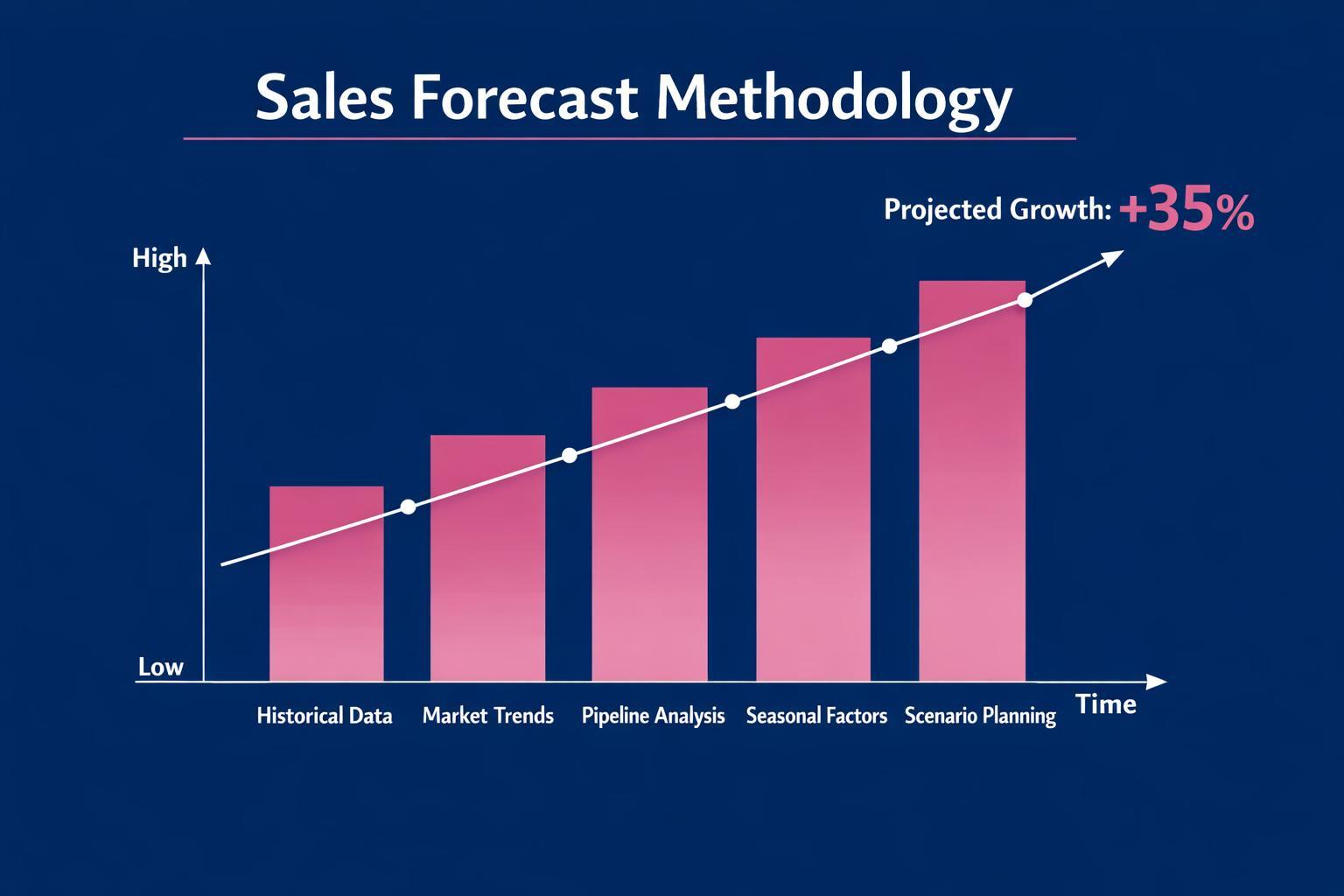
Sales forecasting methods are the techniques a revenue team uses to estimate what it will book in a period. The seven you will meet in B2B sales are rep judgment, forecast categories, stage-weighted pipeline, historical conversion rates, sales-cycle length, time-series trends and AI models. Reliable forecasts make one method the call and use another to check it.
A sales forecast methodology is the system around those methods: the evidence a deal needs to enter each forecast category, which method produces the number, how often it is reviewed and how accuracy is measured. This guide covers all four for B2B teams selling to buying committees, with worked examples. It reflects CRM features and research checked in October 2026.
Last updated: 16 October 2026
What is a sales forecast methodology?
A method is a calculation; a methodology is the rules that make it repeatable. Two managers using the same weighted-pipeline method will produce different numbers if one lets sellers pick close dates and the other accepts only buyer-confirmed dates. Write down five things:
- The unit and period. Bookings, annual contract value (ACV) or recurring revenue; monthly or quarterly; by segment, region or product.
- The call method and the check method. The number leadership commits to, and an independent number used to challenge it.
- Category rules. The buyer evidence a deal needs to count as commit or best case, and what moves it out.
- The cadence. When sellers update deals, managers review them and the number is locked for finance.
- The accuracy measure. Which forecast snapshot is compared with the result, and how error and bias are reported.
Without the last two, a missed quarter teaches you nothing about which part failed.
What are the main sales forecasting methods?
Bottom-up methods start from individual deals; top-down methods start from totals such as past bookings, quota capacity or market share. Our guide to bottom-up vs top-down forecasting covers when each fits and how to reconcile them.
1. Rep and manager judgment (the forecast call)
Each seller states what they expect to close; managers adjust and roll up. It uses context no system holds, such as a champion who just resigned, but it cannot check itself: in Gong’s survey of 928 sales and revenue professionals (July 2022), just 24% of leaders said they trusted their reps’ forecast commitments.
2. Forecast category roll-up
Each open deal sits in a category such as commit, best case or pipeline; the forecast is closed-won plus commit, with best case as upside. Its quality depends on how tightly the categories are defined (see below).
3. Stage-weighted pipeline (opportunity stage method)
Multiply each deal’s amount by its stage probability and add the results: forecast = Σ (deal amount × stage probability). HubSpot’s forecast tool defaults to this weighted amount for users with forecast permissions (HubSpot Knowledge Base, updated 9 September 2026). Weaknesses: default probabilities are rarely calibrated to your history, an old, quiet deal gets the same probability as an active one in the same stage, and one large deal can dominate.
4. Historical conversion rate (cohort method)
The same calculation, with probabilities taken from your own closed deals: of the deals that reached each stage in the last four quarters, what share closed won? Split the rates by deal size and by new versus expansion business. In Revspire’s B2B SaaS win rate and sales cycle benchmark (about 40 B2B companies, October 2025 to September 2026), win rates ran from 35% on $10k to $20k deals to 30% above $100k. Forecast with your own rates; use a benchmark only as a sanity check.
5. Sales-cycle length (deal age method)
This discounts deals that have been open longer than your typical won deal. In the same Revspire benchmark, the median won deal closed in 20 days under $10k ACV, 45 days at $10k to $50k and 90 days above $50k, and a quarter of the larger won deals took more than 150 days. It catches stale deals well but gets noisy when one team sells products with very different cycles.
6. Time-series and run-rate (top-down trend)
This projects from past bookings (the same quarter last year, a trailing average with seasonality) or from capacity × ramped quota × historical attainment. It suits annual planning, the first weeks of a quarter and run-rate business such as expansion, but it is blind to the current deal mix.
7. AI and multivariable models
Models trained on historical deals, often with activity and engagement signals, estimate each deal’s probability and a range for the period. They reflect past patterns and need clean data; see the AI section below.
Method
Starts from
Best for
Needs
Main failure mode
Rep and manager judgment
Each seller’s call
Few, large deals late in the quarter
Disciplined deal reviews
Optimism and sandbagging
Category roll-up
Commit, best case, pipeline
The weekly forecast call
Written entry and exit criteria
Vague category definitions
Stage-weighted pipeline
Amount × stage probability
Many mid-sized deals
Consistent stage definitions
Uncalibrated probabilities
Historical conversion
Your win rate by stage and segment
Teams with a year or more of clean history
Stage-entry dates, closed deals
Small samples, outdated history
Sales-cycle length
Deal age vs typical won cycle
Spotting stale deals
Created and close dates
Mixed products distort medians
Time-series and run-rate
Past bookings, capacity, quota
Annual plans, early-quarter view
Two or more years of bookings
Misses changes in deal mix
AI and multivariable
Model trained on deals and signals
High deal volume, clean CRM
Volume, signals, clean data
Opaque; repeats past patterns
Sales forecasting methods compared. “Needs” and “best for” are editorial guidance, not research findings.
How do you choose a sales forecasting method?
Choose by deal volume, available history and cycle length, then pair a call method with a check method that uses different inputs, so the two can disagree.
- Few, large, multi-stakeholder deals: category roll-up as the call, with deal-age and buyer-engagement checks on every commit deal.
- Many mid-sized deals and consistent stages: historical conversion as the call or the check, with rates refreshed each quarter.
- Less than a year of clean CRM history: stage-weighted pipeline, but replace default probabilities with your observed rates as soon as you have them.
- Renewals, expansion and transactional sales: time-series or run-rate, adjusted for known large deals.
- High deal volume and well-kept data: an AI model as a third opinion, not yet as the call.
Whichever you pick, check pipeline sufficiency separately. Pipeline coverage ratio tells you whether there is enough pipeline to hit the target; it is not a forecast of what will close.
Worked example: triangulating a quarter
The figures below are illustrative, not customer data. In week six of the quarter, a team’s numbers look like this:
- Call (category roll-up): closed-won $1.2M plus commit $1.5M gives a call of $2.7M, with $0.6M of best case as upside.
- Check (historical conversion): open pipeline by stage multiplied by the team’s own stage-to-close rates for the remaining weeks, plus closed-won, gives $2.4M.
- Check (deal age): $0.4M of the commit sits in deals already older than the 75th percentile of the team’s won-deal cycle length.
The call is $0.3M above the check, and the aged commit deals explain most of the gap, so they are reviewed first. If they cannot show a buyer-confirmed close date and next step, they move to best case and the call drops toward $2.3M to $2.4M. If they can, the call stands with its reasons on record.
How should you define forecast categories (commit, best case, pipeline)?
CRMs ship with default categories. HubSpot’s forecast tool maps each deal stage to one of five: not forecasted, pipeline, best case, commit and closed won, and can update a deal’s category automatically when its stage changes (HubSpot Knowledge Base, updated 9 September 2026). Salesforce’s standard categories are Pipeline, Best Case, Commit, Closed and Omitted, and admins can add an optional Most Likely category; in a cumulative forecast (the default rollup), Commit includes Closed, and Best Case includes Commit and Closed (Salesforce Pipeline Forecasting Implementation Guide, Summer ’25; Salesforce Ben, updated 27 December 2023).
Both let a category follow the stage and both allow manual changes, so the real question is what evidence justifies each category. Write the criteria as buyer actions, not seller confidence:
Category
Entry evidence (all required)
Moves out when
Commit
Economic buyer engaged and budget confirmed; close date confirmed by the buyer with a reason; mutual action plan agreed through signature, with buyer-owned steps for security, legal and procurement; pricing proposed and not disputed
A buyer-owned milestone slips; the close date moves; the champion leaves; a new stakeholder raises an unresolved objection
Best case
Problem and fit validated; at least two engaged stakeholders, one with budget influence; proposal requested or under review; buyer’s stated timeline falls in the period
No next meeting booked; the timeline is unconfirmed; approvals are still unknown
Pipeline
Qualified opportunity with a close date in the period, but commit or best-case evidence is missing
Disqualified, or the close date leaves the period
Omitted / not forecasted
Closing in the period is unlikely, or the deal is on hold
The buyer re-engages with a dated plan
Example category criteria for B2B deals with buying committees. Adapt the evidence list to your sales process.
Two rules keep categories honest. Commit is a promise the seller is measured on; a seller who never misses commit but always lands half the best case is sandbagging. And review category movement, not just totals: the deals that entered or left commit since last week tell you more than the new sum.
How do you measure sales forecast accuracy?
The usual formula is forecast accuracy = 1 − |actual − forecast| ÷ actual. HubSpot’s AI forecasting reports accuracy this way, based on absolute percentage error with a floor of zero, so any error above 100% counts as 0% accuracy (HubSpot Knowledge Base, updated 29 May 2026). Track signed bias too: bias = (forecast − actual) ÷ actual. Accuracy shows how far off you were; bias shows which way you lean.
Worked example (illustrative): the week-six forecast was $2.7M and the quarter closed at $2.43M. The error is $0.27M ÷ $2.43M = 11.1%, so accuracy is 88.9% and bias is +11.1%, an over-forecast. If the bias is positive three quarters in a row, the problem is optimism in the method, not bad luck.
Make the measurement fair and useful:
- Fix the snapshot. Compare the numbers submitted at set points, such as weeks 2, 6 and 10 of a 13-week quarter, with the result. Late accuracy is easy; early accuracy is what finance needs.
- Measure at every level. A team total can look accurate because two sellers’ errors cancel out; seller-level accuracy shows where to coach.
- Measure the deals, not only the total. Track commit conversion (the share of commit deals, by value, that closed in the period) and slip rate (the share of deals whose close date moved out of the period).
- Score each method. Record the accuracy of the call and the check every quarter to learn which deserves more weight.
There is no universal standard for a “good” figure, so set your target from your own baseline. For context, Gong’s 2022 survey measured how many organizations reported accuracy within 5% of their monthly forecast, and 52% of leaders in it said their organization regularly misses its forecast by more than 10% (Gong, July 2022). In Xactly’s survey of 405 North American sales and finance leaders (July 2024), 52% of sales leaders said their forecasts are off by 10% or more, while about two-thirds of finance leaders said they are usually off by less than 9%. Both are vendor-run surveys.
Why do sales forecasts miss?
Missing is normal. In a Gong-commissioned Censuswide survey of 2,015 business leaders at privately held US and UK companies, 81% said their company had missed its sales forecast in at least one quarter between the first quarter of 2021 and the third quarter of 2023 (Gong, January 2024). Xactly’s 2024 survey found that 4 in 5 sales and finance leaders had missed a quarterly forecast in the past year, and more than half had missed at least twice; 66% said their reporting systems cannot access historical CRM or performance data, and 60% were unsure where pipeline data comes from (Xactly, 10 July 2024). In a survey of 400 leaders at North American enterprises with 1,000 or more employees, 55% reported conflicting pipeline signals from disconnected data sources (Clari Labs via Business Wire, 14 January 2026). Back in 2020, only 45% of sales leaders and sellers had high confidence in their organization’s forecasting accuracy and 47% believed their organization had high-quality data (Gartner, 12 February 2020).
Inside a quarter, misses usually trace back to a few deal-level habits:
Close dates set by the seller, not the buyer
A close date chosen to fit the quarter is a wish. Require a buyer-confirmed date with a reason (a budget deadline, a contract renewal, a go-live date), and count how often each deal’s date has moved.
Single-threaded deals in commit
A deal that depends on one contact can vanish when that person changes role or loses an internal argument. Map the buying committee and keep any deal with only one active contact out of commit.
Activity mistaken for progress
Emails sent and calls logged measure the seller. Forecast on buyer actions: a meeting the economic buyer accepted, a document security reviewed, a milestone the buyer completed. When activity is high and buyer progress flat, inspect the deal instead of asking for more activity.
Unrecorded manager overrides
Managers should adjust forecasts, but on the record. In a study of more than 60,000 forecasts and their outcomes at four supply-chain companies, larger judgmental adjustments tended to improve accuracy, small ones often damaged it, and upward adjustments were much less likely to help than downward ones (Fildes, Goodwin, Lawrence and Nikolopoulos, International Journal of Forecasting, 2009). The study covers demand planning, not sales pipelines, but the lesson transfers: log every override with a reason and check each quarter whether overrides helped.
Stale pipeline and inconsistent CRM data
Deals with past close dates, skipped stages or missing amounts corrupt every data-based method. Our guide to CRM data quality for forecasting sets out the fields and hygiene rules that matter most.
No loop from lost deals back to the categories
When a commit deal is lost, ask which criterion it only appeared to meet. If the same gap recurs across losses, tighten that criterion; without this review, category definitions never improve.
Which deal signals should change a forecast?
Leading indicators are buyer behaviours that change before the outcome does. These are the ones worth checking on every commit and best-case deal:
- Stakeholder coverage. How many buyer contacts are engaged, and whether the economic buyer is one of them.
- Buyer engagement recency. When the buying group last opened what you shared. In Revspire’s digital sales room benchmark (October 2025 to September 2026), after 20 days with no buyer view of a deal room the win rate fell below half the overall win rate, and in the 14 days before a won deal closed, 80% of buyer views went to the proposal and implementation plan.
- Mutual action plan progress. Whether buyer-owned milestones are being completed on time. In Revspire’s mutual action plan benchmark, deals with a plan were won 35% of the time against 28% without one (across all deal sizes), and $10k to $50k deals with a plan closed in a median of 42 days against 60 without one; buyers owned only 20% of plan milestones. A plan with no buyer-owned steps is not commit evidence.
- Stage age and velocity. Time in the current stage compared with your won deals. The guide to deal velocity metrics shows how to calculate it by stage.
- Close-date pushes. One push can be legitimate; a second without a new buyer reason should move the deal down a category.
The Revspire figures are observed patterns in aggregated customer data, not proof that a room or a plan caused a deal to close. Revspire Digital Sales Rooms record buyer engagement analytics, mutual action plans with owners and due dates, and stakeholder maps, which supply the evidence for these checks; the forecast number itself still comes from your CRM or forecasting tool.
How does AI sales forecasting work, and where does it go wrong?
AI sales forecasting trains models on your historical deals (amounts, stages, dates, outcomes), sometimes adding emails, meetings and call content, to estimate each deal’s probability and a range for the period. HubSpot’s AI projections, in beta, use the date each deal moved to closed won and its amount, for deals won in the past three months, to produce a most likely, upper and lower figure, then compare past projections with actual results; HubSpot says the projections are estimates and should not be the only basis for business decisions (HubSpot Knowledge Base, updated 29 May 2026).
Buyer-interaction data appears to help. In Gong’s 2022 survey, organizations that used customer-interaction insights were twice as likely to report accuracy within 5% of their monthly forecast as those relying on seller-entered data, 22% against 11% (Gong, July 2022). That is a vendor survey showing an association, not a controlled test.
The common mistakes with AI forecasting:
- Making the model the call too early. Run it beside your existing call for at least two quarters and score both on the same snapshots before giving it weight.
- Training on history that no longer applies. A new segment, product, price list or sales motion breaks the patterns the model learned.
- Feeding it dirty data. Missing close dates, skipped stages and deals left open after they died teach the model the wrong lessons.
- Accepting a score with no reason. If a tool cannot show which signals moved a deal’s probability, managers cannot coach on it or challenge it.
- Reading a range as a point. Report the spread; a wide range is information about risk.
Who should own the sales forecast, and how often should you review it?
Split ownership by job. The CRO or VP Sales owns the call; front-line managers own their team’s call and inspect deals against the criteria; revenue operations owns the methodology (category definitions, data rules, the check method, accuracy reporting); finance reconciles the number with the plan. Handoffs are where forecasts break: in Xactly’s 2024 survey, 97% of leaders said sales and finance need to work better together, and about 3 in 10 said forecasts are often missed because of a lack of collaboration between revenue operations, finance and go-to-market teams (Xactly, 10 July 2024; Xactly 2024 Sales Forecasting Benchmark Report).
Weekly was the most popular answer: 41% of the same respondents said weekly forecast updates are best, against 26% for monthly and 22% for daily. Our forecast cadence guide covers daily, weekly and quarterly rhythms. A weekly forecast call can follow this agenda:
- What changed: deals that entered or left commit, close dates that moved, new large deals.
- Call versus check: the size of the gap and which deals explain it.
- Inspect the riskiest commit deals against the written criteria, starting with the largest and the oldest.
- Agree one buyer-facing next step for each deal at risk, with an owner and a date.
- Lock the number and log any manager overrides with a reason.
A 30-day plan to put the methodology in place
- Week 1: collect the forecasts submitted over the last four quarters and the actual results; calculate accuracy and bias for each snapshot point.
- Week 2: write the category entry and exit criteria and get sales leadership to sign them off.
- Week 3: calculate stage-to-close conversion rates and median won-cycle length by segment to build your check method.
- Week 4: run the first weekly call with the call and the check side by side, and start the override log.
To make commit evidence visible to both the buyer and your managers, start from the free mutual action plan template: buyer-owned milestones with dates are the strongest single test of whether a deal belongs in commit.
Frequently asked questions
What is the most accurate sales forecasting method?
No single method is most accurate for every team; it depends on deal volume, data quality and sales cycle. In practice, a forecast call checked against a method with different inputs, such as category roll-up against historical conversion rates, is more reliable than either alone. Score both each quarter to learn which to trust more.
What are qualitative and quantitative sales forecasting methods?
Qualitative methods rely on judgment, such as the seller’s and manager’s forecast call or expert opinion for a new market with no history. Quantitative methods calculate from data, such as stage-weighted pipeline, historical conversion rates, time-series trends and AI models. Most B2B teams use a qualitative call and a quantitative check.
What is the difference between commit and best case in a sales forecast?
Commit deals are those the seller expects to close in the period and is accountable for; best case deals could close if things go well and are reported as upside. HubSpot’s documentation describes commit deals as having a high likelihood of closing and best case deals a moderate one. Define both with buyer evidence, such as a confirmed close date and an agreed mutual action plan for commit.
How do you calculate sales forecast accuracy?
Divide the absolute difference between actual and forecast by the actual, and subtract from 1: accuracy = 1 − |actual − forecast| ÷ actual. For example, a $2.7M forecast against $2.43M actual gives 88.9% accuracy. Also track signed bias, (forecast − actual) ÷ actual, to see whether you consistently over- or under-forecast.
What is a good sales forecast accuracy?
There is no universal standard, so set a target from your own baseline at a fixed snapshot point. For reference, Gong’s 2022 survey measured how many organizations landed within 5% of their monthly forecast, and Xactly’s 2024 survey found that 52% of sales leaders were off by 10% or more. Early-quarter accuracy matters more than the final week.
Sources
- Gong Report Finds More Than 80 Percent of Companies Have Missed Revenue Forecasts Over the Last Two Years, Gong, 30 January 2024. Accessed 16 October 2026.
- As Economic Headwinds Grow Stronger, Only 24% of Sales Leaders Are Confident In Their Team’s Revenue Forecast, Gong, 19 July 2022. Accessed 16 October 2026.
- New Forecasting Research Uncovers Need for Collaboration (2024 Sales Forecasting Benchmark Report), Xactly, 10 July 2024. Accessed 16 October 2026.
- 2024 Sales Forecasting Benchmark Report (PDF), Xactly with Regina Corso Consulting, July 2024. Accessed 16 October 2026.
- New Clari Labs Research Reveals 87% of Enterprises Missed Revenue Targets in 2025 Despite Record AI Investment, Clari + Salesloft via Business Wire, 14 January 2026. Accessed 16 October 2026.
- Gartner Says Less Than 50% of Sales Leaders and Sellers Have High Confidence in Forecasting Accuracy, Gartner, 12 February 2020. Accessed 16 October 2026.
- Set up the forecast tool, HubSpot Knowledge Base, updated 9 September 2026. Accessed 16 October 2026.
- Improve forecasting with AI projections, HubSpot Knowledge Base, updated 29 May 2026. Accessed 16 October 2026.
- Pipeline Forecasting Implementation Guide (PDF), Salesforce, version 1, Summer ’25, last updated 16 May 2025. Accessed 16 October 2026.
- Forecast Categories in Salesforce: Everything You Need to Know, Salesforce Ben (Christine Marshall), updated 27 December 2023. Accessed 16 October 2026.
- Effective forecasting and judgmental adjustments: an empirical evaluation and strategies for improvement in supply-chain planning, Fildes, Goodwin, Lawrence and Nikolopoulos, International Journal of Forecasting 25(1), 2009 (abstract via IDEAS/RePEc). Accessed 16 October 2026.
- B2B SaaS Win Rate and Sales Cycle Benchmark (2026), Revspire, 16 October 2026 (data October 2025 to September 2026). Accessed 16 October 2026.
- Digital Sales Room Benchmark: Win Rate Data 2026, Revspire, 16 October 2026 (data October 2025 to September 2026). Accessed 16 October 2026.
- Mutual Action Plan Benchmark: Cycle & Win Rates, Revspire, 16 October 2026 (data October 2025 to September 2026). Accessed 16 October 2026.