Buyer Education Content: What B2B Buyers Need and Mistakes to Avoid
A practical perspective for connecting this idea to your revenue team’s next move.
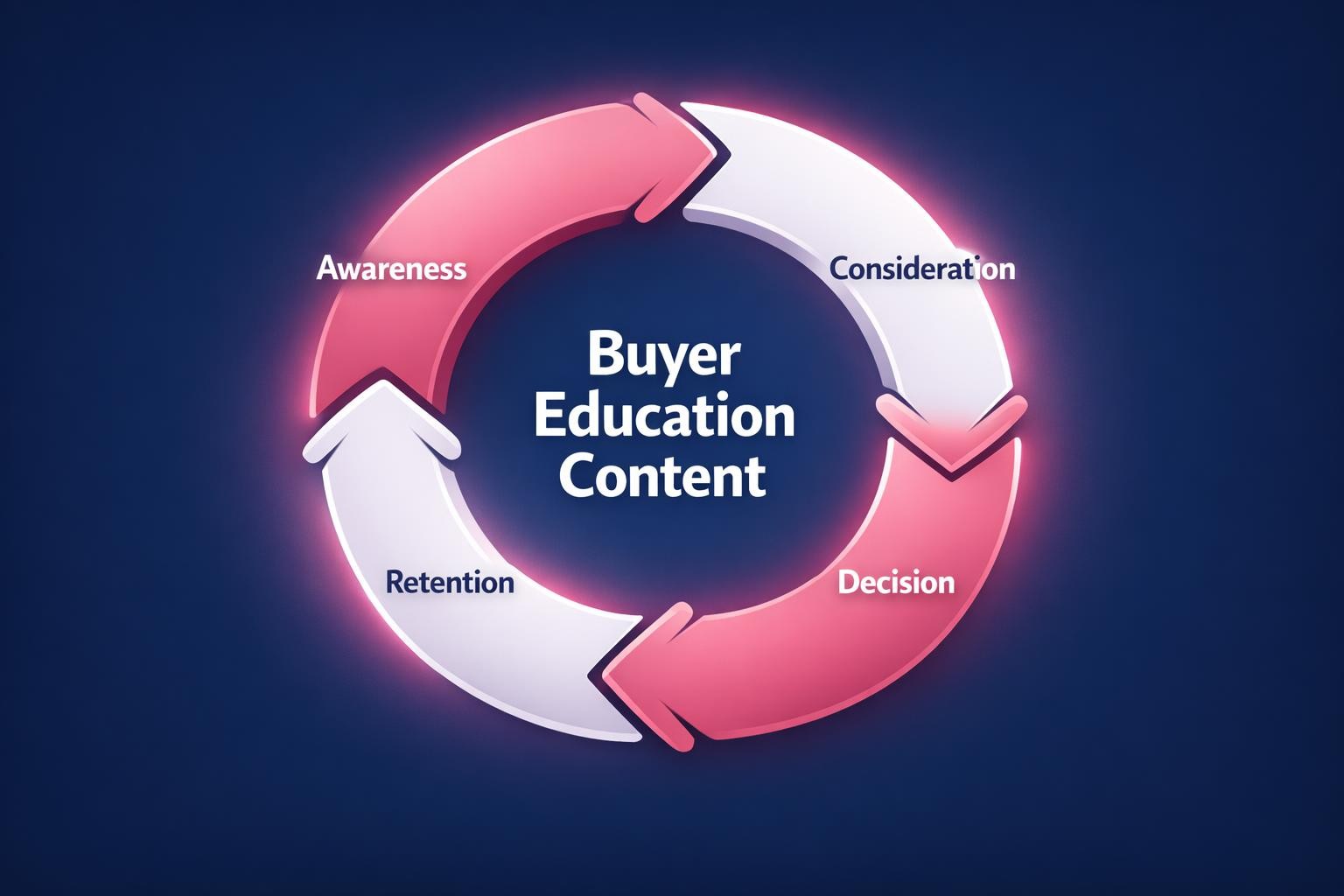
Buyer education content is material that helps a B2B buying group understand its problem, compare the ways to solve it, including doing nothing, and agree on a decision it can defend. It teaches rather than pitches: diagnostic guides, cost-of-inaction models, evaluation guides, role briefs and implementation plans that a champion can forward to colleagues the seller never meets.
It matters because most of the buying group learns without you. Gartner reports a threefold change in the likelihood of a high-value, low-regret deal when buyers get information that helps them move forward (Gartner, customer confidence research, undated page), and Forrester’s 2026 buying study found that a typical decision involves 13 internal stakeholders and nine external influencers (Forrester, 21 January 2026). This guide covers what buyer education content is, how B2B buyers consume content, which assets to build, the mistakes that stall deals and how to measure consumption. It draws on research published from 2018 to 2026 and on Revspire’s aggregated customer data from October 2025 to September 2026.
Last updated: 16 October 2026
What is buyer education content?
Buyer education content teaches buyers what they need to know to make the decision well, whether or not they choose you. The closest analyst framing is Gartner’s definition of buyer enablement: giving customers information or tools that help them complete specific buying jobs. Gartner splits it into prescriptive advice, which tells buyers what steps to take and how, and practical support, the tools for completing those steps (Gartner, 10 October 2018). Buyer education is the content side of that idea. For the wider programme, including ownership and delivery, see our guide to buyer enablement strategy and the buyer enablement definition in our glossary.
Three tests separate education from promotion:
- It answers a question the buyer would ask even if your company did not exist.
- It stays useful if the reader ends up choosing a competitor.
- It makes sense when forwarded to someone who was not on any call.
Buyer education content vs other content types
Teams often label everything they send as education. The content types below have different readers and jobs, and they should be judged by different results.
Content type
Main reader
Job it does
Example
Sign it is working
Buyer education content
The whole buying group, including people sellers never meet
Helps them define the problem, compare approaches and agree a decision
Evaluation guide with the questions to ask every vendor
The group agrees on the problem and criteria and moves to the next stage
Product marketing content
Prospects comparing vendors
Explains what your product does and why it is different
Product overview, feature page, demo video
Shortlisting and demo requests
Sales enablement content
Your sellers
Helps reps run the conversation
Battlecard, talk track, objection guide
Rep readiness and consistent messaging
Thought leadership
Executives and influencers who are not yet buying
Reframes a problem or trend
Research report, point-of-view article
Your name is known when the buying group forms
Customer education
Customers after signature
Drives adoption and renewal
Onboarding course, help centre
Adoption and retention
Why does buyer education content matter in B2B deals?
Buying well is hard. Gartner says 77% of B2B buyers describe their latest purchase as very complex or difficult, and that customers spend around two-thirds of a buying journey gathering, processing and reconciling information (Gartner, customer confidence page, undated). Good information changes the outcome. In 2018 Gartner reported that buyers who got helpful information that eased the purchase were three times as likely to buy the bigger, more expensive option, with less regret (Gartner, 10 October 2018).
The readers are numerous and mostly out of reach. Forrester’s State of Business Buying 2026 found that a typical buying decision involves 13 internal stakeholders and nine external influencers, and that procurement is a decision-maker in 53% of buying cycles (Forrester, 21 January 2026). In Edelman and LinkedIn’s 2025 B2B Thought Leadership Impact Report, 71% of “hidden buyers” in finance, legal, compliance, procurement and operations said they have little or no interaction with sales teams (Edelman, 26 June 2025). Those people form their view from what the champion forwards and what they find for themselves.
The rival that wins most often is no decision at all. In research by Matt Dixon and Ted McKenna on 2.5 million recorded sales conversations, 40% to 60% of lost deals ended in no decision (Challenger Inc., 22 February 2024). CRM data understates this. In Revspire’s win rate and sales cycle benchmark (October 2025 to September 2026), only 10% of closed-lost deals carried a “no decision” or “status quo” reason, a figure Revspire treats as a floor, because sellers tend to record a competitor or price instead. Content that helps a group decide, and decide to change, targets losses that never show up as a named competitor.
How do B2B buyers consume content?
Most teams track whether buyers open what they send. More useful questions are who reads it, in what format, next to what else, and what the reader does next. Five patterns stand out.
Buyers find content themselves, then pass it on
In Demand Gen Report’s 2024 Content Preferences Benchmark Survey, 89% of B2B buyers said they had downloaded and consumed assets they found themselves, and 72% had shared content with relevant team members. Of the colleagues who received shared content, 57% went on to consume it (Demand Gen Report, 2024). Write every education asset for a second reader with no context: put a summary first, define your terms and say who the piece is for.
Short, objective content beats long, salesy content
The same survey found that 67% of buyers rated short-form content among the most valuable formats. Their main complaints were an overwhelming amount of content (56%), content that is not objective or is too much of a sales pitch (54%), content that is too generic (51%, up from 38% in 2023) and too many steps to reach it (51%, up from 30%) (Demand Gen Report, 2024). Hidden buyers in the Edelman and LinkedIn study gave similar answers: 57% prefer quick takeaways to dense reports, and 64% trust thought leadership more than product sheets or brochures when they assess a vendor’s capabilities (Edelman, 26 June 2025).
Vendor content is read next to third-party sources
A FocusVision survey of marketing executives at companies with at least 500 employees who had bought marketing technology found that buyers consumed an average of 13 pieces of content before choosing a vendor: eight created by vendors and five by third parties. The types rated most useful were product specifications (67%), product comparisons (65%), success stories (60%), content showing value to internal stakeholders (54%), tutorials (49%) and guidance on solving the buyer’s problem (48%) (MarTech, reporting FocusVision, 2020). It is a 2020 survey of one software category, so treat the numbers as directional. The pattern, vendor content checked against independent sources, matches Forrester’s 2026 finding that buyers seek validation from trusted sources, which it says underlines the value of human contact (Forrester, 21 January 2026).
AI assistants often read your content first
In Gartner’s survey of 646 B2B buyers (August to September 2025), 45% said they had used AI during a recent purchase. Gartner advised enablement leaders to move beyond static collateral and to break content into modular components that can be assembled into resources for a specific buyer or deal (Gartner, 9 March 2026). Forrester adds that answer engines are fast but often return incomplete or unreliable information, which sends buyers back to trusted sources (Forrester, 21 January 2026). Education content written as clear, self-contained answers, with dates and sources, is easier for an assistant to summarise correctly and easier for a buyer to check.
Early content travels; late content is about cost and rollout
Revspire’s digital sales room benchmark (about 40 B2B companies, October 2025 to September 2026) measures consumption from logged buyer activity rather than surveys. Deal rooms reached 15 unique buyer stakeholders, against 1 to 5 on deals run without a room. 80% of rooms gained a new viewer after the first share. In the 14 days before a won deal closed, 80% of buyer views went to the proposal and the implementation plan, and 20% to value proposition material. These are observed patterns, not proof that a room caused a win. They do show where buyers spend attention: early material spreads across the group, and late material is checked for cost and rollout.
What buyer education content should B2B teams create?
Build for the questions that stall your deals, not for a content calendar. The assets below cover most complex B2B decisions. Each row names the question the asset answers and the reader who needs it most.
Asset
Question it answers
Main reader
Format that travels
Problem diagnostic or self-assessment
Do we have this problem, and how big is it?
Champion, operational lead
Short checklist or scored worksheet
Cost-of-inaction model
What does waiting cost us?
Economic buyer, finance
Editable worksheet that uses the buyer’s own inputs
Approach explainer
What are our options, including building it ourselves or staying as we are?
Champion, executive sponsor
Two-page guide with a comparison table
Evaluation guide
What should we require, and what should we ask every vendor?
Whole buying group, procurement
Criteria list plus a question bank
Role briefs
What does this mean for my team?
Finance, IT security, legal, end users
One page per role
Proof pack
Has this worked somewhere like us?
Sceptics, executive sponsor
Matched case studies, reference calls, independent reviews
Implementation and change plan
How will rollout work, and who does what?
Operational owners, procurement
Dated plan with owners on both sides
Decision memo template
How do we explain and defend this choice internally?
Champion presenting to executives
One page: problem, options, recommendation, risks, cost
To decide which asset goes out at which deal stage, build a buyer journey content map. Three of these assets deserve more detail.
Make the case for change before the case for you
The first three rows do the work most teams skip. In Revspire’s sales skills gap benchmark (more than 2,000 scored AI role-plays, October 2025 to September 2026), the status quo objection, “our current process works fine”, was the hardest to handle, averaging 2.9 out of 5 against 3.2 for price. That is a content gap as much as a skills gap: a rep cannot argue for change without a diagnostic and a cost-of-inaction model the buyer believes. Dixon and McKenna’s JOLT approach reaches a similar conclusion from the buyer’s side. Buyers stall for fear of choosing wrong, so the seller’s job includes giving a clear recommendation and taking risk off the table (Challenger Inc., 22 February 2024).
Write an evaluation guide a competitor’s buyer could use
An evaluation guide earns trust when it includes criteria you do not win on and says when another approach fits better. List the questions to ask every vendor, the evidence that answers each one and the red flags to watch for. Buyers who adopt your structure tend to run their whole evaluation through it, which is worth more than a feature claim they will discount.
Give the champion a memo, not a deck
Champions present to people you will never meet. A one-page decision memo in plain prose (problem, options considered, recommendation, risks and how they are handled, cost and timeline) travels better than slides that need a presenter. In the Edelman and LinkedIn study, 52% of hidden buyers said strong thought leadership helps them persuade other members of the buying group (Edelman, 26 June 2025). A memo template gives them the words.
Buyer education content mistakes that cost deals
These seven mistakes recur in content audits and in the research above. Each comes with a fix.
1. Calling a pitch “education”
When every page ends with your product, buyers notice: 54% of respondents in Demand Gen Report’s 2024 survey said content was not objective or was too much of a sales pitch (Demand Gen Report, 2024). Fix: keep product claims out of diagnostic, explainer and evaluation assets, and put them in clearly labelled product content. Name the alternatives, including doing nothing.
2. Educating the champion and forgetting the group
Content tuned to one person’s priorities can split a buying group. In a Gartner survey of 632 B2B buyers (August to September 2024), tailoring for buying-group relevance improved consensus by 20%, while content focused on individual relevance had a 59% negative impact on consensus (Gartner, 7 May 2025). Fix: build each asset around the group’s shared goal, then add short role sections so finance and IT read the same story from their own angle.
3. Leaving out the option to do nothing
Most education content compares vendors, but the buyer’s biggest alternative is often the current process. Fix: add “stay as we are” as a column in every comparison, put a cost on it using the buyer’s own numbers, and say honestly when waiting is reasonable. Buyers trust a recommendation more when it admits the limits of the case.
4. Publishing more instead of maintaining less
Volume overwhelms buyers (56% in Demand Gen Report’s 2024 survey) and sellers alike. In Forrester’s 2023 Portfolio Marketing Survey, 53% of respondents said fewer than half of their sales enablement materials were used by sales (Forrester blog, undated, citing its 2023 survey). Revspire’s content-to-revenue benchmark found that 35% of active sales assets had no shares and no opens in the last 90 days (October 2025 to September 2026). Fix: keep a small set of current education assets, each with an owner and a review date, and retire what no buyer opens.
5. Gating or hiding the answers
Demand Gen Report noted, citing MarketingCharts data, that nearly two-thirds of buyers are somewhat or not likely to fill out a form for gated content (Demand Gen Report, 2 April 2024), and 51% of respondents to its 2024 survey complained of too many steps to reach content. Fix: publish the education layer openly, including pricing logic and implementation timelines where you can. Gate tools that need setup, not answers.
6. Writing only for people, not for the assistants that summarise you
With 45% of buyers using AI during a recent purchase (Gartner, 9 March 2026), an assistant is often the first reader of your content. Fix: one question per section, the answer in the first sentence, a date on every figure, linked sources and the same facts on the website, in the deal room and in what sellers say. Modular sections are also easier to reassemble for each deal, as Gartner recommends.
7. Measuring downloads instead of buying-group consumption
Downloads and email opens measure activity, not progress. A deal where the champion opened the evaluation guide ten times and nobody else did is single-threaded, however engaged it looks. Fix: track who reads what across the group and how recently, and review those signals against outcomes, as the next section describes.
How do you measure buyer content consumption?
Measure at two levels: the asset (is this piece doing its job across deals?) and the deal (is the buying group learning and moving?). Review deal-level signals in the weekly pipeline review and asset-level signals monthly or quarterly against won and lost deals in the same deal-size band.
Metric
Level
How to calculate it
What it tells you
Reference point
Unique buyer stakeholders
Deal
Distinct buyer-side people who viewed any shared content
Whether education is reaching the group
15 with a deal room vs 1 to 5 without (Revspire)
Forward rate
Asset and deal
Shares that gain a viewer the seller did not send to ÷ all shares
Whether the champion is teaching others
80% of deal rooms gained a new viewer after the first share (Revspire)
Days since last buyer view
Deal
Today minus the date of the most recent buyer view
Momentum
After 20 days without a view, win rate fell below half the overall rate (Revspire)
Role coverage
Deal
Roles that viewed content written for them ÷ roles on the stakeholder map
Who still has unanswered questions
Your own baseline
Progression after first view
Asset
Deals that advance a stage within an agreed window after a buyer first views the asset ÷ deals where it was viewed
Whether the asset moves decisions
Compare with similar deals where it was not viewed
Assets on won vs lost deals
Asset
Median distinct assets shared or viewed per won and per lost deal, by deal-size band
Which evaluation steps progressing deals go through
Won deals used four more distinct assets than lost ones (Revspire)
Unused assets
Library
Active assets with no shares or opens in 90 days ÷ all active assets
Upkeep spent on content nobody reads
35% (Revspire)
Repeat questions
Asset
Buyer questions in calls that an existing asset already answers
A findability or clarity problem
Your own call notes
Revspire reference points are observed patterns in aggregated customer data, October 2025 to September 2026, from the digital sales room and content-to-revenue benchmarks. They are not proof that content or a tool caused a result.
Make content consumption a standing item in the weekly pipeline review. For each late-stage deal, ask which roles have read what, who has gone quiet and what the next education step is. Get the data into the CRM automatically; if reps have to copy view data by hand, it will not be there when you need it. Digital sales room tools, Revspire’s included, record buyer views by stakeholder. Revspire Digital Sales Rooms add buying-committee stakeholder mapping, mutual action plans and AI content recommendations by deal stage and stakeholder role, and the Revspire Content Hub reports asset usage and performance and keeps shared links current when an asset is updated.
How to audit your buyer education content in 90 days
An audit works best as a short, recurring cycle with one owner, usually in revenue enablement or product marketing, rather than a one-off project.
- Take a baseline. Pull the last six months of closed and stalled opportunities and split them by segment, deal size and stage. Note where deals stall and which roles joined late.
- List the buying questions. From call notes, lost-deal interviews and security or procurement questionnaires, list the questions buyers asked more than once. Mark which ones an existing asset already answers.
- Score each education asset against the five tests below. Merge or retire anything that fails three of them.
- Fix two or three gaps. Pick the ones tied to the most revenue at risk, usually the case for change and a role brief for whoever joins late. Give each an owner and a measurable goal.
- Deliver in one place and connect the data. Put the assets where the champion can forward them with one link and where buyer views reach the CRM without manual updates.
- Review at 90 days. Compare stage progression and the metrics above with the baseline, feed win-loss findings back into the assets, and repeat each quarter.
The five tests for each asset:
- Neutral: useful even if the reader picks another vendor.
- Forwardable: makes sense to someone who missed every call, with the summary first.
- Group-relevant: built around the buying group’s shared goal, with role sections.
- Findable: ungated where possible, one link, current version only.
- Readable by AI: one question per section, dated figures, linked sources.
Worked example: fixing a single-threaded deal
This is an illustration, not a customer case. A healthcare services company with about 1,200 staff is evaluating a patient-scheduling platform. The champion, the head of operations, likes the product, but only she has viewed anything the seller shared. Running the five tests shows why: the seller sent a product deck and a feature sheet, both product content, with nothing for finance or IT. The team replaces them with a two-page approach explainer that compares three options, including keeping the current spreadsheets; a cost-of-inaction worksheet the champion fills in with her own backlog figures; a one-page security brief; and a decision memo template. The champion forwards the explainer and the memo to the CFO and the IT security lead. The security lead opens the brief before asking for it, and the next meeting covers the implementation plan rather than whether to act at all.
Next step: list everyone in the buying group and what each person still needs to learn, using our free stakeholder map template.
Frequently asked questions
What content do B2B buyers want from vendors?
Short, objective content that helps them decide. In Demand Gen Report’s 2024 survey, 67% rated short-form content among the most valuable formats and 54% said content was too much of a sales pitch (Demand Gen Report, 2024). Buyers also want material they can pass on: 72% had shared content with their team.
How many stakeholders see sales content in a B2B deal?
More than sellers meet. Forrester’s 2026 study found that a typical buying decision involves 13 internal stakeholders and nine external influencers (Forrester, 21 January 2026). In Revspire’s digital sales room benchmark, deal rooms reached 15 unique buyer stakeholders, against 1 to 5 on deals without a room, and 80% of rooms gained a new viewer after the first share.
What content do buyers look at most before signing?
Cost and rollout material. In the 14 days before a won deal closed, 80% of buyer views in Revspire customers’ deal rooms went to the proposal and the implementation plan, and 20% to value proposition material (Revspire, October 2025 to September 2026). Keep both documents current and at the top of what you share late in a deal; a mutual action plan template helps structure the plan.
Do case studies speed up enterprise deals?
We found no published study that isolates the effect of case studies on enterprise deal velocity. Buyers do value them: 60% of respondents in FocusVision’s 2020 survey rated customer success stories among the most useful content types (MarTech, 2020). To test the effect on your own pipeline, compare median won-cycle length within one deal-size band for deals where a buyer viewed a matched case study and deals where none did.
How do you measure buyer engagement with sales content?
Count people, not opens. Track unique buyer stakeholders per deal, forwarding to new viewers, days since the last buyer view and which roles have read material written for them, then compare those signals on won and lost deals of similar size. In Revspire’s deal room data, 20 days without a buyer view came with a win rate below half the overall rate.
Sources
All pages were accessed on 16 October 2026. Publication dates are shown where the page gives one.
- Gartner Says B2B Brands Need to Rethink Their Content Marketing Strategy, Gartner, 10 October 2018; accessed 16 October 2026.
- Customer Confidence, Gartner for Sales insight page, undated; accessed 16 October 2026.
- Gartner Sales Survey Finds 74% of B2B Buyer Teams Demonstrate “Unhealthy Conflict” During the Decision Process, Gartner, 7 May 2025; accessed 16 October 2026.
- Gartner Sales Survey Finds 67% of B2B Buyers Prefer a Rep-Free Experience, Gartner, 9 March 2026; accessed 16 October 2026.
- Forrester: The State of Business Buying, 2026 (press release), Forrester, 21 January 2026; accessed 16 October 2026.
- A Call for Zero-Waste B2B Marketing, Forrester blog, undated (cites Forrester’s 2023 Portfolio Marketing Survey); accessed 16 October 2026.
- The Rise of the Hidden Buyer: Rethinking B2B Influence Beyond the Obvious (2025 B2B Thought Leadership Impact Report, Edelman and LinkedIn), Edelman, 26 June 2025; accessed 16 October 2026.
- Navigating the Attention Economy via Snack-able and Shareable Content (2024 Content Preferences Benchmark Survey), Demand Gen Report, 2024 (page last modified 20 May 2024); accessed 16 October 2026.
- What Are B2B Buyers’ Top 5 Content Recommendations?, Demand Gen Report, 2 April 2024; accessed 16 October 2026.
- B2B Buyers Consume an Average of 13 Content Pieces Before Deciding on a Vendor (FocusVision survey), MarTech, 2020; accessed 16 October 2026.
- How to Overcome Customer Indecision Using the JOLT Effect Approach, Challenger Inc. (research by Matt Dixon and Ted McKenna), 22 February 2024; accessed 16 October 2026.
- Revspire benchmarks, aggregated customer data, October 2025 to September 2026: win rate and sales cycle, sales skills gap, digital sales room and content to revenue; accessed 16 October 2026.