Revspire blog
Why Buyer-Stage Content Mapping Is the Highest-Leverage Move in B2B Sales
Learn why buyer-stage content mapping matters and how B2B revenue teams can audit, implement, measure, and continuously improve the process.
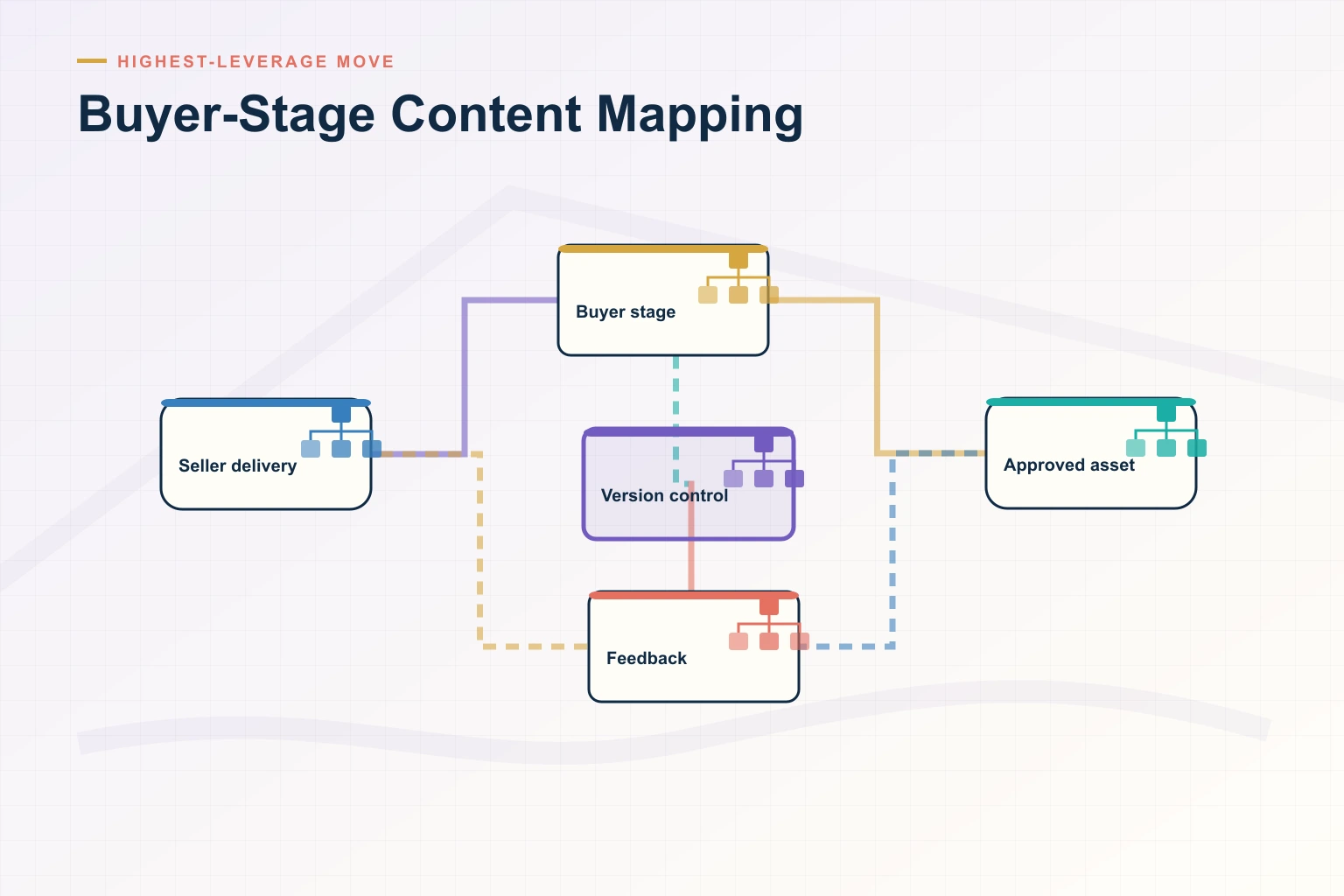
The conventional approach to Buyer-Stage Content Mapping in B2B sales is reactive rather than deliberate. Teams piece together a process from tribal knowledge, manager intuition, and whatever the previous playbook said.
Most B2B revenue leaders know buyer-stage content mapping matters in principle. But knowing and systematizing are very different things. Treating Buyer-Stage Content Mapping as a strategic priority requires a documented operating model, clear ownership, useful measurement, and continuous improvement.
Where revenue leakage happens
Revenue leakage from poor Buyer-Stage Content Mapping practice concentrates in three places. First, deals in early stages that should never enter the pipeline do, consuming rep capacity and distorting the forecast. Second, qualified deals stall mid-cycle because of gaps in buyer-stage content mapping execution that a structured approach would catch. Third, late-stage deals are lost to process failures — procurement surprises, unstated objections, last-minute stakeholder concerns — that better Buyer-Stage Content Mapping management would have surfaced earlier.
Three-part explainer: Expose the hidden cost, Build the business case, and Start where it matters.
The business case for buyer-stage content mapping
Systematically improving Buyer-Stage Content Mapping can affect several connected revenue outcomes, including rep ramp time, average deal size, customer acquisition cost, and forecast accuracy. Improvements in those areas can reinforce one another over time.
The competitive dimension
In markets where a product is differentiated but not unique, Buyer-Stage Content Mapping can become a competitive variable. Buyers assess both product capability and the buying experience. A clearer experience can build trust, reduce perceived risk, and make a vendor relationship harder to displace.
The talent dimension
A structured approach can also shape the environment in which revenue professionals work. Clear buyer-stage practices give representatives a defined system in which to develop and execute.
Build the operating foundation
Assign ownership
Someone on the leadership team is accountable for the outcomes, not just the activities. They set the goals, define the metrics, and ensure the approach evolves as market conditions change.
Document the operating model
An operating model for Buyer-Stage Content Mapping answers three questions: what actions should happen, at what stage, and who is accountable. Document this explicitly.
Align technology with the process
Technology should serve the buyer-stage content mapping process, not define it. Evaluate every tool in your stack against a simple question: does this make Buyer-Stage Content Mapping easier and more consistent, or does it add friction?
Teams evaluating supporting technology can explore the Revspire Content Hub.
A practical implementation framework
Three-part explainer: Define the buyer stages, Match content to context, and Measure and improve.
1. Audit the current state
Before you can improve Buyer-Stage Content Mapping, you need an honest baseline. Pull the last six months of deal data. Map every opportunity against the stages of buyer-stage content mapping and identify where deals are falling out and why.
2. Define strong execution
Top teams do not leave buyer-stage content mapping to intuition. They write down exactly what excellent execution looks like at each stage of the deal, and they hold every rep accountable to that standard.
3. Track leading and lagging indicators
If you cannot measure it, you cannot improve it. The right metrics for Buyer-Stage Content Mapping sit at the intersection of leading and lagging indicators.
Leading indicators might include stakeholder engagement rates, content consumption, mutual action plan progression, or deal velocity at each stage. Review conversion rates at each stage, time-in-stage benchmarks, and correlations between specific behaviors and win rates. Build a dashboard that combines leading indicators with lagging indicators such as win rates, cycle times, and average deal sizes, then review it weekly.
4. Establish a weekly cadence
If buyer-stage content mapping does not appear on your weekly pipeline call agenda, it will not get the attention it needs.
5. Coach through live deals
Use deal-specific coaching: review live opportunities with each rep, identify where buyer-stage content mapping execution breaks down, and work through the fix in real time.
Seven practices for continuous improvement
- Define strong execution. Write down what excellent execution looks like at each stage.
- Track leading indicators. Monitor stakeholder engagement, content consumption, mutual action plan progression, or deal velocity.
- Review the mapping weekly. Include buyer-stage content mapping in the weekly pipeline cadence.
- Coach through live deals. Review live opportunities and work through execution gaps.
- Capture win-loss intelligence. Use post-deal interviews, CRM data analysis, and structured win-loss reviews.
- Align technology with the process. Use technology to make the process easier and more consistent.
- Create feedback loops. Review metrics, update playbooks, and solicit feedback from buyers.
Common mistakes to address
Treating mapping as a one-time initiative
Assign a permanent owner to Buyer-Stage Content Mapping outcomes. Build it into your operating cadence with standing review meetings, defined metrics, and quarterly improvement goals.
Relying on intuition instead of data
Define three to five leading indicators for Buyer-Stage Content Mapping and track them weekly. When the data disagrees with the intuition, trust the data first and investigate the discrepancy.
Depending on one stakeholder
Map every stakeholder in the buying committee, assign coverage, and track engagement with each one.
Confusing activity with progress
Measure outcomes, not activities. Track stage progression velocity, buyer engagement quality, and stakeholder coverage breadth. Use these outcome metrics as the primary lens for coaching conversations and pipeline reviews.
Failing to learn from losses
After every significant lost deal, spend thirty minutes with the rep analyzing the specific buyer-stage content mapping breakdowns that contributed to the loss. Document the findings and update playbooks accordingly.
Where to start
Start with an honest audit. Where is Buyer-Stage Content Mapping working well today? Where is it breaking down? What does the data say versus what the narrative says? Use that assessment to prioritize two or three specific improvements that will have the biggest impact on revenue outcomes. Deploy them with a clear owner, a measurable goal, and a 90-day review cadence. Then build from there.