Consensus Selling: How to Align a B2B Buying Committee
A practical perspective for connecting this idea to your revenue team’s next move.
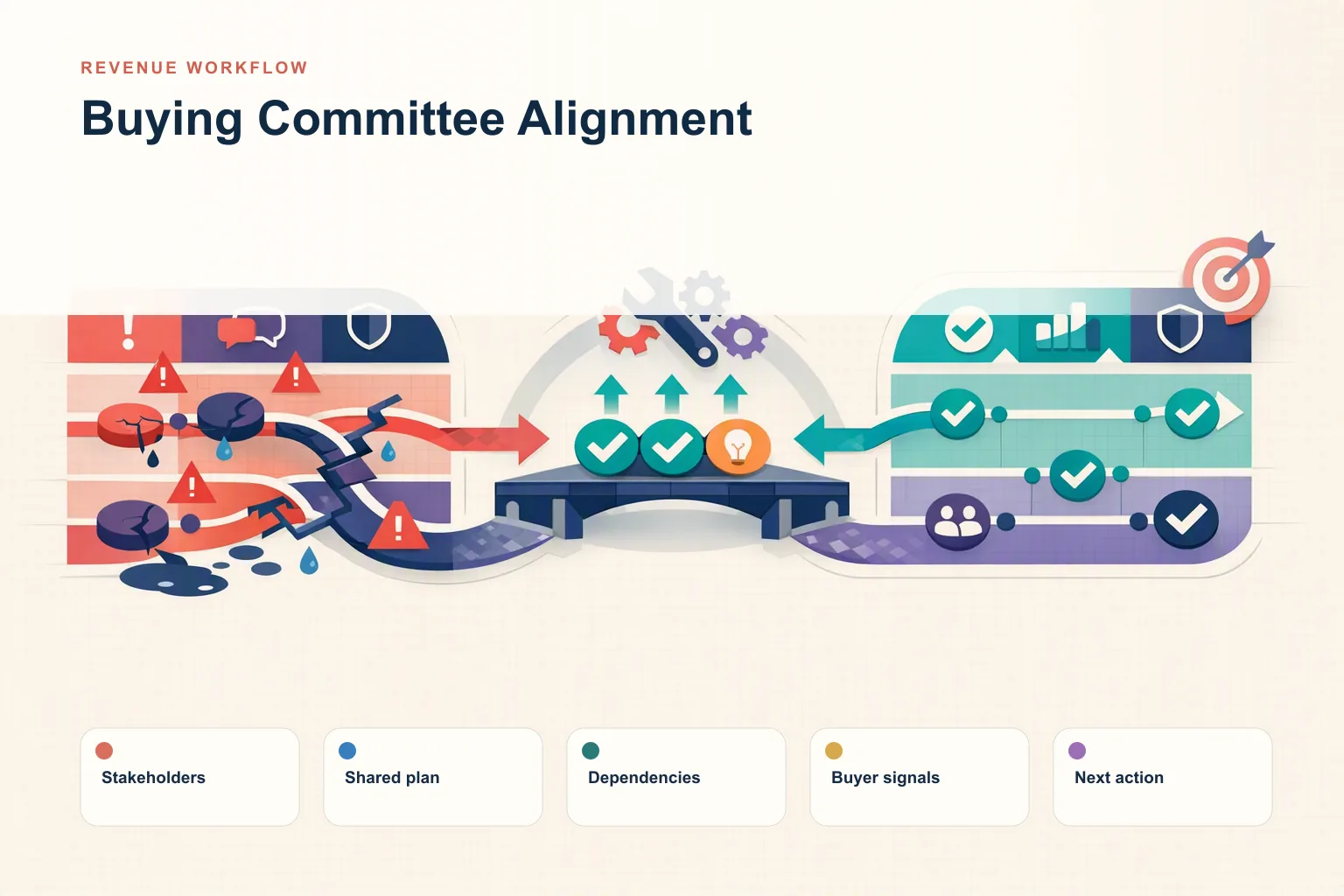
Consensus selling is the practice of helping every member of a B2B buying committee agree on the problem, the solution and how the decision will be made, instead of winning over one champion and hoping they carry the deal. Buying committee alignment matters because a group that cannot agree stalls, and stalled deals often end in no decision.
The research is consistent on this. In a survey of 632 B2B buyers, Gartner found that 74% of buying teams showed “unhealthy conflict” during the decision, and that groups which reached consensus were 2.5 times more likely to report a high-quality deal (Gartner, 7 May 2025). This guide draws on research published between 2015 and 2026 and covers why committees fail to align, the warning signs in a live deal, a step-by-step process, and a worked example.
Last updated: 16 October 2026
What is consensus selling?
Consensus selling treats the buying committee, not the individual buyer, as the customer. The seller’s job shifts from persuading one person to helping a group with different goals reach a decision they will all stand behind. Consensus does not mean everyone is enthusiastic. It means the people who can block the purchase accept the problem, the chosen solution and the plan to buy and implement it.
The idea has been around for a decade. In “Making the Consensus Sale” (Harvard Business Review, March 2015), Karl Schmidt, Brent Adamson and Anna Bird argued that because purchases are made by groups whose members can each veto the deal, suppliers should give the group a shared language for the problem and equip internal champions to persuade their colleagues. In 2018 Gartner listed consensus creation as one of six buying jobs, alongside problem identification, solution exploration, requirements building, supplier selection and validation, and noted that most B2B buyers revisit nearly every job at least once before they buy (Gartner, 9 October 2018, accessed 17 October 2026). Consensus is therefore not a last step before signature. A committee can lose it at any point.
Consensus selling vs. multi-threading, stakeholder mapping and champion enablement
These terms overlap and teams often use them interchangeably, but each answers a different question. Consensus selling depends on the other four.
Practice
Question it answers
What it produces
Why it is not enough on its own
Stakeholder mapping
Who is involved, what does each person care about, and who can say no?
A map of roles, influence, stance and coverage
A map shows disagreement; it does not resolve it
Multi-threading
Are we in contact with more than one person?
Relationships across several roles
Ten threads can pull in ten directions
Champion enablement
Can someone inside sell for us when we are not in the room?
An internal pitch, business case and objection answers
One advocate cannot settle a dispute between finance and IT
Buyer enablement
Does the group have what it needs to complete its buying jobs?
Content and tools that help buyers decide
Shared information is not the same as a shared conclusion
Consensus selling
Does the group agree on the problem, the solution and how it will decide?
A confirmed problem statement, one business case and a decision plan the buyer owns
Needs all of the above to work
How consensus selling relates to the practices it depends on.
How many people are on a B2B buying committee?
Estimates vary with the source and the size of the purchase, but every recent study describes a group, not a person.
Source
What it reports
Date and sample
Gartner
Buying groups range from five to 16 people across as many as four functions
Press release, 7 May 2025; survey of 632 B2B buyers, August to September 2024
Forrester
The typical decision includes 13 internal stakeholders and nine external influencers; procurement is a decision-maker in 53% of buying cycles
Press release, 21 January 2026; sample not stated in the release
6sense
Buying groups average more than 10 members (2023-2024 baseline), and group size did not grow in 2025
2025 B2B Buyer Experience Report; nearly 4,000 buyers
Sources: Gartner (2025), Forrester (2026), 6sense (2025). All accessed 16 October 2026.
Size alone is not the problem. Forrester’s 2026 buying study reports that 94% of buyers with groups of six or more see clear benefits from them, including a better chance of securing budget and approval (Forrester, 21 January 2026). Disagreement is the problem. Gartner defines unhealthy conflict as members having conflicting objectives, disagreeing on the best course of action, or being overruled by decision-makers outside the group (Gartner, 7 May 2025). A large committee that agrees can move faster than a small one that does not.
Why do buying committees fail to reach consensus?
Each function is solving a different problem
Finance wants payback and predictable cost. IT wants something that fits the architecture and does not add support work. The team that will use the product wants less manual effort, not another tool. Procurement wants terms that meet policy. If nobody writes down the shared problem, each person evaluates a different deal, and the evaluation turns into a negotiation between colleagues rather than a decision about your product.
Sellers personalise for individuals and fragment the group
This is the least intuitive finding in the research. Gartner’s buyer survey (fielded in 2024, published May 2025) found that tailoring content for buying-group relevance improved consensus by 20%, while content focused on individual-level relevance had a 59% negative impact on consensus. Buyers who experienced buying-group relevance were three times more likely to report a high-quality deal (Gartner, 7 May 2025). Role-specific evidence still matters. But if the CFO, the CIO and the head of operations each hear a different value story, the seller has armed each side of the internal argument.
The group forms its view before you arrive
6sense’s 2025 B2B Buyer Experience Report found that buyers first contacted sellers about 61% of the way through their journey, and that 94% of buying groups had already ranked their shortlist before talking to any seller. In the report’s words, buying groups “spend months ordering their shortlists as a group” (6sense, 2025). By the first call, the committee has already agreed on some things and is quietly split on others. Early discovery should find out which is which.
The decision feels risky, so nobody makes it
Matt Dixon and Ted McKenna’s analysis of 2.5 million recorded sales conversations found that 40-60% of lost deals ended in no decision. Deals with high customer indecision had a 6% win rate, against 30% for deals with medium indecision (Challenger Inc., 22 February 2024). Committees amplify indecision: every member can find a reason to wait, and no single person owns the risk of saying yes. Forrester’s 2024 buying study found that 86% of B2B purchases stall during the buying process (Forrester, 4 December 2024).
Gatekeepers and unseen readers arrive late
Procurement, security and legal often meet the seller only after the business has chosen a supplier, and then reopen questions the seller thought were settled. Yet Forrester reports that procurement is a decision-maker in 53% of business buying cycles and is involved from the start of the process (Forrester, 21 January 2026). Other readers never meet the seller at all. In Revspire’s digital sales room benchmark (about 40 B2B companies, October 2025 to September 2026), 80% of deal rooms gained a new viewer after the first share: the first recipient passed the room to a colleague the seller had not sent it to.
Buying committee misalignment: warning signs and fixes
Misalignment rarely announces itself. It shows up as small, specific patterns in the deal. Use this table in pipeline reviews: if a row describes the deal in front of you, the fix in the third column is the next action.
Mistake
What you see in the deal
What to do instead
Treating the champion’s enthusiasm as the committee’s decision
One active contact; the meeting with the economic buyer keeps moving
Ask the champion to bring the person most likely to object to the next call
Pitching the solution before the group agrees on the problem
Stakeholders describe the problem differently; requirements change between calls
Write a one-page problem statement and ask each function to confirm or edit it
Telling each persona a different value story
Finance, IT and users each repeat different benefits back to you
One shared business case, with role-specific evidence attached to it
Treating silence as agreement
No objections raised, but no buyer-side tasks completed either
Ask directly who disagrees and why; track which roles have engaged recently
Meeting procurement, security and legal in the final weeks
New names near the close date; “we need to run this past…”
Identify these roles in discovery and put their steps on the plan with dates
A mutual action plan that lists only seller tasks
The plan tracks demos and proposals; buyer steps have no owner
Give each buyer-side milestone a named owner at the customer
Adding options when the group is undecided
More demos, references and proposal versions; the decision date slides
Recommend one option, narrow the evaluation and reduce the risk of saying yes
Recording no-decision losses as competitor or price
Loss reasons rarely say “no decision”
Interview lost buyers and code losses by what actually happened
Eight common causes of buying committee misalignment, with the evidence and the fix.
The last row matters more than it looks. In Revspire’s win rate and sales cycle benchmark (about 40 B2B companies, October 2025 to September 2026), only 10% of closed-lost deals carried a “no decision” or “status quo” loss reason in the CRM, far below the 40-60% found in call-recording research. Sellers tend to record a competitor or price instead, so a team that trusts its loss reasons may never see how many deals it loses to a committee that could not agree.
How to build consensus in a buying committee, step by step
The steps below follow the order of a typical enterprise deal, but they are not one-off tasks. Revisit steps 2, 6 and 8 whenever someone new joins the committee.
1. Map who can say no, not only who says yes
List every role that can approve, block or delay the purchase: the economic buyer, the champion, the technical evaluator, the leader of the team that will use the product, finance, procurement, security and legal. For each, record what they must believe for the deal to go ahead, their likely objection and who on your side covers them. Then ask the champion how the group will decide: who signs, who can veto, and what happens when two functions disagree. The stakeholder mapping guide covers building the map itself in more detail.
2. Agree the problem before you present the solution
Write a one-page problem statement in the buyer’s words: what is happening today, what it costs, what happens if nothing changes, what success looks like and by when. Send it to each function and ask them to correct it. Disagreement at this stage is cheap and useful. The same disagreement after a proposal is expensive, because it looks like an objection to your price.
3. Build one story for the group, then tailor the evidence
Following Gartner’s finding on group relevance, keep one business case and one recommended solution for the whole committee. Tailor the supporting evidence by role: payback and cost ranges for finance, integration and security documentation for IT, a rollout and training plan for the team that will use the product. Every stakeholder should be able to explain the same three reasons to buy, even if each cares most about a different one.
4. Equip the champion to sell when you are not in the room
Most of the committee’s discussion happens in meetings you will not attend. Give the champion a short internal pitch they can deliver in their own words, answers to the objections they will hear, and a summary that still makes sense to someone who missed every call. Because rooms and documents get forwarded, write the first screen for that reader: the problem, the recommendation, the business case and the agreed next steps. The champion enablement guide covers how to test whether your contact is a real champion.
5. Put the decision plan where the whole group can see it
A mutual action plan turns “we need to get everyone on board” into dated steps with owners on both sides: problem statement confirmed, technical validation, security review, business case approved by finance, procurement, legal review, signature and kickoff. In Revspire’s mutual action plan benchmark (October 2025 to September 2026), buyers owned only 20% of plan milestones, and deals with a plan were won 35% of the time against 28% without one. That is an observed pattern, not proof that the plan caused the win, since teams may write plans for their better-qualified deals. The practical point stands: security review, legal and procurement are buyer-side steps and need a named owner at the customer.
6. Bring disagreement into the open early
Silence in a committee is rarely agreement. Ask questions that make dissent safe to voice:
- “Who would be most likely to push back on this, and what would their concern be?”
- “What would finance need to see to approve this budget this year rather than next?”
- “If this project slipped six months, who would be relieved?”
- “Has anyone in the group been burned by a project like this before?”
When a conflict surfaces, write it down with the options for resolving it and the person who will decide. Gartner’s guidance points the same way: help members understand each other’s viewpoints, prioritise shared goals over individual ones, and help buyers validate their decision process (Gartner, 7 May 2025).
7. Make the decision feel safe
An undecided committee does not need more options. Dixon and McKenna’s JOLT method has four steps: judge the level of indecision, offer your recommendation, limit the exploration, and take risk off the table (Challenger Inc., 22 February 2024). In committee terms, that means recommending one configuration, saying which further demos or references will not change the answer, and reducing the cost of being wrong through a phased rollout, a pilot with agreed exit criteria, or contract terms that limit the downside. Buyers already expect this: Forrester reports that more than 60% of business buyers use a trial (Forrester, 21 January 2026).
8. Review committee coverage in every pipeline review
Consensus needs an owner on the selling side too. Set a coverage rule as a stage exit criterion, for example that no deal moves past solution validation until the economic buyer and at least one finance or IT stakeholder have engaged directly. Then ask four questions of every committed deal each week: which role is missing, who has gone quiet, which buyer-side milestone has slipped, and what the next action is with whom. After each closed deal, won or lost, note where alignment broke down and update the playbook.
Worked example: aligning a seven-person buying committee
This example is illustrative, not a customer case. A seller at a software company is working a new deal with a 1,500-employee manufacturer that is evaluating a field-service scheduling platform. The champion is the Director of Service Operations. After two discovery calls, the seller maps the committee like this:
Role
Must agree that…
Likely objection
What moves them
Director of Service Operations (champion)
Missed appointments are a scheduling problem, not a staffing one
“I can’t get the CFO’s time this quarter”
A one-page summary to forward and a rehearsed internal pitch
CFO (economic buyer)
Doing nothing costs more than the project
“Why now and not next year?”
A business case built on the buyer’s own figures, shown as a range
VP Field Service (user leader)
Technicians will adopt it
“My team won’t use another app”
A rollout plan with a pilot region and adoption checkpoints
IT architect (technical evaluator)
It connects to the ERP without custom work
“We have no integration capacity”
Integration documentation and a call with the seller’s solutions engineer
Security lead
Data handling meets policy
“This needs a full security review”
The security questionnaire answered early, with the review dated on the plan
Procurement manager
Commercial terms fit policy
“We need three bids”
Pricing structure and terms shared early; the procurement step on the plan
Legal counsel
Contract risk is acceptable
“Your agreement needs redlines”
Standard terms sent at the start of evaluation, not after verbal approval
Illustrative committee map for a mid-market deal. Roles and objections are examples.
The seller’s sequence follows the steps above. First, the champion and the VP Field Service confirm a written problem statement, and the CFO’s analyst corrects the cost figures in it. Next, the IT architect raises integration capacity in week three rather than week ten, because the seller asked “who would push back?” on the second call. The seller then builds one business case with three role appendices instead of three decks. Finally, the mutual action plan carries six buyer-owned steps, including the security review, procurement and legal, each with a named owner and a date the champion agreed on a call. When the CFO asks to wait until next year, the seller offers a single-region pilot with exit criteria, which takes the risk of a full rollout off the table without reopening the evaluation.
How do you know a buying committee is aligned?
Use this checklist before committing a deal to the forecast. A “no” on any line is a gap to close, not a reason to drop the deal.
- Every role that can block the deal has engaged directly, not only through the champion.
- The committee has confirmed a written problem statement, and finance has seen the cost of doing nothing.
- Stakeholders describe the same reasons to buy when you speak to them separately.
- Known disagreements are written down with a decision owner.
- Buyer-side milestones (security, procurement, legal, sign-off) have named owners and dates, and none is more than a week late.
- The champion has introduced you to the economic buyer.
- Your material is being read by several people on the buyer’s side, not only opened many times by one person.
- The buying group has not gone 20 days without viewing your material.
The last two lines come from engagement data. In Revspire’s digital sales room benchmark, deal rooms engaged 15 unique buyer stakeholders, against 1 to 5 on deals without a room, and after 20 days with no buyer view the win rate fell below half the overall win rate. Gong reports that closed-won deals include 67% more contacts than closed-lost deals (Gong, The Data-Backed Guide to Multi-Threading, undated, accessed 16 October 2026). Both are correlations: breadth of engagement is a sign of a committee at work, not a guarantee that it agrees.
Where software helps, and where it does not
Software cannot create agreement. The conversations in steps 2, 6 and 7 do that. What software can do is keep the committee working from the same material and show the seller who is engaged. A digital sales room gives the whole group one place for the business case, the mutual action plan and the supporting evidence, so the version the CFO reads is the version IT reads. Revspire Digital Sales Rooms include mutual action plans with owners and due dates, buying-committee stakeholder mapping and real-time buyer engagement analytics, which make a missing role or a silent stakeholder visible before the forecast call. The process above works with any tool, including a shared document and a spreadsheet, as long as the group can see the same plan.
To start on a live deal, download the stakeholder map template and fill it in with the champion: every role that can say no, what each must agree to, and who covers them.
Frequently asked questions
What is buyer consensus in B2B sales?
Buyer consensus is the point at which the members of a buying committee accept the same problem, the same solution and the same plan for deciding and implementing. It does not require everyone to be enthusiastic, only that nobody with a veto is still opposed. Gartner found that buying groups that reach consensus are 2.5 times more likely to report a high-quality deal (Gartner, May 2025).
How do you respond when a prospect says the committee needs to decide?
Treat it as a request for help, not a brush-off. Ask who is on the committee, what each member needs to see, when they meet and what would make the decision easy, then offer to prepare a summary the champion can present. If you cannot get those answers, you have a contact, not a champion, and the next step is to ask for a meeting with the person who will make the final call.
How do you reduce no-decision losses?
Find them first: interview a sample of lost buyers, because CRM loss reasons tend to under-record indecision. Then agree the problem in writing early, keep one business case for the whole committee, and reduce the risk of deciding with a clear recommendation, a narrower evaluation and a phased start. Dixon and McKenna’s research puts no decision at 40-60% of lost deals (Challenger Inc., February 2024), so this is often the largest source of losses in a pipeline.
What is the difference between consensus selling and multi-threading?
Multi-threading means building relationships with several people in the buying organisation. Consensus selling means getting those people to agree. A deal can be thoroughly multi-threaded and still stall if each thread wants something different, so multi-threading is the access and consensus selling is the outcome.
What does buying committee dynamics mean?
Buying committee dynamics are the relationships, priorities and power between the people involved in a purchase: who influences whom, who can veto, which functions compete for budget, and how disagreements get resolved. Mapping these dynamics early tells a seller where consensus is likely to break, such as a CFO who was not part of the original evaluation or an IT team with no capacity this quarter.
Sources
- Gartner Sales Survey Finds 74% of B2B Buyer Teams Demonstrate “Unhealthy Conflict” During the Decision Process, Gartner, 7 May 2025. Accessed 16 October 2026.
- Gartner Says the Marketing-to-Sales Handoff Should No Longer Exist, Gartner, 9 October 2018. Accessed 17 October 2026.
- Forrester’s 2026 Buyer Insights: GenAI Is Upending B2B Buying As Leaders Face Mounting Pressure To Justify Every Dollar Spent, Forrester, 21 January 2026. Accessed 16 October 2026.
- Forrester: To Master B2B Buying Mayhem, Providers Must Prioritize Buyers’ Needs (The State of Business Buying, 2024), Forrester, 4 December 2024. Accessed 16 October 2026.
- 2025 B2B Buyer Experience Report, 6sense, 2025 (no publication date shown). Accessed 16 October 2026.
- How to Overcome Customer Indecision Using the JOLT Effect Approach, Challenger Inc. (research by Matt Dixon and Ted McKenna), 22 February 2024. Accessed 16 October 2026.
- Making the Consensus Sale, Karl Schmidt, Brent Adamson and Anna Bird, Harvard Business Review, March 2015. Accessed 16 October 2026.
- The Data-Backed Guide to Multi-Threading and Team Selling, Gong, undated. Accessed 16 October 2026.
- Revspire research (aggregated Revspire customer data, about 40 B2B companies, October 2025 to September 2026; observed patterns, not proof of cause): Digital sales room benchmark, Mutual action plan benchmark and B2B SaaS win rate and sales cycle benchmark, Revspire, 2026. Accessed 16 October 2026.