Revspire blog
The Biggest Champion and Buyer Alignment Mistakes Costing Your Team Deals in 2026
Learn five common champion and buyer alignment mistakes and improve ownership, measurement, stakeholder coverage, coaching, and structured loss reviews.
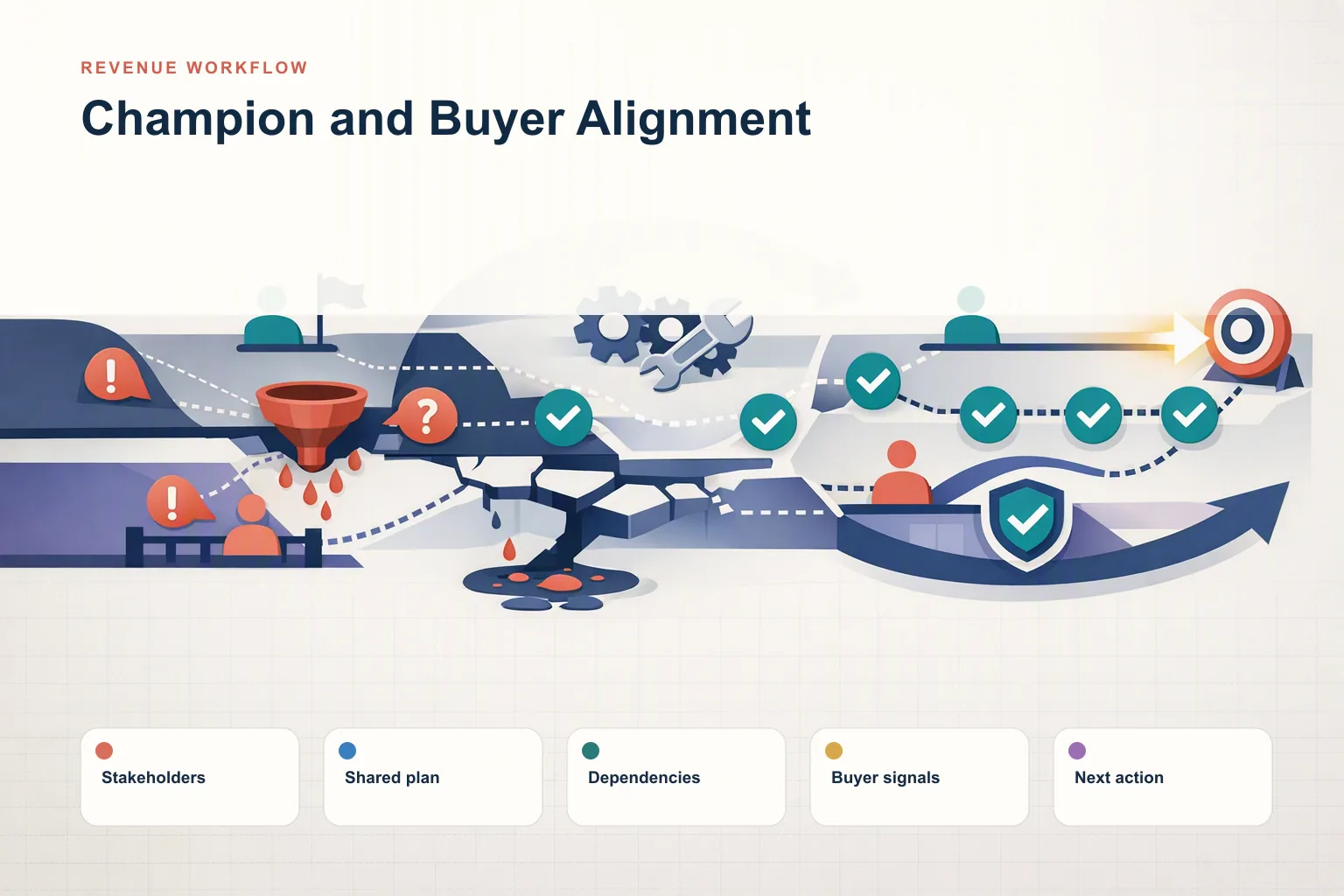
Many B2B revenue teams make predictable, fixable mistakes in how they approach champion and buyer alignment. The most common problems involve treating alignment as a temporary initiative, relying on intuition, single-threading relationships, confusing activity with progress, and failing to learn from losses.
Five champion and buyer alignment mistakes
1. Treating alignment as a one-time initiative
The most common champion economic buyer alignment B2B mistake is treating it as a project with a start and end date rather than an ongoing operational discipline. Teams can launch a new approach and then let it drift as day-to-day pipeline pressure takes over.
The fix: Assign a permanent owner to Champion and Buyer Alignment outcomes. Build it into the operating cadence with standing reviews, defined metrics, and quarterly improvement goals.
2. Relying on intuition instead of data
Revenue teams that manage champion economic buyer alignment B2B by gut feel can make decisions based on recent or memorable deals rather than the full portfolio. Define three to five leading indicators for Champion and Buyer Alignment and track them weekly. When the data disagrees with intuition, investigate the discrepancy.
When reviewing the role of technology and data, include the available deal-level signals. The source posts refer to Revspire Stakeholder Intelligence in this context.
3. Single-threading the relationship
One of the most expensive Champion and Buyer Alignment mistakes is building the entire relationship around a single stakeholder. When that person goes dark, gets reorganized, or leaves the company, the team may have no fallback.
The fix: Map the stakeholders in the buying committee, assign coverage, and track engagement with each one. Deals where only one contact is active should be flagged as high risk.
Three-part explainer: Recognize the leak, Correct the behavior, and Prevent repeat failure.
4. Confusing activity with progress
High activity levels can mask an absence of forward momentum. Reps who send many emails, have many calls, and create many tasks can still have a pipeline that never moves.
The fix: Measure outcomes, not activities. Track stage progression velocity, buyer engagement quality, and stakeholder coverage breadth. When activities are high but outcomes are poor, investigate what is happening inside the deal rather than asking for more activity.
5. Failing to learn from losses
Most teams conduct minimal post-mortem analysis on lost deals. The cost of not learning from losses is that the same Champion and Buyer Alignment mistakes can recur quarter after quarter.
The fix: Implement a structured loss review process. Document the alignment breakdowns that contributed to significant losses and update playbooks accordingly.
Build a practical operating model
Before you can improve Champion and Buyer Alignment, you need an honest baseline. Review recent opportunities by rep, segment, deal size, and stage to identify where deals are falling out and why.
Define what good looks like with clear milestones, documented criteria, and a shared vocabulary. Instrument the process so each stage produces data that informs the next, and build feedback loops from closed-won and closed-lost deals.
Establish ownership and standards
Every high-performing Champion and Buyer Alignment program starts with explicit strategy ownership. An accountable leader can set goals, define metrics, and keep the approach current as conditions change.
Use leading and lagging indicators
If you cannot measure it, you cannot improve it. Leading indicators are behaviors that predict future outcomes, while lagging indicators such as win rates, cycle times, and average deal sizes help confirm whether the approach is working.
- Leading indicators may include: stakeholder engagement, content consumption, mutual action plan progression, and deal velocity by stage.
- Lagging indicators may include: win rate, cycle time, average deal size, and stage conversion rates.
Embed alignment in weekly work
Build a standing review of Champion and Buyer Alignment health into the weekly pipeline cadence. Use the discussion as a structured conversation about what needs to change in the next seven days.
Coach against live deals
Deal-specific coaching reviews live opportunities with each rep, identifies where execution breaks down, and works through the fix in real time.
Capture win-loss intelligence
Capture insights through post-deal interviews, CRM data analysis, and structured win-loss reviews. Feed those findings back into playbooks, training, and strategy.
Align technology to the process
Technology should serve the champion economic buyer alignment B2B process, not define it. Evaluate whether each tool makes execution easier and more consistent or adds friction.
Start with a focused improvement cycle
Start with an honest audit. Use that assessment to prioritize two or three specific improvements, each with a clear owner, a measurable goal, and a 90-day review cadence. Then build from there.
Fixing these mistakes requires process, data, coaching, and supporting technology to work together. See how Revspire helps B2B revenue teams eliminate these patterns.