Revspire blog
The Biggest Champion Enablement Mistakes Costing Your Team Deals in 2026
Deals with an enabled internal champion close 34% faster Discover the strategies top B2B revenue teams use to improve champion enablement B2B sales.
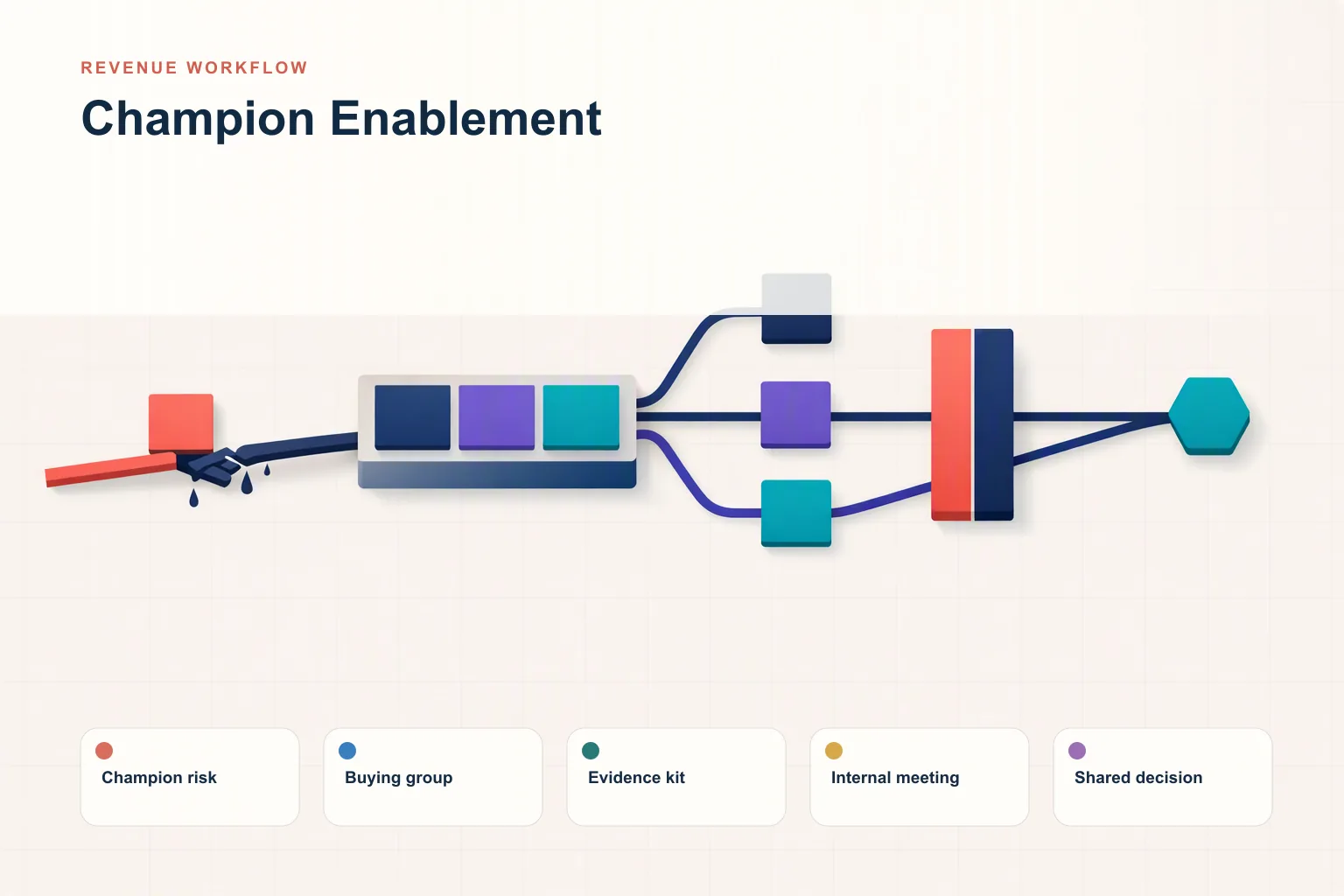
Champion enablement needs an ongoing process, visible evidence, and broad stakeholder coverage. The mapped articles consistently warn against one-time initiatives, intuition-led management, single-threaded relationships, activity without progress, and failure to learn from losses. This consolidated article keeps that mistakes-led intent and uses the source-supported ownership, measurement, coaching, and feedback practices needed to correct each failure.
Three-part explainer: Recognize champion risk, Equip internal selling, and Coordinate the decision.
Mistake 1: Treating champion enablement as a one-time handoff
A project with a start and end date can drift when normal pipeline pressure returns. Assign a permanent leadership owner to champion-enablement outcomes. That owner should set goals, define measures, maintain standing reviews, and keep quarterly improvement work active. Document the process, reinforce it through managers, and update the playbook when evidence changes.
Technology should make the process easier to follow rather than becoming the process itself. Connect the data used in the review so leaders have a current view of the portfolio, and keep ownership of the expected actions explicit.
Mistake 2: Managing the relationship by intuition
A representative’s confidence is context, but the sources call for observable evidence. Define three to five leading indicators and inspect them weekly. Stakeholder engagement, content consumption, mutual action plan progress, and deal velocity are listed as possible early signals. When the data and intuition disagree, investigate the discrepancy before treating the relationship as healthy.
Build the baseline from recent deal data. Map opportunities to the relevant stages and identify where they fall out and why. Examine representatives, segments, and deal sizes so the team is not making a policy decision from one memorable deal.
Pair early signals with resulting outcomes. Win rate, cycle time, and average deal size show what happened; the leading measures give the team a chance to intervene earlier. Put both on the same dashboard and use the evidence during coaching and territory reviews.
Mistake 3: Single-threading the opportunity
Building the entire relationship around one stakeholder leaves the team without a fallback if that contact becomes inactive, changes role, or loses influence. Map the buying committee, assign coverage, and track engagement with each relevant stakeholder. An opportunity with one active contact should remain visible as a coverage risk regardless of overall seller activity.
The retained target links to the Revspire deal room for readers exploring how stakeholder activity, content, and shared actions can be viewed together.
Mistake 4: Confusing seller activity with buyer progress
Email, call, and task volume can look healthy while an opportunity remains stuck. Measure outcomes rather than activity alone. The mapped sources point to stage progression, buyer engagement quality, stakeholder coverage, conversion at each stage, time in stage, and relationships between specific behaviors and win rate.
Use live opportunities for coaching. Identify the point at which execution breaks down, work through the correction with the representative, and agree how the next result will be observed. This turns the review into an evidence-led action rather than another request for more activity.
Mistake 5: Failing to learn from outcomes
Run a structured review after a significant lost deal. Document the champion-enablement breakdowns and update the playbook so the same issue is not repeated unchanged. The strategy source supports post-deal interviews, CRM analysis, and win-loss reviews as inputs to training and strategy.
Review measures against targets each quarter, include buyer feedback, and choose one change that would most improve the process. Keep the resulting update visible in the weekly cadence and in deal-level coaching.
A loss review should produce a documented change rather than an isolated explanation. Feed the learning into the playbook, training, and strategy, then inspect whether the revised approach is being used in current opportunities.
Use one operating model for the corrections
Define the expected action and owner
Document what action should happen, at which stage, and who is accountable. Add clear milestones, criteria, and shared language. A simple model that people follow is more useful than a sophisticated model that remains separate from live work.
Choose a focused first cycle
Start with an honest assessment, select two or three improvements tied to outcomes, give each one a clear owner and measurable goal, and schedule a 90-day review. This keeps the work focused enough to evaluate.
Connect technology and data
Technology should reduce friction and support the documented process. Data should move between the CRM, engagement platform, and deal room so leaders have a current view without repeated manual updates. Review leading and lagging measures together and use them in coaching conversations.
Keep the playbook current with evidence from wins and losses. When the team learns something new, update the guidance and reinforce it in the normal workflow so representatives do not have to rely on an outdated shared document.
A weekly champion-enablement review
Use the weekly pipeline rhythm to decide what must change during the next seven days. Inspect stakeholder coverage, buyer engagement, mutual action plan progress, stage movement, and the relevant outcome measures. Make the next action and owner explicit, then revisit the evidence at the agreed review point.
The source-backed sequence is continuous: assess the current state, define the standard, inspect evidence, coach the live opportunity, learn from the outcome, and update the playbook. It corrects the five mistakes while omitting unsupported promotional statistics.
At the next 90-day checkpoint, compare the selected improvements with their measurable goals. Keep the changes that evidence supports, revise the ones that do not, and preserve the same named accountability into the following cycle.
Request a Revspire demo to explore how the retained target’s deal-room approach can support this review discipline.