Automated Win-Loss Analysis in 2026: Programs, Metrics and Software
A practical perspective for connecting this idea to your revenue team’s next move.
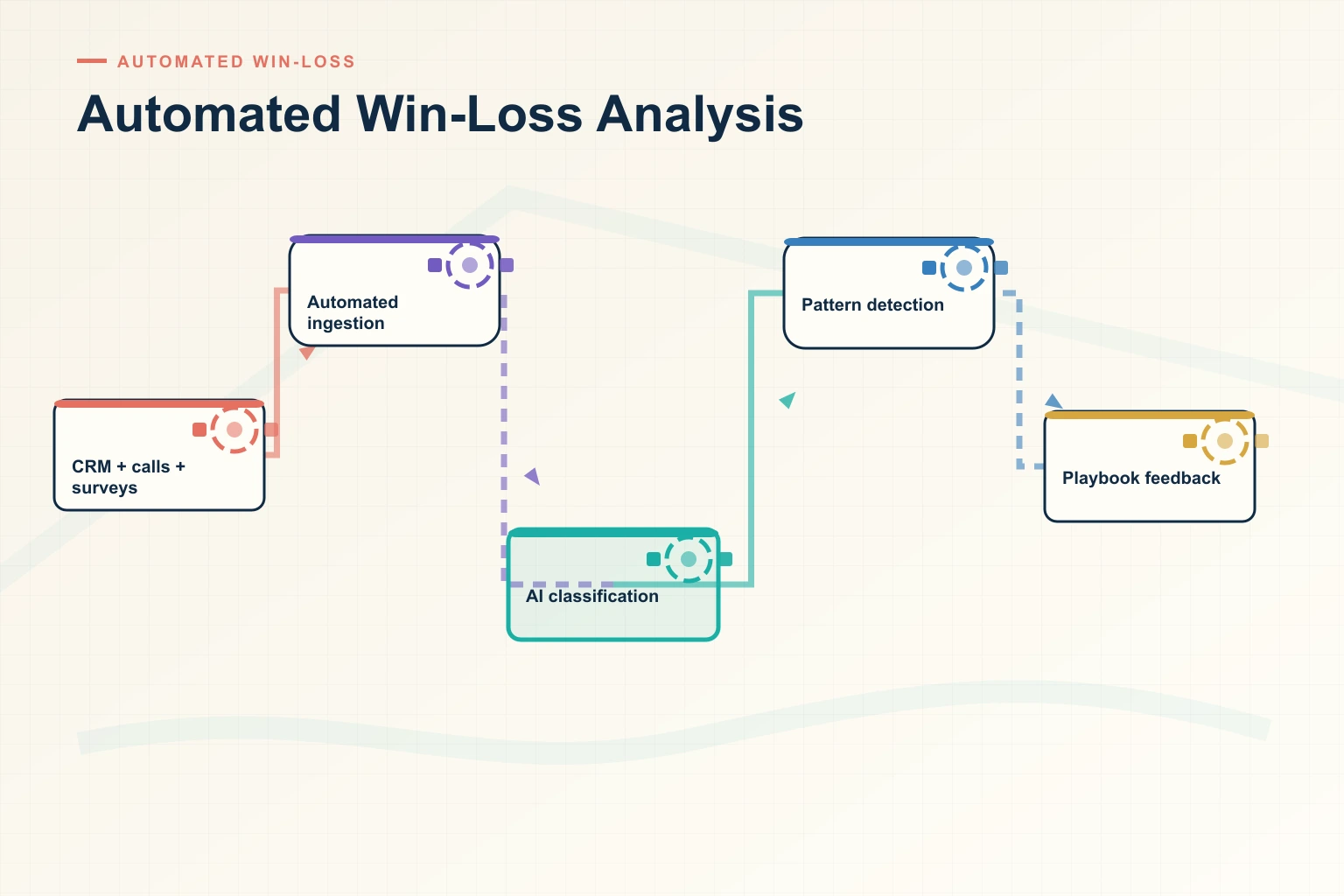
Automated win-loss analysis is a continuous program that collects buyer interviews, surveys, CRM fields and call recordings from closed deals, then uses software and AI to transcribe, code and report why deals were won or lost. Automation handles outreach, tagging and dashboards; people still choose the questions, read the evidence and decide what to change.
This guide covers program design (who to interview, how many, when, and which method), the metrics to track with formulas, how findings reach the product roadmap, sales training and battlecards, and the main types of win-loss software in 2026, with vendor details checked on each vendor’s own site.
Last updated: 17 October 2026
What is automated win-loss analysis, and why are CRM loss reasons not enough?
Win-loss analysis is the structured study of why buyers chose you, a competitor or nothing at all, across many deals rather than one post-mortem at a time (see our win-loss analysis definition). Automation removes the manual work that makes most programs stall after a quarter: finding contacts, inviting, scheduling, transcribing, coding and reporting. The case for it is that the CRM rarely tells the real story:
- Clozd compared 1,000 closed-lost deals with buyer interviews. The CRM closed-lost reason matched the buyer’s account only 15% of the time, the CRM competitor was wrong in nearly 7 of 10 deals, and 44% of CRM loss reasons described an outcome rather than a cause (Clozd, “5 lies your CRM is telling you about your buyers”, undated).
- Across more than 3,400 buyer win-loss interviews, Klue found price was only the third most common loss reason, behind product and sales-experience issues. Budget constraints came up in fewer than 10% of deals lost on price, while confusing pricing structure or model issues contributed to more than 40% (Klue, 10 October 2024).
- Matt Dixon and Ted McKenna’s analysis of 2.5 million recorded sales conversations found that 40–60% of lost deals end in no decision, not a loss to a competitor (Challenger Inc., 22 February 2024).
The dropdown says “price”; the buyer says nobody showed them how the rollout would work; and stalled deals are never studied. More published figures, with sample sizes and dates, are on our win-loss statistics page.
What to automate, and what to keep human
- Automate: triggering outreach when an opportunity closes in the CRM, invitations and reminders, AI-led or asynchronous interviews for smaller deals, transcription, first-pass theme coding, dashboards, and alerts to deal owners, battlecard owners and product managers.
- Keep human: deciding what the program must answer, live interviews on large or strategic deals, spot-checking AI-coded themes against transcripts, and the quarterly decision about what changes.
How do you start a win-loss program? Six design decisions
1. Decide what the program has to answer
Start with two or three questions an executive will act on, such as “Why do we lose mid-market deals to our main competitor in EMEA?” or “Why do qualified enterprise deals end in no decision?” Clozd recommends scoping programs by business unit or product line and focusing on one segment until new themes stop appearing (Clozd, 21 April 2026).
2. Choose who to interview
- Competitive losses: the final decision-maker and the person who ran the evaluation.
- Wins: the same roles, to learn which strengths to protect.
- No-decision deals: your champion, who can explain where consensus broke down.
- Your own seller: a short, separate debrief to compare with the buyer’s account.
Use an interviewer who was not on the deal: Clozd advises a third party because buyers are more candid with someone neutral (Clozd, “Eight tips”, undated). Our guide to running win-loss interviews covers question design.
3. Set the sample size
Win-loss interviews are qualitative, so the target is saturation (new interviews stop producing new themes), not statistical significance. Two published rules of thumb:
- Writing for the Product Marketing Alliance, Willem Maas sets a baseline of at least 20 buyer interviews. His reasoning: nine loss interviews give an 85% chance of surfacing an issue that affects 20% of buyers in lost deals, nine win interviews give the same sensitivity on wins, and the 18 is rounded up to allow for interviews that miss. He suggests about 30 to catch issues affecting around 12% of buyers (Product Marketing Alliance, 5 January 2021).
- Clozd says some organisations get useful insight from around 10 interviews and most of its clients run 50 to 200 a year, largely set by budget. It treats the roughly 400 responses quantitative research typically needs for statistical significance as the wrong benchmark for interviews (Clozd, 21 April 2026).
Plan outreach from the participation rate. Clozd puts a standard rate at about 20%, so 20 completed interviews need about 100 contacts (Clozd, undated). Worked example: 20 interviews in one segment this quarter means about 100 reachable buyer contacts; at two usable contacts per deal, about 50 closed opportunities. A smaller segment needs a longer window, or surveys and AI interviews to widen coverage.
4. Time the outreach
Clozd’s scheduling guide recommends reaching out within about two weeks of the decision, while the buyer still remembers the evaluation, keeping interviews to 30 minutes or less, and following up more than once: it reports that most appointments are booked on or after the second email. The same guide suggests incentives from about $25 to several hundred dollars, or a charity donation, starting low and raising the offer in later reminders (Clozd, “Win-Loss 101, part 3”, undated).
5. Pick the method: interview, survey or call-recording analysis
Method
What it captures
Strengths
Limits
Best used for
Live interview (human)
The buyer’s full decision story, in their own words
Depth, follow-up questions, quotes leaders trust
Cost per interview, scheduling, needs a neutral interviewer
Strategic and large deals, competitive losses, no-decision deals
AI or asynchronous interview
Recorded answers to set questions, with AI follow-ups
Scale, the buyer picks the time, little admin
Shorter and less probing (Klue describes its AI interviews as two to five minutes)
Mid-size and high-volume deals, quick seller feedback
Survey
Ratings and short answers on decision factors
Cheapest per response, easy to trend
Answers are limited to the options you write
Trend tracking across many deals; choosing whom to interview
Call-recording and CRM analysis
What was said and done during the sale: stakeholders, competitor mentions, objections, deal length
Covers every deal with no buyer effort
Seller-side view only; misses what happened after the last call
Patterns across all deals; flagging deals worth an interview
Method trade-offs summarised by Revspire. The two-to-five-minute figure is from Klue’s Win-Loss page, checked 16 October 2026.
Mature programs combine them: call and CRM analysis on every closed deal, surveys or AI interviews on most, and live interviews on the deals that matter most.
6. Assign an owner and a readout rhythm
Give the program one owner (often product marketing, competitive intelligence or RevOps), a sales-leadership sponsor, and a cross-functional group that meets quarterly to decide changes. Share themes monthly, alert the deal and battlecard owners as soon as a competitive interview lands, and log every decision made from the findings: that log is your evidence the program is worth its cost.
How do you run a win-loss buyer interview?
A win-loss buyer interview is a short, open-ended conversation with someone who made or shaped the buying decision, run by a person who was not on the deal, soon after the decision (see step 4 above for timing). It reconstructs how the buyer decided, in their own words, and is coded against one theme list so deals can be compared. Clozd’s interview guide (updated September 2026) suggests about 30 minutes; longer requests tend to lower response rates.
Who to interview
Deal outcome
First choice
Also worth interviewing
What you learn
Competitive loss
The final decision-maker
The evaluation lead; a technical evaluator if product fit was in doubt
What the winner did better, and when the decision tilted
Win
The decision-maker or executive sponsor
Your champion; the lead user
Which strengths to protect, and what nearly lost the deal
No decision or stalled
Your champion
A committee member who stopped engaging
Where consensus broke down
Choose deals from all closed and stalled opportunities, not just CRM loss reasons: in Revspire’s B2B SaaS win rate and sales cycle benchmark, just 10% of closed-lost deals carried a no-decision reason, which the benchmark treats as a floor. Clozd also suggests letting sellers opt deals out of outreach, not in, so painful losses stay on the list.
Who should run the interview?
Interviewer
Strengths
Risks
Best for
Third-party firm
Neutral, trained interviewers
Cost per interview
Strategic deals, competitive losses, executive readouts
Internal researcher outside sales, such as product marketing
Knows the product and market; lower cost
Buyers soften criticism of the vendor
A regular sample of mid-size deals
AI interviewer
Scale; the buyer picks the time
Shorter answers, less probing
High-volume, smaller deals
The deal’s account executive
Knows the history
Not neutral
A separate seller debrief, never the buyer interview
Clozd’s guide to blind and non-blind interviews (17 April 2026) calls third-party execution “the gold standard” and says internal interviews suffer from politeness bias. For deal-level win-loss it recommends non-blind interviews (the buyer knows the sponsor but talks to a neutral party) and keeps blind ones for market research.
A win-loss interview question set
Ask open questions one at a time and probe the reason behind each answer. Save yes/no and rating questions for a follow-up survey, as Clozd’s guide advises.
- Trigger: What problem were you solving, and why did you start looking when you did?
- People: Who was involved in the decision, and what did each person care about most?
- Shortlist: How did you find your options, and what did you rule out early?
- Criteria: Which criteria mattered most by the end, and did they change along the way?
- Comparison: How did the vendors compare on those criteria?
- Turning point: When did the decision start to lean one way, and what happened then?
- Sales experience: How would you describe your interactions with our team?
- Risk: What concerns came up from finance, IT security or legal, and how were they settled?
- Price and terms: How did pricing and the commercial terms affect the decision?
- Decision and advice: What was the main reason for the final choice, and what would you change if you were advising us?
For no-decision deals, replace questions 5 and 6 with: what made the group keep its current approach, and what would have had to be true to go ahead?
How to code the answers
- Code from the transcript within a day, against the coding frame in the next section (8 to 12 themes), so interviews, surveys and CRM reasons share one list.
- Record for each interview the primary reason and three to five themes in total (Clozd’s guide suggests tagging three to five), each with a weight (decisive, a factor or mentioned), a direction (for or against you) and a supporting quote.
- Log the CRM loss reason beside the buyer’s primary reason; it feeds the CRM agreement rate in the metrics table below.
- Double-code a sample. A second person independently codes every fifth interview without seeing the first codes; tighten any theme definition the two coders disagree on, and check AI first-pass codes the same way.
- Report a theme only once it repeats across several interviews in a segment; a single vivid quote is an anecdote.
No systematic tracking of competitive win-loss? How to fix it
If competitive wins and losses are not tracked consistently, fix the data you control before buying anything:
- Make “primary alternative” a required field on every closed deal. Values: named competitor, incumbent, build in-house, no decision. No decision needs its own value or it disappears into “other”.
- Separate outcome from cause. Use one field for what happened (lost to competitor, no decision, disqualified) and another for why (product gap, pricing structure, value case, sales experience, implementation risk, timing). Clozd’s finding that 44% of CRM loss reasons are outcomes rather than causes is the reason to split them.
- Write one coding frame of 8 to 12 themes and code every interview, survey and CRM reason against the same list, so the sources can be compared.
- Interview a monthly sample of competitive deals, wins as well as losses, through a neutral interviewer.
- Compare the CRM reason with the buyer’s reason for each interviewed deal and report the agreement rate. It tells leaders how far to trust the dropdown.
- Publish a quarterly readout per major competitor: win-rate trend, top reasons you win and lose, buyer quotes, and what changed as a result.
Which win-loss metrics should you track?
Track a small set that shows both outcomes and whether the program itself is working. Keep the same denominators every quarter, or the trend lines mean nothing.
Metric
Formula
What it tells you
Benchmark or note
Win rate
Closed-won ÷ (closed-won + closed-lost), for opportunities that reached your qualified stage
Conversion of qualified pipeline
Ebsta and Pavilion (2022 data, 3.2M opportunities): 29% for small deals with 1–3 buyer relationships, 48% for medium deals with 7–9, 42% for enterprise deals with 10–12. Definitions vary; compare like with like.
Competitive win rate
Wins against competitor X ÷ closed deals where X was the primary alternative
Where you win and lose head to head
No reliable public benchmark by competitor; track your own trend.
No-decision rate
Closed-lost deals where no vendor was chosen ÷ all closed-lost deals
How much pipeline dies from indecision
40–60% of lost deals in Dixon and McKenna’s dataset.
Loss-reason mix (buyer-confirmed)
Interviewed losses citing theme T ÷ interviewed losses
Which causes to fix first
Record primary and secondary reasons; Clozd says buyers typically name four to five primary factors.
CRM agreement rate
Interviewed deals where the CRM reason matches the buyer’s primary reason ÷ interviewed deals
How far to trust CRM loss data
15% in Clozd’s 1,000-deal comparison.
Participation rate
Completed interviews ÷ buyers invited
Outreach health and cost per insight
About 20% is standard, per Clozd.
Feedback coverage
Closed deals with buyer feedback (interview, AI interview or survey) ÷ closed deals
Whether findings represent the pipeline
Set a target per segment.
Insight-to-action time
Days from a theme being accepted to the related play, battlecard, training or roadmap change going live
Whether the program changes anything
No published benchmark; log it yourself.
Win rate on addressed themes
Win rate in deals where a fixed issue applied, before vs after the change
Program impact
Compare at least two quarters; other factors move too.
Benchmarks: Ebsta and Pavilion, 2023 B2B Sales Benchmark Report; Challenger Inc., 2024; Clozd.
How to calculate win rate: a worked example
Gong’s win/loss analytics uses the same formula as the table: won deals divided by won plus lost deals (Gong Help Center, updated 30 June 2026). Illustrative numbers: a team closes 120 qualified opportunities in a quarter, 42 won and 78 lost, and 36 of the losses ended in no decision. Win rate is 42 ÷ 120 = 35%, and the no-decision rate is 36 ÷ 78 = 46% of losses. If someone quietly drops no-decision deals from the denominator, the “win rate” becomes 42 ÷ 84 = 50%. Agree the definition once and write it on the dashboard.
How do you use win-loss data for the product roadmap?
Product teams discount sales anecdotes but act on patterns with revenue attached. Turn findings into roadmap input in four steps:
- Tag each product theme to a specific capability, and grade it: a deal-breaker (the buyer says it decided the outcome), a factor (mentioned, not decisive) or a preference.
- Attach revenue: the pipeline value of lost deals where the gap was a primary reason, and the value of won deals where a capability was a reason to choose you.
- Check where it concentrates: one segment, region or competitor, or everywhere. Klue’s interviews found product issues rose sharply as a loss reason in enterprise deals (5,000+ employees) while sales-experience issues fell, so segment cuts change the answer (Klue, 2024).
- Bring a quarterly evidence pack to roadmap planning: theme, number of deals, revenue at stake, segments, the competitor that wins on it, and three buyer quotes.
Two guardrails. A gap named in losses but never in wins may be a positioning problem, not a missing feature. And one large lost deal should not outweigh a pattern across many mid-size ones. When the capability ships, tell sales, update the battlecard, and keep interviewing that segment to confirm the theme fades.
How do you build a closed-loop process from win-loss insight to sales training?
Win-loss improves selling only when a theme becomes a practised behaviour and is then checked in later deals:
- Isolate the themes sellers control: discovery depth, multithreading, the business case, demo relevance, security and procurement handling, follow-through. Keep product and pricing themes for the product and pricing owners.
- Write each as an observable behaviour, for example “ties the demo to the two problems the buyer named in discovery”.
- Build practice scenarios from real interviews: the anonymised persona, objection and competitor that buyers described.
- Practise, score and coach: reps rehearse, and managers coach from the scores in their weekly one-to-ones. Our sales coaching cadence guide shows where this fits in a manager’s week.
- Close the loop next quarter: does the theme appear less often in losses, and does the CRM agreement rate improve as sellers learn what buyers really weigh?
How do you turn win-loss insights into battlecards?
Battlecards are where competitive findings reach a seller mid-deal, so map each finding to a section:
- Why we win: the top win themes against that competitor, each with a buyer quote.
- Where they beat us: the top loss themes, with the honest response and the proof that answers them.
- Objections, in the buyer’s words: phrasing taken from transcripts, not from internal guesses.
- Landmines: questions that expose the competitor’s weak spots buyers actually raised.
Update the card whenever a competitive interview surfaces a new theme, and re-validate every card each quarter against the readout. A sales battlecard template gives you the section structure.
Win-loss analysis software in 2026: summary table
Disclosure: Revspire publishes this list. Revspire appears once, in the deal and call data category, and is not ranked above other tools. Tools are grouped by approach and listed alphabetically within each group. Product details and pricing were checked on each vendor’s own site on 16 October 2026; we used no review ratings.
Tool
Approach
How feedback is collected
AI and automation
Published pricing
Anova Consulting Group
Research firm
Independent executive-level interviews, in local languages
myView portal with AI View
None
DoubleCheck Research
Research firm
Expert-led interviews
None described
None
Clozd
Platform plus services
Live 30-minute interviews; Flex recorded interviews with AI follow-ups
AI interviewer; Flow agent in beta; MCP search
None (demo)
Klue Win-Loss
Platform plus services
AI voice interviews, Blindspot interviews, expert-led interviews, uploaded interviews
Win & Loss Story Agent, Ask Klue, MCP server
None (demo)
Primary Intelligence TruVoice
Platform
Automated buyer feedback requests when a deal closes in the CRM
Automated requests and dashboards
None
Gong (Win/Loss analytics)
Deal and call data
Recorded calls and CRM data; no buyer outreach
Weekly analysis of all deals; tracker comparisons
Quote-based: per-user licences plus a platform fee
Revspire (AI Playbook Engine)
Deal and call data
CRM, calls and buyer feedback you supply
AI win/loss analysis; suggested playbook changes routed for approval
Per module, unlimited users; average about $25,000 USD a year (quote)
Checked on vendor sites, 16 October 2026. Links are in each entry below.
Win-loss research firms (human-led interviews)
Research firms recruit buyers, run the interviews and write the analysis for you. Choose this route when credibility with executives matters more than volume.
Anova Consulting Group
Anova runs independent, executive-level win/loss interviews with decision-makers, evaluators and other stakeholders, across regions and in local languages, plus churn, customer experience and post-implementation research. Clients see program statistics, transcript search and competitor battlecards in its myView portal, which includes an AI View for natural-language questions (Anova; win/loss service page).
- Best for: global enterprise programs that need senior interviewers and multi-language coverage.
- Pricing: not published; contact for a quote.
- Limitation: the service page gives no interview volumes and says cadence depends on deal volume, sales-cycle length and objectives, so scope and cost are set per engagement.
- Choose it when: you want a research partner rather than software your team operates.
DoubleCheck Research
DoubleCheck runs expert-led win-loss and churn interviews and gives clients interview summaries, recordings and transcripts, centralised online reporting, cross-interview trend analysis, analyst research briefs, competitive updates and periodic executive presentations (DoubleCheck Research).
- Best for: product marketing and competitive intelligence teams that want outsourced interviews with analyst synthesis.
- Pricing: not published.
- Limitation: the site names no software product and no AI or survey option, so ask how it would cover high volumes of smaller deals.
- Choose it when: depth and an outside analyst view matter more than covering every deal.
Win-loss platforms that automate interviews, surveys and reporting
These platforms trigger outreach from the CRM, run or capture interviews and surveys, and turn responses into searchable themes and reports. Most also sell human interviewing.
Clozd
Clozd offers live 30-minute interviews run by its interviewers, Flex interviews (buyers answer pre-recorded questions and an optional AI interviewer asks follow-ups), an Expert Network, and a platform with integrations and a Clozd MCP search tool. It covers win-loss, churn and customer-experience feedback (Clozd; Flex Interviews).
- Best for: teams that want live interviews, AI-assisted interviews and a shared insights platform from one vendor.
- Pricing: not published; the site routes to “Talk with us” and demo requests.
- Limitation: Flow, its fully AI-led interview agent, is listed as beta and “coming soon”, so full AI interviewing is not yet generally available.
- Choose it when: you plan a sustained program across several teams and want both interview types in one place.
Klue Win-Loss
Klue’s win-loss suite combines an AI Interviewer (short asynchronous voice interviews with buyers and sellers), Blindspot interviews with buyers sourced outside your pipeline, expert-led interviews by Klue analysts, uploads of your own interviews, and a Win & Loss Story Agent that drafts a deal recap from CRM data and call recordings (Klue Win-Loss).
- Best for: teams already using Klue for competitive enablement that want win-loss findings next to their battlecards.
- Pricing: not published; the pricing page lists no plans or prices.
- Limitation: AI interviews run two to five minutes, per Klue’s FAQ, so deep causal questions still need the expert-led option.
- Choose it when: competitive intelligence owns win-loss and you want coverage across high-volume deals.
Primary Intelligence (TruVoice)
TruVoice sends automated feedback requests to buyers after a deal closes in the CRM, asking about sales experience, decision drivers, product, price and more, and compiles responses into dashboards and reports that also cover positioning and competitors. The company says it has done win-loss work for more than 20 years (Primary Intelligence).
- Best for: teams that want buyer feedback on most closed deals with little admin; the closest fit for “win-loss survey software”.
- Pricing: not published.
- Limitation: the homepage names survey methods and does not mention interviews, so ask whether interviews are available; survey answers are bounded by the questions you set.
- Choose it when: deal volume is high and trend data across many deals matters more than long interviews.
Deal and call-data approaches (no buyer outreach)
These tools mine what already happened in the sale. They cover every deal but only from the seller’s side, so pair them with buyer interviews.
Gong (Win/Loss analytics)
Gong’s Win/Loss analytics compares won and lost deals on number of contacts, “power in deal” (share of senior participants), deal duration, deal size, number of calls, and competitor or other tracker mentions. It sits under Revenue > Analytics > Win/Loss and is available on Forecast Essentials and Gong Forecast (Gong Help Center, updated 30 June 2026).
- Best for: teams already recording calls in Gong that want patterns across all closed deals.
- Pricing: quote-based, with per-user licences plus a platform fee based on users supported (Gong pricing).
- Limitation: it needs at least 100 qualifying closed deals in the selected time range, and it shows seller-side signals, not the buyer’s stated reasons.
- Choose it when: you have the deal volume and want a quantitative layer before investing in interviews.
Revspire (AI Playbook Engine)
Revspire publishes this list. Its AI Playbook Engine includes AI win/loss analysis of deals and calls, looking for decision patterns in won and lost opportunities from CRM data, calls and buyer feedback. Findings become suggested playbook and battlecard changes that are reviewed before sellers see them; Revspire’s AI role-play lets reps practise the fixes.
- Best for: mid-market and enterprise teams that want findings to flow into approved battlecards, plays and seller practice.
- Pricing: priced by module, not per seat: Content Hub is the base platform and Deal Room, Academy (training and certification), Partner Portal and CPQ are added to it, each at a fixed annual price quoted by sales. Every plan includes unlimited user licenses, and the average customer pays about $25,000 USD a year (Revspire pricing). Confirm in a demo which module includes the Playbook Engine’s win/loss analysis for your team.
- Limitation: it does not recruit or interview buyers for you; win/loss interview transcripts are an input you bring.
- Choose a research firm, Clozd or Klue instead when: you need buyer outreach and interviewing done for you.
Building it yourself
Without new software: the CRM fields above, a survey on every closed deal, a neutral internal interviewer for a monthly sample, and an AI assistant to code transcripts against your theme list. It works at low volume while one owner has protected time, and breaks when that owner gets busy.
How to choose win-loss software: six questions
- Who will run interviews: the vendor, AI, or your own team?
- Does it trigger outreach from closed opportunities in your CRM, and write findings back?
- Can you code interviews, surveys and CRM reasons against one theme list?
- How are findings routed to battlecard owners, enablement and product?
- Can you export transcripts and recordings, and who owns them?
- Is pricing per interview, per seat or per program, and what do incentives add?
To see how win/loss findings can feed approved battlecards, plays and AI role-play in one workflow, book a Revspire demo.
Frequently asked questions
What is win-loss analysis in sales?
Win-loss analysis in sales is the structured review of why deals were won or lost, using buyer interviews, surveys, seller input and CRM and call data. It looks for patterns across many deals rather than judging one. Findings feed messaging, battlecards, sales training, pricing and the product roadmap.
How do you automate win-loss analysis?
Trigger buyer outreach when an opportunity closes in the CRM, collect feedback through surveys and AI interviews, and keep live interviews for the largest deals. Code everything against one theme list and route themes to battlecard, enablement and product owners. A person still checks AI-coded themes and decides what changes.
How much does a win-loss program cost?
None of the dedicated win-loss vendors in this guide publish prices (checked 16 October 2026), so expect a quote. Cost is driven by interview volume, the mix of live, AI and survey feedback, incentives (Clozd suggests about $25 to several hundred dollars per interview) and owner time. Clozd says most of its clients run 50 to 200 interviews a year.
What is the difference between win-loss analysis and churn analysis?
Win-loss analysis studies new-business decisions: why a prospect chose you, a competitor or nothing. Churn analysis studies why existing customers leave or downgrade. The interview methods are similar, and several vendors (Clozd, Anova, DoubleCheck) offer both, but keep the two datasets separate so findings are not mixed.
What should you ask a prospect after losing a deal?
Ask how the evaluation started, who was involved, what made the shortlist and when the decision tilted. Then ask what the chosen vendor did better, how your sales experience compared, and what would have had to change for you to win. Use a neutral interviewer and let the buyer tell the story before you probe.
What are the top-rated tools for automated win-loss analysis?
We do not rank by review ratings. The main options are research firms (Anova, DoubleCheck), platforms that automate interviews, surveys and reporting (Clozd, Klue Win-Loss, Primary Intelligence TruVoice), and deal and call-data analysis (Gong, Revspire). Check current review-site ratings yourself and pilot on your own closed deals.
Who should conduct win-loss interviews?
A neutral interviewer: a third-party firm for strategic and competitive deals, or an internal researcher from outside sales, such as product marketing or competitive intelligence, for a regular sample. The account executive should not run the buyer interview, because buyers soften criticism of the person they dealt with; give the seller a separate debrief instead. Clozd recommends non-blind interviews run by a neutral third party for deal-level win-loss.
How do you code win-loss interview answers?
Code each transcript against one fixed list of themes. Record the primary reason, three to five themes with their weight and direction, a supporting quote for each, and the CRM loss reason for comparison. Have a second person double-code a sample to keep definitions consistent, and report a theme only once it repeats across several interviews.
Sources
All pages were accessed on 16 October 2026. Publication or update dates are shown where the page gives one.
- 5 lies your CRM is telling you about your buyers, Clozd (Nate Bagley), undated
- Beyond the Price Tag: The Real Deal-Breakers, According to Your Buyers, Klue (Adam McQueen), 10 October 2024
- How to Overcome Customer Indecision Using the JOLT Effect Approach, Challenger Inc. (research by Matt Dixon and Ted McKenna), 22 February 2024
- 2023 B2B Sales Benchmark Report, Ebsta and Pavilion, February 2023 (2022 data)
- What’s the magic number when it comes to win/loss interviews?, Product Marketing Alliance (Willem Maas), 5 January 2021
- How Many Post-Decision Interviews Do You Actually Need?, Clozd (Braydon Anderson), 21 April 2026
- Eight tips to help your win-loss analysis program, Clozd, undated
- Win-Loss 101: How to effectively schedule win-loss interviews with your buyers (part 3 of 6), Clozd (Nate Bagley), undated
- Review win/loss analytics, Gong Help Center, published 12 April 2024, updated 30 June 2026
- Pricing, Gong, undated
- Clozd homepage and Flex Interviews, Clozd, undated
- Klue Win-Loss and Pricing, Klue, undated
- DoubleCheck Research homepage, DoubleCheck Research, undated
- Anova homepage and Win/Loss Analysis, Anova Consulting Group, undated
- Primary Intelligence homepage (TruVoice), Primary Intelligence, undated
- AI Playbook Engine and Pricing, Revspire, undated
- How to Conduct Win-Loss Interviews: A Complete Guide, Clozd (Matt Payne), updated September 2026 (accessed 17 October 2026)
- The Complete Guide to Blind vs. Non-Blind Win-Loss Interviews, Clozd, 17 April 2026 (accessed 17 October 2026)
- B2B SaaS Win Rate and Sales Cycle Benchmark (2026), Revspire, 16 October 2026 (data October 2025 to September 2026) (accessed 17 October 2026)