Revspire blog
The Biggest Content Performance Analytics Mistakes Costing Your Team Deals in 2026
Examine five content performance analytics mistakes and build a practical framework for ownership, measurement, coaching, and continuous improvement.
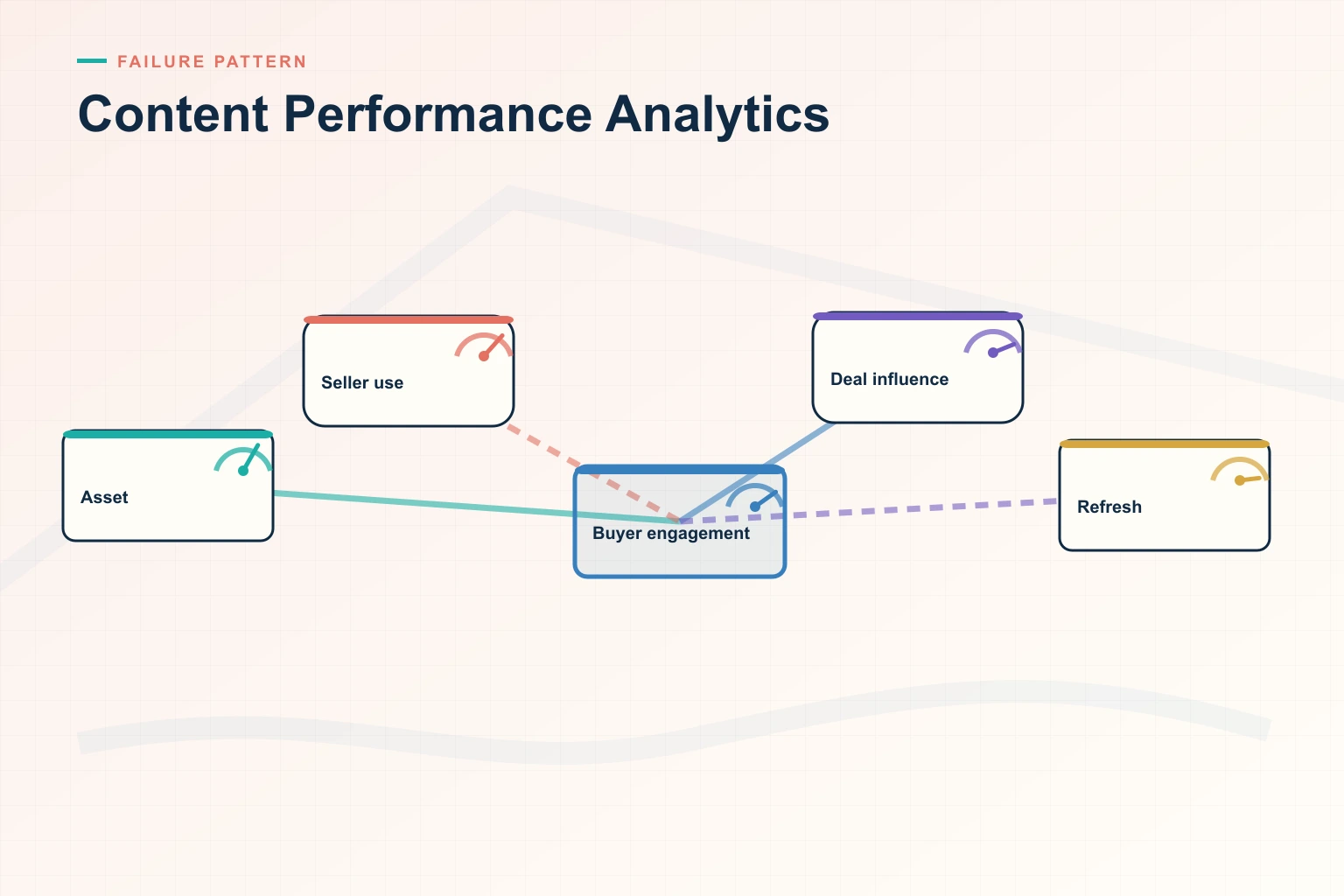
Content performance analytics can be managed as an ongoing operating discipline. Revenue teams can use it to review deal movement, buyer engagement, stakeholder coverage, content consumption, and lessons from completed opportunities.
This guide covers five mistakes to examine, a three-step operating framework, supporting system components, and seven practices teams can adapt to their sales process.
Five Content Performance Analytics Mistakes to Examine
1. Treating Analytics as a One-Time Initiative
Treating sales content performance analytics as a project with a fixed end date can leave the process without continuing ownership or review.
The correction: Assign a permanent owner, define the review cadence and metrics, and revisit the operating model quarterly. Keep the work connected to the documented revenue process after the initial rollout.
2. Relying on Intuition Instead of Portfolio Data
Recent or memorable opportunities may influence an internal narrative. Compare those impressions with available data across representatives, segments, stages, and deal sizes before changing policy.
The correction: Define three to five leading indicators and review them weekly. When the data and internal narrative differ, investigate the discrepancy. For the product context referenced in the source material, see Revspire Content Hub.
3. Building the Relationship Around One Stakeholder
If the only active contact disengages, changes roles, or leaves the company, the team may have no alternate route through the buying group.
The correction: Map relevant stakeholders, assign coverage, and track engagement by contact. Flag opportunities with only one active relationship for additional review rather than assuming that one contact represents the full buying group.
4. Confusing Activity with Progress
Email volume, calls, and task counts can remain high while an opportunity does not move forward.
The correction: Measure outcomes, not activities. Review stage progression, buyer engagement, and stakeholder coverage alongside activity metrics. When activity is high but movement is limited, examine execution inside the opportunity before requesting more activity.
5. Failing to Learn from Completed Deals
Moving directly from a completed opportunity to the next one can leave useful observations uncaptured.
The correction: Capture findings through post-deal interviews, CRM data analysis, and structured win-loss reviews. Document what the team learned and decide whether the evidence warrants a change to playbooks, coaching, training, or strategy.
Three-part explainer: Recognize the leak, Correct the behavior, and Prevent repeat failure.
A Three-Step Operating Framework
Step 1: Audit the Current State
Before you can improve Content Performance Analytics, you need an honest baseline. Review recent opportunities by stage, representative, segment, and deal size. Identify where deals enter the pipeline, stall, advance, or exit, and record the evidence available for each pattern.
Compare what the data shows with the prevailing internal narrative. Select a small number of clearly defined problems for further investigation instead of assuming that correlation establishes a cause.
Step 2: Build the Operating Model
Define the actions expected at each stage, the evidence required to advance, and the person accountable for maintaining the process. Document the workflow, teach it, reinforce it through managers, and include it in the regular pipeline cadence.
The operating model should also define how buyer signals, stakeholder activity, content engagement, and deal-level observations enter the review process. Keep the model simple enough for teams to use consistently.
Step 3: Measure and Improve
Use leading and lagging indicators for different purposes. Leading indicators can include stakeholder engagement, content consumption, mutual action plan progression, and deal velocity. Lagging indicators can include win rates, cycle times, and average deal sizes.
Build a dashboard that shows both. Review it weekly. Use the dashboard to identify questions for pipeline reviews, coaching conversations, and territory reviews. Treat changes in the metrics as prompts for investigation rather than proof that one action caused an outcome.
Three-part explainer: Audit the current state, Build the operating model, and Measure and improve.
Components of a Durable Analytics System
Strategy and Ownership
A designated leadership owner can set goals, define metrics, coordinate stakeholders, and maintain the review cadence. Accountability should cover the operating process and the quality of its evidence, not activity volume alone.
Process and Playbooks
The process that governs sales content performance analytics must be documented, taught, and enforced. Playbooks should describe stage expectations, decision criteria, and review procedures. Update them when structured evidence supports a change rather than treating every anecdote as a new rule.
Technology and Data
Technology should serve the sales content performance analytics process, not define it. Evaluate tools by whether they reduce manual work, make relevant signals easier to review, and support the documented workflow. Where systems are connected, define data ownership and check data quality before relying on a portfolio view.
Three-part explainer: Define the system, Operationalize the workflow, and Measure the impact.
Seven Practices for Scaling the Process
- Define excellent execution. Document what the team expects at each stage so managers and representatives use a shared standard.
- Instrument each stage. Select leading indicators that help the team identify questions before lagging results are available.
- Establish a weekly cadence. Include analytics health in pipeline conversations and assign follow-up actions.
- Coach at the deal level. Review live opportunities to identify execution gaps in their actual context.
- Capture win-loss intelligence. Use post-deal interviews, CRM data analysis, and structured win-loss reviews, then decide which findings warrant updates.
- Align technology with the process. Reduce unnecessary manual data movement and evaluate each tool against the documented workflow.
- Create feedback loops. Review metrics against targets, update playbooks when evidence supports a change, collect buyer feedback, and record the next improvement to test.
Content Performance Analytics strategies for B2B revenue teams.
Business, Competitive, and Talent Questions to Test
Where Pipeline Problems Appear
An audit can examine three areas raised by the source material: early-stage opportunities that consume capacity without sufficient qualification evidence, qualified opportunities that stall while execution gaps remain unresolved, and late-stage opportunities affected by procurement questions, unstated objections, or stakeholder concerns.
Use these as diagnostic categories, not established prevalence findings. The frozen sources do not provide a dataset showing how often these problems occur or proving that content performance analytics alone causes or prevents them.
The Competitive Dimension
Where products are differentiated but not unique, evaluate the buying experience as a hypothesis. Ask whether content and stakeholder signals reveal unanswered questions, perceived risk, or unnecessary friction. Validate any conclusion with buyer feedback and opportunity evidence rather than assuming that a smoother process produces a particular commercial result.
The Talent Dimension
Examine whether the operating model has any measurable relationship with onboarding, coaching, development, or retention. The source material raises this talent dimension but supplies no dataset or methodology establishing a directional outcome. Treat it as an internal research question and measure it separately before making a performance claim.
Where to Start
Start with an honest audit. Compare the available data with the internal narrative, choose two or three specific improvements, assign an owner, define a measurable goal, and set a review date. Record what changed, what remained unchanged, and what evidence would justify the next adjustment.
Three-part explainer: Expose the hidden cost, Build the business case, and Start where it matters.
Build a More Consistent Practice
A content performance analytics practice can connect ownership, documented workflows, suitable metrics, deal-level coaching, technology, and structured feedback. See how Revspire helps B2B revenue teams eliminate these patterns.