Revspire blog
The Biggest Deal Room Content Management Mistakes Costing Your Team Deals in 2026
Identify the strategic, execution, measurement, coaching, and technology mistakes that weaken deal room content management—and learn how to correct them.
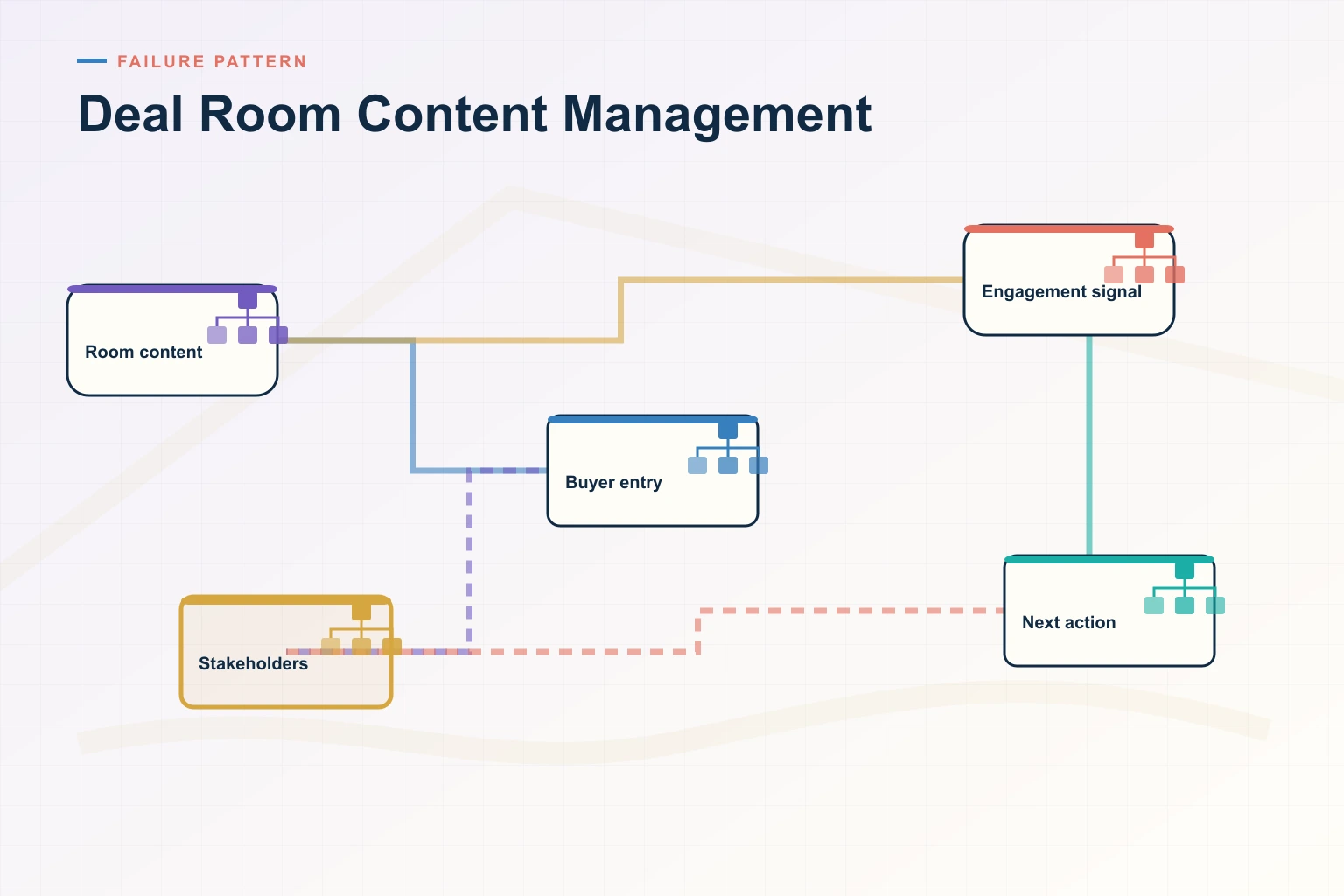
The most common deal room content strategy mistake is treating it as a project with a start and end date rather than an ongoing operational discipline. A more consistent approach connects ownership, documented workflows, deal signals, measurement, coaching, and feedback loops.
Why deal room content management mistakes matter
The cost of ignoring it is rarely visible in a single deal. Problems can emerge across the pipeline when weak opportunities consume rep capacity, qualified deals stall, or late-stage process failures remain hidden.
Revspire Deal Rooms is designed to close these gaps at every stage.
Strategic mistakes
1. Treating content management as a one-time initiative
Deal room content management can drift when the initial project ends and day-to-day pipeline pressure takes over.
The fix: Assign a permanent owner to Deal Room Content Management outcomes. Build it into the operating cadence with defined metrics and quarterly improvement goals.
2. Relying on intuition instead of evidence
Decisions based on a few memorable deals can obscure patterns across the full portfolio.
The fix: Define a small set of leading indicators and track them regularly. Relevant indicators can include stakeholder engagement, content consumption, mutual action plan progression, and deal velocity. Compare those signals with lagging indicators such as win rate, cycle time, and average deal size.
Recognize the leak, correct the behavior, and prevent repeat failure.
Execution mistakes
3. Single-threading the buyer relationship
Building the entire relationship around a single stakeholder creates risk when that person becomes unavailable, changes roles, or leaves the company.
The fix: Map the buying committee, assign stakeholder coverage, and track engagement. Treat deals with only one active contact as higher risk.
4. Confusing activity with progress
Email, call, meeting, and task volume can increase while an opportunity remains stalled.
The fix: Measure outcomes, not activities. Track stage progression, buyer engagement quality, and stakeholder coverage. When activity is high but progress is weak, investigate what is happening inside the deal instead of simply asking for more activity.
5. Using generic training without deal-level coaching
Generic training may not identify where execution breaks down in a live opportunity.
The fix: Review live opportunities with each rep, identify the specific execution gap, and work through the next action in the context of the deal.
A practical framework starts with an audit, an operating model, and revenue-linked measurement.
Learning and technology mistakes
6. Failing to learn from wins and losses
Every won and lost deal contains insights about what works and what does not in an approach to Deal Room Content Management.
The fix: Capture those insights through rep debriefs, buyer feedback where available, CRM analysis, and structured win-loss reviews. Feed the findings into playbooks, coaching, and strategy.
7. Allowing technology to define the process
Technology should serve the deal room content strategy process, not define it.
The fix: Start with the required actions, owners, decision points, and metrics. Then evaluate whether each tool reduces friction and allows data to flow between the CRM, engagement platform, and deal room.
Deal room content management problems can appear from initial qualification through late-stage execution.
Build a repeatable operating system
Audit the current state
Before you can improve Deal Room Content Management, you need an honest baseline. Review recent opportunities by stage, rep, segment, and deal size, then identify where deals stall or exit.
Define ownership and the operating model
An operating model for Deal Room Content Management answers three questions: what actions should happen, at what stage, and who is accountable. Document the model, teach it to the team, and reinforce it through managers.
Measure leading and lagging indicators
If you cannot measure it, you cannot improve it. Build a dashboard that shows leading and lagging indicators, review it regularly, and connect the findings to coaching conversations and territory reviews.
Create continuous feedback loops
Review Deal Room Content Management metrics against targets, update playbooks when the team learns something new, and solicit buyer feedback on the experience.
Define the standard, instrument each stage, coach live deals, capture learning, and improve continuously.
Define the system, operationalize the workflow, and measure the impact.
Next steps
Start with an honest audit, prioritize two or three improvements, assign a clear owner, define a measurable goal, and establish a recurring review cadence.
See how Revspire helps B2B revenue teams eliminate these patterns