Revspire blog
Risk Aversion in B2B: 5 Buyer-Risk Mistakes to Fix
Diagnose B2B buyer risk, build trust with relevant proof, reduce exposure responsibly, cover the buying group, and learn from outcomes.
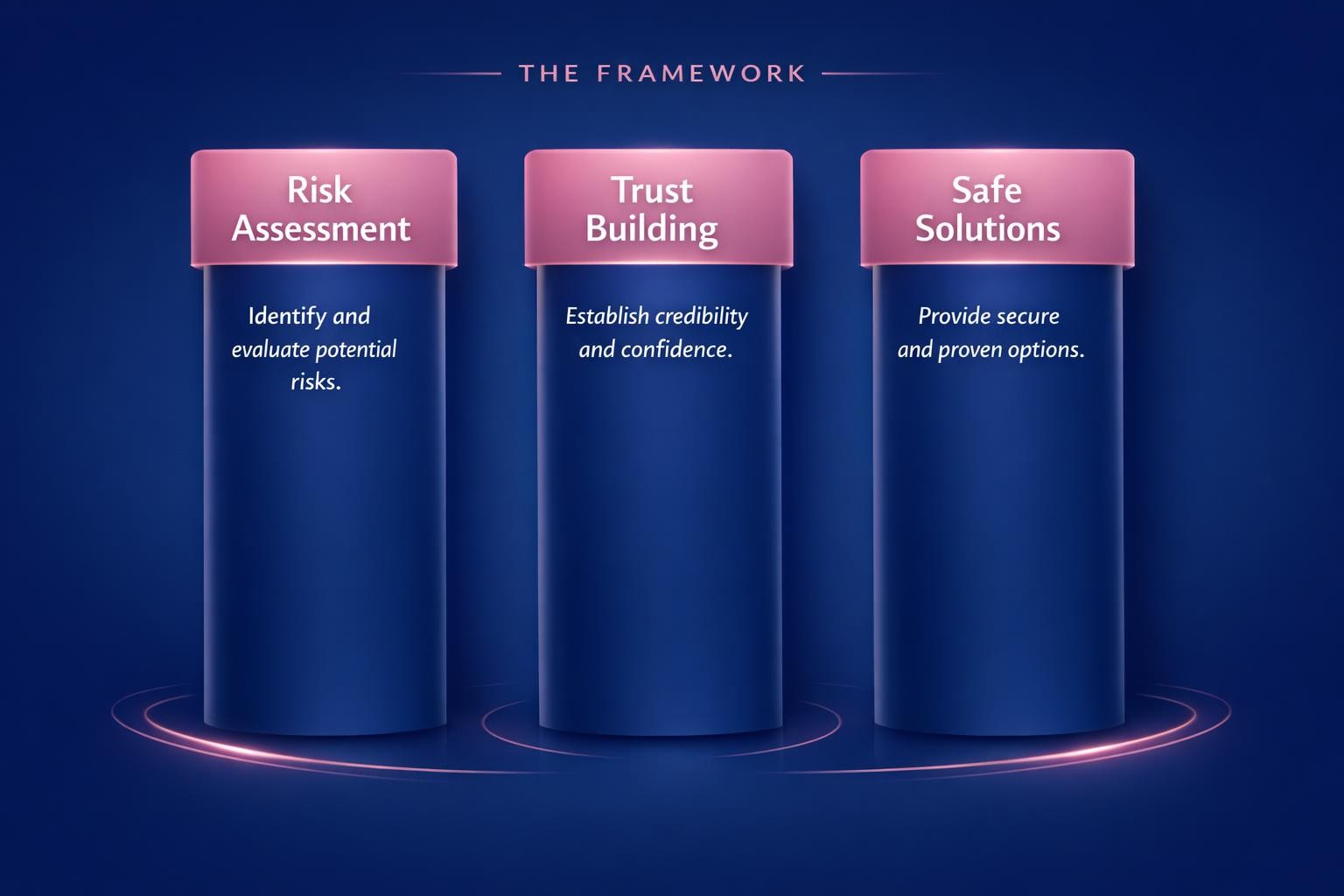
Risk aversion in B2B buying appears when the perceived downside of choosing, implementing, or defending a purchase outweighs the buyer’s confidence in the outcome. A concern stated as price may actually involve implementation, timing, internal approval, fit, or uncertainty about value. The right response is to diagnose that concern, supply relevant proof, and reduce avoidable exposure without making promises the business cannot honor.
HubSpot’s objection-handling guidance emphasizes listening, confirming the concern, using relevant social proof, and adapting the response to the actual risk. The five mistakes below combine that buyer-facing guidance with practical ownership, stakeholder coverage, coaching, and outcome learning.
Mistake 1: Answering before diagnosing the risk
An immediate rebuttal can answer the wrong objection and weaken trust. Let the buyer finish, acknowledge that the concern is reasonable, and ask open-ended questions. Restate what you heard and confirm it before proposing a response. This separates a budget issue from an implementation, timing, fit, authority, or internal-justification issue.
Record the concern in the opportunity and name the evidence required to resolve it. A specific diagnosis gives the account team something reviewable; a generic label such as “risk-averse buyer” does not. If the buyer’s concern remains unclear, the next action should be further discovery rather than a larger volume of seller activity.
Mistake 2: Substituting broad claims for relevant proof
Trust grows when the evidence matches the buyer’s situation. Use a customer story or case study from a comparable industry, use case, or operating constraint, and explain the starting problem, the change made, and the observed result. Do not present an unrelated logo, testimonial, or benchmark without a cited basis as proof.
Match the proof to the concern. For an outcome question, show a relevant customer result and how it was measured. For implementation risk, show the implementation plan, responsibilities, support model, and a comparable transition. For technical fit, involve the appropriate specialist and verify the required workflow or integration. For internal approval, provide a clear business case the buying group can inspect.
Make uncertainty visible. Distinguish verified customer evidence from an estimate or expectation, and avoid implying that another customer’s result is guaranteed. Concrete, bounded evidence is more credible than a superlative.
Mistake 3: Asking for more commitment than the evidence supports
Risk reversal means reducing a specific, legitimate source of buyer exposure while preserving a sound commercial agreement. Depending on the offer and company policy, that may mean a phased implementation, a smaller initial scope, subscription tiers, or shorter commitment periods. Use only options the business can deliver and document; do not invent guarantees or hide conditions.
Tie the reduced-risk path to explicit success criteria, ownership, and a review point. State what is in scope, what the customer and vendor each provide, how progress will be assessed, and what decision follows. If no smaller path is viable, address the concern honestly rather than presenting a false concession.
The objective is not to pressure the buyer into an easier signature. It is to make the decision, implementation, and next commitment proportionate to the evidence available.
Mistake 4: Building confidence with only one stakeholder
One supportive contact cannot represent every concern in a buying group. Map the relevant stakeholders, assign relationship coverage, and track engagement. Surface opportunities with only one active contact for review so the account team can identify missing technical, financial, operational, or executive perspectives where they are relevant.
Do not confuse communication volume with broader confidence. Review stage movement, buyer engagement quality, stakeholder coverage, mutual action plan progress, and deal velocity. When seller activity is high but buyer progress is weak, investigate the unresolved concern and the people involved instead of asking for more calls or emails.
Mistake 5: Failing to learn which proof changed the decision
Run a structured review after significant wins and losses. Record the concern that mattered, when it surfaced, whether the right stakeholder was involved, which evidence was offered, and whether a reduced-risk path was considered. Feed repeated findings into discovery questions, proof libraries, implementation guidance, training, and account strategy.
Separate the seller’s interpretation from buyer feedback and portfolio data. One memorable deal should not become policy. Look for repeated patterns, select two or three improvements, assign an owner and measurable goal, and review the effect after 90 days.
Use a trust, proof, and risk-reversal workflow
- Surface: ask what could prevent the decision or make implementation unacceptable.
- Confirm: restate the concern and verify that the account team understands it correctly.
- Classify: identify whether the issue concerns value, implementation, timing, fit, authority, internal buy-in, or commercial exposure.
- Prove: provide evidence relevant to that concern, with its context and limits.
- Reduce: where policy allows, offer a proportionate scope, implementation path, term, or review point that lowers the specific exposure.
- Commit: document the next buyer and seller actions, owners, dates, and evidence still required.
Assign a permanent leader to maintain the workflow, its evidence standards, and its measures. Review live opportunities weekly as a decision forum, not a status report. Teams evaluating how to make buyer and stakeholder signals visible can explore Revspire Buyer Intelligence.
Review risk with observable evidence
- Has the buyer stated the concern in their own terms?
- Has the team confirmed whether the concern is value, implementation, timing, fit, authority, internal buy-in, or commercial exposure?
- Is the proof relevant to the buyer’s industry, use case, or constraint, and are its limits clear?
- Are all relevant stakeholders represented rather than one contact carrying the decision?
- Is any phased scope or shorter commitment documented with clear success criteria and ownership?
- Does the opportunity have a buyer-supported next action and date?
- Will the final outcome update the proof, playbook, or coaching guidance?
Review the selected leading and lagging measures together, including stakeholder engagement, stage progression, cycle time, and win-loss patterns. Use the evidence to coach current opportunities and improve the workflow each quarter.
Request a Revspire demo to discuss an evidence-led approach to buyer risk.