B2B Buyer Journey Mapping: Stages, Template and Worked Example
A practical perspective for connecting this idea to your revenue team’s next move.
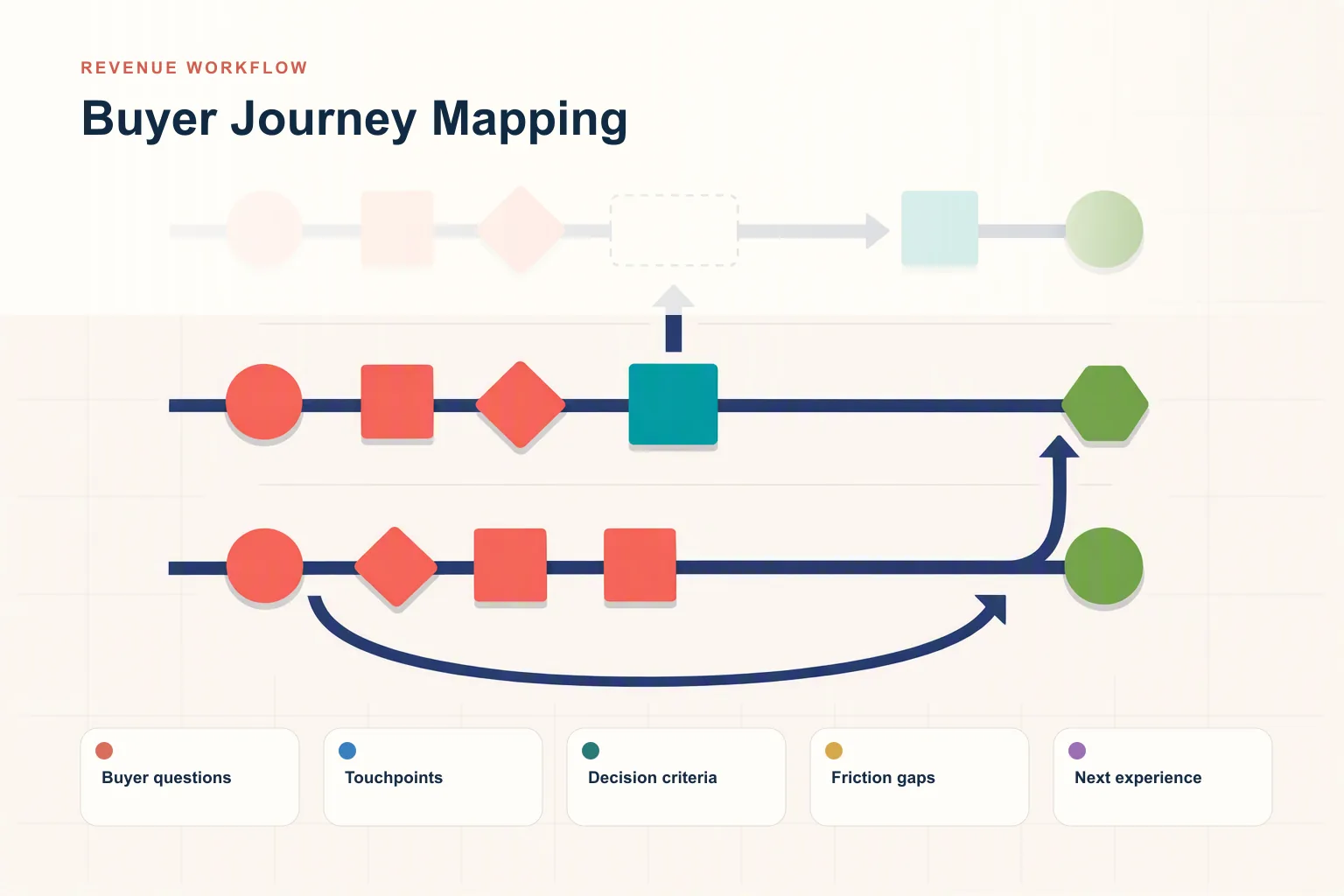
B2B buyer journey mapping is documenting how a buying group gets from noticing a problem to signing a contract: the stages it moves through, who joins at each one, what each person needs to learn, and the evidence that shows the group has moved on. For a revenue team, the map shows where deals stall and what to do next.
This guide is written for sales, enablement and RevOps leaders rather than marketers. It covers the six stages buyers move through, how they differ from your CRM stages, a seven-step method that starts from your own deal data, a copyable template, a worked example, the points where journeys usually break, and the metrics that show whether yours is improving.
Last updated: 16 October 2026
What is the B2B buyer journey?
The B2B buyer journey is the path an organisation takes to make a purchase, seen from the buyer’s side. It usually starts with a change inside the business: a Gartner press release (23 June 2020) says 93% of B2B purchases take place in the context of organisational change, such as a shift in operations, market conditions or structure. It ends when the group signs and starts to implement. Three things make it different from a consumer purchase.
- It is a group decision. Forrester’s 2026 State of Business Buying release (21 January 2026) puts the typical decision at 13 internal stakeholders and nine external influencers, and says procurement is a decision-maker in 53% of buying cycles. Our glossary entry on the buying committee covers the usual roles.
- It is not linear. Gartner research found that most B2B buyers revisit nearly every one of six buying jobs at least once before they buy (press release, 9 October 2018).
- Most of it happens without you. In 6sense’s 2025 B2B Buyer Experience Report (nearly 4,000 buyers), buyers made first contact with sellers 61% of the way through their journey, down from 69% in 2024, and buyers rather than sellers initiated 79% of those first engagements.
Buyer journey vs sales process vs customer journey
The three terms are often used interchangeably, which is how teams end up with a “buyer journey map” that is really their sales stages renamed.
Term
Whose view
What it describes
Example stage
Measured by
Buyer journey
The buying group’s
How the group decides to buy
“Requirements agreed”
What the buyer has done: requirements signed off, security review started
Sales process
The seller’s
What the sales team does to win the deal
“Demo completed”
Seller activities and CRM stage conversion
Customer journey
The customer’s, across the lifecycle
Everything from first awareness through onboarding, renewal and expansion
“Renewal decision”
Retention, expansion and satisfaction
A buyer journey map describes the buyer’s decision, then shows where each sales stage and seller action should line up with it.
What are the stages of the B2B buyer journey?
Gartner’s widely used model names six “buying jobs” rather than funnel stages: problem identification, solution exploration, requirements building, supplier selection, validation and consensus creation (Gartner, 9 October 2018). Buyers work on several at once and go back to earlier ones, so treat the order as typical, not fixed. The simpler awareness, consideration and decision model maps onto them: awareness is problem identification; consideration covers solution exploration and requirements building; decision covers supplier selection, validation and consensus creation.
Stage (buying job)
What the buying group is doing
Questions it needs answered
Evidence it has moved on
The seller’s job
1. Problem identification
Agreeing something must change, and that it is worth fixing now
What is this costing us? Why now?
A named owner and a stated trigger, such as a new leader, a missed target or an audit finding
Help quantify the cost of the problem; do not pitch yet
2. Solution exploration
Looking at types of solution, including doing nothing or building in-house
What are our options? What do peers use?
A shortlist of approaches, often built from search, AI assistants, peers and review sites
Be findable and useful in rep-free research; offer a point of view
3. Requirements building
Writing down what the solution must do and who must approve it
What do we need? Who signs off on security, legal and budget?
A requirements list or RFP; IT security and procurement named
Shape requirements around the problem; map the buying group
4. Supplier selection
Comparing vendors against the requirements
Which vendor fits best? What will it really cost?
A short list of vendors; a trial or proof of concept agreed
Run a focused evaluation; share pricing and implementation detail early
5. Validation
Checking the choice is safe: references, trial, security review, business case
Will this work for us? What could go wrong? Can we defend the decision?
Security review passed, references taken, business case drafted
Reduce risk with proof, references and an implementation plan
6. Consensus creation
Getting every member of the group to agree and sign
Does everyone agree? What do finance and procurement need?
Economic buyer approval; procurement and legal under way with dates
Equip the champion to sell internally; run a mutual action plan
Stage names from Gartner’s six B2B buying jobs. The other columns are Revspire’s guidance for sales-led teams.
Two practical notes. First, write the evidence column as things the buyer does or produces, never as seller activities: “security questionnaire returned” is evidence; “security pack sent” is not. Second, validation and consensus are where many deals are decided and where most maps are thinnest. In a Gartner survey of 632 buyers (press release, 7 May 2025), 74% of buying teams showed “unhealthy conflict” during the decision, and groups that reached consensus were 2.5 times more likely to report a high-quality deal.
How has the modern B2B buyer journey changed?
The stages are not new; the conditions around them are. Five shifts should change how you draw the map.
- Buyers prefer to research without a rep, increasingly with AI. In a Gartner survey of 646 buyers (press release, 9 March 2026), 67% said they prefer a rep-free experience and 45% had used AI during a recent purchase. 6sense’s 2025 report found 94% of buyers used large language models during their buying process. Forrester (January 2026) calls generative AI search the starting point for B2B buyers, and warns that those answers are often incomplete or unreliable.
- The shortlist forms early. 6sense (2025) reports that the vendor buyers contact first still wins about eight in ten deals, that buyers evaluated 5.1 vendors on average, and that the average journey took 10.1 months, down from 11.3 months in 2024.
- Groups are large and include outsiders. With 13 internal stakeholders and nine external influencers in a typical decision (Forrester, January 2026), consultants, peers and analysts belong on the map, not only the people on your calls. The same release says more than 60% of business buyers now use a trial.
- Buyers move across many channels. McKinsey’s 2024 B2B Pulse survey (published 12 September 2024, nearly 4,000 decision makers) found B2B customers use an average of ten interaction channels, up from five in 2016, and split roughly into thirds between preferring in-person, remote and digital self-serve at every stage. More than half said they were likely to turn to another supplier if the experience across channels was not smooth.
- Purchases stall and disappoint. Forrester’s State of Business Buying 2024 release (4 December 2024) found 86% of B2B purchases stall during the buying process and 81% of buyers were dissatisfied with the provider they chose.
None of this means sellers matter less. In a Gartner survey of 645 B2B buyers (press release, 20 May 2026), 69% said they prefer to check AI-generated insights with a sales rep, and at the problem-research stage buyers still ranked reps as their most important information source. The map has to cover the rep-free parts of the journey and show where a seller adds the most.
How do you create a B2B buyer journey map?
Build the map from evidence about your own deals, not from a workshop about how buyers ought to behave. Seven steps:
1. Pick one segment and one sales motion
A new-logo enterprise deal and a mid-market expansion are different journeys with different buying groups. Map one motion first, usually the one with the most revenue at stake, and write its scope at the top of the map: segment, deal-size band, product and region.
2. Audit six to twelve months of closed deals
Pull won and lost opportunities for that motion and look at where they entered, where they slowed and where they ended, broken down by deal size, segment and rep. Look for three things: the stage with the longest median time, the stage where lost deals most often stopped moving, and the share of deals with only one active buyer contact. Then compare what the data shows with what the team believes. The gap between the two is usually the first thing to fix.
Benchmarks give context if you compare like with like. In Revspire’s B2B SaaS win rate and sales cycle benchmark (about 40 B2B companies, October 2025 to September 2026), the median won deal closed in 20 days under $10k annual contract value, 45 days at $10k to $50k and 90 days above $50k, counted from opportunity creation.
3. Interview recent buyers, won and lost
CRM data tells you where deals stopped, not why. Talk to a handful of recent buyers, including lost ones, and ask them to retell the purchase in their own order: what triggered it, who joined and when, where they looked for information, what nearly stopped it, and who had to be convinced last. Our guide to win-loss interviews covers how to run these conversations.
4. Write each stage as a buyer outcome with exit criteria
For each stage, write one sentence on what the buying group is trying to achieve and two or three exit criteria the buyer can verify. “Problem owner confirmed the cost of doing nothing” is an exit criterion; “discovery call held” is not. Then line your CRM stages up against the buyer stages. Where a CRM stage has no buyer evidence behind it, that stage is measuring seller activity.
5. Add the buying group to each stage
List the roles involved in each stage and when each one usually joins: champion, economic buyer, end users, IT and security, procurement, legal and outside advisers. Security, procurement and legal are the roles most often missing until late, even though procurement is a decision-maker in 53% of buying cycles (Forrester, January 2026). A stakeholder map template helps you record each role and where they stand.
6. List touchpoints and content, including the ones you do not control
For each stage, note where the buyer gets information: your website and pricing page, review sites, AI assistants, peers, analysts, events, trials and conversations with your team. Then note what the buyer needs to see at that point. The companion guide on buyer journey content mapping covers which assets to prepare for each deal stage and buying-group role.
7. Choose one signal per stage, an owner and a review cadence
Pick one signal that shows a deal is progressing in each stage and one that shows it is stalling. Give the whole map a single owner, usually in RevOps or enablement, who updates it when win-loss findings change. Use it in weekly deal reviews to decide the next action on live deals, and refresh it every quarter.
Buyer journey map template
Copy this structure into a spreadsheet with one row per stage. The example column is filled in for the validation stage.
Column
What to write
Example (validation stage)
Stage
The buyer’s name for the step
Validation
Buyer goal
What the group is trying to achieve
Confirm the shortlisted vendor is safe to choose
Roles involved
Who is active, and who joins at this point
Champion, IT security, end-user leads, a reference customer
Questions to answer
What they must learn to move on
Will it pass our security review? Has it worked for a company like ours?
Touchpoints
Rep-led and rep-free
Security questionnaire, reference call, trial workspace, review sites
Assets
What you provide
Security pack, implementation plan, references from the same industry
Exit criteria
Evidence the buyer has moved on
Security review passed; business case drafted by the champion
Stall signal
What tells you it has stopped
No buyer activity for two weeks; security questionnaire unopened
Seller next action
The play when it stalls
Offer a call between their security lead and yours
Owner
Who keeps this row current
Enablement lead for the segment
Worked example: mapping a mid-market software purchase
This example is hypothetical, built to show the method. It is not a Revspire customer and contains no outcome data. A mid-sized logistics company is replacing spreadsheets and shared inboxes with a contract lifecycle management (CLM) tool.
Stage
What the buying group did
Where it stalled
What the map told the seller to do
Problem identification
A new general counsel found contracts renewing without review after an audit
No stall
Help the legal operations manager, the champion, estimate the cost of missed renewals
Solution exploration
The champion asked peers, read review sites and asked an AI assistant for options
No stall
Make sure the pricing model, integrations and a security overview are public
Requirements building
Legal, finance and IT agreed a requirements list
IT security was named only after the list was written
Map the buying group early and invite IT security to the requirements discussion
Supplier selection
A vendor shortlist and a trial
The trial had no agreed success criteria
Agree trial success criteria with the champion in writing before it starts
Validation
Security review, reference calls, business case
Weeks of silence while the CFO questioned the cost
Give the champion a one-page business case written for the CFO
Consensus creation
CFO approval, procurement and legal review
Procurement had a vendor onboarding process nobody had mentioned
Add procurement’s steps to the mutual action plan, with dates and buyer owners
Two things stand out. Both stalls with a clear cause came from roles that joined late (IT security and procurement), and the longest silence came from a question the champion could not answer for the CFO. Neither shows up in a CRM stage report; both show up when the map lists roles and evidence for every stage.
Where do B2B buyer journeys break?
Most journeys fail at one of five points, and each has a symptom you can find in your own data.
Break point
Usual stage
Symptom in your data
Fix
No real trigger
Problem identification
Opportunities created after a first meeting with no named problem owner; many losses in early stages
Make a named trigger and problem owner an entry criterion for the pipeline
Single-threaded deal
Requirements to selection
One active buyer contact; new roles appear late
Treat one active contact as high risk and add contacts before the shortlist
Silent stall
Selection and validation
No buyer activity for weeks while the CRM stage stays the same
Track days since the last buyer engagement, not only days in stage
Late approvers
Validation and consensus
Security, legal or procurement steps added after a verbal yes
Put their steps and dates in a mutual action plan the buyer co-owns
No decision
Validation and consensus
Lost deals with no competitor named, or deals pushed quarter after quarter
Reduce the risk of choosing: proof, references, a phased start
What the evidence says about each:
- Single-threading. In Revspire’s digital sales room benchmark (October 2025 to September 2026), deal rooms engaged 15 unique buyer stakeholders, against 1 to 5 on deals run without one, and 80% of rooms gained a new viewer after the seller first shared them. These are observed patterns, not proof that a room wins a deal. Our glossary entry on multithreading covers how to add contacts without going around your champion.
- Silent stalls. The same Revspire benchmark (2026) found that once a deal room went 20 days without a buyer view, the deal’s win rate fell below half the overall rate.
- Late approvers. In Revspire’s mutual action plan benchmark (October 2025 to September 2026), buyers owned only 20% of plan milestones, even though security review, legal and procurement happen on the buyer’s side. Deals with a plan were won 35% of the time against 28% without one, and closed faster in each of three deal-size bands: median 20 against 25 days, 42 against 60, and 85 against 120, smallest band to largest. Teams may write plans for their better-qualified deals, so read this as a pattern, not a cause.
- No decision. Matt Dixon, co-author of The JOLT Effect , said in a CustomerThink interview (12 October 2022) that research on about 2.5 million recorded sales conversations found 40% to 60% of deals are lost to customers doing nothing. A preference for the status quo explained less than half of those losses; the larger part was buyers’ fear of making a mistake. CRM loss reasons under-record this: in Revspire’s win rate benchmark (2026), only 10% of closed-lost deals were tagged “no decision” or “status quo”.
How do you improve the B2B buyer experience?
Buyer experience is how easy and how safe the buying group finds it to decide with you. Seven changes follow from a good map.
- Make rep-free research worth doing. Publish what buyers look for before they talk to you: your pricing model, integrations, a security overview and implementation steps. With first contact coming 61% of the way through the journey (6sense, 2025), this is where the shortlist forms.
- Replace attachment threads with one shared space. Attachments go out of date and stay in the inbox of whoever received them. One link to a shared page that always holds the current proposal, plan and documents, and that the champion can pass to colleagues, keeps the whole group working from the same version.
- Let buyer behaviour set the next conversation. If the security lead has spent time on the security documents and nobody has opened pricing, the next call should be about security, not price.
- Write for the group, not each individual. Gartner’s May 2025 survey found content tailored for buying-group relevance improved consensus by 20%, while content focused on individual relevance had a 59% negative impact on it. Give the group shared material: one business case, one plan, one set of answers.
- Keep channels consistent. The answer a buyer gets from your website, an AI assistant, a rep and a partner should match. In McKinsey’s September 2024 survey, more than half of buyers said they were likely to switch suppliers after a poor experience across channels.
- Pair digital tools with a person. With 69% of B2B buyers preferring to check AI-generated insights with a sales rep (Gartner, May 2026), self-serve tools work best with a named seller behind them, not instead of one.
- Ask buyers what it was like. At close, won or lost, ask one question: what made this decision harder than it needed to be? Feed the answers back into the map.
Revspire’s Digital Sales Rooms are one way to run several of these in one place: a branded shared room for buyers and sellers, mutual action plans with owners and due dates, buying-committee stakeholder mapping, secure content sharing and buyer-engagement analytics. On a smaller scale, a shared folder, a plan in a spreadsheet and disciplined follow-up can do the same job.
How do you measure buyer journey progress?
Measure what the buyer does, not what the seller does. Call and email counts describe effort; the indicators below describe whether the buying group is moving.
Indicator
Type
What it tells you
Conversion from each buyer stage to the next
Leading
Where deals stop moving
Median time in stage, against your own median
Leading
Which stage is slowing; flags deals well past the norm
Active buyer stakeholders per deal, and roles covered
Leading
Whether the deal is multithreaded before validation
Days since the last buyer engagement
Leading
Silent stalls that the CRM stage hides
Mutual action plan milestones on time, split by buyer-owned and seller-owned
Leading
Whether the buyer is committing effort, not only the seller
Win rate by deal-size band
Lagging
Whether the journey works overall; compare like with like
Median sales cycle by deal-size band
Lagging
Whether friction is falling
Share of losses to no decision, from interviews as well as CRM
Lagging
How often buyers fail to decide at all
Some teams roll the buyer-side signals into a single buyer engagement score: visits by the buying group, new stakeholders joining, and buyer-owned plan tasks completed. If you build one, watch the trend on each deal rather than the absolute number, and check each quarter that the score actually separates won deals from lost ones. For a lagging-indicator reference point, Revspire’s win rate benchmark (2026) found win rates of 35% on $10k to $20k deals, falling to 30% above $100k.
A 90-day plan to put the map to work
- Days 1 to 30: audit and interview. Pick the motion, pull the closed deals, interview recent buyers, and list the stages where deals most often stall.
- Days 31 to 60: draft and wire up. Write the map with exit criteria and roles for each stage, add the exit criteria to your CRM stage definitions, and pilot the map with one team.
- Days 61 to 90: run it. Use the map in weekly deal reviews and live-deal coaching, and fix two or three break points, each with a named owner and a measurable goal. At day 90, review the indicators and update the map.
Once the map is stable, turn it into a working plan with each buyer. Our mutual action plan template is a starting point for a plan you build and share with your champion.
Frequently asked questions
What are the stages of the B2B buyer journey?
Gartner names six buying jobs: problem identification, solution exploration, requirements building, supplier selection, validation and consensus creation. The simpler three-stage model calls them awareness, consideration and decision. Buyers work on several at once and loop back, so a map should show the stages as jobs with evidence, not as a strict sequence.
What is the difference between a buyer journey and a sales process?
The buyer journey describes how the buying group decides, in its own terms; the sales process describes what your team does to win. A good map lines the two up so that each CRM stage is backed by something the buyer has done, such as returning a security questionnaire, rather than by a seller activity.
How do you create a B2B buyer journey map?
Choose one segment and sales motion, audit six to twelve months of won and lost deals, and interview recent buyers. Then write each stage as a buyer outcome with exit criteria, add the roles involved, list touchpoints and content, and pick a progress signal and an owner for each stage. Use it weekly on live deals and refresh it every quarter.
How long is the B2B buyer journey?
6sense’s 2025 B2B Buyer Experience Report put the average buying journey at 10.1 months. Sales cycles counted from opportunity creation are shorter: in Revspire’s 2026 benchmark, the median won deal closed in 20, 45 or 90 days depending on deal size. Much of the difference is research buyers do before they contact a vendor.
How do you improve the B2B buyer experience?
Make your public information good enough for rep-free research, give the buying group one shared place for documents and the plan, and write content for the group rather than for individuals. Pair digital tools with a named seller, keep answers consistent across channels, and ask every buyer at close what made the decision harder than it needed to be.
Sources
- Gartner Says the Marketing-to-Sales Handoff Should No Longer Exist, Gartner, 9 October 2018 (accessed 17 October 2026)
- Gartner Says B2B CMOs Should Employ Three Strategies to Reduce Buyers’ Uncertainty and Unlock Purchase Decisions During the COVID-19 Pandemic, Gartner, 23 June 2020 (accessed 17 October 2026)
- Gartner Survey Finds 69% of B2B Buyers Turn to Sales Reps to Validate AI-Generated Insights, Gartner, 20 May 2026 (accessed 17 October 2026)
- Gartner Sales Survey Finds 67% of B2B Buyers Prefer a Rep-Free Experience, Gartner, 9 March 2026 (accessed 16 October 2026)
- Gartner Sales Survey Finds 74% of B2B Buyer Teams Demonstrate “Unhealthy Conflict” During the Decision Process, Gartner, 7 May 2025 (accessed 16 October 2026)
- 2025 B2B Buyer Experience Report, 6sense, 2025, page undated (accessed 16 October 2026)
- Forrester’s 2026 Buyer Insights: GenAI Is Upending B2B Buying As Leaders Face Mounting Pressure To Justify Every Dollar Spent, Forrester, 21 January 2026 (accessed 16 October 2026)
- Forrester: To Master B2B Buying Mayhem, Providers Must Prioritize Buyers’ Needs, Forrester, 4 December 2024 (accessed 16 October 2026)
- Five fundamental truths: How B2B winners keep growing, McKinsey & Company, 12 September 2024 (accessed 16 October 2026)
- The problem of customer indecision and how to get over it: interview with Matt Dixon, Adrian Swinscoe, CustomerThink, 12 October 2022 (accessed 16 October 2026)
- B2B SaaS win rate and sales cycle benchmark, Revspire customer data, October 2025 to September 2026, last updated 16 October 2026 (accessed 16 October 2026)
- Digital sales room benchmark, Revspire customer data, October 2025 to September 2026, 2026 (accessed 16 October 2026)
- Mutual action plan benchmark, Revspire customer data, October 2025 to September 2026, 2026 (accessed 16 October 2026)