B2B Sales Metrics and RevOps KPIs: Formulas, Benchmarks, Dashboards
A practical perspective for connecting this idea to your revenue team’s next move.
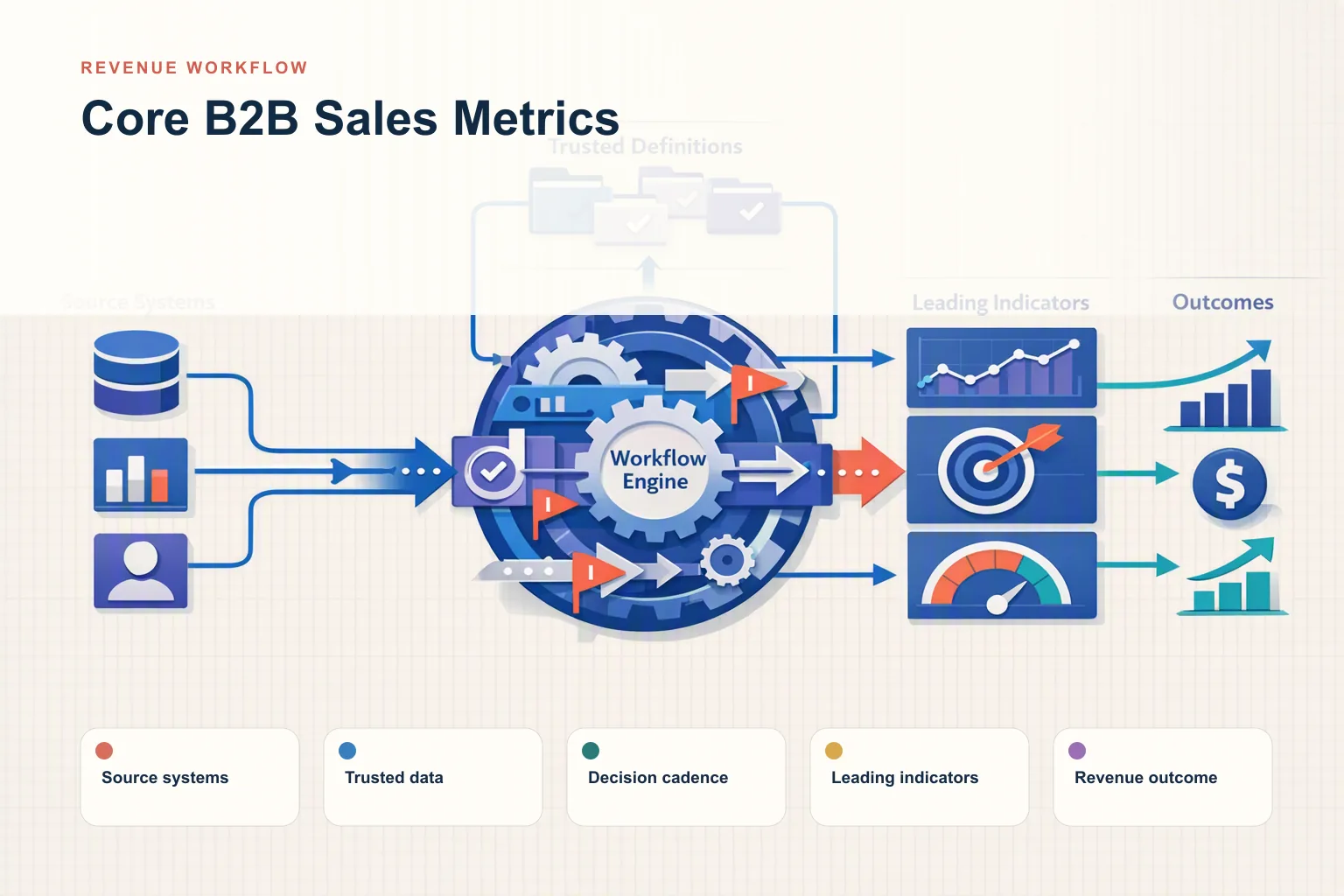
B2B sales metrics are the numbers a revenue team uses to judge whether its pipeline, deals and sellers will deliver the plan. The core set is pipeline coverage, stage conversion, win rate, average deal size, sales cycle length, sales velocity and quota attainment, read alongside leading indicators of buyer engagement and efficiency measures such as the CAC ratio.
This guide gives a formula and a review cadence for 17 metrics, what named benchmarks report and where their definitions differ, a rep-level scorecard, a way to turn metrics into goals, and how to use the numbers to find training needs. It reflects research published up to October 2026.
Last updated: 17 October 2026
What is the difference between a sales metric, a KPI and a goal?
A sales metric is any number you measure: calls made, opportunities created, days in a stage. A sales KPI is one of the few metrics leadership has agreed to run the business by, because it is tied directly to the revenue plan. Win rate, pipeline coverage and quota attainment are typical KPIs. A sales goal is a target value for a KPI with an owner and a date, for example “raise discovery-to-proposal conversion in the mid-market team from 40% to 45% by the end of Q2” (a hypothetical goal).
Two more distinctions decide how each metric should be used:
- Lagging or leading. Lagging indicators report an outcome after it has happened: bookings, win rate, quota attainment, cycle length, deal size. Leading indicators move before the outcome, while you can still change it: pipeline created, stage conversion this month, the number of buyer stakeholders engaged, mutual action plan progress, and days since the buyer last engaged.
- Company, team or rep level. The board looks at bookings, net revenue retention and sales efficiency. Sales leaders look at coverage, conversion and win rate by segment. Frontline managers look at each rep’s conversion by stage, deal hygiene and buyer engagement on live deals. The same metric usually needs a different cut at each level.
Which B2B sales metrics should you track?
The table lists 17 core B2B sales KPIs, grouped by what they measure. No one reviews all of them every week: frontline managers live in the leading indicators, while the CRO and finance own the lagging and efficiency rows. Definitions vary between companies, so write yours down before you compare against any benchmark.
Group
Metric
Formula
Type
Usual review
Pipeline
Pipeline created
Value of new qualified opportunities created in the period, by source and segment
Leading
Weekly
Pipeline
Pipeline coverage ratio
Open qualified pipeline due to close in the period ÷ quota still to be closed in the period
Leading
Weekly
Pipeline
Stage conversion rate
Opportunities that moved from stage N to N+1 ÷ opportunities that entered stage N
Leading
Monthly
Pipeline
Time in stage and slippage
Median days in each stage; close-date pushes per opportunity
Leading
Weekly
Deals
Win rate
Closed-won ÷ (closed-won + closed-lost), for opportunities that reached a qualified stage
Lagging
Monthly
Deals
Average deal size
Won annual contract value ÷ number of won deals (report the median too)
Lagging
Quarterly
Deals
Sales cycle length
Median days from opportunity creation to closed-won
Lagging
Quarterly
Deals
Sales velocity
(Qualified opportunities × average deal value × win rate) ÷ cycle length in days
Lagging
Monthly
Reps
Quota attainment
Bookings ÷ quota for each rep; report the share of reps at or above 100%
Lagging
Monthly
Reps
Ramp time
Months from start date to the first full period at an agreed share of full quota
Lagging
Quarterly
Reps
Selling time
Share of the working week spent with buyers or on work for a specific deal
Leading
Twice a year (time study or survey)
Buyer engagement
Stakeholders engaged per deal
Distinct buyer-side people who joined a meeting, replied or opened shared material
Leading
Weekly
Buyer engagement
Days since last buyer engagement
Days since any buyer-side meeting, reply or content view on the opportunity
Leading
Weekly
Buyer engagement
Mutual action plan progress
Plan milestones completed on time ÷ milestones due, split by buyer-owned and seller-owned
Leading
Weekly
Efficiency
New CAC ratio
Sales and marketing expense ÷ new-customer ARR
Lagging
Quarterly
Efficiency
Magic number
Net new ARR in the quarter ÷ prior-quarter sales and marketing expense
Lagging
Quarterly
Retention
Net revenue retention
A starting cohort’s ARR at period end, including expansion, downsell and churn ÷ that cohort’s ARR at the start
Lagging
Quarterly
Pipeline metrics: are there enough of the right deals?
Pipeline created
Pipeline created is the value of new qualified opportunities added in a period. Report it by source (inbound, outbound, partner, expansion) and by segment, and compare it with what the plan needs (the goal-setting section below shows that calculation). Because most deals close weeks or months after they are created, this month’s pipeline created is an early signal of next quarter’s bookings.
Pipeline coverage ratio
Coverage divides the open, qualified pipeline due to close in a period by the quota still to be closed in that period. Rather than borrowing a rule-of-thumb multiple, work out the coverage your own team needs from its win rate by value: required coverage = 1 ÷ win rate. A team that wins 25% of the pipeline value it closes out needs 4x coverage; a team that wins a third needs 3x. Calculate it per segment, because a blended number hides a thin enterprise pipeline behind a healthy mid-market one. The pipeline coverage ratio guide covers the metric in more detail.
Stage conversion, time in stage and slippage
Stage conversion shows where deals leak: the share of opportunities that move from each stage to the next. Time in stage, reported as a median, shows where they stall. Slippage counts how often close dates move. Slippage matters because late deals win far less often. In Ebsta’s 2024 B2B Sales Benchmarks H1 update, win rates declined 34% when deals slipped one to four weeks past their close date and fell a further 67% beyond a month. The same Ebsta update found opportunities updated weekly were 17% more likely to close won, which is an argument for making CRM hygiene part of the weekly review rather than a quarter-end clean-up.
How do you calculate win rate, deal size, sales cycle and sales velocity?
Win rate
Win rate is closed-won deals divided by all closed deals (won plus lost) in the period. State the denominator: counting only opportunities that reached a qualified stage gives a higher, more useful number than counting every opportunity ever created, and open deals should be excluded. Report win rate by count and by value, by segment and ACV band, and separately for deals with and without a named competitor.
Benchmarks only help when the definition matches. In the Revspire B2B SaaS win rate and sales cycle benchmark (about 40 B2B companies, closed deals from October 2025 to September 2026), win rate fell from 35% on $10k-$20k deals to 30% above $100k. A named competitor was recorded on 90% of deals, and those deals were won 30% of the time against 35% without one. Older third-party data uses different cuts: Ebsta and Pavilion’s 2023 B2B Sales Benchmark Report (2022 data, 3.2 million opportunities) gives peak win rates of 29% for small deals with one to three buyer relationships, 48% for medium deals with seven to nine, and 42% for enterprise deals with ten to twelve.
Average deal size
Average deal size is won annual contract value divided by the number of won deals. Report the median beside the mean, because one large deal can lift the average for a whole quarter, and keep ACV (annual value) and TCV (total contract value) separate. A falling average deal size with a steady win rate often points to discounting or to reps scoping deals too narrowly.
Sales cycle length
Measure cycle length as calendar days from opportunity creation to closed-won, and use the median by ACV band. Track lost deals separately: how long a lost deal stays open is a cost in itself. In the Revspire benchmark, the median won deal closed in 20 days under $10k ACV, 45 days at $10k-$50k and 90 days above $50k. Sellers report that buyers are slowing down: in Salesforce’s State of Sales, 7th edition (2026), a survey of 4,050 sales professionals fielded in August and September 2025, 57% said customers take longer to decide than they used to.
Sales velocity
Sales velocity combines the four metrics above into revenue per day. Salesforce’s sales velocity guide (12 March 2024) gives the formula as (opportunities × deal value × win rate) ÷ length of sales cycle. A worked example with hypothetical numbers:
- 120 qualified opportunities × $30,000 average deal × 30% win rate ÷ 60-day cycle = $18,000 of revenue per day .
- Lift win rate to 33% and velocity rises to $19,800 a day.
- Cut the cycle to 50 days instead and it rises to $21,600 a day.
The formula is useful for deciding which lever to work on, but it assumes the levers are independent, and they are not: pushing more weak opportunities into the pipeline usually lowers win rate. The gap between sellers is large. Ebsta’s 2025 GTM Benchmarks announcement (22 April 2025) says top performers close deals 11 times faster than lower performers. For the full method, see the deal velocity metrics guide.
Which rep-level performance metrics should managers review?
Quota attainment is the headline rep metric, but on its own it says little about why a rep is ahead or behind. Read it as a distribution, not an average. The Bridge Group’s AE Models, Motions & Metrics 2026 report (22 June 2026), a survey of 158 B2B companies, found 48% of reps at quota, down from 51% in 2024, with more companies in the 0-30% attainment range. Ebsta’s 2025 GTM Benchmarks (22 April 2025) reported that 78% of sellers missed quota, up from 69% the year before. The two studies use different samples and methods (a survey of 158 companies versus Ebsta’s pipeline data and CRO survey; Ebsta’s release does not say which produced the 78%), so their numbers are not directly comparable. Revenue is also concentrated: in Ebsta’s 2024 H1 update, 16% of reps contributed 83% of revenue.
Three rules keep rep-level reviews fair and useful:
- Compare like with like. Put reps side by side only within the same segment and ACV band, and use two to four quarters of closed deals so one big win or loss does not decide the picture.
- Check the data against the story. For each rep, ask what is working, what is breaking down, and whether the numbers match what the rep and manager believe. When they disagree, look at the deals before deciding who is right.
- Read activity next to progress. A rep with many calls and emails but few stage movements or engaged stakeholders is busy, not productive. Review activity only alongside buyer engagement and stage progression.
Use a scorecard like this one in monthly one-to-ones. Each row pairs a metric with the pattern to look for and a first action.
Metric
Compare against
Warning pattern
Likely cause to check
Manager’s first action
Discovery-to-next-stage conversion
Reps in the same segment
Well below peers
Weak discovery, or poor-fit opportunities entering the pipeline
Review three recent discovery calls; tighten stage entry criteria
Proposal-to-won conversion
Same segment and ACV band
Many proposals, few wins
Business case not reaching the economic buyer; competitor arriving late
Check who has seen the proposal; practise the business-case conversation
Average deal size
Segment median
Consistently below
Discounting or under-scoping
Review discount approvals; practise value framing
Cycle length
Segment median for the ACV band
Much longer than peers
Single-threaded deals; no agreed plan with the buyer
Inspect the stakeholder map; agree a mutual action plan
Stakeholders engaged per open deal
Team median
One contact on late-stage deals
Deals dependent on a single champion
Ask the champion to introduce finance, IT or the executive sponsor
Close-date pushes
Team average
Same deals pushed repeatedly
Optimistic forecasting or stalled deals
Re-qualify each pushed deal; close out the dead ones
Pipeline created vs target
The rep’s own target
Short for two months running
Too little prospecting time, or territory issues
Protect prospecting blocks; review territory and account list
Ramp progress (new hires)
Ramp plan milestones
Behind plan at month three
Product knowledge gaps or too few practice reps
Add certification role-plays and shadowed calls
Two further rep metrics frame what is realistic. The Bridge Group’s 2026 report puts average AE ramp time at 6.2 months, the highest in the study’s history, and the median AE quota at $960K, 4.6 times on-target earnings. And selling time is scarce: reps in Salesforce’s 2026 State of Sales spent 40% of their week selling and 60% on other work such as data entry and prospecting.
How to use sales metrics to identify training needs
Metrics show where a rep’s deals go wrong; they do not show why. Use them to form a hypothesis about a skill gap, then confirm it by listening to calls or scoring a role-play before you build any training. Common patterns:
- Low conversion out of discovery points to questioning and qualification skills, or to prospecting into poor-fit accounts.
- Deals that stall after the demo with one contact point to multithreading and champion-building skills.
- Late-stage losses to “no decision” point to building the business case and handling the status quo objection.
- Healthy win rate but small deals points to negotiation and value framing.
- Long ramp with good activity points to product and use-case knowledge.
Practice data can confirm the gap. In the Revspire sales skills gap benchmark (more than 2,000 scored AI role-plays across 20 B2B companies, October 2025 to September 2026), reps scored 4.4 out of 5 on product knowledge but 3.0 on closing and 3.2 on objection handling, and the status quo objection was the hardest at 2.9. The sales training needs analysis guide shows how to turn these signals into a skill-gap matrix.
What are the key sales efficiency metrics?
Sales efficiency metrics ask how much new revenue each dollar of sales and marketing spend produces. They are owned jointly by the CRO and the CFO, and they are where board conversations about headcount start.
- New CAC ratio = sales and marketing expense ÷ new-customer ARR. In Benchmarkit’s 2025 B2B SaaS Performance Metrics Benchmarks (covering 2024), the median rose 14% to $2.00 of sales and marketing expense per $1.00 of new-customer ARR, and the fourth quartile spent $2.82.
- CAC payback period = sales and marketing expense ÷ (new-customer ARR × gross subscription margin) × 12, in months, as Benchmarkit defines it in the same report. It tells finance how long a new customer takes to repay the cost of winning them.
- Magic number compares net new ARR in a quarter with the previous quarter’s sales and marketing expense. Benchmarkit’s 2025 report describes 0.75 as the traditional low-water mark for adding sales and marketing investment and above 1.0 as ideal. If you measure the change in quarterly revenue rather than ARR, annualise it first so the result is comparable.
- Net and gross revenue retention. Benchmarkit reported net revenue retention of 101% and gross revenue retention of 88%. Retention belongs on a sales dashboard because deals sold to poor-fit customers show up here a year later.
A worked example with hypothetical numbers: a team spends $3 million on sales and marketing in a quarter and adds $1.5 million of new-customer ARR at an 80% gross margin. Its new CAC ratio is $2.00, and its CAC payback is $3.0m ÷ ($1.5m × 0.8) × 12 = 30 months.
Mistakes that make efficiency metrics misleading
- Mismatched time windows. Spend in a quarter produces bookings one or two quarters later. Comparing same-quarter spend and bookings flatters teams in a ramp-down and punishes teams that are hiring.
- Mixing new and expansion revenue. Expansion is usually cheaper to win: Benchmarkit’s 2025 median was $1.00 of spend per $1.00 of expansion ARR, half the new-customer figure. Track the new CAC ratio separately from any blended figure.
- Inconsistent cost scope. Decide once whether SDRs, sales engineers, enablement, tools and partner fees sit inside “sales and marketing expense”, and keep the scope stable between quarters.
- One company-wide number. Enterprise and mid-market motions have different economics. A blended ratio can hide one segment that loses money on every deal.
- Treating busy as efficient. Activity per rep is not efficiency. Flag deals with plenty of activity but no stage movement or new stakeholders and review them as a group.
Which RevOps KPIs should you track beyond sales metrics?
RevOps KPIs measure whether the revenue system works, not how individual sellers perform: how accurate the forecast is, whether next quarter’s pipeline is being built in time, whether leads and customers move between teams on schedule, whether CRM data can be trusted, and what growth costs and keeps. Sales metrics show how the team is selling; RevOps KPIs show whether the plan, data and handoffs underneath hold up.
RevOps KPI
Formula
What it tells you
Warning sign
Forecast accuracy
1 − (|actual bookings − forecast| ÷ actual bookings), using the forecast called at the same point in every quarter
Whether leadership can plan on the number
Accuracy measured in a different week each quarter, which makes the trend meaningless
Forecast bias
(Forecast − actual) ÷ actual, keeping the sign, tracked over four quarters
Whether misses lean one way
Always positive (over-calling) or always negative (sandbagging)
Forward pipeline coverage
Qualified pipeline due to close next quarter ÷ next quarter’s quota, measured at the start of the current quarter
Whether next quarter is being built in time
Coverage that appears only in the last weeks before the quarter starts
Lead SLA compliance
Leads accepted or rejected within the agreed time ÷ leads routed to sales
Whether the marketing-to-sales handoff works
Leads left with no decision; rejection reasons never reviewed
Handoff conversion
Accepted leads that become opportunities; closed-won deals whose onboarding kickoff is held on time
Where revenue leaks between teams rather than inside one
A conversion step no team is measured on
CRM data completeness
Open opportunities with amount, a future close date, next step and buyer contact roles filled ÷ open opportunities
Whether reports and forecasts can be trusted
Open deals with close dates in the past
CAC payback and net revenue retention
CAC payback as defined in the efficiency section above; net revenue retention = (starting ARR + expansion − contraction − churn) ÷ starting ARR, for the same customers over 12 months
What growth costs and how much revenue is kept and expanded
A different cost scope or cohort each quarter
Quote turnaround
Median hours from quote request to approved quote
Whether approvals slow late-stage deals
Approvals that wait on one person
GTM tool adoption
Weekly active users of each revenue tool ÷ licensed users
Whether the stack you pay for is used
Tools whose data nobody reviews
RevOps owns the definitions and the reporting for each KPI; the functions own the results.
Forecast accuracy and data quality lead the list because they are often weak. In a Gartner release of 12 February 2020 on its State of Sales Operations survey, only 45% of sales leaders and sellers had high confidence in their organization’s forecasting accuracy, and only 47% believed their organization had high-quality data. A more recent survey points the same way: in Openprise’s 2025 State of RevOps survey (29 January 2025, more than 600 respondents), only 11% rated their data as excellent and 42% called it “good enough”. Openprise sells data-management software, so read that as a vendor survey.
Worked example (hypothetical numbers): the forecast called in week three of a quarter was $4.0 million and the team booked $3.6 million. Forecast accuracy is 1 − ($0.4m ÷ $3.6m) = 89%, and bias is +11%. If bias has been positive for four quarters running, look at how deals enter the commit category, not at the forecast spreadsheet. Our CRM data quality guide covers the fields that most often break forecasts, and the RevOps team structure guide covers who should own each KPI.
Which leading indicators predict B2B deal outcomes?
Lagging metrics arrive too late to save the quarter. Buyer-engagement indicators move weeks earlier, and modern buying groups make them necessary: Forrester’s 2026 Buyer Insights release (21 January 2026) says a typical buying decision includes 13 internal stakeholders and nine external influencers, and Ebsta’s 2024 H1 update reports the number of stakeholders involved grew from five to eight. Track these four indicators on every open deal:
- Stakeholders engaged. Count distinct buyer-side people, not views. In the Revspire digital sales room benchmark (about 40 B2B companies, October 2025 to September 2026), deal rooms engaged 15 unique buyer stakeholders against one to five on deals without a room, and closed deals with an active room were won 35% of the time against 28%.
- Days since last buyer engagement. In the same benchmark, after 20 days with no buyer view the win rate fell below half the overall rate. Set an alert at a threshold your own data supports.
- Mutual action plan progress. In the Revspire mutual action plan benchmark, deals with a plan were won 35% of the time against 28% without one, and closed in a median of 42 days against 60 at $10k-$50k. Buyers owned only 20% of plan milestones, so track buyer-owned milestones completed on time as a separate number.
- Senior and finance involvement by mid-stage. Record when the economic buyer and finance first engage. Ebsta’s 2024 H1 update reports win rates 42% lower when the C-suite is engaged late.
These are observed patterns, not proof that a tool or practice caused a result: well-run deals tend to have more stakeholders and a plan for the same reasons they tend to be won. Use them as early warnings to inspect a deal, not as targets to game. Digital sales room tools, Revspire’s included, log buyer views by stakeholder, which makes the first three indicators measurable without asking reps to type them in.
How do you turn sales metrics into sales goals?
Goals should come from the plan, through the metrics, down to each team and rep. A worked example with hypothetical numbers:
- New-customer ARR target for the year: $6 million.
- Average won deal: $40,000, so the team needs 150 won deals.
- Win rate of 30% on qualified opportunities, so it needs 500 qualified opportunities, or $20 million of qualified pipeline at the same average size.
- With a 60-day median cycle, pipeline for each quarter has to be created mostly in the quarter before it.
Then shape the goals so they drive the right behaviour:
- Set monthly goals from seasonality, not the annual target divided by 12. If the last two years’ bookings landed 20% in Q1, 25% in Q2, 22% in Q3 and 33% in Q4 (hypothetical figures), the Q4 target is $1.98 million, not $1.5 million, and Q3 needs to be a pipeline-creation quarter.
- Add team goals beside individual quota. Shared goals such as the share of late-stage deals with three or more engaged stakeholders, or mutual action plans agreed before the proposal, reward the habits that protect the whole forecast.
- Use milestone goals for long cycles. In a 90-day cycle a rep can go weeks without a closed deal. Interim milestones (first meeting held, plan agreed with the buyer, proposal reviewed by the economic buyer) show progress while there is still time to act.
- Prioritise deals that will retain. Tie part of variable pay to customer outcomes such as go-live or first-year renewal, not only to contract value, so reps are not paid to close customers who churn.
- Make the stretch goal about time. For top performers, a stretch goal to shorten their median cycle can raise velocity without pushing more weak deals into the pipeline.
- Avoid pure activity goals. A target of 100 calls a day measures effort, not progress. If you set activity goals, pair them with a conversion goal.
How should revenue leaders review sales metrics?
A metric nobody reviews on a set day does not change behaviour. This cadence keeps each metric with the people who can act on it.
Cadence
Who
Metrics
Decision it supports
Weekly
Frontline manager and each rep
Stakeholders engaged, days since buyer engagement, plan progress, close-date pushes, stage movement
Which deals need help this week, and what kind
Weekly
Sales leader and RevOps
Pipeline created, coverage by segment, forecast changes
Where to shift prospecting effort or resources
Monthly
Sales leadership and enablement
Stage conversion, time in stage, rep scorecards, ramp progress
Coaching priorities and training needs
Quarterly
CRO, finance and the executive team
Win rate, deal size, cycle length, velocity, attainment distribution, CAC ratio, magic number, retention
Hiring, territory, pricing and investment decisions
Before the first review, put the basics in place:
- Write a one-page metric dictionary: name, formula, CRM source field, owner and review cadence for each metric.
- Define when an opportunity is created and what qualifies it, and add entry criteria to each stage so conversion rates mean the same thing for every rep.
- Track close-date changes and stage history, not just current values.
- Make the competitor, the loss reason and the deal’s ACV band required fields at close.
- Audit the last six months of closed deals by rep, segment, deal size and stage, and compare what the data shows with the story the team tells about why it wins and loses.
- Choose three to five leading indicators for the weekly review and leave the rest to the monthly and quarterly ones.
What belongs on a sales dashboard?
A sales dashboard should hold only the metrics its audience reviews on a set day and can act on. A rep needs their own deals and next steps, a frontline manager needs to see where each rep’s pipeline is stuck, and a CRO needs to know whether this quarter’s plan, the forecast and next quarter’s pipeline will hold. Build one dashboard per audience from the same definitions, not one dashboard for everyone.
Audience
Question it answers
Put on it
Leave off
Rep
Which of my deals need action this week?
Open deals with stage age against the segment median, days since last buyer engagement, next step and its date, mutual action plan items due, pipeline created against target, attainment to date
Company-level efficiency metrics; leaderboards beyond attainment
Frontline manager
Which reps and deals need coaching?
Coverage and pipeline created by rep, stage conversion by rep, deals with one engaged buyer contact, close-date pushes, deals with no next step, CRM data completeness, ramp progress for new hires
Activity counts shown without stage movement
CRO
Will we hit the plan this quarter and next?
Bookings against plan, forecast against commit with forecast accuracy history, forward coverage by segment, win rate and cycle length by segment and ACV band, net revenue retention, CAC payback
Individual deal detail (link to it instead); metrics nobody owns
Sales dashboard design mistakes to avoid
- Every metric on one screen. When everything is shown, nothing has priority. Keep the top row to the three to five KPIs the audience reviews each week and move diagnostic charts to a second page.
- Lagging numbers only. Bookings and win rate arrive after the quarter is decided. Put each lagging KPI next to the leading indicator that predicts it, such as pipeline created next to bookings.
- Averages without distributions. Average quota attainment can look healthy while half the team is far behind. Show reps by attainment band, and medians for deal size and cycle length.
- Blended segments. One company-wide win rate or cycle length mixes motions with different economics. Filter by segment and ACV band by default.
- No target or baseline. A number with nothing beside it cannot trigger a decision. Show the target, last quarter or the segment median next to each metric.
- Numbers you cannot open. If a manager cannot click through to the deals behind a count such as “deals with no next step”, the dashboard reports a problem without helping anyone fix it.
- Silent definition changes. Link each metric to its entry in the metric dictionary, and annotate the chart when a definition changes so a step change is not read as a trend.
- Data nobody trusts. Stale close dates and empty fields make every chart suspect. Put CRM data completeness on the manager dashboard, so hygiene is reviewed where the data is created.
Frequently asked questions
What are the most important B2B sales metrics?
For most B2B teams the core set is pipeline coverage, stage conversion, win rate, average deal size, sales cycle length and quota attainment, which together explain whether the plan will be hit. Sales velocity combines four of them into one number. Add two or three buyer-engagement leading indicators, such as stakeholders engaged per deal, and the new CAC ratio for efficiency.
What is a good win rate in B2B sales?
It depends on deal size and on how you count. In the Revspire B2B SaaS benchmark (about 40 companies, October 2025 to September 2026), win rates ran from 35% on $10k-$20k deals to 30% above $100k, counting closed-won divided by all closed deals. Benchmarks that count only forecast deals, or every opportunity created, will give different numbers, so match the definition before you compare.
What is the difference between leading and lagging sales indicators?
Lagging indicators such as win rate, bookings and quota attainment report outcomes after they have happened. Leading indicators such as pipeline created, stakeholders engaged and mutual action plan progress move earlier, while a deal or a quarter can still be changed. A useful dashboard pairs each lagging KPI with one or two leading indicators that predict it.
How many sales KPIs should a team track?
Keep the weekly review to three to five leading indicators and the leadership dashboard to about ten KPIs. The rest of the metrics in this guide are diagnostic: you look at them when a KPI moves, to find out why. More KPIs than people can discuss in one meeting usually means none of them gets managed.
How do you measure sales efficiency?
The most common measures are the new CAC ratio (sales and marketing expense divided by new-customer ARR), CAC payback in months, and the magic number (net new ARR divided by the previous quarter’s sales and marketing expense). Benchmarkit’s 2025 report puts the median new CAC ratio at $2.00 per $1.00 of new-customer ARR. Calculate them by segment and with a lag between spend and bookings.
Want to see how your win rate and cycle length compare by deal size? Read the Revspire B2B SaaS win rate and sales cycle benchmark, with its method and sample.
What are the most important RevOps KPIs?
Start with forecast accuracy and bias, forward pipeline coverage, lead SLA compliance, CRM data completeness, CAC payback and net revenue retention. Together they show whether the forecast can be trusted, whether next quarter is being built, whether handoffs work and what growth costs. In a 2020 Gartner release, only 45% of sales leaders and sellers had high confidence in their forecasting accuracy, which is why accuracy is usually the first KPI to fix.
What should be on a sales manager’s dashboard?
A manager’s dashboard should show where each rep’s pipeline is stuck: coverage and pipeline created by rep, stage conversion by rep, deals with only one engaged buyer contact, close-date pushes, deals with no next step and CRM data completeness. Each number should open the list of deals behind it, so the dashboard leads straight into coaching conversations.
Sources
- AE Models, Motions & Metrics: 2026 Research Report, The Bridge Group (Matt Bertuzzi), 22 June 2026. Accessed 16 October 2026.
- 2025 B2B SaaS Performance Metrics Benchmarks, Benchmarkit (PDF hosted by HiBob), 2025, covering 2024 data. Accessed 16 October 2026.
- Ebsta unveils 2025 GTM Benchmarks Report, Ebsta (Amy Cook), 22 April 2025. Accessed 16 October 2026.
- 2024 B2B Sales Benchmarks: H1 Update, Ebsta, July 2024. Accessed 16 October 2026.
- 2023 B2B Sales Benchmark Report, Ebsta and Pavilion, February 2023 (2022 data). Accessed 16 October 2026.
- Forrester’s 2026 Buyer Insights: GenAI Is Upending B2B Buying As Leaders Face Mounting Pressure To Justify Every Dollar Spent, Forrester, 21 January 2026. Accessed 16 October 2026.
- State of Sales, 7th Edition, Salesforce, 2026 (survey fielded August-September 2025). Accessed 16 October 2026.
- How to Supercharge Your Sales Velocity for Quicker Wins, Salesforce (Erin Hueffner), 12 March 2024. Accessed 16 October 2026.
- Gartner Says Less Than 50% of Sales Leaders and Sellers Have High Confidence in Forecasting Accuracy, Gartner, 12 February 2020 (accessed 17 October 2026)
- 2025 State of RevOps Survey: Data quality’s impact on GTM execution, Openprise, 29 January 2025 (accessed 17 October 2026)