Revspire blog
Buyer Engagement in Deal Rooms: 7 Practical Strategies for 2026
A practical guide to buyer engagement in deal rooms, including ownership, leading indicators, live-deal coaching, stakeholder coverage, and win-loss reviews.
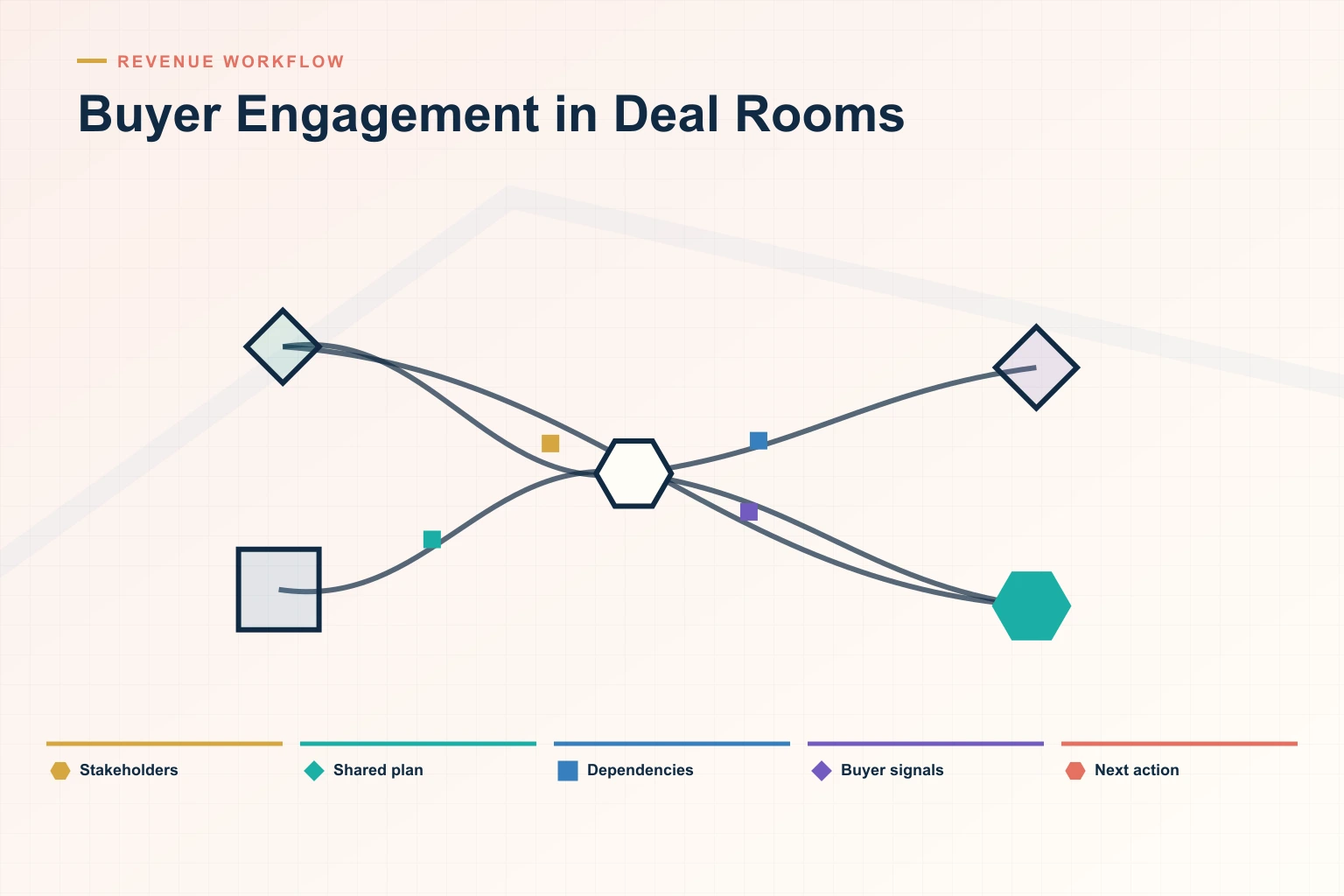
This guide presents seven practical strategies for making buyer engagement a documented, measurable part of the revenue workflow.
Start with a baseline
Before you can improve Buyer Engagement in Deal Rooms, you need an honest baseline.
Review recent opportunities by representative, segment, deal size, and stage. Compare the available data with the team’s explanations, then identify a small number of breakdowns to address first.
Start with an honest audit. Deploy the selected improvements with a clear owner, a measurable goal, and a 90-day review cadence.
Three-part explainer: Audit the current state, build the operating model, and measure and improve.
Seven buyer engagement strategies
1. Define the operating model
An operating model for Buyer Engagement in Deal Rooms answers three questions: what actions should happen, at what stage, and who is accountable.
Document the expected milestones, buyer signals, seller actions, and responsibilities for each stage. Keep the model simple enough to use during active opportunities.
2. Assign ongoing ownership
Someone on the leadership team is accountable for the outcomes, not just the activities.
The owner can maintain the playbook, define the review cadence, coordinate manager reinforcement, and record changes made in response to results.
3. Select leading and lagging indicators
For Buyer Engagement in Deal Rooms, leading indicators might include stakeholder engagement rates, content consumption, mutual action plan progression, or deal velocity at each stage.
Review those signals alongside lagging indicators such as win rate, sales-cycle length, and average deal size.
4. Review engagement each week
Build a dashboard that shows both. Review it weekly.
Use the review to identify missing stakeholders, stalled actions, unclear ownership, or differences between representative confidence and observable engagement. Measure outcomes, not activities.
Three-part explainer: Set the standard, embed the practice, and scale what works.
5. Coach active opportunities and broaden stakeholder coverage
Review live opportunities with representatives, identify the specific engagement breakdown, and agree on the next action. Map every stakeholder in the buying committee, assign coverage, and track engagement with each one.
6. Align technology with the process
The technology layer for Buyer Engagement in Deal Rooms should reduce friction, not add it.
Evaluate tools according to whether they support the documented workflow and reduce conflicting records or manual updates. For product information, visit Revspire Deal Rooms.
Three-part explainer: Define the system, operationalize the workflow, and measure the impact.
7. Build a win-loss feedback loop
Every won and lost deal contains insights about what works and what does not in your approach to Buyer Engagement in Deal Rooms.
Capture findings through structured reviews, post-deal interviews, and CRM analysis. Use the findings to update playbooks, training, metrics, and future reviews.
Common mistakes to check
- Temporary ownership: Assign an ongoing owner and a recurring review cadence.
- Intuition without review: Compare team judgment with a defined set of indicators.
- Single-threaded relationships: Map the buying committee and assign stakeholder coverage.
- Activity without progress: Examine stage movement, engagement quality, and stakeholder coverage.
- Unrecorded losses: Document recurring breakdowns and update the playbook.
Three-part explainer: Recognize the leak, correct the behavior, and prevent repeat failure.
Put the framework into practice
Choose two or three priorities, assign an owner and measurable goal to each one, and review the results after 90 days before expanding the rollout.