Revspire blog
The Complete 2026 Guide to CPQ and Revenue Operations for Revenue Leaders
A practical 2026 guide for revenue leaders to build, measure, and continuously improve a CPQ and Revenue Operations operating system.
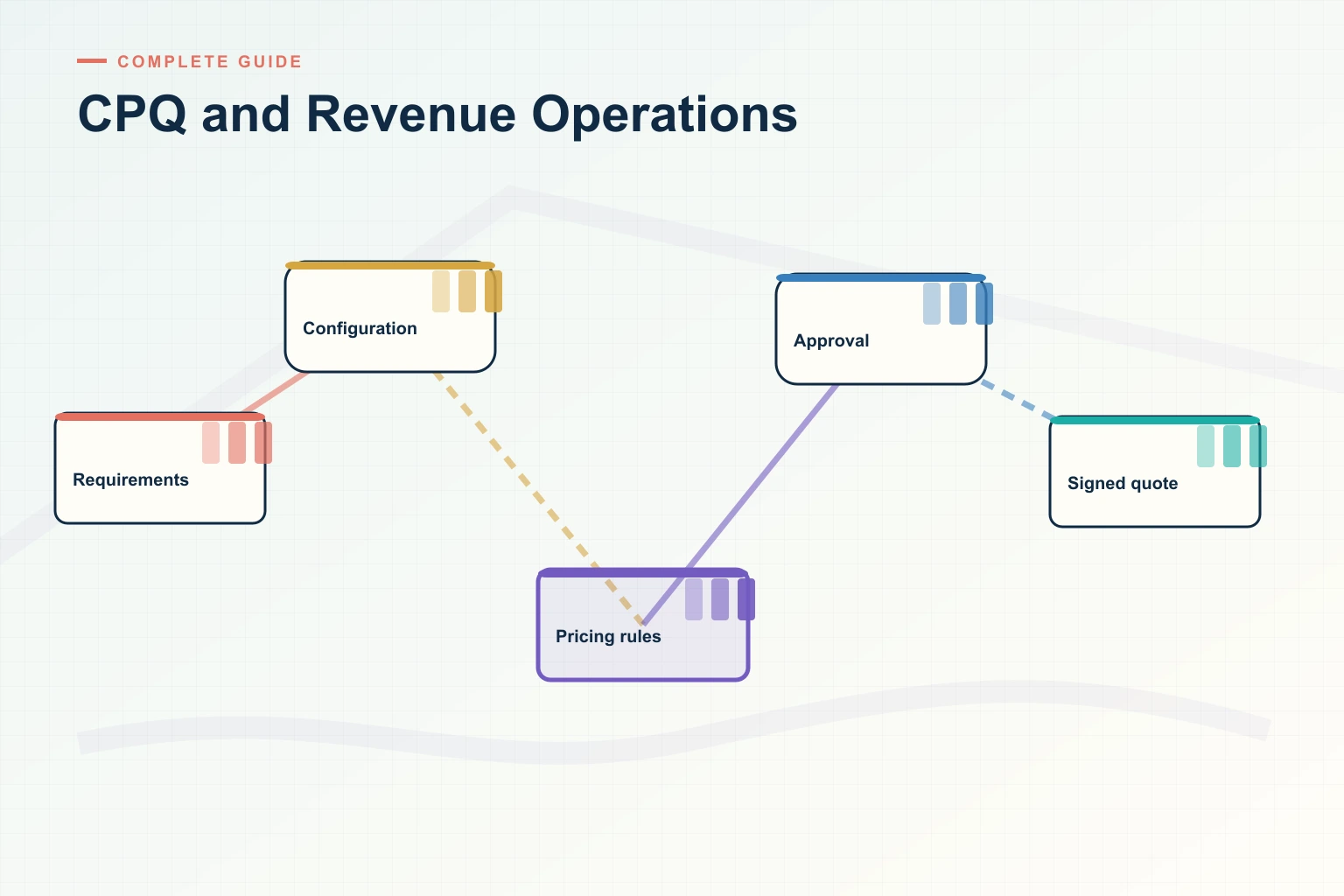
This guide organizes the essential parts of a CPQ and Revenue Operations system into a practical framework for revenue leaders.
Establish ownership and an operating model
Assign a permanent owner to CPQ and Revenue Operations outcomes. Build it into your operating cadence with standing review meetings, defined metrics, and quarterly improvement goals.
An operating model for CPQ and Revenue Operations answers three questions: what actions should happen, at what stage, and who is accountable. Document the model so the team can apply it consistently.
Connect the process, technology, and data
The process that governs CPQ revenue operations RevOps must be documented, taught, and enforced. Reinforce it through embedded workflows, manager guidance, coaching, and regular deal reviews.
Technology should serve the CPQ revenue operations RevOps process, not define it. Evaluate whether each tool makes the process easier and more consistent or adds friction.
For product context, see Revspire CPQ.
Three-part explainer: Define the system, Operationalize the workflow, and Measure the impact.
Use leading and lagging indicators
Leading indicators can include stakeholder engagement, content consumption, mutual action plan progression, and deal velocity at each stage. They give managers evidence to review before final outcomes are known.
Lagging indicators — win rates, cycle times, average deal sizes — confirm whether your approach is working.
Build a dashboard that shows both. Review it weekly. Tie it directly to coaching conversations and territory reviews.
Make improvement part of the weekly workflow
Build a standing review of CPQ and Revenue Operations into the weekly pipeline cadence. Use it as a structured conversation about what needs to change rather than as a status update.
Review live opportunities with each rep, identify where execution breaks down, and work through the correction in context.
Use the audit to select two or three specific improvements. Give each improvement a clear owner, a measurable goal, and a defined review cadence.
Three-part explainer: Set the standard, Embed the practice, and Scale what works.
Address recurring execution mistakes
Relying on intuition instead of evidence
Define three to five leading indicators for CPQ and Revenue Operations and track them weekly. When the data disagrees with the intuition, investigate the discrepancy.
Depending on one stakeholder
Map every stakeholder in the buying committee, assign coverage, and track engagement with each one.
Confusing activity with progress
Measure outcomes, not activities. Track stage progression velocity, buyer engagement quality, and stakeholder coverage breadth. Use these outcome metrics as the primary lens for coaching conversations and pipeline reviews.
Build a continuous feedback loop
Capture lessons through post-deal interviews, CRM data analysis, and structured win-loss reviews. Feed those lessons back into playbooks, training, and strategy.
Review CPQ and Revenue Operations metrics against targets and update the operating model when the evidence supports a change.
Ready to discuss your CPQ and Revenue Operations system? Talk to Revspire.