Customer Expansion Strategy: How B2B Teams Grow Existing Accounts
A practical perspective for connecting this idea to your revenue team’s next move.
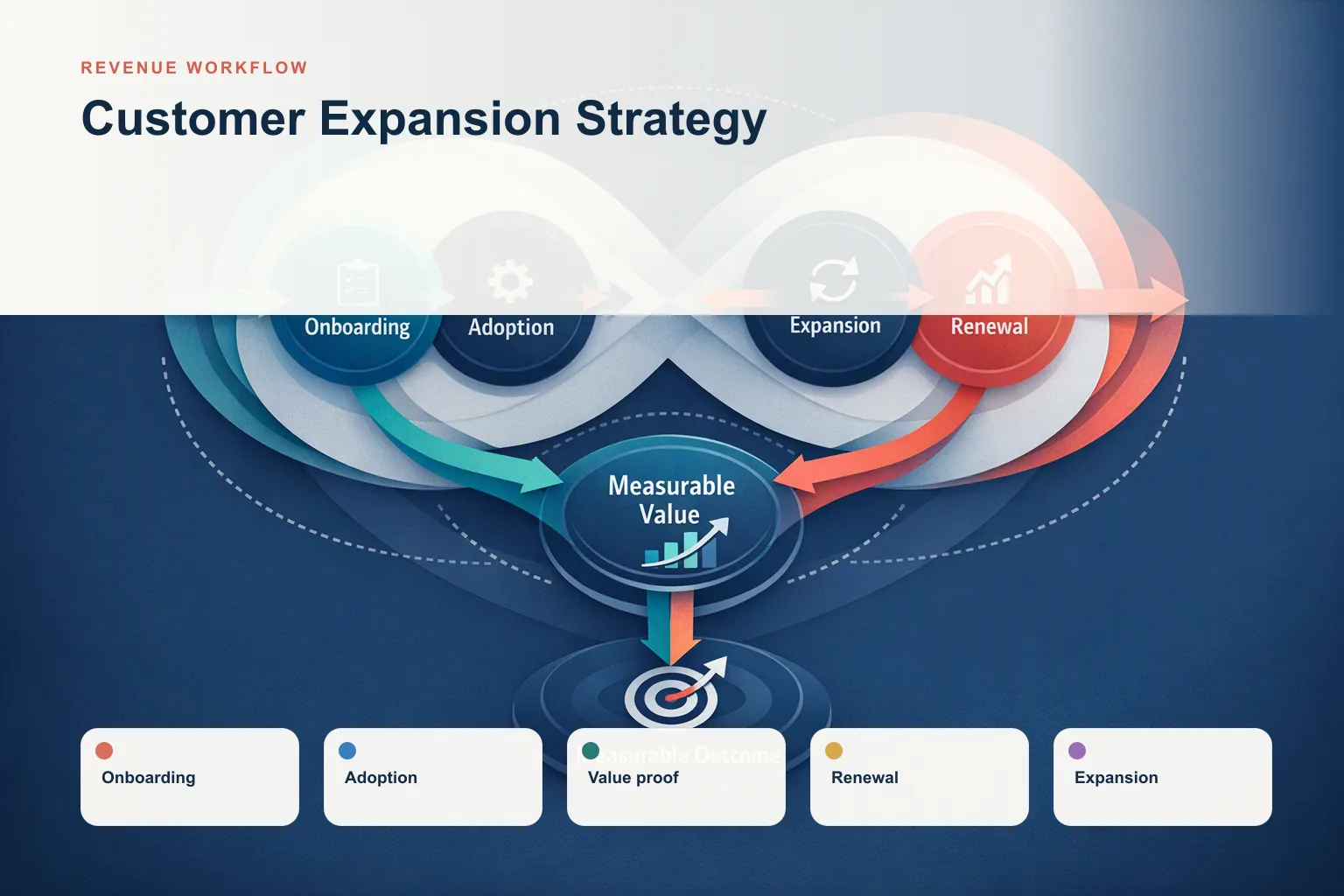
A customer expansion strategy is a B2B company’s plan for growing revenue from the customers it already has: upsells to higher tiers, cross-sells of other products, more seats or usage, and new business units. It decides which accounts to grow, which signals start the conversation, who owns it, and how you measure it, usually through net revenue retention.
Below: the land-and-expand model, upsell vs cross-sell, expansion signals, a QBR agenda, who should own the number and the metrics to track. The third-party research cited was published between 2018 and 2025 and checked in October 2026; every figure links to its source.
Last updated: 16 October 2026
What is a customer expansion strategy?
Expansion revenue is any increase in recurring revenue from an existing customer. A renewal keeps the revenue you have; a new-logo sale adds a customer. A customer expansion strategy (also called an account expansion strategy) makes expansion something the team plans rather than waits for, starting with where there is room to grow: teams, regions or use cases that do not use you yet.
Motion
What the customer buys
Typical trigger
Usually led by
Watch out for
Upsell
A higher tier or edition of the same product
Hitting plan limits, asking for advanced features
Account manager or AE
Selling a tier the customer will not use
Cross-sell
A different product for an adjacent need
A related problem found during adoption
Account manager or AE
A new budget owner who has not seen your results
Add-on
A module that only works with the base product
A request for a capability you sell separately
Account manager or CSM
Implementation work nobody planned for
Seat or usage growth
More users, volume or consumption
New hires, usage near the cap
CSM, often low-touch
Growth that outruns adoption, so value per seat falls
New business unit (land and expand)
The same product for another team, region or division
A referral from a successful team, a reorganisation
AE with the original sponsor
A new buying group that has never seen your proof
The five common expansion motions. Each needs its own entry criteria and reporting.
Why does expansion revenue matter more than it used to?
Expansion now carries a larger share of growth. In the Benchmarkit 2025 SaaS Performance Metrics report, summarised by Ray Rike on the Maxio blog in July 2025, existing customers supplied 40% of total new ARR in 2024, up from a median of 25% in 2022. The same report put median net revenue retention at 101% in 2024, down from 105% in 2021. Together they suggest many companies expand some accounts while losing revenue in others, so expansion and retention must be planned together.
Higher retention also goes with higher valuations. McKinsey’s November 2025 analysis of more than 100 B2B SaaS companies (Q1 2019 to Q4 2024) found that companies in the top quartile for valuation had net revenue retention of 113%, against 98% in the bottom quartile, and a median enterprise-value-to-revenue multiple of 24x against 5x. Gartner makes the same point from the customer side: a July 2024 Gartner research summary states that existing customers contribute 65% of total organisational revenue through retention and growth.
Expansion has also tended to cost less than winning a new logo. The 2018 KBCM private SaaS company survey, as summarised by Sage in November 2018, put the median cost of acquiring $1 of new ARR at $1.32 from new customers and $0.71 from upsells to existing ones. The data is old, so treat it as direction, not as a target.
How does the land-and-expand model work?
Land and expand means winning one valuable use case, proving adoption and value, then growing from that proof into more seats, products or business units. The first contract is deliberately smaller than the account’s potential, so it signs faster; it only pays off if the expansion path is designed before that deal closes.
1. Land a use case you can prove
- A measurable outcome inside two quarters, which the first team can show with its own numbers.
- A sponsor whose influence reaches past the first team. A director whose peers run similar teams beats an isolated power user.
- A contract that shows the path. McKinsey’s November 2025 research recommends predefined upsell paths, such as capacity increases and add-ons, and bundles that encourage customers to consolidate with one vendor. Agree in the first order form how extra teams, tiers or modules will be priced.
2. Prove value in the customer’s terms
The same McKinsey study links stronger net revenue retention to agreeing onboarding and adoption goals at the outset and tracking time to value. Write two or three success criteria into the kickoff, agree how the customer will measure them, and review them every quarter. Proof the customer measured beats any usage report you produce.
3. Expand from proof, not from a price list
Every new team is a new buying group with its own priorities, approvers and objections. Map it before you propose anything; a stakeholder map template lists who decides, who influences and who might block. Ask the original champion to introduce you and share their results, not to sell for you.
Worked example (hypothetical)
A procurement software vendor lands with the accounts-payable team at one plant of a manufacturer, with two success criteria the customer’s finance team measures: invoice cycle time and automatic match rate. At the second QBR the AP lead shows the results to the CFO, who asks whether the second plant could use it. The AE runs discovery with that plant’s controller and IT lead, whose concerns differ (ERP integration, local tax rules), and agrees a mutual plan covering security review and a pilot.
Upselling vs cross-selling: what is the difference, and when should you use each?
Salesforce’s guide to cross-selling (Niraj Kapur, August 2024) defines cross-selling as offering complementary products or services to an existing customer and upselling as selling a more expensive version of a product than the buyer first had in mind. It also warns against cross-selling when a customer is unhappy or straight after the first deal.
- Upsell when the product works and the customer needs more of it: capacity, access, service level or advanced features. Tie the bigger commitment to an outcome they want.
- Cross-sell when discovery shows an adjacent problem another product solves, such as a workflow or integration gap raised after adoption.
- Do neither when adoption is weak, a service issue is open or the offer matches no stated need. Fix that first.
Entry criteria before you open an expansion opportunity
Record these before an expansion opportunity goes into the CRM. If two or more are missing, it is a lead, not an opportunity.
- The current product is delivering value, and the customer agrees with the evidence.
- The need is confirmed in the customer’s own words.
- The motion is labelled: upsell, cross-sell, add-on, seats or usage, or new business unit.
- The person who will make the decision is named, not only the user who asked.
- There is a reason for the timing: a budget cycle, a new initiative or a renewal date.
- There are no open escalations or unresolved severity-one issues on the account.
What goes in an upsell or cross-sell play
Write each motion down as a short play: trigger signal, target persona, discovery questions, proof assets, pricing guardrails, answers to common objections (“we are not using what we already have”) and exit criteria. Revspire’s AI Playbook Engine can draft plays like these from approved messaging and route them for approval. Report each motion separately before rolling them up, so healthy seat growth does not hide a cross-sell motion that rarely closes.
What are the signals that a customer is ready to expand?
An expansion signal is evidence that an account may have a new or larger need. Treat it as a reason to start a discovery conversation, not as permission to send a quote.
Signal
Where you see it
What to do first
Usage close to plan limits (seats, volume, storage)
Product analytics, billing
Ask whether the growth is planned; compare the next tier with overage costs
A new team asks for access, or logins spread beyond the original team
Admin requests, SSO and usage logs
Find out who sponsors the new team and map their stakeholders
Questions about a capability you sell separately
Support tickets, CSM calls
Scope the problem before mentioning the module
The executive sponsor asks for results or a business case
QBR, email
Build the value summary with them and ask what is next on their agenda
A new initiative, funding round, acquisition or reorganisation
News, earnings calls, LinkedIn
Ask how priorities have changed and who now owns the decision
Your champion is promoted, or moves to another company
LinkedIn, CRM contact updates
Promotion: discuss the wider remit. Move: confirm a new sponsor at the old account and open the new one
A renewal is two or three quarters away and the account is healthy
CRM, health score
Raise expanded scope or a longer term well before the renewal date
Common expansion signals and the first step for each. A signal on its own is not a qualified opportunity.
Signals that mean fix first
Hold off when active usage is falling, the champion has left with no successor, escalations are open, invoices are overdue or onboarding milestones were missed. Asking these customers to spend more damages trust and can put the renewal at risk. Put them on a recovery plan with an owner and a date first.
How do you run a QBR that leads to expansion?
A quarterly business review (QBR) is the customer’s review of whether they are getting what they paid for. Run that way, it is where results, changed priorities and new needs surface. McKinsey’s November 2025 research recommends regular check-ins and quarterly reviews, especially around renewals and expansion, as part of the value-realisation practices it associates with higher net revenue retention. The fastest way to ruin a QBR is to turn it into a pitch.
A 60-minute expansion QBR agenda
- Goals agreed at kickoff (5 minutes). Restate them in the customer’s words.
- Results against those goals (15 minutes). Ideally presented by the customer’s owner, using their numbers.
- Adoption by team (10 minutes). Who uses the product, who does not, and why.
- What has changed in their business (10 minutes). New priorities, initiatives, budget or organisation changes.
- Gaps and risks (10 minutes). Include anything your side got wrong.
- Next quarter (10 minutes). Goals, owners and dates. If a new need came up, book a separate discovery session instead of discussing price in the room.
Before the meeting, invite the customer’s executive sponsor, pull usage by team and open tickets, pre-brief your champion, and decide which expansion question, if any, you will ask.
Treat a large expansion as a new deal
A June 2024 Gartner research summary on expanding customer spend at renewal reports that 27% of surveyed customers expanded their tech contracts at high values (at least 1.5 times the original contract value), another 27% made low-value expansions (below 1.1 times), and customers who expanded significantly took on average 1.5 to 2.5 more months between considering and finalising the expansion. Large expansions need the same discipline as new business: a mapped buying group, a business case and a mutual action plan with dates both sides own.
Revspire’s mutual action plan benchmark (aggregated customer data, October 2025 to September 2026, all deal types rather than expansion alone) observed a 35% win rate for deals with a plan against 28% without, with buyers owning 20% of plan milestones. That is an observed pattern, not proof the plan caused the result; but a plan in which the customer owns nothing is just your to-do list.
Who should own expansion: customer success, account management or sales?
Companies split it differently, and the split is shifting. ChurnZero’s 2024 Customer Success Leadership Study (more than 1,000 CS leaders, published October 2024) found that about 40% of customer success teams have owned expansion over the past five years. Since 2022, account management ownership of expansion rose from 20% to 29% while sales ownership fell from 33% to 24%. Only 44% of CS teams were paid on expansion in 2024, down from 57% in 2023. Fewer than 35% of respondents in the highest net revenue retention band said CS owns expansion, against 56% in the lowest band. That is a correlation, not proof, but it suggests many high-retention companies keep CSMs on adoption and give the commercial conversation to someone else.
Whichever model you choose, give every step one owner and a standard of evidence:
Step
Typical owner
Evidence to move on
Capture adoption and health signals
CSM
Signal logged on the account, with its source
Validate the need
CSM with the account manager
Need confirmed in the customer’s words; decision owner named
Scope and propose
Account manager or AE
Discovery notes, stakeholder map, mutual action plan
Price and approve
Account manager with the deal desk
Price within guardrails; approvals recorded
Close and hand back
Account manager to CSM
Signed order and success criteria for the new scope
Report
RevOps
Expansion pipeline, win rate and net revenue retention by segment and motion
A responsibility map for expansion. Titles vary; what matters is that each step has one owner.
If CSMs are expected to open commercial conversations, train them for it. In ChurnZero’s September 2025 CSM careers research, 42% of CSMs named sales and negotiation as a skills gap, the largest gap cited. Have them rehearse common objections, such as “no budget until next year”, and the move from a value review to a discovery question. AI role-play and coaching lets account teams practise these scenarios with scored feedback before the real QBR.
Which metrics show your expansion strategy is working?
Net revenue retention (NRR) is the headline measure. McKinsey (November 2025) defines it as the revenue retained and expanded from existing customers: cross-sell plus upsell, minus churn. For a customer cohort over twelve months:
- NRR = (starting ARR + expansion − contraction − churn) ÷ starting ARR
- Gross revenue retention (GRR) = (starting ARR − contraction − churn) ÷ starting ARR. It leaves expansion out, so it shows whether growth is masking losses.
Worked example (hypothetical): a cohort starts the year at $10.0M ARR. It adds $1.5M of expansion, loses $0.3M to downgrades and $0.6M to churn. NRR is ($10.0M + $1.5M − $0.3M − $0.6M) ÷ $10.0M = 106%. GRR is ($10.0M − $0.3M − $0.6M) ÷ $10.0M = 91%. Expansion is healthy, but nearly one dollar in ten is leaking out, so retention work comes before bigger expansion targets.
For a reference point, High Alpha (Blake Koriath, January 2025), citing its 2024 SaaS Benchmarks Report, puts “good” NRR at 100% to 105% and “great” NRR at 107% to 120% depending on ARR band, so what counts as good varies with company size; compare yourself with companies of similar size and model. For more on the metric, see our guide to net revenue retention.
NRR is a lagging measure; pair it with leading indicators you can act on weekly:
- Signals logged per account per quarter, and the share that become qualified opportunities.
- Expansion pipeline coverage against target, by motion.
- Breadth of adoption (teams or business units actively using the product) and stakeholders engaged per account.
- Days from signal to proposal, and expansion win rate and cycle length by motion.
McKinsey’s November 2025 survey of more than 100 leaders at 98 US B2B SaaS companies compared basic and best-in-class practices. The differences are associations, not guaranteed gains:
Practice area
NRR difference, best-in-class vs basic
What it looks like
Pricing and packaging
About 16 percentage points
Predefined upsell paths, bundles, discount limits
Performance management
15 percentage points
Account-team incentives that include nonfinancial metrics, such as time to first value
NRR reporting
13 percentage points
Near-real-time dashboards of what drives NRR
Value realisation and adoption journeys
About 7 percentage points
Adoption goals agreed up front, regular reviews
Source: McKinsey, “The net revenue retention advantage”, November 2025.
How do you roll out a customer expansion strategy in 90 days?
- Days 1 to 15: set a baseline. Pull twelve months of expansion, contraction and churn by account. Calculate NRR and GRR by segment, break expansion down by motion, account team and deal size, and note where opportunities stalled.
- Days 15 to 30: pick two or three priorities, such as new-business-unit expansion in enterprise and seat growth in mid-market, each with an owner and a measurable goal.
- Days 30 to 45: write it down. Agree the signal list, entry criteria and responsibility map, and add CRM fields for motion type and signal source.
- Days 45 to 75: run it. Use the new QBR agenda with top accounts, and hold a 30-minute weekly review of what must happen in the next seven days on each open expansion opportunity.
- Day 90: review and adjust. Keep, change or drop each priority, and feed lessons from won, lost and declined expansions back into the plays.
Where Revspire fits in an expansion motion
Revspire is an AI sales enablement platform for B2B revenue teams. Revspire Digital Sales Rooms give each expansion opportunity a shared, branded space with a mutual action plan, stakeholder mapping for the new buying group and buyer-engagement analytics showing who opened the proposal. The Content Hub keeps approved proof current and easy to find, and the AI Playbook Engine and AI Sales Training & Coaching help teams publish expansion plays and practise the conversations.
To plan your next expansion deal with the customer, start with the mutual action plan template.
Frequently asked questions
What is the difference between upselling and cross-selling?
Upselling moves a customer to a higher tier or larger plan of the product they already use. Cross-selling adds a different, complementary product for an adjacent need. Upsells usually follow heavy use; cross-sells usually follow the discovery of a new problem.
What is land and expand in sales?
Land and expand is a model in which you win a smaller first deal around one valuable use case, prove value, then grow into more seats, products or business units. It only pays off if success criteria, a path to other teams and expansion pricing are planned from the start.
What is a good net revenue retention rate?
It depends on company size and model. High Alpha (January 2025) puts good NRR at 100% to 105% and great NRR at 107% to 120%, depending on ARR band, and the Benchmarkit 2025 report, summarised on the Maxio blog (July 2025), found a median of 101% for 2024.
Who should own expansion revenue?
Customer success, account management and sales all own it at different companies. ChurnZero’s October 2024 leadership study found about 40% of CS teams have owned expansion over the past five years, with account management’s share rising since 2022. A common split: CSMs own adoption and signals, account managers own the commercial conversation.
How do you identify expansion opportunities in existing accounts?
Look for usage near plan limits, new teams asking for access, questions about capabilities you sell separately, executive requests for results, and changes such as a new initiative or a promoted champion. Confirm the need in discovery before creating an opportunity, and skip accounts with falling usage or open escalations until they recover.
Sources
- The net revenue retention advantage: Driving success in B2B tech, McKinsey & Company (Alfonso Pulido, Begum Erdogan, Jake Berliner), 19 November 2025. Accessed 16 October 2026.
- Sales Strategies to Expand Customer Spend During Renewals, Gartner (Rithvik Kumar; research summary), 17 June 2024. Accessed 16 October 2026.
- Beyond Resolution: Ensure Customers Realize Value Through Service and Support, Gartner (Jennifer MacIntosh, John Quaglietta; research summary), 31 July 2024. Accessed 16 October 2026.
- What are the Latest SaaS Metrics Benchmarks Telling Us?, Maxio (Ray Rike, on the Benchmarkit 2025 SaaS Performance Metrics Benchmarks report), 3 July 2025. Accessed 16 October 2026.
- Net Revenue Retention: Why It’s Crucial for SaaS Growth in 2025, High Alpha (Blake Koriath), 7 January 2025. Accessed 16 October 2026.
- Three 2024 Customer Success Leadership Study key findings and what they mean for CS leaders, ChurnZero, 8 October 2024 (updated 11 July 2025). Accessed 16 October 2026.
- Hoping to lead, but prepared to leave? ChurnZero research highlights CSM career concerns, ambitions, and training needs, ChurnZero, 4 September 2025. Accessed 16 October 2026.
- What is Cross-Selling? A Complete Guide, Salesforce (Niraj Kapur), 23 August 2024 (page metadata). Accessed 16 October 2026.
- Key bank SaaS survey: four takeaways for finance teams, Sage (David Appel, on the 2018 KBCM Private SaaS Company Survey), 9 November 2018. Accessed 16 October 2026.