Revspire blog
The Complete 2026 Guide to Deal Velocity vs Win Rate for Revenue Leaders
A practical guide to deal velocity and win rate covering ownership, stage standards, measurement, coaching, business impact, and feedback loops.
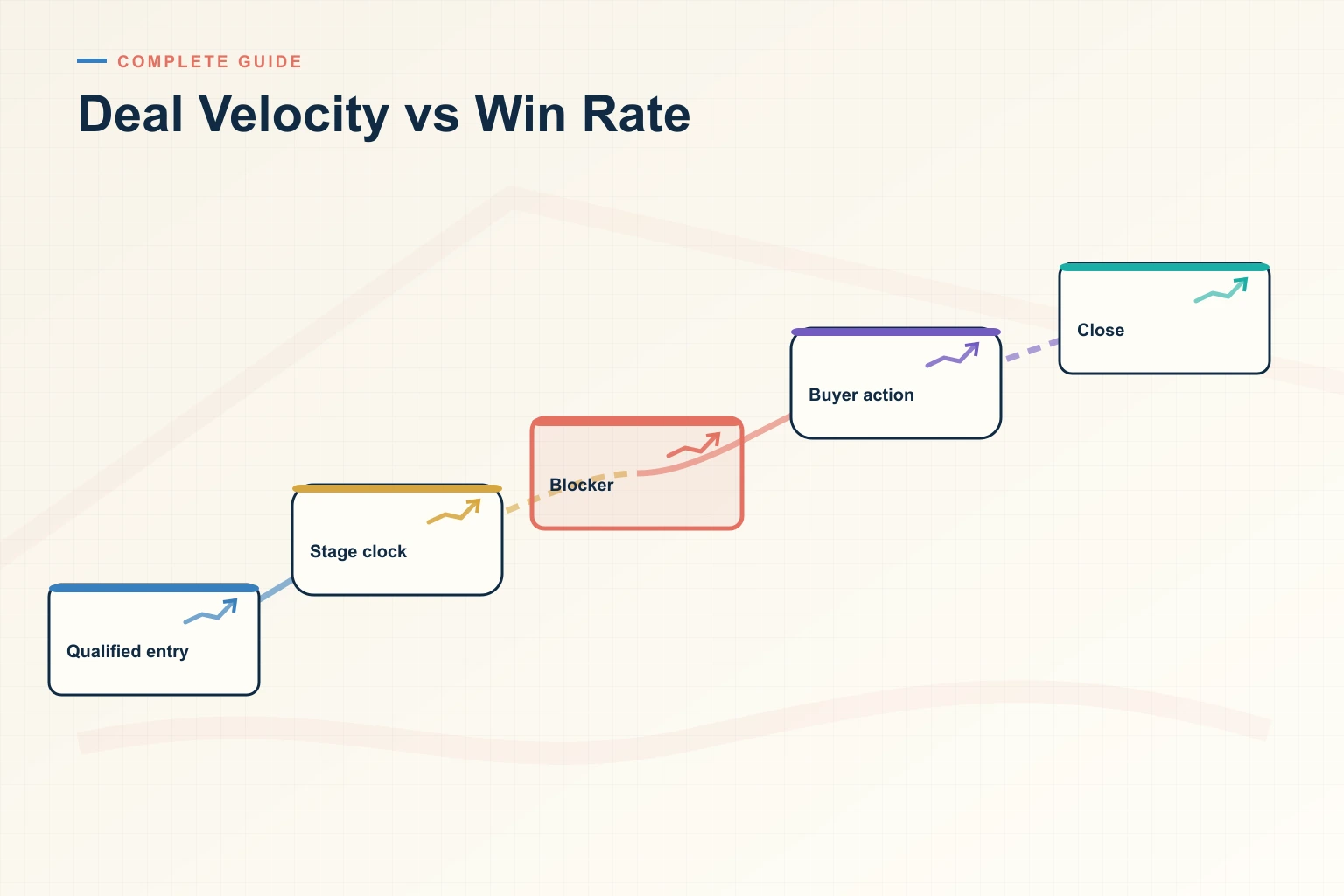
Optimizing for both velocity and win rate requires deal-level qualification signals. The practical goal is to make deal velocity and win rate an ongoing, data-driven discipline rather than a one-time initiative.
Define the operating system
Teams that consistently improve deal velocity and win rate share three structural advantages. They define good execution through clear milestones, documented criteria, and shared language; instrument each stage so its data informs the next; and use closed-won and closed-lost findings to improve how they work.
Every high-performing deal velocity and win rate program starts with explicit strategy ownership. A leadership owner is accountable for outcomes, sets goals, defines metrics, and ensures the approach evolves as market conditions change.
An operating model answers three questions: what actions should happen, at what stage, and who is accountable. Document the model explicitly, teach it, reinforce it through managers, and embed it in daily workflows.
Define what excellent execution looks like at each deal stage and hold representatives to that shared standard. A common definition makes performance easier to coach, measure, and improve systematically.
Three-part explainer: Define the system, Operationalize the workflow, and Measure the impact.
Audit the current state
Before improving deal velocity and win rate, establish an honest baseline. Pull the last six months of deal data, map every opportunity against the relevant stages, and identify where deals fall out and why. Break the findings down by representative, segment, and deal size.
Use the assessment to prioritize two or three specific improvements with the greatest expected impact on revenue outcomes. Give each improvement a clear owner, a measurable goal, and a 90-day review cadence.
Three-part explainer: Audit the current state, Build the operating model, and Measure and improve.
Instrument and measure every stage
Lagging indicators such as win rate, quota attainment, cycle time, and average deal size show what happened. Leading indicators show what may happen next and create an opportunity to intervene earlier.
Useful leading indicators can include stakeholder engagement rates, content consumption, mutual action plan progression, deal velocity at each stage, buyer engagement quality, and stakeholder coverage breadth.
Also monitor conversion rates by stage, time-in-stage benchmarks, and correlations between specific behaviors and win rates. These measures connect execution standards to revenue outcomes and make coaching conversations more factual.
Build a dashboard that shows leading and lagging indicators together. Review it weekly and use it in coaching conversations, pipeline reviews, and territory reviews so adverse movement can be addressed before the end of the quarter.
Make review and coaching operational
Include deal velocity and win-rate health in the weekly pipeline cadence. Treat the review as a structured conversation about what must change during the next seven days, not as a status update.
Use deal-specific coaching instead of relying only on generic training. Review live opportunities with each representative, identify where execution breaks down, and work through the correction in real time.
Buyer signals should be a primary input to deal decisions. Engagement data, stakeholder activity, and other deal-level signals give managers and representatives a clearer basis for action than intuition alone.
Align technology with the process
Technology should support the deal velocity and win-rate process rather than define it. Evaluate each tool by whether it makes execution easier and more consistent or adds friction, and ensure data can flow between the systems used by the revenue team.
Revspire Deal Acceleration centralizes signals, content, and stakeholder intelligence and is designed to surface the right action within the workflow.
Find the sources of revenue leakage
Revenue leakage concentrates in three places: early-stage deals that should not enter the pipeline, qualified deals that stall mid-cycle, and late-stage deals lost to process failures such as procurement surprises, unstated objections, or last-minute stakeholder concerns.
Understand the broader business case
Systematic improvement can affect more than win rate or cycle time. The source framework connects it with faster ramp times for new representatives, higher average deal sizes, lower customer acquisition cost, and improved forecast accuracy for resource-allocation decisions.
Deal velocity and win rate also have a competitive dimension. When products are differentiated but not unique, buyers consider how easy and confidence-building the buying experience feels; a process that builds trust and reduces perceived risk can strengthen the vendor relationship.
There is also a talent dimension. The source framework links a disciplined operating environment with the ability to attract strong revenue professionals, help them develop faster, and retain them longer.
Build continuous feedback loops
Capture insights from won and lost deals through post-deal interviews, CRM data analysis, and structured win-loss reviews. Feed the findings back into playbooks, training, and strategy so the operating system improves over time.
Review deal velocity and win-rate metrics against targets each quarter, update playbooks when new findings emerge, and ask buyers for feedback on their experience. This turns the playbook into a living document rather than a static asset.
Correct five recurring mistakes
Three-part explainer: Recognize the leak, Correct the behavior, and Prevent repeat failure.
1. Treating improvement as a one-time initiative
Assign a permanent owner, establish standing review meetings and defined metrics, and set quarterly improvement goals connected to revenue outcomes.
2. Relying on intuition instead of data
Define three to five leading indicators and track them weekly. When data and intuition disagree, investigate the discrepancy before making a policy decision.
3. Relying on one stakeholder
Map the stakeholders in the buying committee, assign coverage, and track engagement with each one. Flag a deal as high risk when only one contact is active.
4. Confusing activity with progress
Measure outcomes rather than activity volume. Track stage progression velocity, buyer engagement quality, and stakeholder coverage breadth, and investigate deals where activity is high but outcomes are poor.
5. Failing to learn from losses
After every significant lost deal, analyze the specific execution breakdowns that contributed to the loss, document the findings, and update playbooks accordingly.
Put the framework into practice
Begin with the baseline audit, define stage-level execution standards, assign ownership, and select two or three measurable improvements. Then instrument the stages, review live deals weekly, coach against outcomes, and use quarterly and win-loss feedback to keep the system current.