Pipeline Generation: How B2B Teams Build Early-Stage Pipeline
A practical perspective for connecting this idea to your revenue team’s next move.
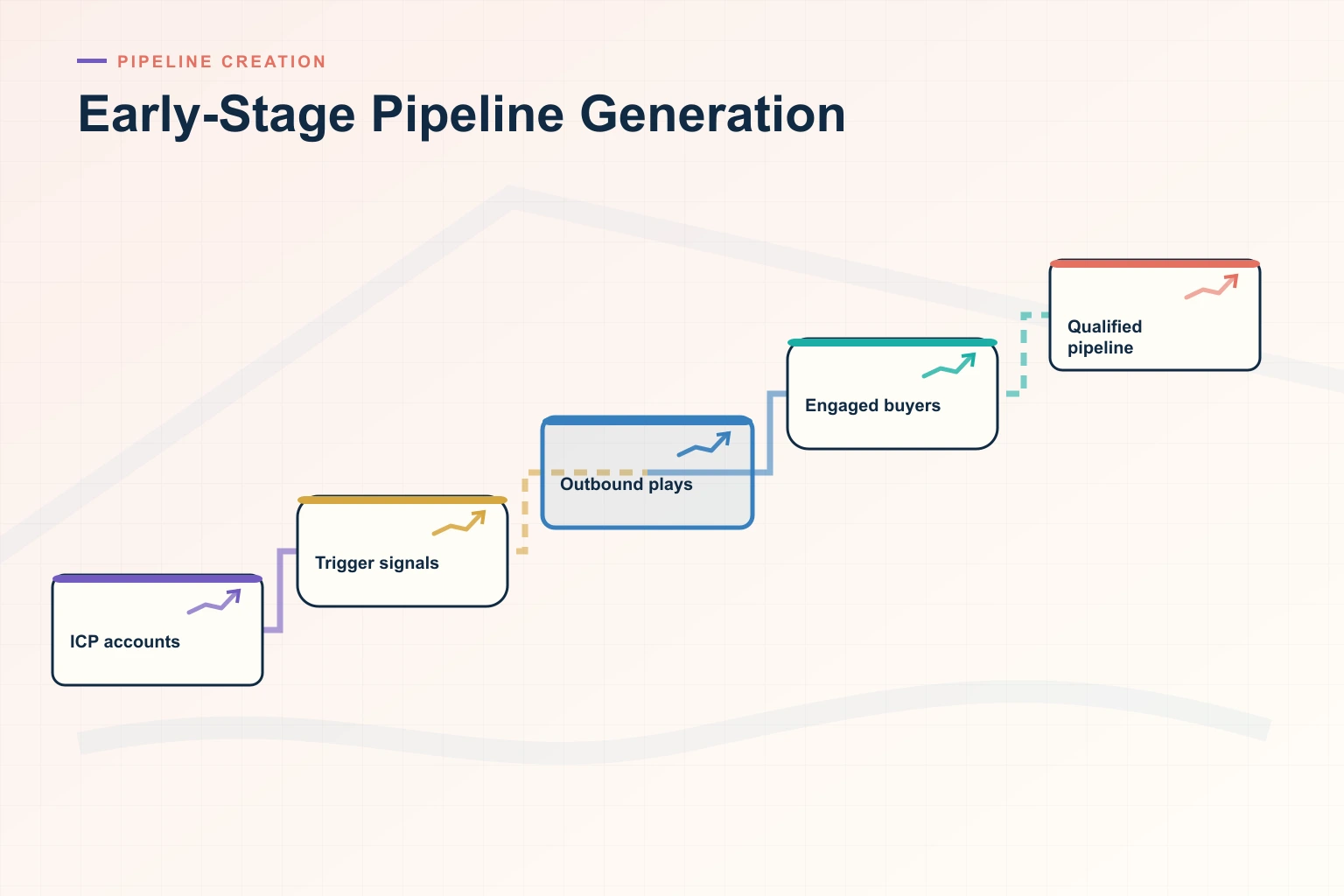
Pipeline generation is the work of creating new, qualified sales opportunities with a value attached, not just leads or meetings. Effective B2B pipeline generation finds the few accounts that are in market, gets your company onto the buyer’s shortlist before they contact vendors, and reaches several members of the buying group from the first conversation.
Below: the five sources of early-stage pipeline, a signal-led process for creating it, how account executives self-source, the metrics that show new pipeline is real, and a worked sizing example. It reflects research current to October 2026.
Last updated: 16 October 2026
What is pipeline generation?
Pipeline generation covers every activity that turns an account with no open deal into an opportunity your team would put in the forecast. It spans marketing, sales development (SDRs and BDRs), account executives, partners and customer success. Early-stage pipeline is the part of the funnel between a first meeting and a qualified opportunity: Stage 0 meetings and Stage 1 opportunities that have not yet met your qualification criteria.
Decide where pipeline generation ends and write it down as an exit criterion, for example “the buyer has confirmed a problem, a sponsor and a reason to act this year”. Without that line, one team counts a booked meeting as pipeline, another counts only a qualified opportunity, and the numbers never reconcile.
Pipeline generation vs lead generation vs demand generation
The three are related, but each produces a different output:
- Demand generation builds awareness and preference among accounts, most of which will not buy this year. Its output is reach and preference, and marketing usually owns it.
- Lead generation captures contact details and interest: form fills, event attendees, marketing-qualified leads. Its output is people.
- Pipeline generation turns that interest, plus outbound work, into opportunities with a dollar value and a buyer-confirmed next step. Its output is qualified pipeline, and marketing, sales and partners share it.
A team can hit its lead target and still miss its pipeline target. Setting one shared number for marketing and sales, qualified pipeline created by source, removes that argument.
Why is B2B pipeline generation harder now?
Published research points to five reasons the volume-first playbook (more SDRs, more sequences, tolerance for very low reply rates) yields less each year.
Few accounts are in market at any time
The “95-5 rule” from the LinkedIn B2B Institute, set out by Peter Weinberg and Jon Lombardo in Marketing Week on 2 September 2021, estimates that only about 5% of B2B buyers are in market at any moment. Their worked example: if companies switch business banks roughly once every five years, about 20% are likely to be in market over the next year and about 2% over the next month. Outreach to the other 95% will not create pipeline this quarter; at best it builds preference for later.
Buyers choose a favourite before they contact you
The 6sense 2025 Buyer Experience Report found that 94% of buyers had ranked their shortlist before engaging sellers, and that the winning vendor was on the Day One shortlist 95% of the time. Buyers made first contact about 61% of the way through their journey, earlier than 69% in 2024, and initiated 79% of engagements themselves. The 6sense release of 12 November 2025, based on more than 4,000 buyers, adds that the vendor preferred before seller contact still wins about 80% of deals. For pipeline generation the lesson is blunt: most deals are decided by whether you are on the list before the first meeting.
Buying groups are large
Forrester’s State of Business Buying 2026 release (21 January 2026) says a typical buying decision now includes 13 internal stakeholders and nine external influencers. An opportunity sourced through one contact is fragile from day one.
Irrelevant outreach is punished
In a Gartner survey of 632 B2B buyers published on 25 June 2025, 73% said they actively avoid suppliers who send irrelevant outreach, and 61% preferred a rep-free buying experience overall. Inbox providers enforce the same lesson. Google’s bulk-sender rules, announced for February 2024, require anyone sending more than 5,000 emails a day to Gmail users to authenticate their domain with SPF, DKIM and DMARC, offer one-click unsubscribe and keep their spam rate below 0.3%, as TechSpot reported on 4 October 2023.
SDR quotas per head have fallen
The Bridge Group’s 2025 SDR Models & Metrics report (351 B2B companies, published 6 February 2025) puts the median SDR quota at 6 converted Stage 1 opportunities a month, down 43% since 2018, while the median SDR still logs 112 activities a day. “AI SDRs” appeared as a distinct category for the first time, reported by 1% of respondents. Adding headcount or automated volume will not close a pipeline gap on its own.
Where does early-stage pipeline come from?
Most B2B teams draw new pipeline from five sources. Each needs its own trigger, owner and measure.
Source
What it is
Best trigger to act on
Usual owner
Watch out for
Inbound
Demo requests, trials, pricing and comparison page visits, high-intent content
A named person asks for contact or starts a trial
Marketing and SDRs
Slow follow-up; treating every form fill as pipeline
SDR outbound
Prospecting into target accounts that have not raised their hand
A change event or research signal at an ICP account
SDRs and BDRs
Targets that reward meetings booked, not opportunities qualified
AE self-sourced
Account executives prospecting their own named accounts and network
A relationship, referral or trigger the AE spots first
Account executives
Prospecting time squeezed out by late-stage deals
Partners and channel
Opportunities introduced or co-sold by partners
A partner’s customer starts a related project
Partner or channel team
Unclear attribution and duplicate opportunities
Existing customers
Expansion, new divisions, referrals, former champions who changed jobs
A new team, use case or job change
Account managers and customer success
Counting renewals as new pipeline
Track pipeline created by each source separately. A blended number hides a failing source until it is too late to fix within the quarter.
How to generate pipeline: a signal-led process in six steps
Signal-led pipeline generation means you contact an account when there is evidence it may be in market, and you choose the message by the signal, not by job title alone. For the data side, our guide to intent data for B2B sales compares first- and third-party sources and providers.
1. Define the ICP and the evidence that an account is in market
Start with an ideal customer profile narrow enough to say no to: industry, size band, the systems they run and the problem you solve best. Then list the evidence that would make you act: a new executive, a funding round, a job posting for the team you serve, repeat visits to pricing or comparison pages, a product trial, or a question asked at your webinar.
2. Tier the signals and give each tier an action
Not every signal deserves a call. Sort signals into three tiers, and give each tier an owner and a response target you can measure:
- Tier 1, act now: a known person shows buying behaviour (pricing visits, trial sign-up, demo request) or a former champion joins an ICP account. Personal outreach from the account owner, the same business day.
- Tier 2, research and engage: an ICP account shows category research or a change event, but you do not know who is involved. An SDR identifies the buying group and opens a relevant, low-ask conversation.
- Tier 3, nurture: the account fits the ICP but shows no current signal. Marketing programmes and useful content, not sales sequences.
Joining first-party engagement, third-party research data and CRM history into one account view matters more than buying another data feed. The usual failure is activation: the signal sits in one system while the rep works from another.
3. Write one play per signal
A visitor to your pricing page and a reader of a competitor comparison are at different points and need different first messages. Write a short play for each signal you act on. The signal-based selling framework covers scoring and routing in more depth.
Signal
Tier
Play
First message offers
A known contact visits the pricing page twice in a week
1
The account owner calls and emails that contact
A plain pricing explainer and a short scoping call
A new VP Sales or CRO joins an ICP account
1
The account owner reaches out in their first weeks
A point of view on the first-quarter priorities you see at similar companies
A former champion joins an ICP company
1
The AE who knew them reaches out personally
A catch-up, and how their new team compares with the last one
An ICP account researches your category or reads competitor comparisons
2
An SDR maps the buying group; marketing serves comparison content
An honest comparison, including when another option fits better
A job posting for the role your product supports
2
An SDR contacts the hiring manager
A resource that helps the new hire’s first 90 days
A deal lost six or more months ago shows a new trigger
2
The original AE re-engages
What has changed since the last evaluation
4. Lead with something useful, not a meeting request
Buyers do most of their research alone, so the first touch should help that research. Send something specific: a one-page point of view on a problem their peers face, a relevant customer example, or a short account-specific page that gathers two or three resources and asks one question. A shareable page has a second benefit. When it is forwarded inside the account, you learn who else is involved. Keep the ask small and easy to decline, such as “worth comparing notes for 20 minutes?”
5. Multi-thread from the first meeting
With 13 internal stakeholders in a typical decision (Forrester, January 2026), ask in the first meeting who else will weigh in and what each of them cares about, then reach them with material written for their role. Multithreading early costs less than rescuing a single-threaded deal later. In Revspire’s digital sales room benchmark (about 40 B2B companies, October 2025 to September 2026), deal rooms engaged 15 unique buyer stakeholders, against 1 to 5 on deals run without a room, and 80% of rooms gained a new viewer after the first share. That is an observed pattern, not proof that a room wins deals, but it shows how far shared material travels inside a buying group.
6. Qualify at the line, and send the rest back
Move an opportunity out of the early stage only when the buyer has confirmed the evidence your exit criteria ask for. Expect the status quo to be the main competitor. In Revspire’s sales skills gap benchmark (more than 2,000 scored AI role-plays across 20 B2B companies, October 2025 to September 2026), “our current process works fine” was the hardest objection, averaging 2.9 out of 5 against 3.2 for price. Give reps a cost-of-inaction story before they open new accounts. Send meetings that do not qualify back to nurture with a reason code, so marketing learns what is not converting.
How can account executives self-source pipeline?
Self-sourced pipeline is opportunity value an account executive creates from their own prospecting, network and referrals, rather than receiving it from marketing, SDRs or partners. It matters because attainment is under pressure: The Bridge Group’s 2026 AE Models, Motions & Metrics report (158 B2B companies, published 22 June 2026) found 48% of AEs at quota, down from 51% in 2024. An AE who depends only on handed-over meetings has no buffer in a slow month.
The report’s public summary does not give the share of AE pipeline that is self-sourced, and we found no reliable cross-industry benchmark for it. Set the expectation by segment: an AE with a short list of named enterprise accounts can be expected to create more of their own pipeline than one working a high-volume inbound territory.
A weekly self-sourcing routine
- Keep a short target list. Fifteen to 25 named accounts that fit the ICP, reviewed monthly. A short list gets researched; a long one gets sequenced.
- Block prospecting time. Put two or three fixed blocks in the calendar each week and protect them from late-stage deal work.
- Research before you reach out. For each account, note the trigger, the likely sponsor and two or three other stakeholders, and keep them on a stakeholder map.
- Build one page per top account. A short page or room with a point of view on the account’s situation, one relevant example and one question. Share it with several stakeholders, not only the most senior, and watch who opens and forwards it.
- Use social channels for conversations, not broadcasts. Share an observation about a problem your buyers have, then reply to the people who respond with something specific to them. A like is not a lead; a thoughtful comment from an ICP buyer can be.
- Work your existing network. Ask satisfied customers for an introduction each quarter, follow former champions when they change jobs, and revisit lost deals when something changes.
- Log the source honestly. Mark self-sourced opportunities in the CRM when you create them, so the team can see what works.
A 30-day self-sourcing plan
- Week 1: choose 20 accounts, record one trigger and three stakeholders for each, and drop any account you cannot find a reason to contact.
- Week 2: build account pages for the top five, send each to two or three stakeholders with a specific question, and post one observation about a problem those accounts share.
- Week 3: follow up on opens and forwards, reply to everyone who engaged, and ask two customers for an introduction.
- Week 4: review meetings booked, opportunities that met the exit criteria and which triggers drew replies. Keep what worked and replace accounts that showed no signal.
Which pipeline generation metrics should you track?
Measure the quality of new pipeline, not just the amount. These metrics work at team and source level.
Metric
How to calculate it
What it tells you
Qualified pipeline created
Value of opportunities that passed the early-stage exit criteria in the period, by source
Whether the engine produces enough, and from where
Meeting-to-opportunity rate
Opportunities created ÷ first meetings held
Whether meetings are with the right accounts and people
Early-stage conversion
Opportunities reaching the qualified stage ÷ opportunities created
Whether qualification is honest
Win rate by source
Won ÷ (won + lost), split by source
Which sources produce pipeline that closes
Pipeline coverage
Open qualified pipeline ÷ remaining target
Whether there is enough to hit the number
Stakeholders engaged per new opportunity
Distinct buyer contacts active in the first 30 days
Whether reps multi-thread early
Signal-to-first-touch time
Time from a Tier 1 signal to the first personal outreach
Whether signals are acted on
Compare conversion and win rate by source before you move budget or headcount. If signal-led or self-sourced pipeline does not convert better than cold outbound on your own data, revisit the triggers rather than adding volume.
Worked example: how much pipeline do you need to create?
Suppose a hypothetical team must close $3 million in new annual contract value next year, at an average deal size of $40,000. Revspire’s B2B SaaS win rate and sales cycle benchmark (about 40 B2B companies, October 2025 to September 2026) found a 33% win rate on $20,000 to $100,000 deals. Use your own rate if you have a year of closed deals.
- Qualified pipeline needed: $3,000,000 ÷ 0.33 ≈ $9.1 million.
- Opportunities needed: $9.1 million ÷ $40,000 ≈ 227 qualified opportunities a year, or about 19 a month.
- Implied coverage: $9.1 million ÷ $3 million ≈ 3x. This matches the familiar 3x coverage rule, which is roughly the inverse of a one-in-three win rate. A team that wins one in four needs about 4x. Our pipeline coverage ratio guide covers the calculation by stage.
- Split by source: with an assumed mix of 40% inbound, 30% SDR, 20% AE self-sourced and 10% partner, the team needs about 91, 68, 45 and 23 qualified opportunities. With eight AEs, 45 self-sourced opportunities is about one per AE every two months.
- Time it: the same benchmark found a median of 45 days from opportunity creation to a won close for $10,000 to $50,000 deals. Pipeline created in the last six weeks of a quarter will mostly close in the next one, so create it early.
Two cautions. The calculation ignores deals that slip or stay open, so treat it as a minimum. And The Bridge Group’s median quota (February 2025) of 6 converted Stage 1 opportunities per SDR a month is not the same as qualified pipeline in this model: measure your own Stage 1-to-qualified rate before you size an SDR team from it.
How do you know early-stage pipeline is real?
A large early-stage number can hide opportunities that look healthy in the CRM but have no active buyer. Check each new opportunity against six questions in your weekly pipeline review:
- Does it meet the written exit criteria, with buyer evidence rather than the rep’s opinion?
- Are at least two buyer stakeholders identified, including someone who can approve budget?
- Is there a dated next step that the buyer agreed to?
- Has anyone on the buyer side acted in the last two weeks: replied, attended, or opened shared material?
- Is the reason to act now recorded, such as a trigger, a deadline or a cost of waiting?
- Does the CRM record match what the rep says about the deal?
Buyer silence is the clearest warning. In Revspire’s digital sales room benchmark (October 2025 to September 2026), after 20 days with no buyer view of the room, the win rate fell below half the overall rate. Losses also hide in the status quo: in the win rate benchmark only 10% of closed-lost deals were tagged “no decision”, a figure the benchmark treats as a floor because sellers tend to record a competitor or price instead. Review early-stage losses for the real reason, and feed what you learn back into the ICP and the signal tiers.
Where do tools help with pipeline generation?
Tools should carry the process above, not define it. A typical stack pairs a CRM (source fields, exit criteria, reporting by source) with contact and intent data joined at account level, a sales engagement tool whose deliverability settings meet inbox-provider rules, conversation intelligence for first meetings, and a shareable space for each account that shows who opens, forwards and returns.
Revspire covers that last part together with enablement. Revspire Digital Sales Rooms give each account or opportunity a branded room with mutual action plans, stakeholder mapping and real-time buyer engagement analytics; the AI Playbook Engine turns approved messaging into role-specific playbooks; and Content Hub keeps the assets sellers share current. It connects to your CRM and does not replace your data provider or sequencing tool.
Frequently asked questions
What is pipeline generation in sales?
Pipeline generation is the process of creating new, qualified sales opportunities that have a value and a buyer-confirmed next step. It includes inbound follow-up, SDR outbound, account executive self-sourcing, partner introductions and expansion within existing customers. It ends when an opportunity meets your written early-stage exit criteria.
What is the difference between pipeline generation and lead generation?
Lead generation produces people who have shown interest, such as form fills and event attendees. Pipeline generation produces opportunities with a dollar value that sales has qualified. A team can hit its lead target and miss its pipeline target, so measure qualified pipeline created by source.
What is self-sourced pipeline?
Self-sourced pipeline is opportunity value an account executive creates from their own prospecting, network and referrals, not from marketing, SDRs or partners. We found no reliable published benchmark for the share of AE pipeline that should be self-sourced, and the public summary of The Bridge Group’s June 2026 AE report does not include one. Set a target by segment and track it with a source field filled in when the opportunity is created.
How much pipeline do you need to hit your number?
Divide the revenue target by your win rate. At a one-in-three win rate you need about three times the target in qualified pipeline; at one in four, about four times. Create it early enough to close: in Revspire’s win rate benchmark (October 2025 to September 2026), the median won deal of $10,000 to $50,000 took 45 days from creation to close.
Who owns pipeline generation?
Ownership is shared. Marketing usually owns inbound and demand, SDRs own outbound into target accounts, AEs own self-sourced pipeline in their named accounts, and partner and customer teams own their sources. One leader, often the CRO, should own the single target and report on it by source.
Next step: map the buying group for your top target accounts with the free stakeholder map template, and bring it to your first meeting so you can multi-thread from day one.
Sources
All external pages were accessed on 16 October 2026. Publication dates are shown where the page gives one.
- “The 95-5 rule” by Peter Weinberg and Jon Lombardo (LinkedIn B2B Institute), Marketing Week, 2 September 2021. Accessed 16 October 2026.
- 2025 Buyer Experience Report, 6sense, 2025 (no exact date shown on the page). Accessed 16 October 2026.
- The timeline for influencing B2B buyers is shrinking: insights from 6sense’s 2025 Buyer Experience Report, 6sense, 12 November 2025. Accessed 16 October 2026.
- Forrester: The State of Business Buying, 2026, Forrester, 21 January 2026. Accessed 16 October 2026.
- Gartner sales survey finds 61% of B2B buyers prefer a rep-free buying experience, Gartner, 25 June 2025. Accessed 16 October 2026.
- Google’s new spam rules for senders of 5,000+ emails a day, TechSpot (Rob Thubron), 4 October 2023. Accessed 16 October 2026.
- 2025 SDR Models & Metrics Report, The Bridge Group (Matt Bertuzzi), 6 February 2025. Accessed 16 October 2026.
- 2026 AE Models, Motions & Metrics, The Bridge Group (Matt Bertuzzi), 22 June 2026. Accessed 16 October 2026.
- B2B SaaS win rate and sales cycle benchmark, Revspire, 16 October 2026 (aggregated customer data, October 2025 to September 2026). Accessed 16 October 2026.
- Sales skills gap benchmark, Revspire, 16 October 2026 (aggregated customer data, October 2025 to September 2026). Accessed 16 October 2026.
- Digital sales room benchmark, Revspire, 16 October 2026 (aggregated customer data, October 2025 to September 2026).