Revspire blog
Why Pipeline Health Metrics Is the Highest-Leverage Move in B2B Sales
A practical guide to auditing pipeline health, combining leading and lagging indicators, improving deal reviews, and avoiding common pipeline mistakes.
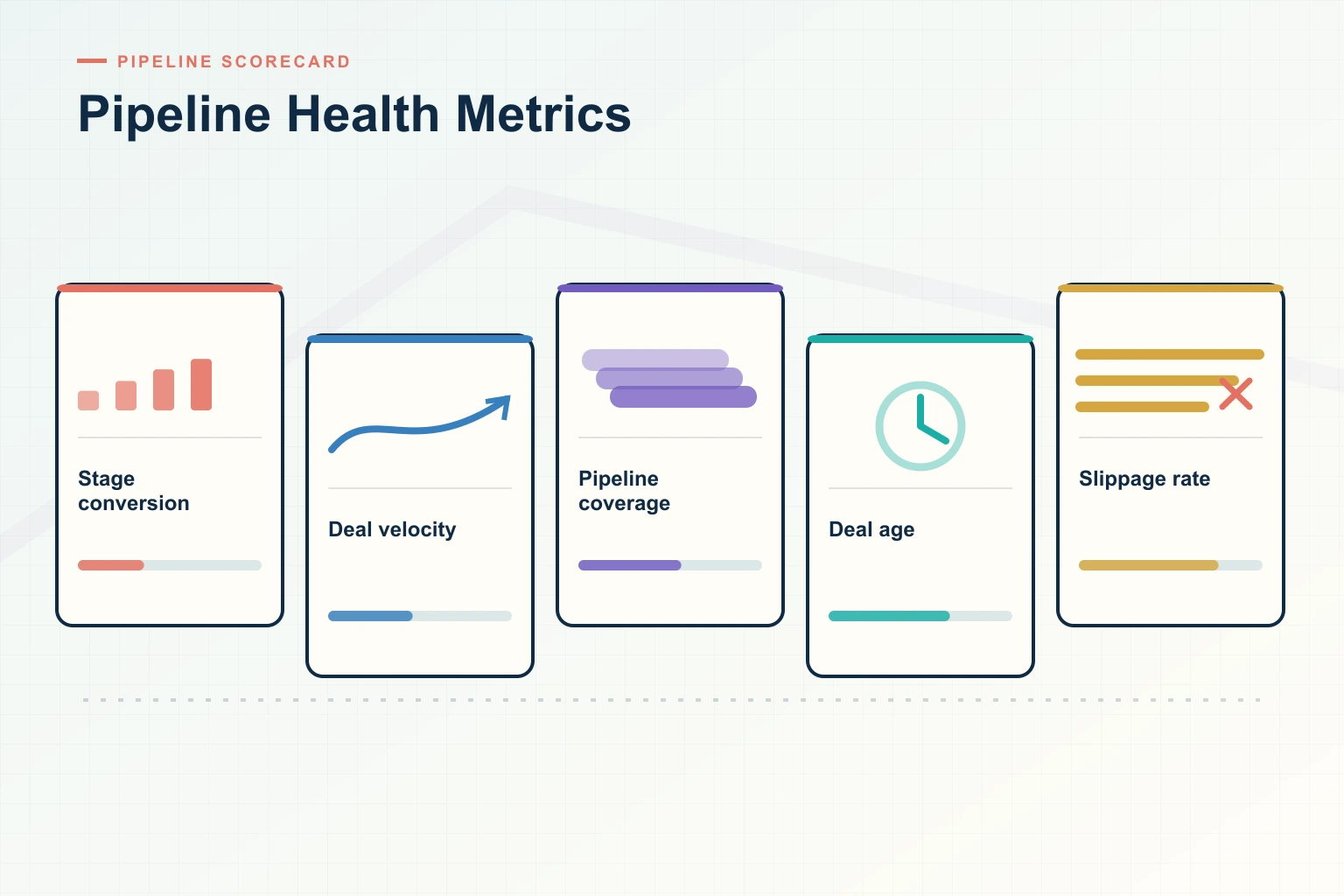
A practical pipeline health system combines clear milestones, documented criteria, shared ownership, measurable signals, and feedback from completed deals. It should operate continuously rather than as a one-time initiative.
Why pipeline health matters
Revenue leakage from poor Pipeline Health Metrics practice concentrates in three places.
Early-stage opportunities that should not enter the pipeline can consume representative capacity and distort the forecast. Qualified deals can stall when teams miss execution gaps. Late-stage deals can be lost to procurement surprises, unstated objections, or stakeholder concerns that were not surfaced earlier.
Three-part explainer: Expose the hidden cost, Build the business case, and Start where it matters.
Audit the current state
Before you can improve Pipeline Health Metrics, you need an honest baseline.
Review recent opportunities by stage, representative, segment, and deal size. Identify where deals leave the pipeline, where they remain too long, and which loss reasons recur. Compare the narrative around each deal with the available engagement and stage-progression data.
Build the operating model
An operating model should specify which actions happen at each stage and who is accountable. Document what excellent execution looks like so representatives can be coached and measured consistently. A simple model that teams follow is more useful than an elaborate model they ignore.
Three-part explainer: Audit the current state, Build the operating model, and Measure and improve.
Measure leading and lagging indicators together
Leading indicators help teams assess what may happen next. Examples include stakeholder engagement, content consumption, mutual action plan progress, and deal velocity. Lagging indicators such as win rates, cycle times, and average deal sizes show what happened.
Build a dashboard that shows both. Review it weekly. Connect the results to coaching conversations and territory reviews instead of treating the dashboard as passive reporting.
Three-part explainer: Define the system, Operationalize the workflow, and Measure the impact.
Seven practices for a healthier pipeline
- Define what good looks like. Document excellent execution at each stage.
- Track leading indicators. Monitor stakeholder engagement, content consumption, mutual action plan progress, and deal velocity.
- Use a weekly cadence. Discuss what must change during the next seven days rather than limiting the review to status reporting.
- Coach live deals. Use current opportunities to identify execution gaps and work through specific corrections.
- Capture win-loss intelligence. Feed findings from completed deals into playbooks, training, and strategy.
- Align technology with the process. Technology should serve the pipeline health metrics B2B sales process, not define it.
- Create feedback loops. Review performance against targets, update playbooks when new evidence emerges, and collect buyer feedback.
Practices for defining, measuring, coaching, and improving pipeline health.
Five mistakes to avoid
Treating improvement as temporary
Assign a permanent owner, define measurable goals, and make pipeline health part of the recurring operating cadence.
Relying on intuition alone
Review a defined set of indicators consistently. When the data conflicts with the team’s assumptions, investigate the discrepancy.
Single-threading an opportunity
A deal becomes vulnerable when the relationship depends on one contact. Map stakeholders, assign coverage, and flag opportunities with only one active contact as high risk.
Confusing activity with progress
High activity levels in pipeline health metrics B2B sales can mask a complete absence of forward momentum.
Use stage progression, buyer engagement quality, and stakeholder coverage as evidence of progress rather than relying on counts of emails, calls, or tasks.
Failing to learn from losses
Use a structured review after significant losses, document the pipeline breakdowns that contributed to the outcome, and update the relevant playbooks.
Strategic and execution mistakes that can weaken pipeline health.
Where to start
Start with an honest audit. Select two or three improvements connected to revenue outcomes, and give each improvement a clear owner and measurable goal. Review progress after 90 days before expanding the system.
Learn more about Revspire Revenue Analytics.