Enterprise Sales Playbook: Framework, Template, and Metrics
A practical perspective for connecting this idea to your revenue team’s next move.
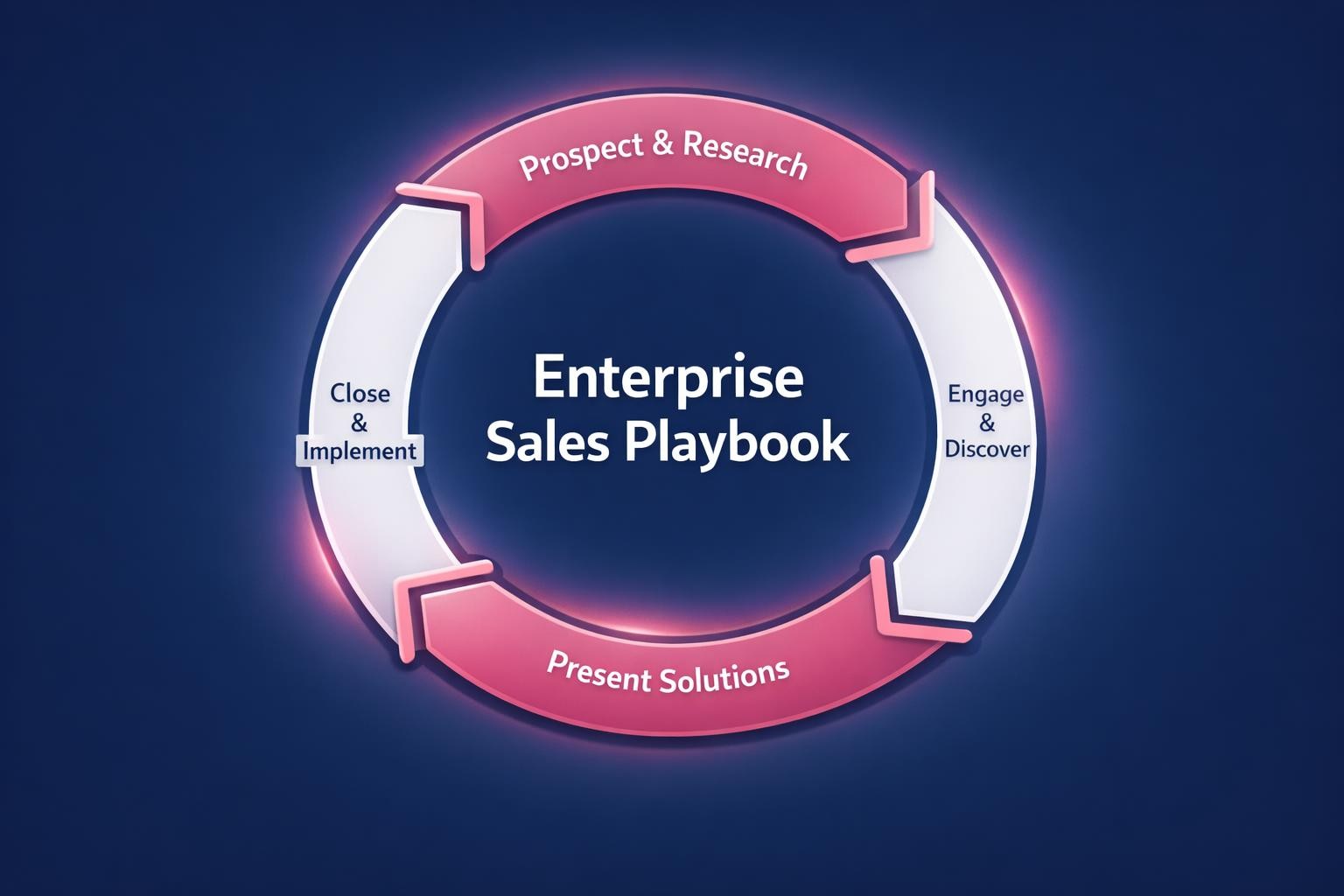
An enterprise sales playbook documents how opportunities advance, who is accountable, which evidence supports stage progression, and how teams review their process.
Use this guide to define stage evidence, buyer and seller actions, ownership, coaching routines, measurement, and the review process that keeps an enterprise sales playbook current.
Why an Enterprise Sales Playbook Matters
When teams piece together their process from tribal knowledge, manager intuition, and older documents, execution can vary between representatives. A documented playbook provides shared milestones, qualification criteria, responsibilities, and terminology for pipeline reviews and coaching.
Process risks can appear at several points. Unqualified opportunities can consume capacity in early stages, qualified opportunities can stall when execution gaps remain hidden, and late-stage opportunities can encounter procurement questions, objections, or stakeholder concerns that were not surfaced earlier.
The playbook should describe the evidence required to advance an opportunity and the actions expected from sellers, managers, buyers, and other stakeholders.
Core Components of the Playbook
Strategy and ownership
Assign a leader to maintain the playbook’s goals, metrics, review cadence, and change-approval process. This establishes responsibility for keeping the operating document current.
Documented stages and responsibilities
For each stage, document the expected actions, the evidence required to advance, and the person responsible for the next step. The resulting model should be clear enough for representatives and managers to use during live opportunities.
Enterprise sales playbook stage template
Field
What to document
Example evidence
Stage objective
The buyer decision or outcome this stage supports
Buyer confirms the problem and desired outcome
Entry evidence
What must already be true
Qualified problem, owner, and agreed discovery
Buyer action
The observable commitment expected from the buyer
Relevant stakeholders attend the validation session
Seller action
The work the representative must complete
Document requirements, gaps, owners, and follow-up
Stakeholders
Required roles and current relationship coverage
Business, technical, financial, legal, and procurement roles mapped
Exit evidence
The proof required before advancement
Buyer-approved criteria and next decision step
Age and escalation
Expected duration and the exception path
Manager review when the stage threshold is exceeded
Supporting assets
Approved content, tools, and templates
Discovery guide, mutual plan, security pack, or proposal template
Treat the playbook as an operating document. Reinforce it through workflows, manager coaching, pipeline reviews, and revisions informed by reviews of completed opportunities.
Technology and data
The technology layer for Enterprise Sales Playbook should reduce friction, not add it. Tools can be evaluated according to whether they reduce manual work, make relevant deal information visible, and support the documented process.
Revspire’s Playbook Engine as an offering for organising deal signals, content, and stakeholder information.
Feedback loops
Reviews of closed-won and closed-lost opportunities can produce observations for future execution. Teams can collect information from deal data, representatives, managers, and buyers where feedback is available, then decide whether the playbook or coaching materials need revision.
A Three-Step Implementation Framework
Three-part explainer: Audit the current state, Build the operating model, and Measure and improve.
Step 1: Audit the current state
Before you can improve Enterprise Sales Playbook, you need an honest baseline. Review available opportunity data and map opportunities against the current stages. Examine where opportunities leave the pipeline, how long they remain in each stage, and whether patterns differ by representative, segment, or deal size.
Compare the available data with the team’s account of what is happening. Record process gaps that can be addressed directly rather than redesigning the system without a baseline.
Step 2: Build the operating model
An operating model should answer three questions for each stage: what should happen, when should it happen, and who is accountable? It can include qualification evidence, stakeholder requirements, expected buyer actions, next-step standards, and escalation conditions.
Assign an owner to each selected improvement, define how it will be evaluated, and establish a review cadence. The model should make the expected next action visible to the people working on the opportunity.
Step 3: Measure and revise
Monitor selected indicators such as stage conversion, time in stage, stage progression, stakeholder coverage, and the evidence associated with each stage. Use the findings during coaching and pipeline discussions, and revise the operating model when reviews identify a documented process gap.
Seven Operating Practices
- Define the standard. Write down the evidence and behaviour expected at each stage so managers and representatives have a shared reference.
- Track stage-level indicators. Review selected indicators such as stakeholder engagement, content consumption, mutual action plan progress, and deal velocity.
- Include the playbook in the weekly cadence. Use pipeline discussions to identify what needs attention instead of limiting the conversation to status updates.
- Coach using live opportunities. Review individual deals with representatives, identify execution gaps, and discuss possible corrections in context.
- Capture win-loss observations. Use post-deal interviews, CRM data, and structured reviews to record observations from completed opportunities.
- Align technology with the process. Technology should serve the enterprise sales playbook B2B process, not define it. Review whether each tool supports the documented workflow or adds avoidable manual work.
- Create feedback loops. Compare selected metrics with internal goals, update the playbook when reviews produce new evidence, and gather buyer feedback where available.
Five Common Mistakes and Corrective Actions
Mistake 1: Treating the playbook as a one-time initiative
A playbook can become outdated when nobody owns its maintenance. Assign an accountable owner and include playbook reviews in the normal operating cadence.
Mistake 2: Relying only on recent or memorable deals
Review portfolio data alongside individual deal accounts. When the available evidence conflicts with the prevailing narrative, investigate the discrepancy before changing the process.
Mistake 3: Depending on one stakeholder relationship
An opportunity may be exposed when contact is limited to one stakeholder. Map the relevant buying participants, record relationship coverage, and identify opportunities that depend on a single active contact.
Mistake 4: Confusing activity with progress
Email, call, and task volumes do not by themselves show that a buyer has advanced. Measure outcomes, not activities. Review stage progression, buyer engagement, stakeholder coverage, and evidence of agreed next steps.
Mistake 5: Failing to review losses
Use a structured review after selected losses to identify specific process or execution breakdowns. Document the findings and decide whether the playbook or coaching materials should change.
Building the Internal Business Case
Three-part explainer: Expose the hidden cost, Build the business case, and Start where it matters.
Start with an honest audit. An internal business case can focus on observable process questions: whether representatives follow the same stage criteria, whether managers can identify missing deal evidence, whether stakeholder coverage is visible, and whether observations from completed opportunities are incorporated into future work.
Revenue leaders can use the audit to identify current gaps, select a limited set of changes, assign ownership, and define how each change will be reviewed. This keeps the business case tied to the organisation’s own process and data.
How to Measure Playbook Performance
Use both leading and lagging indicators. Leading indicators describe activity or evidence available while an opportunity remains open. Lagging indicators describe completed results.
- Possible leading indicators: stakeholder engagement, stakeholder coverage, content consumption, mutual action plan progress, stage evidence, deal velocity, and time-in-stage exceptions.
- Possible lagging indicators: stage conversion, win rate, sales-cycle length, average deal size, forecast accuracy, and quota attainment.
Select indicators that correspond to the documented stages and available data. Review them during coaching, pipeline, and territory discussions, then use broader periodic reviews to decide whether any part of the playbook needs revision.
Where Revenue Leaders Can Start
Begin with an audit of the current process. Identify a limited set of documented gaps, assign an owner to each selected change, define the evidence that will be reviewed, and set a review date.
The resulting cycle is: diagnose, prioritise, implement, measure, and update.
See how Revspire connects playbooks, content, coaching, and live deal work.